Science, plants and cellsQuizPart 9 of 9, PhotosynthesisUpdated 1 October 2026
Photosynthesis Quiz: 10 Questions with Answers
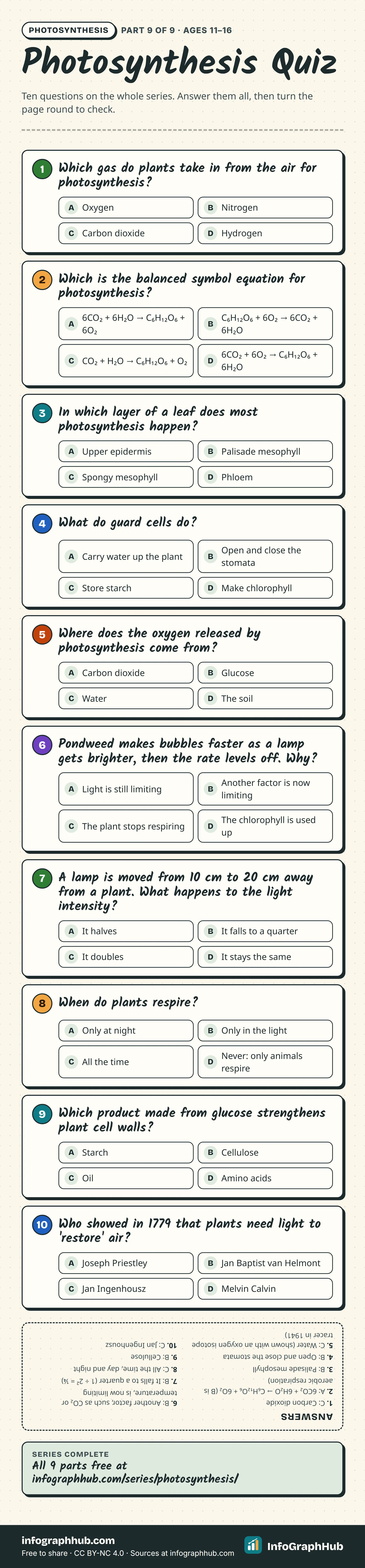
Ten multiple-choice questions on the whole Photosynthesis series: the equation, leaf structure, where the oxygen comes from, limiting factors, the inverse square law, respiration, uses of glucose and the history of discovery.
Use this infographic
Free under CC BY-NC 4.0, with credit to InfoGraphHub.
How to use this quiz
Answer all ten questions before you look at the answers, which are printed upside down at the foot of the infographic. Each question tests one part of the Photosynthesis series. If you get one wrong, read the explanation below and then revisit that part.
1. What goes in
Plants take in carbon dioxide from the air through their stomata. Oxygen is a product of photosynthesis, not a reactant, although plants do use some oxygen for respiration. Carbon dioxide makes up only about 0.04% of the air, which is why it is often a limiting factor.
2. The balanced equation
The answer is 6CO₂ + 6H₂O → C₆H₁₂O₆ + 6O₂. Option B is the equation for aerobic respiration, the same reaction run backwards. Option C is not balanced, and option D has oxygen on the wrong side. Check by counting atoms: 6 carbon, 12 hydrogen and 18 oxygen on each side.
3. The busiest layer
Most photosynthesis happens in the palisade mesophyll: tall, tightly packed cells just under the upper surface, full of chloroplasts and in the brightest light. The upper epidermis has no chloroplasts, and the phloem carries sugar rather than making it. The spongy mesophyll does photosynthesise, but its cells are looser and have fewer chloroplasts.
4. Guard cells
Guard cells open and close the stomata. Open stomata let carbon dioxide in and oxygen out; closing them saves water, but also cuts off the supply of carbon dioxide.
5. The source of oxygen
The oxygen comes from water, split in the chloroplasts using light energy. This was shown in 1941 with water labelled with a heavy oxygen isotope. It is one of the most common myths that the oxygen comes from carbon dioxide.
6. Reading a rate graph
When more light no longer speeds up photosynthesis, light is no longer the limiting factor: another factor, such as carbon dioxide concentration or temperature, is now in short supply.
7. The inverse square law
Light intensity is proportional to 1 ÷ distance². Doubling the distance from 10 cm to 20 cm gives 1 ÷ 2² = one quarter of the light, not a half. Going the other way, halving the distance from 20 cm to 10 cm makes the light four times as intense. This only changes the rate of photosynthesis while light is the limiting factor.
8. When plants respire
Plants respire all the time, day and night, in every living cell. In the light they also photosynthesise, usually faster than they respire.
9. Uses of glucose
Glucose is built into cellulose, the fibres that strengthen cell walls. Starch and oils are energy stores, and amino acids are used to build proteins. To make amino acids, a plant also needs nitrate ions from the soil, because glucose contains no nitrogen.
10. The history
In 1779 Jan Ingenhousz showed that plants only restore air in the light, and only their green parts do it. Priestley had shown in 1771 that plants restore air, but not that light was needed.
Frequently asked questions
Where are the answers to the photosynthesis quiz?
They are printed upside down at the bottom of the infographic, and each answer is explained on this page under the matching question number.
What topics does the photosynthesis quiz cover?
The equation, leaf structure, guard cells, where the oxygen comes from, limiting factors, the inverse square law, respiration in plants, uses of glucose and the history of discovery.
Is this quiz suitable for GCSE and middle school?
Yes. It is written for ages 11–16 and matches the photosynthesis content of courses such as AQA GCSE Biology and the NGSS middle-school life science standards.
Sources & methodology
Every fact is checked against the sources below. We write original explanations and draw original graphics; no figures are copied from textbooks. Spotted an error? See our corrections policy.
- GCSE Biology (8461) specification: 4.4 Bioenergetics (AQA, accessed 1 Oct 2026)
- 30.4 Leaves (Biology 2e) (OpenStax, Rice University, accessed 1 Oct 2026)
- What is respiration and photosynthesis in plants? (BBC Bitesize, accessed 1 Oct 2026)
- Discoveries in oxygenic photosynthesis (1727–2003): a perspective (Photosynthesis Research 80: 15–57, 2004) (Govindjee and D. Krogmann, University of Illinois at Urbana-Champaign, accessed 1 Oct 2026)
Editorial review pending · Updated
Made by the InfoGraphHub editorial team (how we research and check: editorial and AI policy). First published 1 October 2026, last reviewed 1 October 2026. Found a mistake? Tell the editors.
For teachers: ages and curriculum fit
Ages 11–16 · Grades 6–10 (US) · Years 7–11 (UK) · Classes 6–10 (India)
NGSS is a registered trademark of WestEd. Names and codes are used only to describe curriculum fit; InfoGraphHub is not endorsed by these organisations.
Embed this on your site
Paste this HTML into your page. Keep the credit line: it is required by the CC BY-NC 4.0 license.
Related infographics


For teachers and parents: new InfoGraphHub resources by email
One short email when new free resources go live. For adults (18+) only. No spam, no tracking in emails, unsubscribe anytime.