Science, plants and cellsMyths and factsPart 8 of 9, PhotosynthesisUpdated 1 October 2026
Photosynthesis Myths: What Plants Really Do
Eight common myths about photosynthesis, corrected with evidence: plants do not get food or most of their mass from soil, they do respire, they do not breathe, their oxygen comes from water, and the Amazon is not the planet's lungs.
Use this infographic
Free under CC BY-NC 4.0, with credit to InfoGraphHub.
Why photosynthesis myths are so common
Photosynthesis happens out of sight, inside cells, and turns an invisible gas into solid wood. That is hard to picture, so many people, adults and teachers included, fall back on everyday ideas: plants 'eat' through their roots, 'breathe' like animals, or get 'plant food' from a bottle. The myths on this infographic are among the most common, and each has a clear piece of evidence that sets it straight.
Food, soil and mass
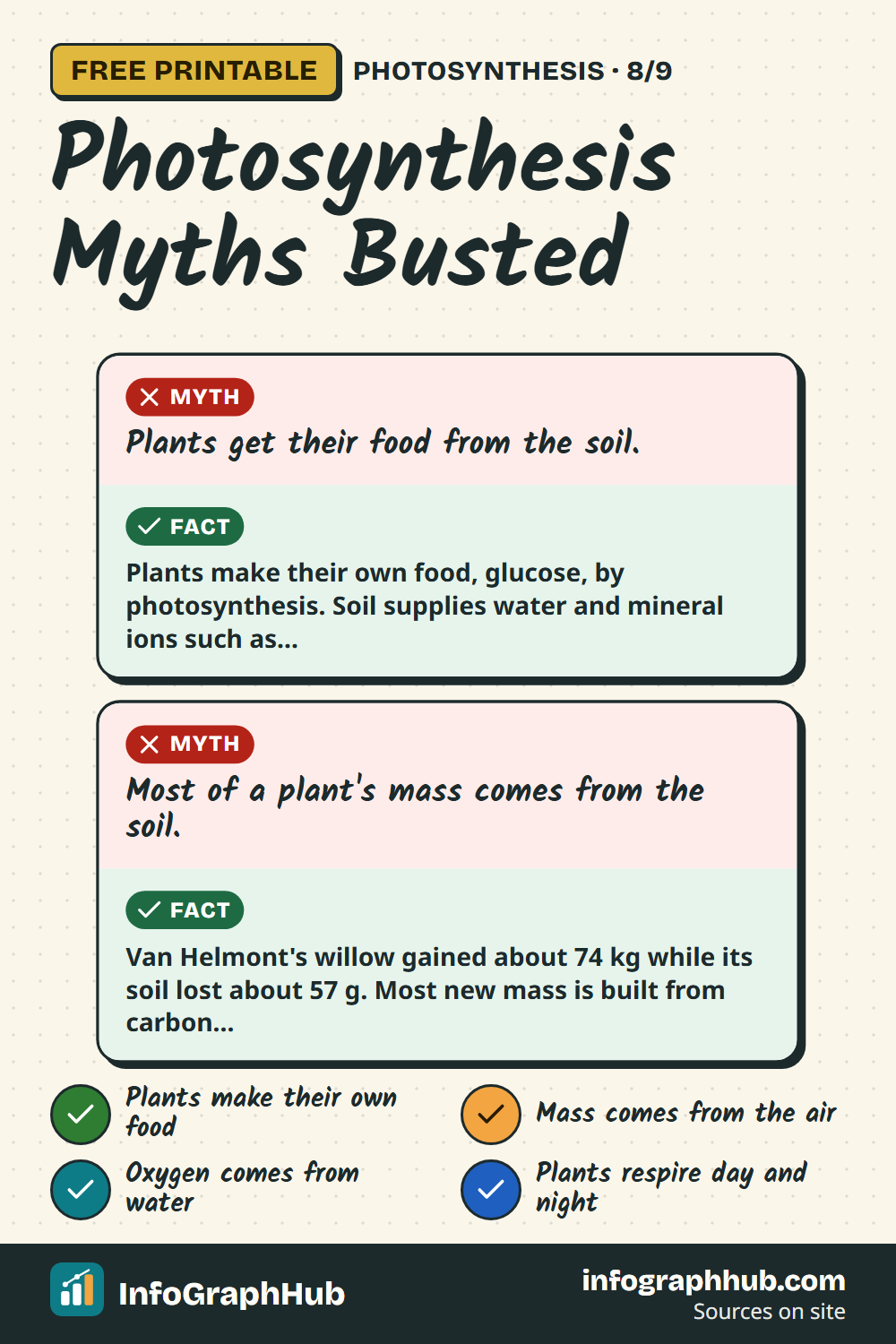
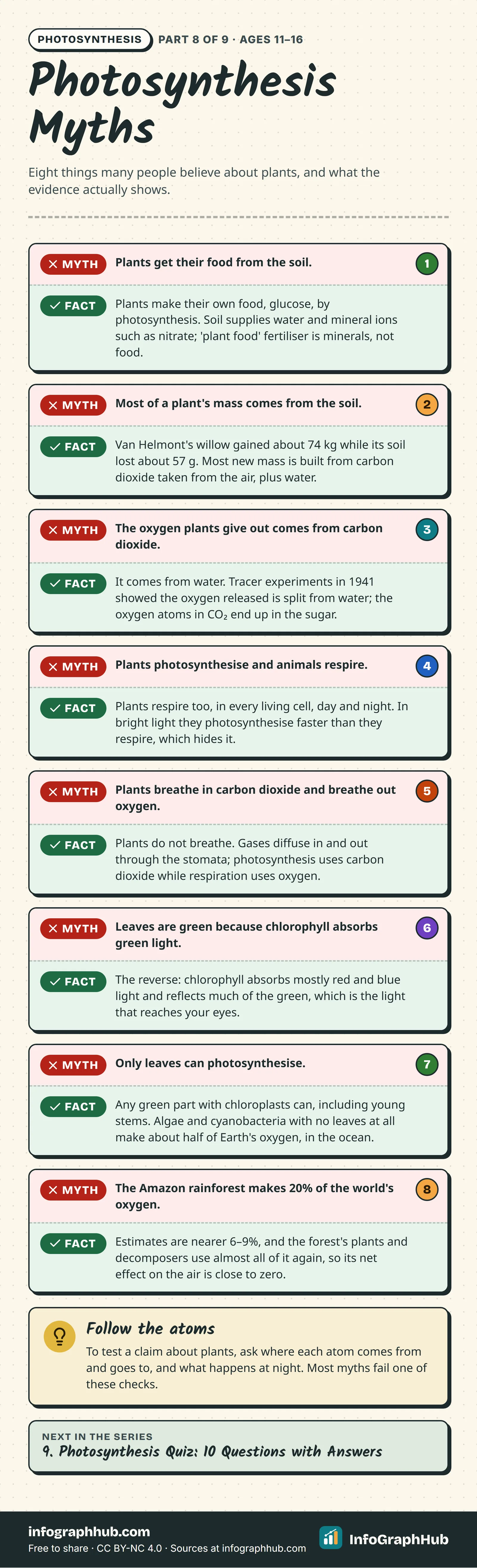
Plants do take things from the soil, but not food. Their roots absorb water and mineral ions such as nitrate and magnesium, which they need in small amounts to build proteins and chlorophyll. Fertiliser sold as 'plant food' is really a mix of these minerals. The food itself, glucose, is made in the leaves.
The mass of a plant is the most surprising part. Van Helmont's willow tree gained about 74 kg in five years while its soil lost only about 57 g. Most of the new mass is built from carbon dioxide taken from the air, together with water. You can check this with the equation: in a glucose molecule, the carbon and oxygen atoms come from carbon dioxide and only the hydrogen comes from water, so by mass more than nine-tenths of the sugar is built from CO₂.
Where the oxygen comes from
Because carbon dioxide goes in and oxygen comes out, it is natural to think the plant pulls the oxygen off the carbon dioxide. It does not. In 1941, scientists gave algae water labelled with a heavy isotope of oxygen, and the heavy oxygen came out in the gas the algae released. The oxygen we breathe is split from water in the chloroplasts, and the oxygen atoms from carbon dioxide end up in the sugar.
Plants respire, and they do not breathe
Many people learn that 'plants photosynthesise and animals respire'. In fact every living plant cell respires all the time, day and night, just like animal cells. In bright light the plant photosynthesises faster than it respires, which hides its respiration, but in the dark respiration is all that is happening.
Plants do not breathe either. They have no lungs and do not pump air. Gases simply diffuse in and out of the leaves through the stomata.
The Amazon and the world's oxygen
A widely shared claim says the Amazon rainforest makes 20% of the world's oxygen. Scientists interviewed by National Geographic put its share of the world's oxygen production at roughly 6–9%. More importantly, the forest's own plants and the microbes that decompose fallen leaves use almost all of that oxygen again, so its net effect on the air is close to zero. The Amazon matters enormously for wildlife, rainfall and storing carbon, just not as the planet's 'lungs'.
How to spot a myth
When you meet a claim about plants, ask two questions. Where do the atoms come from and go to? And what is happening at night? Most myths fall apart under one of them.
Frequently asked questions
Do plants get their food from the soil?
No. Plants make their own food, glucose, by photosynthesis in their leaves. From the soil they take water and mineral ions such as nitrate and magnesium, which they need in small amounts. 'Plant food' fertiliser is really a source of these minerals.
Where does most of a plant's mass come from?
Mostly from carbon dioxide in the air, combined with water during photosynthesis. Very little comes from the soil: van Helmont's willow gained about 74 kg in five years while its soil lost only about 57 g.
Does the oxygen from photosynthesis come from carbon dioxide?
No. It comes from water, which is split in the chloroplasts using light energy. Tracer experiments with labelled water in 1941 showed this.
Does the Amazon produce 20% of the world's oxygen?
No. Scientists estimate it makes roughly 6–9% of the oxygen from photosynthesis, and its plants and decomposers use nearly all of it again, so its net contribution to the air is close to zero.
Sources & methodology
Every fact is checked against the sources below. We write original explanations and draw original graphics; no figures are copied from textbooks. Spotted an error? See our corrections policy.
- Common Misconceptions about Plants (Beyond Penguins and Polar Bears, The Ohio State University, accessed 1 Oct 2026)
- Respiration and photosynthesis: animation (Science & Plants for Schools (SAPS), accessed 1 Oct 2026)
- Why the Amazon doesn't really produce 20% of the world's oxygen (National Geographic, accessed 1 Oct 2026)
- How much oxygen comes from the ocean? (NOAA National Ocean Service, accessed 1 Oct 2026)
- Discoveries in oxygenic photosynthesis (1727–2003): a perspective (Photosynthesis Research 80: 15–57, 2004) (Govindjee and D. Krogmann, University of Illinois at Urbana-Champaign, accessed 1 Oct 2026)
- 8.1 Overview of Photosynthesis (Biology 2e) (OpenStax, Rice University, accessed 1 Oct 2026)
Editorial review pending · Updated
Made by the InfoGraphHub editorial team (how we research and check: editorial and AI policy). First published 1 October 2026, last reviewed 1 October 2026. Found a mistake? Tell the editors.
For teachers: ages and curriculum fit
Ages 11–16 · Grades 6–10 (US) · Years 7–11 (UK) · Classes 6–10 (India)
NGSS is a registered trademark of WestEd. Names and codes are used only to describe curriculum fit; InfoGraphHub is not endorsed by these organisations.
Embed this on your site
Paste this HTML into your page. Keep the credit line: it is required by the CC BY-NC 4.0 license.
Related infographics


For teachers and parents: new InfoGraphHub resources by email
One short email when new free resources go live. For adults (18+) only. No spam, no tracking in emails, unsubscribe anytime.