What Limits Photosynthesis? The Limiting Factors
The rate of photosynthesis is set by whatever is in shortest supply: light intensity, carbon dioxide, temperature, chlorophyll or water. See how each factor works, how to read rate graphs and how the inverse square law applies.
Part 3 of 9Photosynthesis series
Ages 11–16 · Grades 6–10 (US) · Years 7–11 (UK) · Classes 6–10 (India)
What a limiting factor is
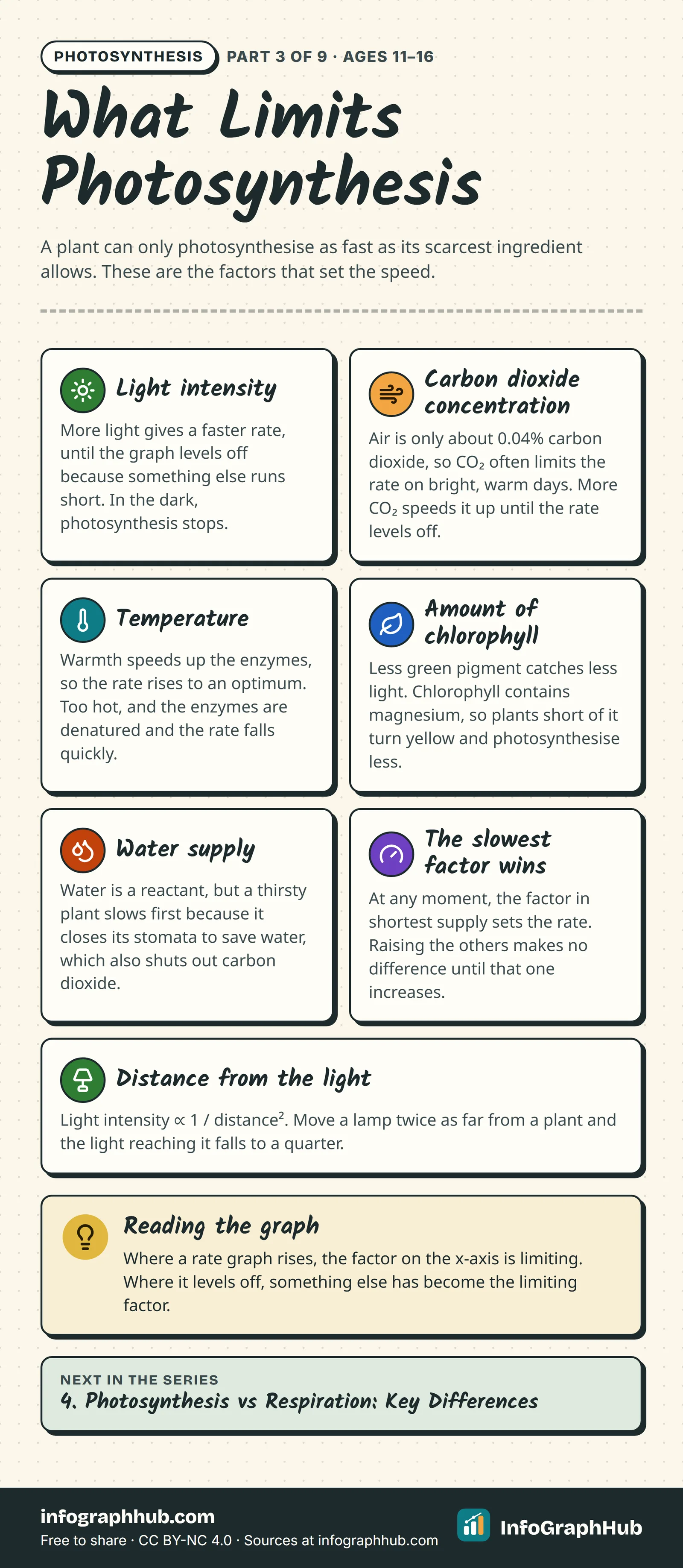
Photosynthesis needs several things at once: light, carbon dioxide, water, chlorophyll and a suitable temperature for its enzymes. If any one of them is in short supply, the whole process slows down, however much there is of the others. The factor that is holding the rate back is called the limiting factor.
Think of a sandwich production line with plenty of bread and fillings but only one person spreading butter. Adding more bread will not make sandwiches any faster; only more butter-spreading will. In the same way, more light does nothing for a plant whose real shortage is carbon dioxide.
Reading a rate graph
In experiments, the rate of photosynthesis is usually measured as the volume of oxygen given off, or the number of oxygen bubbles from pondweed, in a set time. Plot the rate against light intensity and the graph has two parts:
- A rising slope. Here light is the limiting factor: more light gives a faster rate.
- A flat plateau. Now more light makes no difference. Something else, such as carbon dioxide concentration or temperature, has become limiting.
If you repeat the experiment with more carbon dioxide or a warmer temperature, the plateau is higher. That tells you which factor was limiting before.
Temperature is different
Light and carbon dioxide graphs rise and then level off. A temperature graph rises to a peak and then falls. Warmth gives molecules more energy, so the enzymes of photosynthesis work faster up to an optimum temperature. Above it, the enzymes start to change shape (they are denatured) and the rate drops quickly. This is why grass grows very slowly in a cold winter even on a bright day.
Chlorophyll and water
A leaf with less chlorophyll absorbs less light. Chlorophyll is built around a magnesium atom, so a plant short of magnesium makes less of it, and its older leaves turn yellow between the veins.
Water is a reactant, but water shortage usually limits photosynthesis in a less direct way. A plant that is losing too much water closes its stomata, and closed stomata also stop carbon dioxide getting in. That is why photosynthesis slows on hot, dry afternoons and in deserts.
Worked example: the inverse square law
In the classroom pondweed practical, light intensity is changed by moving a lamp. Light spreads out as it travels, so its intensity is inversely proportional to the square of the distance:
light intensity ∝ 1 / distance²
- Lamp moved from 10 cm to 20 cm: the distance doubles, so the intensity falls to 1 ÷ 2² = ¼ of what it was.
- Lamp moved from 30 cm to 10 cm: the distance is divided by 3, so the intensity rises 3² = 9 times.
This is why a small change in distance can make a large change in the bubble count, as long as light is still the limiting factor.
Using limiting factors to grow more food
Commercial growers use the same ideas in greenhouses. They can add heat, artificial light and extra carbon dioxide, but each costs money, so they only pay to raise the factor that is actually limiting. Outdoor air is only about 0.04% carbon dioxide, and a crop in a closed greenhouse on a sunny day can use it up faster than it is replaced. Advice for growers from Ontario's agriculture ministry says that raising carbon dioxide to about 1,000 parts per million can increase photosynthesis by about 50%, provided there is enough light.
Frequently asked questions
What are the limiting factors of photosynthesis?
The main ones are light intensity, carbon dioxide concentration and temperature. The amount of chlorophyll and the water supply can also limit the rate. At any moment, the factor in shortest supply sets how fast photosynthesis can go.
Why does the rate of photosynthesis level off at high light intensity?
Because light is no longer the limiting factor. Another factor, usually carbon dioxide concentration or temperature, is now in short supply, so adding more light makes no difference.
Why does photosynthesis slow down at high temperatures?
Photosynthesis is controlled by enzymes. Above their optimum temperature the enzymes start to lose their shape (they are denatured), so they work less well and the rate drops.
How does the inverse square law affect photosynthesis experiments?
Light intensity is proportional to 1 divided by the distance squared. Doubling the distance between a lamp and a plant cuts the light intensity to a quarter, so the rate of photosynthesis falls if light is limiting.
Sources & methodology
Every fact is checked against the sources below. We write original explanations and draw original graphics; no figures are copied from textbooks. Spotted an error? See our corrections policy.
- GCSE Biology (8461) specification: 4.4 Bioenergetics (AQA, accessed 1 Oct 2026)
- What are limiting factors in photosynthesis? (BBC Bitesize, accessed 1 Oct 2026)
- What is photosynthesis and how does it affect plants? (CCEA) (BBC Bitesize, accessed 1 Oct 2026)
- Climate Change: Atmospheric Carbon Dioxide (NOAA Climate.gov, accessed 1 Oct 2026)
- Supplemental carbon dioxide in greenhouses (Government of Ontario (Ministry of Agriculture, Food and Agribusiness), accessed 1 Oct 2026)
- Magnesium Deficiencies in Vegetables (University of Delaware Cooperative Extension, Weekly Crop Update, accessed 1 Oct 2026)
Editorial review pending · Updated
Embed this on your site
Paste this HTML into your page. Keep the credit line: it is required by the CC BY-NC 4.0 license.
Related infographics
 Science
How Photosynthesis Works: From Sunlight to Sugar
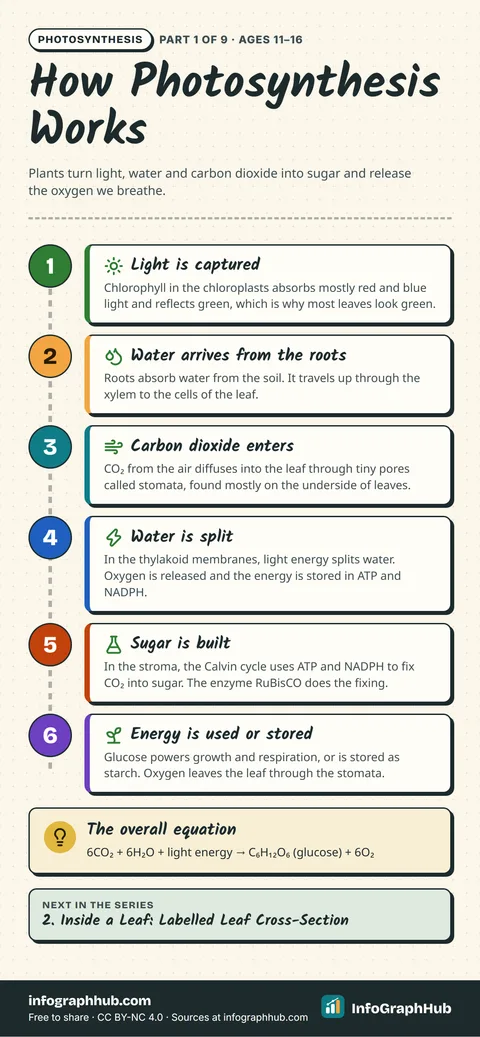
Photosynthesis is how plants use light energy to turn carbon dioxide and water into glucose, releasing oxygen as a by-product. It happens in chloroplasts in two linked stages: the light-dependent reactions and the Calvin cycle.
 Science
Inside a Leaf: Labelled Leaf Cross-Section
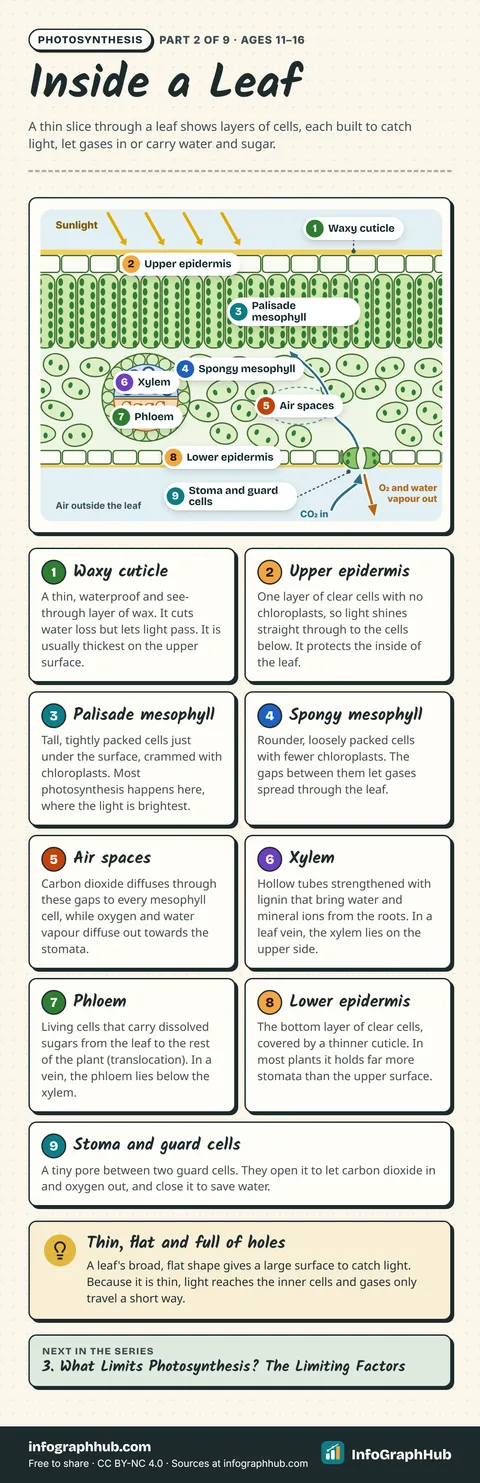
A labelled cross-section of a leaf, from the waxy cuticle to the stomata. See how each layer, from palisade cells packed with chloroplasts to air spaces, veins and guard cells, helps the leaf photosynthesise.
 Science
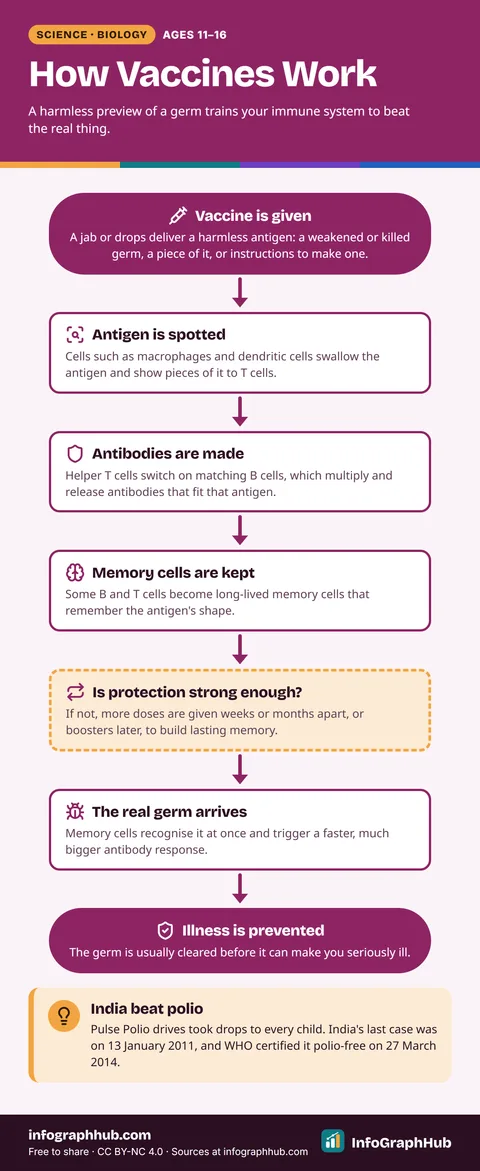
How Vaccines Work: Training Your Immune System
Vaccines work by imitating an infection. They show your immune system a harmless antigen from a germ, so it makes matching antibodies and memory cells that can fight the real germ quickly if it ever arrives.
 Science
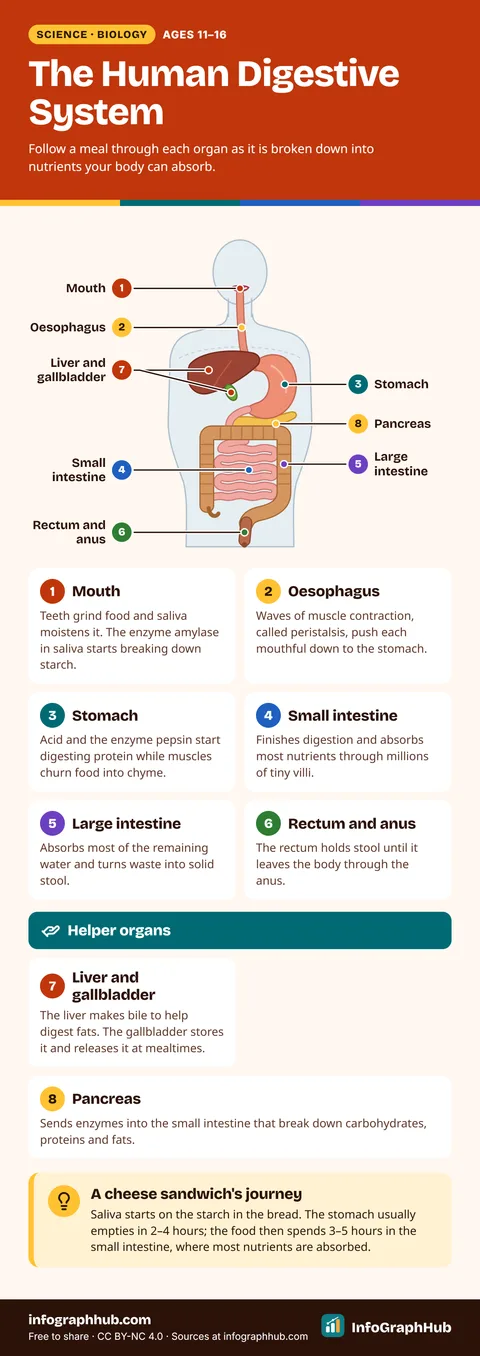
The Human Digestive System: How Food Becomes Energy
The digestive system breaks food into nutrients small enough to enter the blood. Food passes from the mouth through the oesophagus, stomach and intestines, helped by juices from the liver, gallbladder and pancreas.
 Science
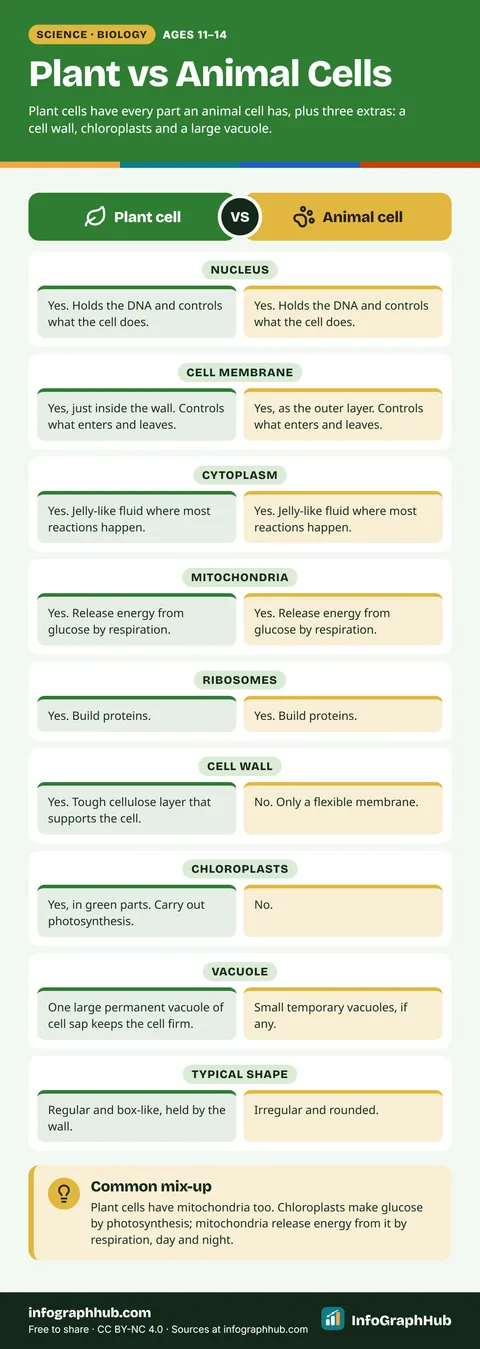
Plant vs Animal Cells: What Each Part Does
Plant and animal cells share a nucleus, cell membrane, cytoplasm, mitochondria and ribosomes. Plant cells also have a cellulose cell wall, chloroplasts and a large permanent vacuole. This comparison poster shows each part and its job.
 Science
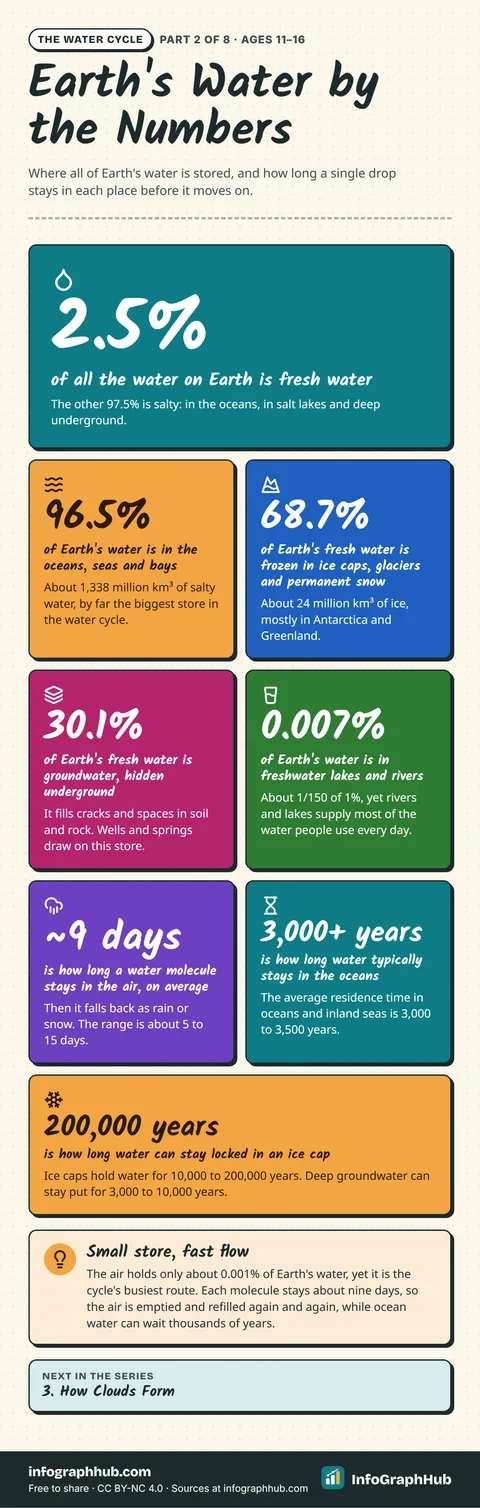
Earth's Water by the Numbers
Where is all of Earth's water, and how long does it stay there? Only 2.5% is fresh, most of that is frozen or underground, and a drop can spend nine days in the air or thousands of years in the ocean or an ice cap.
For teachers and parents: new InfoGraphHub resources by email
One short email when new free resources go live. For adults (18+) only. No spam, no tracking in emails, unsubscribe anytime.