Plant vs Animal Cells: What Each Part Does
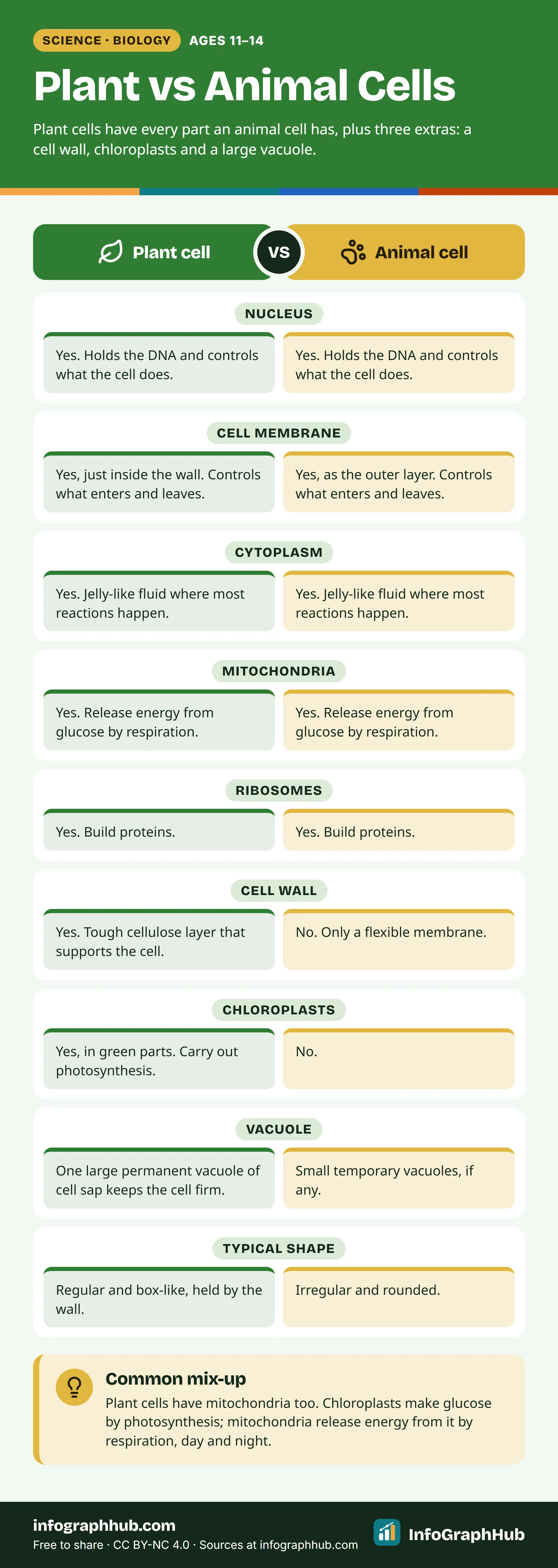
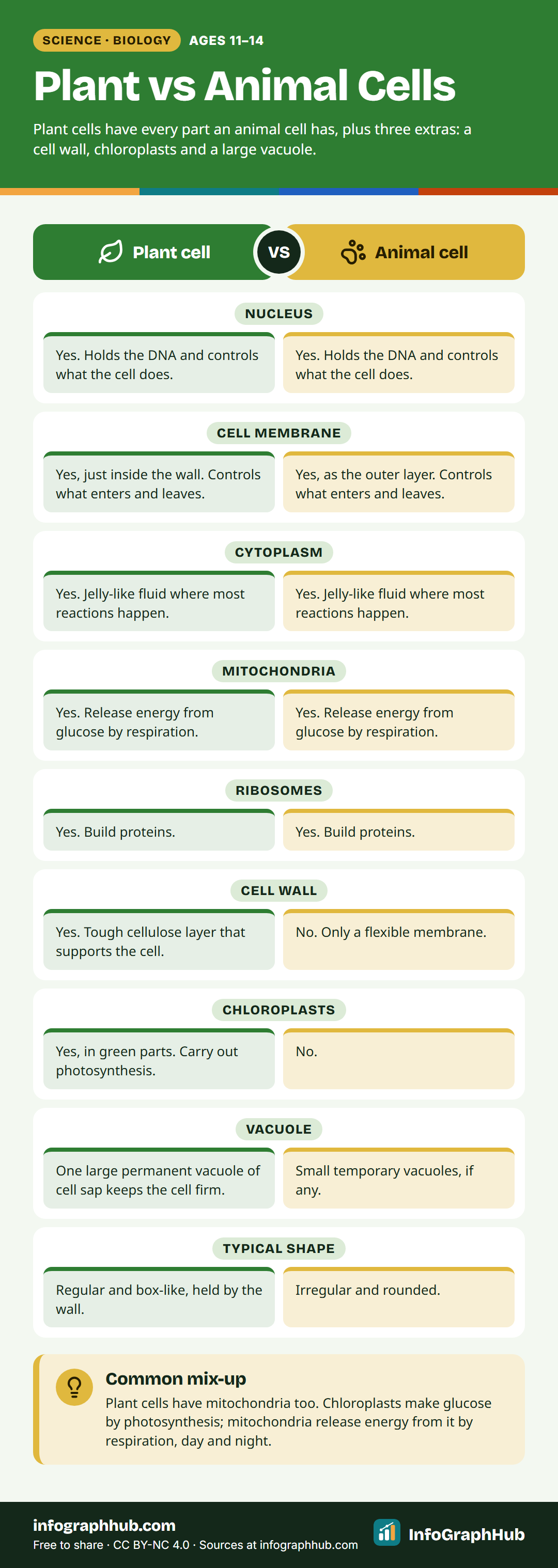
Plant and animal cells share a nucleus, cell membrane, cytoplasm, mitochondria and ribosomes. Plant cells also have a cellulose cell wall, chloroplasts and a large permanent vacuole. This comparison poster shows each part and its job.
Ages 11–14 · Grades 6–8 (US) · Years 7–9 (UK) · Classes 6–8 (India)
- England KS3 Years 7–9
- AQA GCSE 4.1.1.2
- Cambridge IGCSE 0610 2.1
- NGSS MS-LS1-2
- Australian Curriculum v9 AC9S8U01
- CBSE Class 9
NGSS is a registered trademark of WestEd. Cambridge and IGCSE are trademarks of Cambridge University Press & Assessment. Names and codes are used only to describe curriculum fit; InfoGraphHub is not endorsed by these organisations.
What a cell is
Every living thing is made of one or more cells, the smallest units that can carry out the processes of life. New cells only come from existing cells dividing. Most cells are far too small to see without a microscope: a typical plant or animal cell is about 10–100 micrometres across, and a micrometre is a thousandth of a millimetre.
Plants and animals are both made of cells with a nucleus. That shared design is why their cells have so much in common, and why the differences are worth learning.
The five parts plant and animal cells share
- Nucleus: holds the cell's DNA and controls its activities.
- Cell membrane: a thin, flexible layer that controls what enters and leaves.
- Cytoplasm: the jelly-like fluid where most of the cell's chemical reactions take place.
- Mitochondria: release energy from glucose by respiration.
- Ribosomes: tiny structures that build proteins. They are too small to see with a school light microscope.
The three extra parts in plant cells
- Cell wall: a tough layer of cellulose outside the membrane. It supports the cell and gives it a fixed shape.
- Chloroplasts: contain green chlorophyll and carry out photosynthesis. They are found in the green parts of a plant, such as leaves, not in every plant cell.
- Large permanent vacuole: filled with cell sap. When full of water it presses outwards on the wall and keeps the cell firm.
Animal cells may have small, temporary vacuoles, but never one large permanent vacuole.
Why the differences matter
A plant has no skeleton, so it relies on firm cells to hold up its stems and leaves. When water runs short, the vacuoles shrink, the walls are left unsupported and the plant wilts. Chloroplasts let plants make their own food from light, carbon dioxide and water. Animals cannot do this, so they must eat.
Without a rigid wall, animal cells are held in only by their flexible membrane, so they can change shape more easily and are often rounder or irregular.
Worked example: two cells under a microscope
A classic practical compares a thin layer of onion skin with cells gently scraped from inside the cheek, both stained so the nucleus shows up. Through a school light microscope, which magnifies up to about 400 times:
- The onion cells are box-shaped and sit in neat rows. You can see the outline of each cell wall and a dark, stained nucleus.
- The cheek cells are rounded and irregular, often lying separately. There is no wall, only a thin membrane, and each has a stained nucleus.
Ask students to label only what they can actually see. Ribosomes are far too small to show up at this magnification.
Using this poster
Print it on A4 or US Letter as a handout, or on A3 or Tabloid for the classroom wall. Students can cover one column and test themselves on the other. It pairs with the free LearnBySlides lesson on plant and animal cells, which has speaker notes, a quiz and a worksheet.
Frequently asked questions
What are the main differences between plant and animal cells?
Plant cells have three structures that animal cells lack: a cellulose cell wall, chloroplasts and a large permanent vacuole. Plant cells are often box-shaped, while animal cells are usually rounder and irregular.
Do plant cells have mitochondria?
Yes. Plant cells have mitochondria as well as chloroplasts. They make glucose by photosynthesis and release energy from it by respiration, which happens all the time.
Do all plant cells have chloroplasts?
No. Chloroplasts are found in the green parts of a plant that photosynthesise, such as leaves. Root cells, which grow underground without light, take in water and minerals or store food instead.
How big is a cell?
A typical plant or animal cell is about 10 to 100 micrometres across. A micrometre is a thousandth of a millimetre, so you need a microscope to see most cells.
Sources & methodology
Every fact is checked against the sources below. We write original explanations and draw original graphics; no figures are copied from textbooks. Spotted an error? See our corrections policy.
- Biology 2e, 4.3 Eukaryotic Cells (OpenStax (Rice University), accessed 1 Oct 2026)
- Biology 2e, 4.2 Prokaryotic Cells (cell size) (OpenStax (Rice University), accessed 1 Oct 2026)
- Biology 2e, 4.1 Studying Cells (cell theory, microscopes) (OpenStax (Rice University), accessed 1 Oct 2026)
- Biology 2e, 30.3 Roots (OpenStax (Rice University), accessed 1 Oct 2026)
- Talking Glossary of Genomic and Genetic Terms: Ribosome (National Human Genome Research Institute (NIH), accessed 1 Oct 2026)
Editorial review pending · Updated
Embed this on your site
Paste this HTML into your page. Keep the credit line: it is required by the CC BY-NC 4.0 license.
Related infographics
 Science
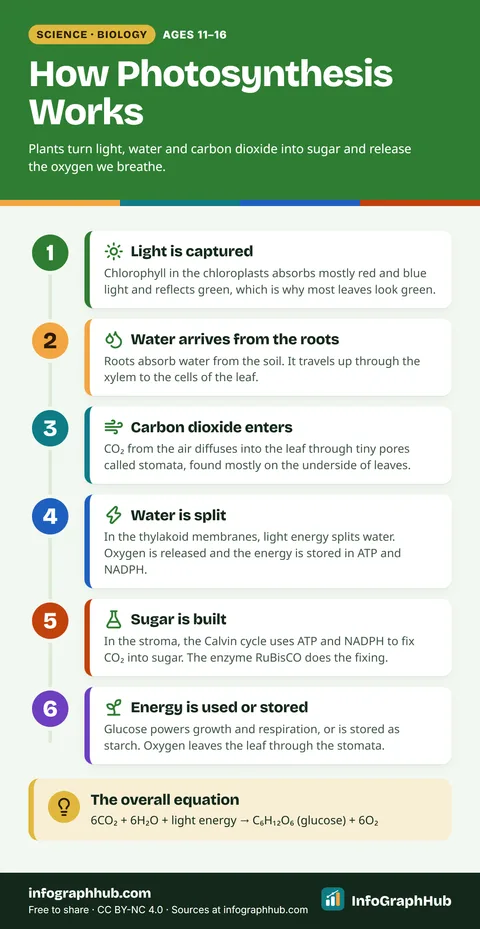
How Photosynthesis Works: From Sunlight to Sugar
Photosynthesis is how plants use light energy to turn carbon dioxide and water into glucose, releasing oxygen as a by-product. It happens in chloroplasts in two linked stages: the light-dependent reactions and the Calvin cycle.
 Science
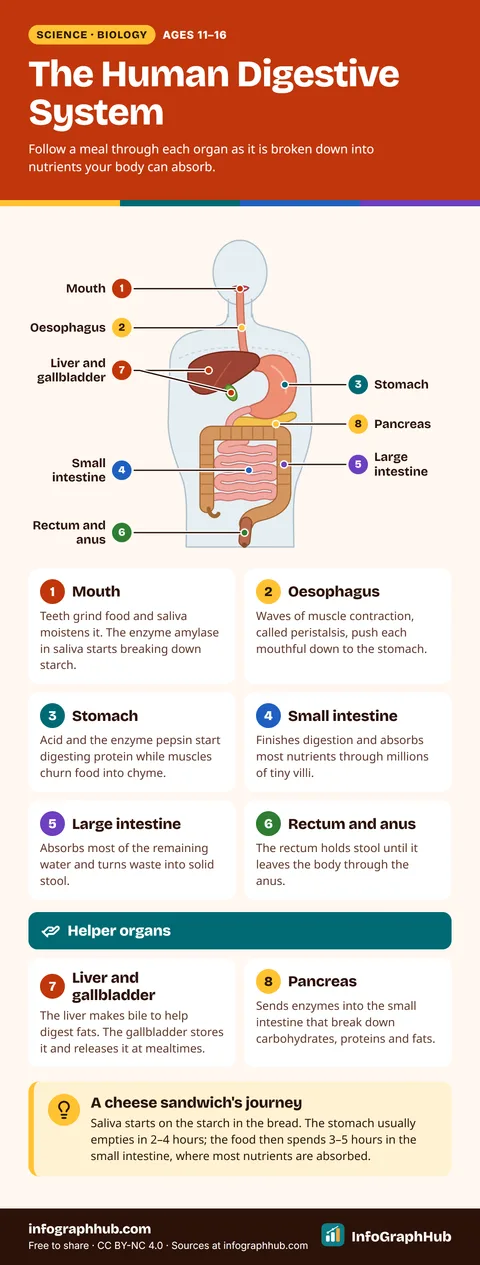
The Human Digestive System: How Food Becomes Energy
The digestive system breaks food into nutrients small enough to enter the blood. Food passes from the mouth through the oesophagus, stomach and intestines, helped by juices from the liver, gallbladder and pancreas.
 Science
How Vaccines Work: Training Your Immune System
Vaccines work by imitating an infection. They show your immune system a harmless antigen from a germ, so it makes matching antibodies and memory cells that can fight the real germ quickly if it ever arrives.
 Science
Newton's Three Laws of Motion Explained
Newton's three laws explain how forces change motion: with no resultant force motion does not change, resultant force equals mass times acceleration, and forces always come in equal and opposite pairs acting on different objects.
 Science
Series vs Parallel Circuits: Key Differences
In a series circuit there is one path, so the current is the same everywhere and the voltage is shared. In a parallel circuit each branch gets the full voltage and the branch currents add up. This poster compares the two side by side.
 Science
States of Matter: Solids, Liquids and Gases in the Particle Model
Solids, liquids and gases are made of the same kinds of particles; only their spacing, arrangement and movement differ. This poster compares the three states and shows the changes of state and whether each takes in or gives out energy.
For teachers and parents: new InfoGraphHub resources by email
One short email when new free resources go live. For adults (18+) only. No spam, no tracking in emails, unsubscribe anytime.