The Human Digestive System: How Food Becomes Energy
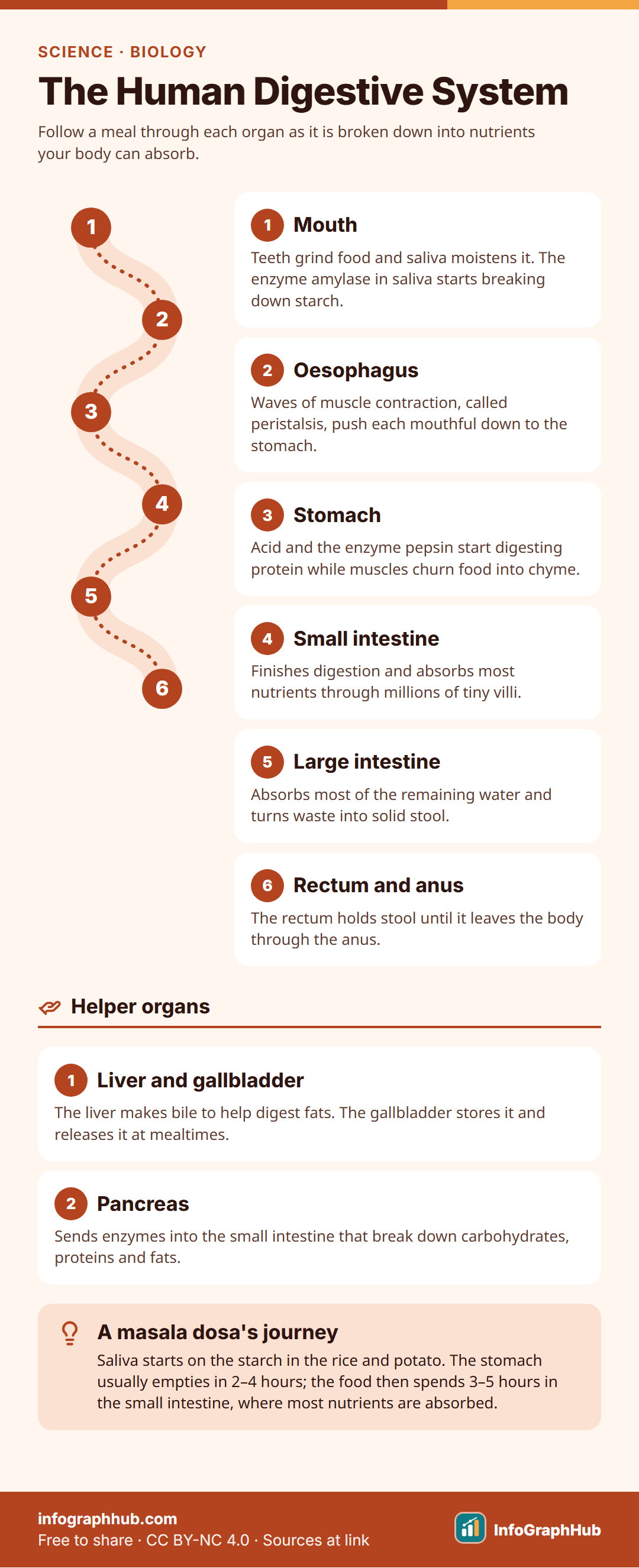
The digestive system breaks food into nutrients small enough to enter the blood. Food passes from the mouth through the oesophagus, stomach and intestines, helped by juices from the liver, gallbladder and pancreas.

What digestion does
Your cells need energy and building materials, but they cannot use a bowl of dal and rice as it is. The molecules in food are far too big to pass into the blood. Digestion breaks them down into small pieces that can.
It works in two ways:
- Mechanical digestion: chewing, and the churning of the stomach, break food into smaller bits.
- Chemical digestion: enzymes and acid split large molecules into simple ones. Carbohydrates become simple sugars, proteins become amino acids, and fats become fatty acids and glycerol.
Food travels through the digestive tract, one long tube from the mouth to the anus. The liver, gallbladder and pancreas sit outside the tube and pour their juices into it.
From mouth to stomach
Digestion starts as soon as you chew. Teeth grind food into smaller pieces, and saliva moistens it and begins breaking down starch with an enzyme called amylase.
When you swallow, the food enters the oesophagus. It does not simply fall: waves of muscle contraction called peristalsis squeeze it down to the stomach.
In the stomach, glands make acid and enzymes, and strong muscles mix the food with them. The acid kills much of the bacteria swallowed with food and helps the enzyme pepsin start digesting protein. The food is slowly turned into a thick liquid called chyme. A stomach usually empties into the small intestine within two to four hours of a meal.
The small intestine and its helpers
The small intestine is the longest part of the tract and where most of the work happens. It has three parts: the duodenum, the jejunum and the ileum. Here, three helper organs join in:
- The pancreas makes a juice full of enzymes that break down carbohydrates, proteins and fats.
- The liver makes bile, which helps digest fats.
- The gallbladder stores bile between meals and releases it when you eat.
The lining of the small intestine is covered in tiny finger-like villi, which give it a huge surface for absorbing nutrients. It absorbs most of the nutrients in your food and about 90 per cent of the water you take in.
The large intestine and the end of the journey
Whatever is left moves into the large intestine. It is shorter than the small intestine but more than twice as wide. It absorbs most of the remaining water and turns liquid waste into solid stool.
Trillions of bacteria live here. They break down some leftover material and make certain vitamins, including vitamin K. Waste usually spends 12 to 24 hours in the large intestine before the rectum stores it and it leaves the body through the anus.
Worked example: following a masala dosa
Imagine a masala dosa for breakfast. The rice and urad dal batter supplies starch and some protein, the potato filling adds more starch, and the oil or ghee adds fat.
While you chew, amylase in your saliva is already working on the starch. In the stomach, acid and pepsin begin taking apart the dal's protein. Once the food reaches the small intestine, pancreatic enzymes finish the job, and bile from the gallbladder helps with the fat. Glucose and amino acids pass through the villi into your blood. A few hours after breakfast, that dosa is fuelling your brain and muscles through a school morning.
Where the nutrients go
After absorption, the blood carries simple sugars, amino acids and glycerol to the liver, which stores and processes them before sending them on to the rest of the body. Fatty acids and some vitamins take a different route, entering the lymph system first. This is why a healthy digestive system matters: every cell in your body depends on it for fuel and raw materials.
Frequently asked questions
Which organ absorbs most of the nutrients from food?
The small intestine. Its lining is covered in millions of finger-like villi that give it a huge surface area, so most nutrients pass into the blood or lymph here.
Is most water absorbed in the large intestine?
No. The small intestine absorbs about 90 per cent of the water you take in. The large intestine absorbs most of what is left, which turns liquid waste into solid stool.
How does food move down the oesophagus?
By peristalsis: rings of muscle contract and relax in waves that squeeze food towards the stomach. This is why food still reaches your stomach even if you swallow while lying down.
Why does the stomach contain acid?
Stomach acid kills much of the bacteria swallowed with food. It also unfolds proteins and switches on the enzyme pepsin, which starts protein digestion.
How long does digestion take?
It varies from person to person and meal to meal. As a rough guide, the stomach empties in 2 to 4 hours, chyme takes 3 to 5 hours to leave the small intestine, and waste spends 12 to 24 hours in the large intestine.
Sources & methodology
Every fact is checked against the sources below. We write original explanations and draw original graphics; no figures are copied from textbooks. Spotted an error? See our corrections policy.
- Your Digestive System & How It Works (National Institute of Diabetes and Digestive and Kidney Diseases (NIH), accessed 30 Sept 2026)
- 23.4 The Stomach (Anatomy and Physiology 2e) (OpenStax, Rice University, accessed 30 Sept 2026)
- 23.5 The Small and Large Intestines (Anatomy and Physiology 2e) (OpenStax, Rice University, accessed 30 Sept 2026)
- Small Intestine: Function, Length & Anatomy (Cleveland Clinic, accessed 30 Sept 2026)
Reviewed by Claude (pending owner check) · Updated
Embed this on your site
Paste this HTML into your page. Keep the credit line: it is required by the CC BY-NC 4.0 license.
Related infographics
 Science
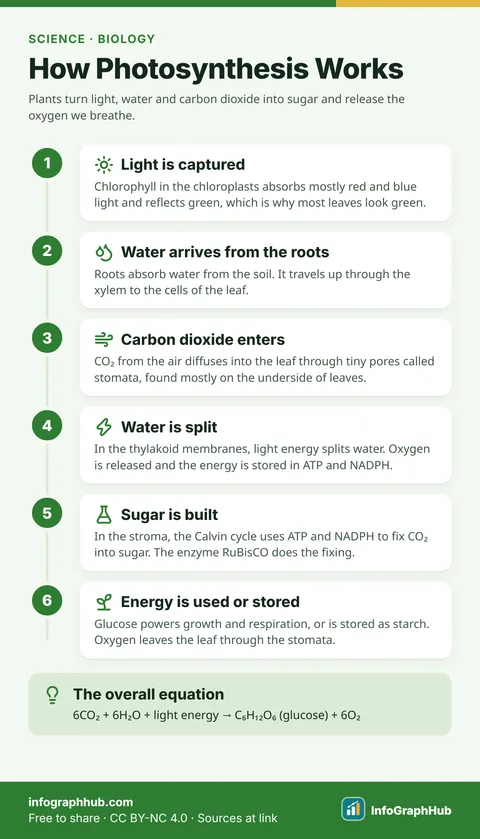
How Photosynthesis Works: From Sunlight to Sugar
Photosynthesis is how plants use light energy to turn carbon dioxide and water into glucose, releasing oxygen as a by-product. It happens in chloroplasts in two linked stages: the light-dependent reactions and the Calvin cycle.
 Science
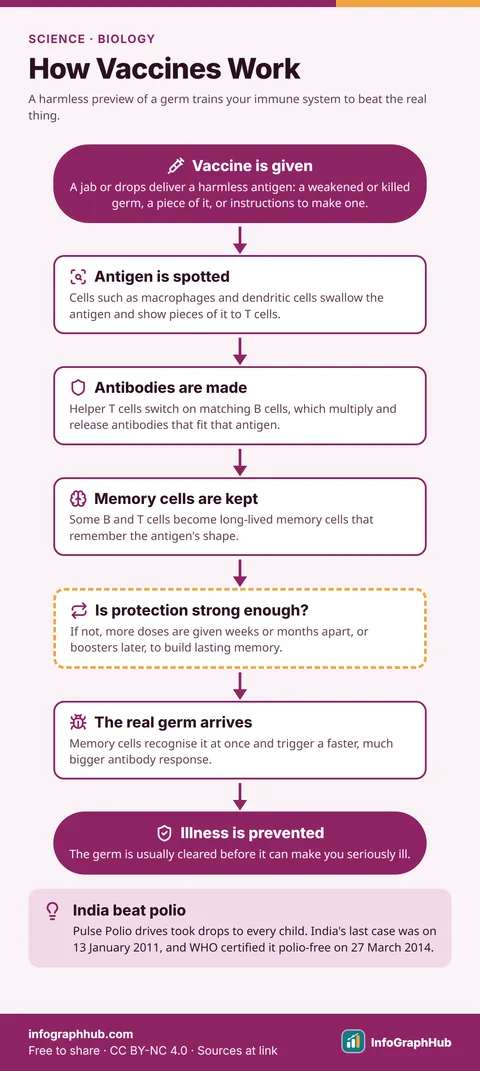
How Vaccines Work: Training Your Immune System
Vaccines work by imitating an infection. They show your immune system a harmless antigen from a germ, so it makes matching antibodies and memory cells that can fight the real germ quickly if it ever arrives.
 Science
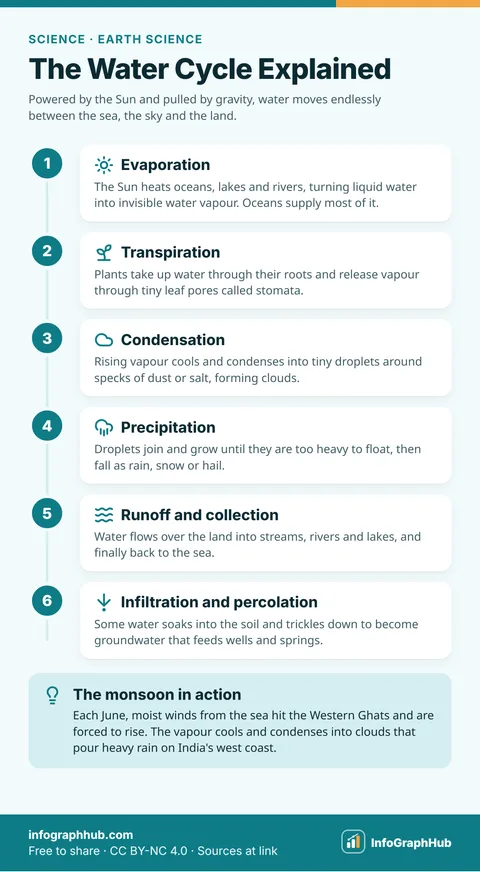
The Water Cycle Explained
The water cycle is the non-stop movement of water between oceans, air and land. Powered by the Sun, water evaporates, condenses into clouds, falls as rain or snow, and flows or soaks back towards rivers, groundwater and the sea.
 Finance
Compound Interest Explained: How Money Grows Over Time
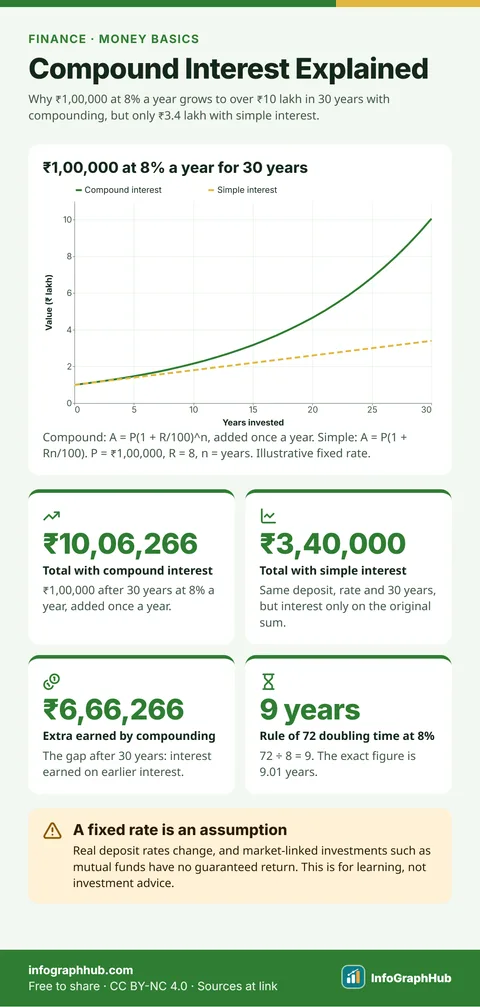
Compound interest is interest earned on your interest. Each year’s interest is added to the balance, so the next year’s interest is worked out on a bigger sum. Over long periods this makes money grow far faster than simple interest.
 Tech
TechGit Commands Cheat Sheet: The Essentials for Beginners
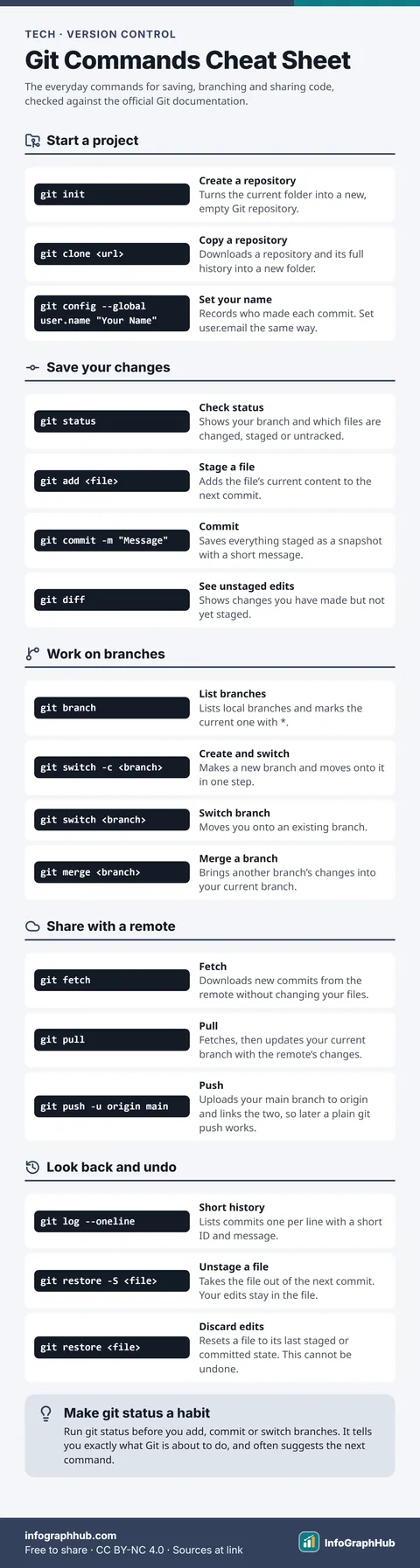
The Git commands beginners use most: set up a repository with init or clone, save work with add and commit, build features on branches with switch and merge, share work with fetch, pull and push, and undo safely with restore.
 Finance
How Credit Scores Work in India: What Moves Your Score
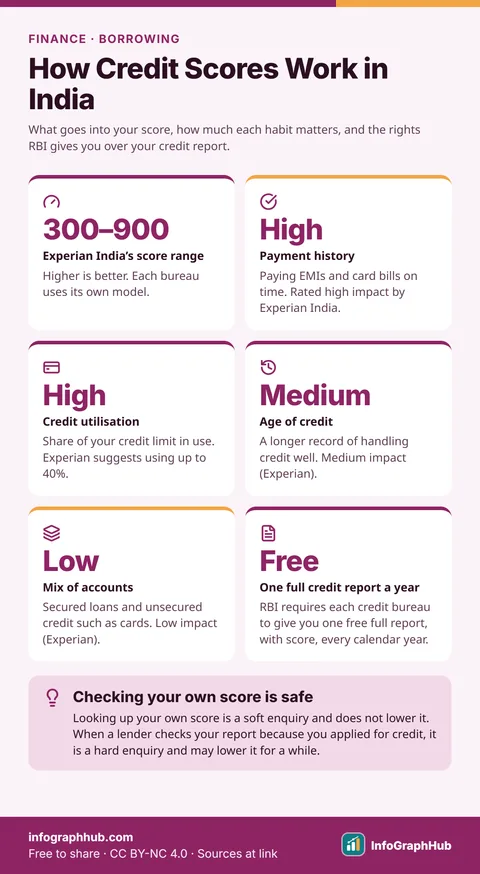
A credit score is a three-digit number, such as Experian India’s 300–900 score, built from your borrowing record. Paying on time and using little of your credit limit matter most; the age and mix of your accounts matter less.
Get new InfoGraphHub resources by email
One short email when new free resources go live. No spam, unsubscribe anytime.