How Credit Scores Work in India: What Moves Your Score
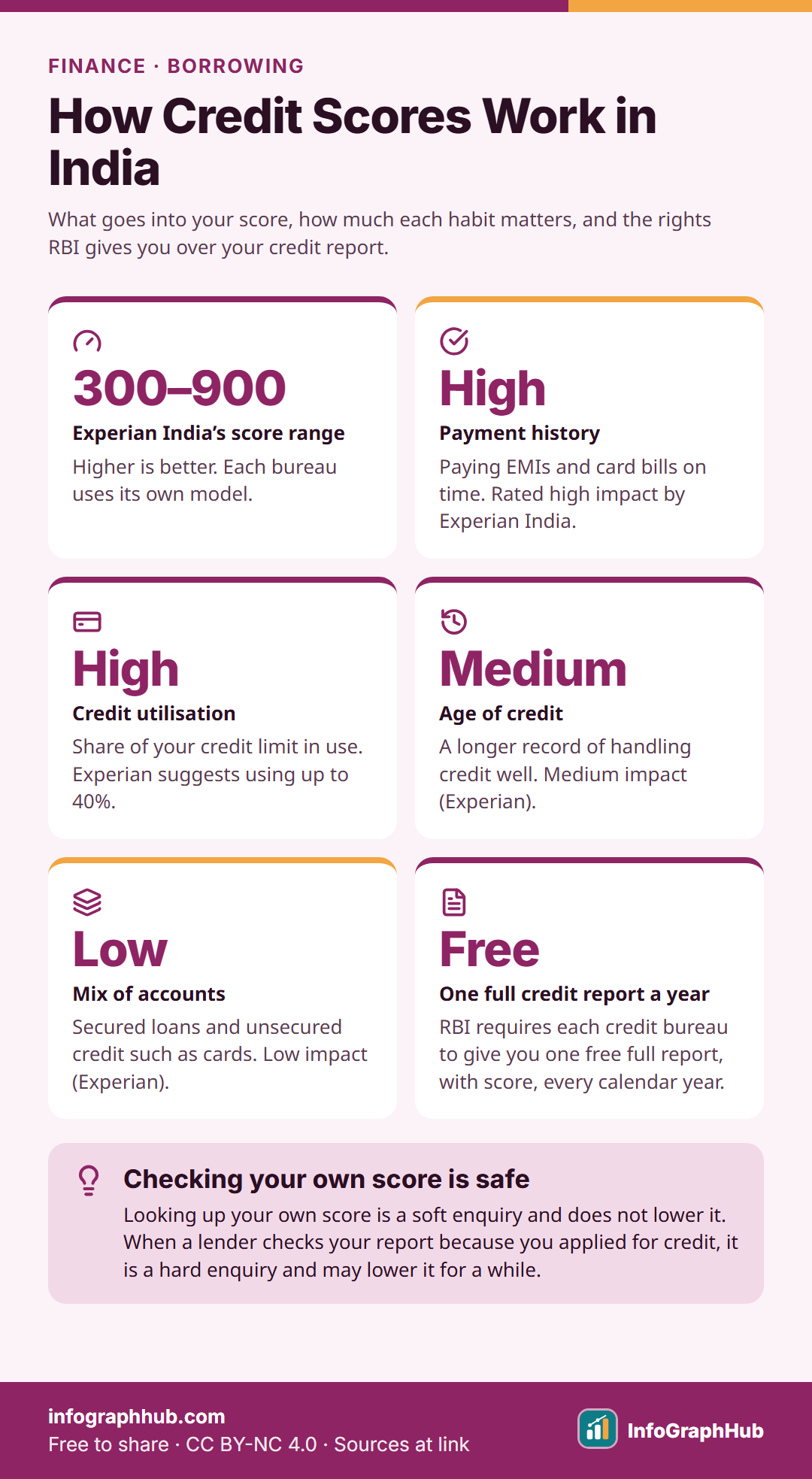
A credit score is a three-digit number, such as Experian India’s 300–900 score, built from your borrowing record. Paying on time and using little of your credit limit matter most; the age and mix of your accounts matter less.

What a credit score is
When you borrow, through a loan, a credit card or even a phone bought on EMI, the lender regularly reports how you repay to credit information companies (CICs), also called credit bureaus. India has four, all licensed by the Reserve Bank of India: TransUnion CIBIL, Equifax, Experian and CRIF High Mark.
Each bureau keeps a credit report listing your accounts and repayments, and turns it into a credit score. Experian India’s score, for example, runs from 300 to 900. As RBI puts it, the higher the score, the better your chances of getting a loan. Lenders still make their own decision and look at other details, such as your income.
What moves your score
Each bureau uses its own formula, and they describe the factors as high, medium or low impact rather than as exact percentages. Experian India lists:
- Payment history (high impact): paying every EMI and card bill in full and on time. Missed or late payments pull the score down.
- Credit utilisation (high impact): how much of your available limit you use. Experian suggests using up to 40% of your limit; CRIF High Mark suggests under 30–40%.
- Age of credit (medium impact): a longer track record helps.
- Mix of accounts (low impact): having both secured loans, such as a home loan, and unsecured credit, such as a credit card.
CRIF High Mark also counts recent credit enquiries as a low-to-medium factor.
Soft and hard enquiries
When you check your own score, that is a soft enquiry, and it does not affect the score. When you apply for a loan or card and the lender pulls your report to decide, that is a hard enquiry, which can lower your score for a while. Applying to many lenders in a short time means several hard enquiries close together, so it is worth comparing offers carefully before you apply.
Worked example: Rohan and Amit
Rohan and Amit, two friends in Mumbai, each get their first credit card with a ₹50,000 limit.
- Rohan spends about ₹15,000 a month, which is 30% of his limit, and pays the full bill before the due date.
- Amit regularly spends ₹45,000, which is 90% of his limit, pays only the minimum due and is sometimes late.
After a year, Rohan has a clean payment record and low utilisation, the two high-impact factors. Amit has high utilisation and late payments on his report, so his score is likely to suffer, and lenders may offer him less credit or charge him more.
Your rights under RBI rules
RBI’s Credit Information Reporting Directions give borrowers several protections:
- A free full credit report, including your score, once every calendar year (January to December) from each bureau.
- Alerts by SMS or email when your credit report is accessed, and when a lender reports a default or overdue payment.
- Error correction: if your report is wrong, complain to the bureau or lender. If the complaint is not resolved within 30 calendar days, you are entitled to compensation of ₹100 for each day of delay.
This page is general information, not financial advice. For help with your own finances, speak to your lender or a qualified adviser, such as a SEBI-registered investment adviser.
Frequently asked questions
What counts as a good credit score?
There is no single official cut-off. CRIF High Mark, for example, describes 750–900 as excellent and 700–749 as good. Each lender sets its own rules and also looks at things such as your income.
Does checking my own credit score lower it?
No. Checking your own score is a soft enquiry and has no effect. Only hard enquiries, made when a lender assesses an application for credit, can lower it, and usually only for a while.
Is a CIBIL score the same as a credit score?
A CIBIL score is the credit score made by TransUnion CIBIL, one of India’s four credit bureaus. Equifax, Experian and CRIF High Mark each produce their own scores, so your numbers may differ slightly between bureaus.
How can I get my credit report for free?
RBI requires every credit bureau to give you one free full credit report, including your score, once each calendar year. You can request it on each bureau’s website.
Sources & methodology
Every fact is checked against the sources below. We write original explanations and draw original graphics; no figures are copied from textbooks. Spotted an error? See our corrections policy.
- Master Direction – Reserve Bank of India (Credit Information Reporting) Directions, 2025 (Reserve Bank of India, accessed 30 Sept 2026)
- Exercise Credit Discipline (Financial Literacy poster) (Reserve Bank of India, accessed 30 Sept 2026)
- Frequently Asked Questions (Experian Credit Information Company of India, accessed 30 Sept 2026)
- Understanding Credit Score India: Why It Matters and How to Improve It (CRIF High Mark, accessed 30 Sept 2026)
Reviewed by Claude (pending owner check) · Updated
Embed this on your site
Paste this HTML into your page. Keep the credit line: it is required by the CC BY-NC 4.0 license.
Related infographics
 Finance
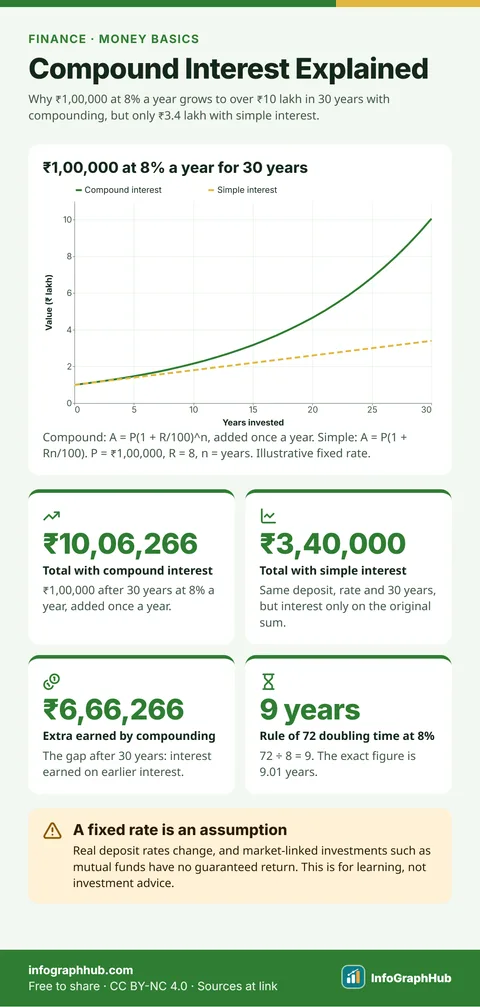
Compound Interest Explained: How Money Grows Over Time
Compound interest is interest earned on your interest. Each year’s interest is added to the balance, so the next year’s interest is worked out on a bigger sum. Over long periods this makes money grow far faster than simple interest.
 Finance
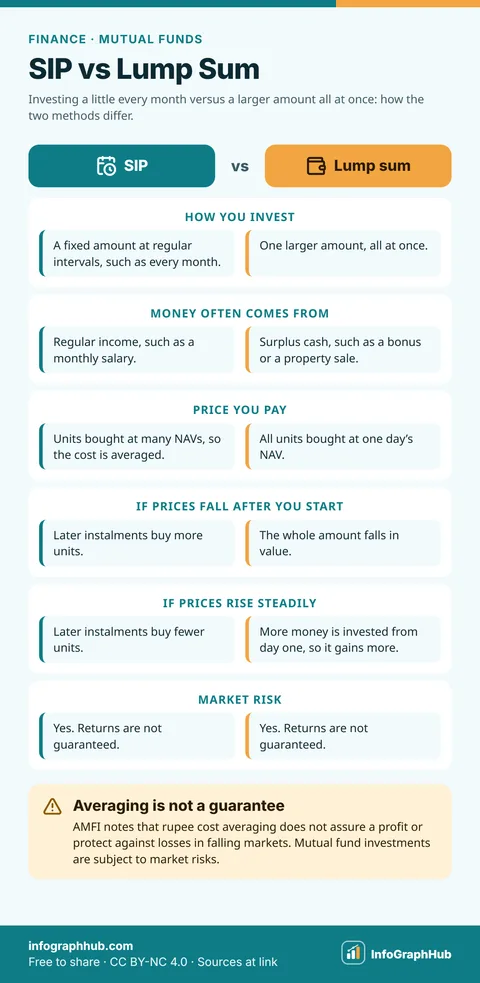
SIP vs Lump Sum: Two Ways to Invest in Mutual Funds
An SIP puts a fixed amount into a mutual fund at regular intervals, so you buy units at many different prices. A lump sum invests one larger amount at once, at a single price. Neither is always better, and neither guarantees a return.
 Tech
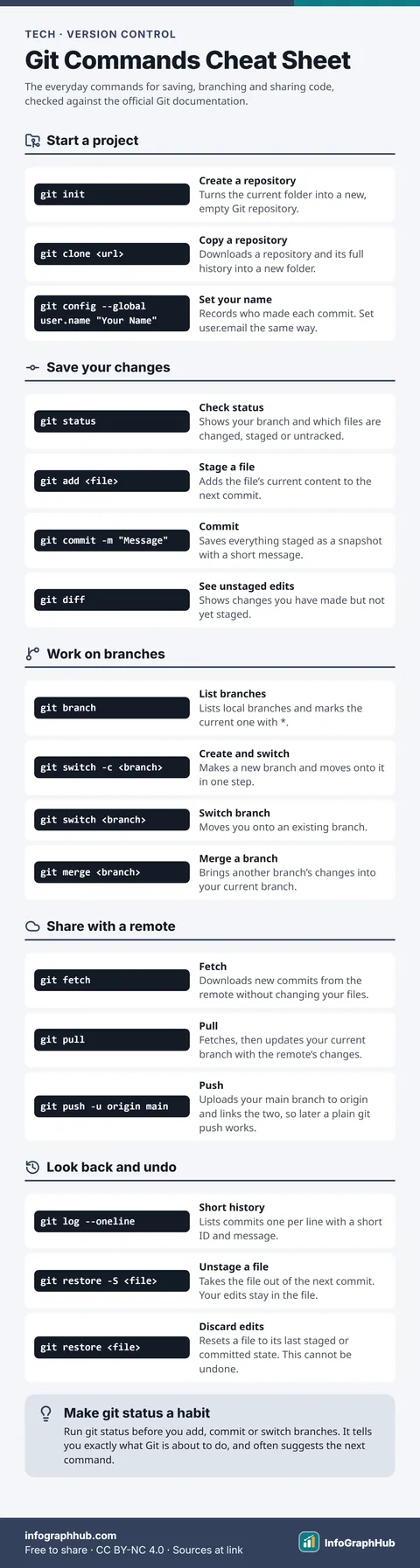
TechGit Commands Cheat Sheet: The Essentials for Beginners
The Git commands beginners use most: set up a repository with init or clone, save work with add and commit, build features on branches with switch and merge, share work with fetch, pull and push, and undo safely with restore.
 Tech
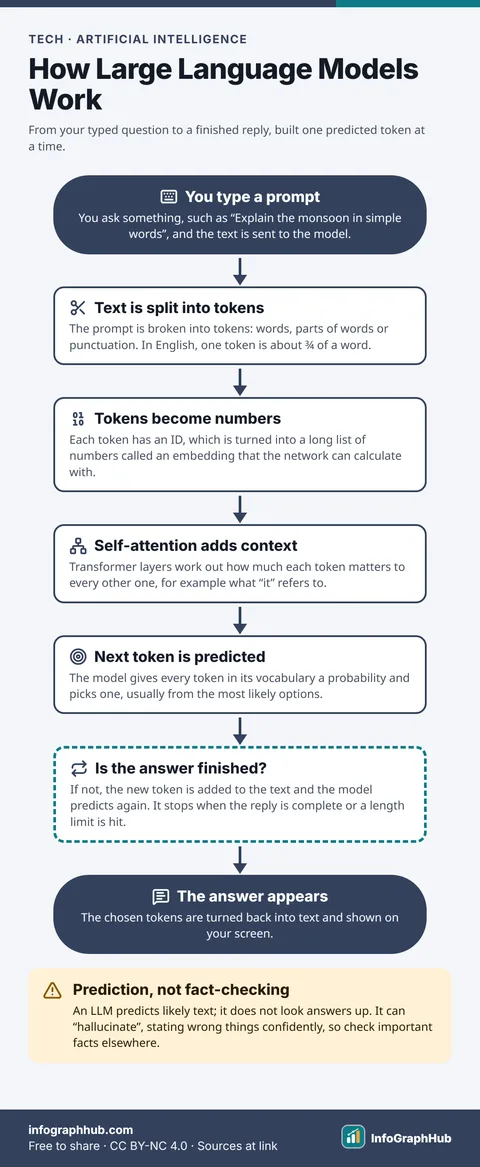
TechHow Large Language Models Work: From Prompt to Answer
A large language model splits your prompt into tokens, turns them into numbers, uses self-attention to work out context, then predicts the most likely next token. It repeats that prediction, one token at a time, until the answer is complete.
 Science
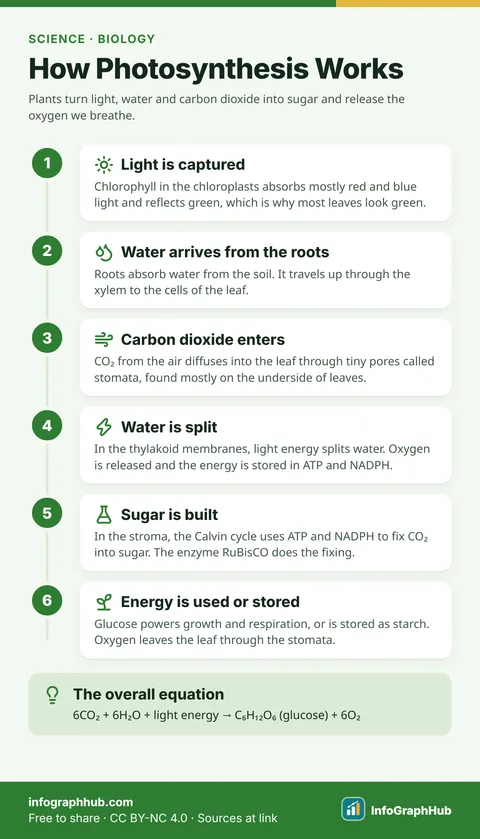
How Photosynthesis Works: From Sunlight to Sugar
Photosynthesis is how plants use light energy to turn carbon dioxide and water into glucose, releasing oxygen as a by-product. It happens in chloroplasts in two linked stages: the light-dependent reactions and the Calvin cycle.
 Science
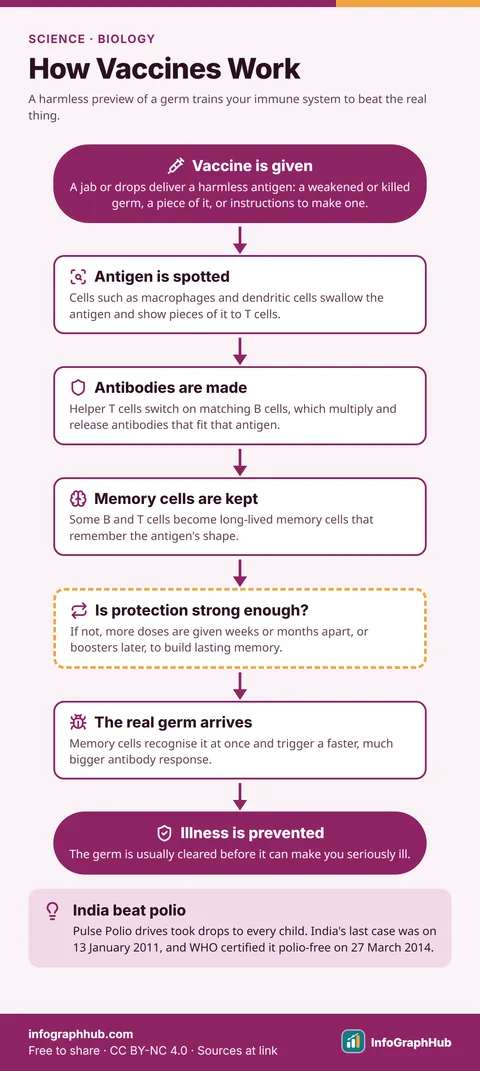
How Vaccines Work: Training Your Immune System
Vaccines work by imitating an infection. They show your immune system a harmless antigen from a germ, so it makes matching antibodies and memory cells that can fight the real germ quickly if it ever arrives.
Get new InfoGraphHub resources by email
One short email when new free resources go live. No spam, unsubscribe anytime.