SIP vs Lump Sum: Two Ways to Invest in Mutual Funds
An SIP puts a fixed amount into a mutual fund at regular intervals, so you buy units at many different prices. A lump sum invests one larger amount at once, at a single price. Neither is always better, and neither guarantees a return.

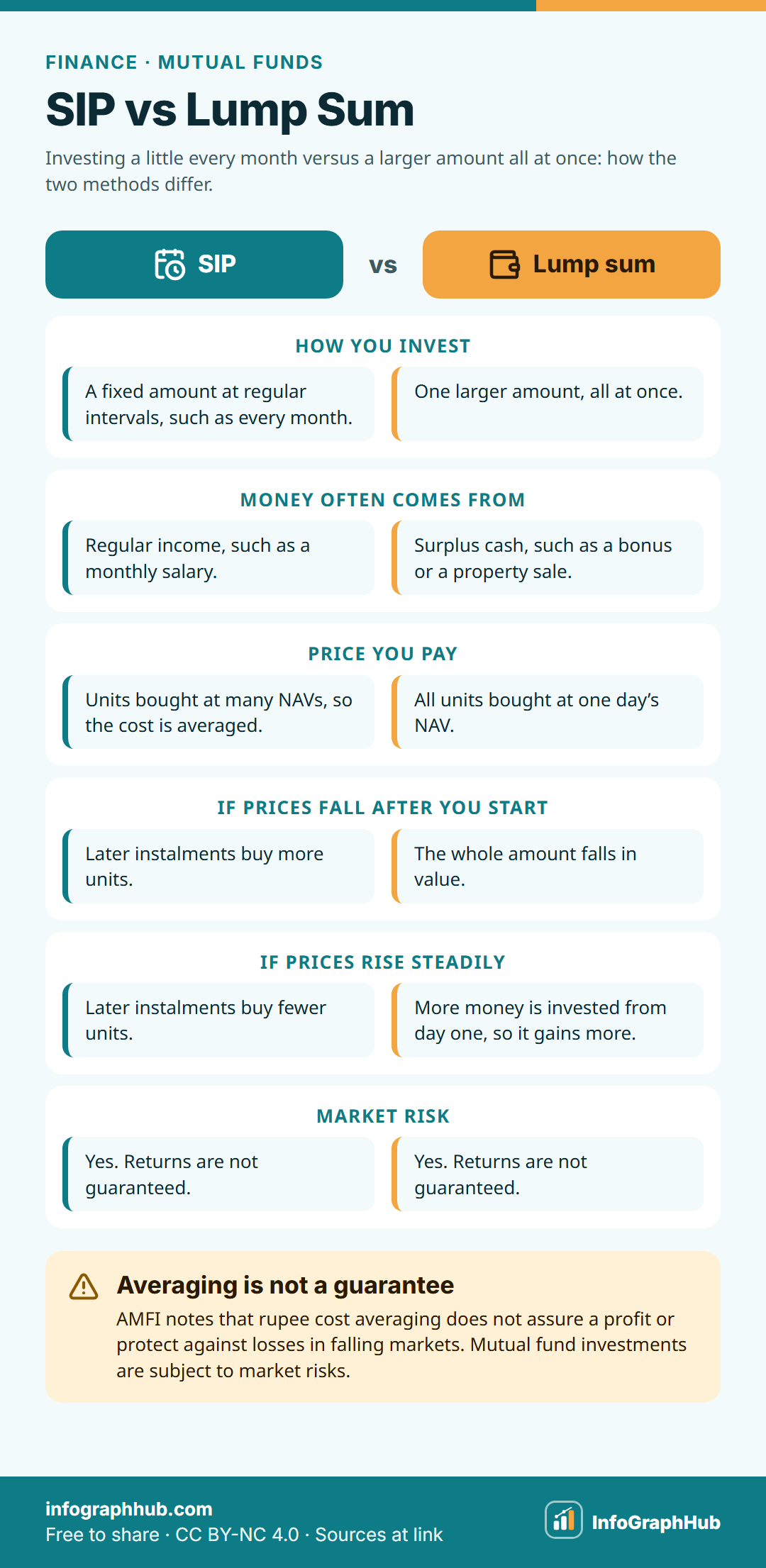
Two ways to put money into a fund
A mutual fund pools money from many people and invests it in shares, bonds or both. When you invest, you buy units of the fund. The price of one unit is called the NAV (net asset value), and it is worked out at the end of each business day.
There are two common ways to buy units:
- A Systematic Investment Plan (SIP) invests a fixed amount at regular intervals, for example on the 5th of every month. AMFI says an SIP instalment can be as little as ₹500 a month, though each scheme sets its own minimum.
- A lump sum invests one larger amount in a single go.
How rupee cost averaging works
Because an SIP invests the same amount each time, it automatically buys more units when the NAV is low and fewer units when the NAV is high. This is called rupee cost averaging. Over time it averages out the price you pay, and it removes the need to guess the “right” day to invest.
It is not magic, though. AMFI points out that rupee cost averaging does not assure a profit and does not protect you against losses when markets fall.
Worked example: Priya and Rahul
Priya, a teacher in Bengaluru, invests ₹2,000 a month for four months through an SIP. Her colleague Rahul puts his ₹8,000 Diwali bonus into the same fund as a lump sum in month 1. The NAVs below are made up for illustration, and we ignore any interest on the cash Priya has not yet invested.
Market A: prices dip, then recover (NAV ₹50, ₹40, ₹50, ₹60)
- Priya buys 40 + 50 + 40 + 33.33 = 163.33 units, an average cost of ₹48.98 each. At ₹60 they are worth ₹9,800.
- Rahul buys 160 units at ₹50. At ₹60 they are worth ₹9,600.
Market B: prices rise steadily (NAV ₹50, ₹55, ₹60, ₹65)
- Priya buys 40 + 36.36 + 33.33 + 30.77 = 140.47 units, worth ₹9,130 at ₹65.
- Rahul’s 160 units are worth ₹10,400.
The same ₹8,000 gives a different winner in each market. Nobody knows in advance which kind of market is coming.
What the choice depends on
Neither method is better in every situation. The differences come down to a few questions:
- Where is the money coming from? Money earned month by month fits naturally into an SIP. A one-off sum, such as a bonus, may be ready to invest all at once.
- How long can it stay invested? AMFI notes that SIPs need a long enough time horizon to be useful.
- How would you feel about a fall? With a lump sum, a drop straight after investing affects the whole amount at once.
- What kind of fund is it? AMFI’s investor education pages suggest SIPs for equity-oriented schemes and discuss lump sums mainly for debt funds, but it depends on each person’s goals.
Risks to keep in mind
Both methods invest in the same market, so both can lose money. Mutual funds do not pay a fixed rate, past returns are no guarantee of future returns, and some schemes charge an exit load if you sell units within a set period. Read the scheme documents before investing.
This page is for learning only and is not a recommendation. To decide what suits your own situation, speak to a SEBI-registered investment adviser.
Frequently asked questions
Is SIP better than lump sum?
Not always. In a falling or bumpy market, an SIP can end up with more units at a lower average cost. In a steadily rising market, a lump sum is usually ahead because all the money was invested earlier. No one can reliably predict which market is coming.
What happens if I miss an SIP instalment?
An SIP is a convenient way of investing, not a contract, so AMFI says there is no penalty for missing an instalment or two. If several are missed, the fund house may stop the SIP, and you would need to set up a new one.
Does rupee cost averaging guarantee a profit?
No. It only averages the price you pay for units. If the fund’s value falls and stays low, you can still lose money.
Who can advise me on which method to use?
This infographic explains the ideas but does not give advice. For guidance on your own money, consult a SEBI-registered investment adviser, and always read the scheme-related documents.
Sources & methodology
Every fact is checked against the sources below. We write original explanations and draw original graphics; no figures are copied from textbooks. Spotted an error? See our corrections policy.
- Systematic Investment Plan (SIP) (Association of Mutual Funds in India (AMFI), accessed 30 Sept 2026)
- SIP vs Lumpsum: how should I choose? (AMFI – Mutual Funds Sahi Hai, accessed 30 Sept 2026)
- How do I start/stop an SIP, and what happens if I miss an instalment? (AMFI – Mutual Funds Sahi Hai, accessed 30 Sept 2026)
- Financial Education Booklet (SIP; Rupee Cost Averaging) (Securities and Exchange Board of India (SEBI), accessed 30 Sept 2026)
Reviewed by Claude (pending owner check) · Updated
Embed this on your site
Paste this HTML into your page. Keep the credit line: it is required by the CC BY-NC 4.0 license.
Related infographics
 Finance
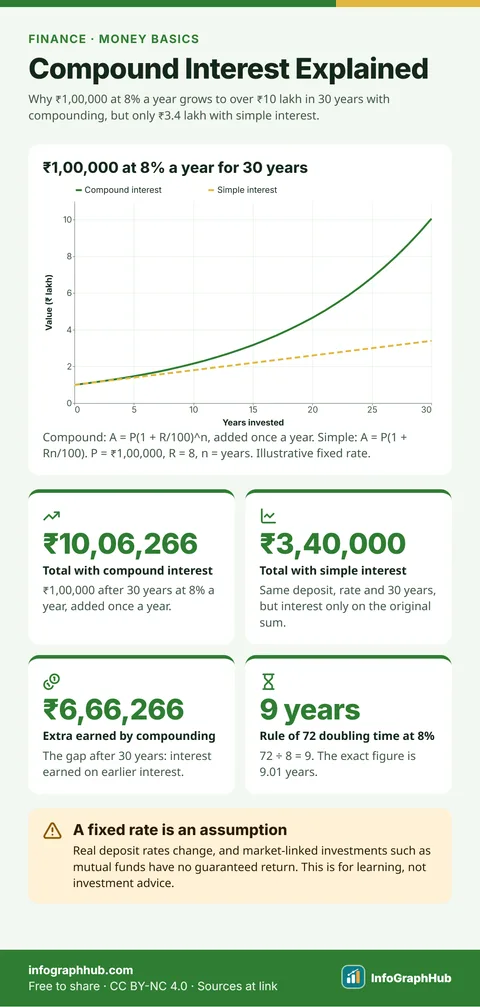
Compound Interest Explained: How Money Grows Over Time
Compound interest is interest earned on your interest. Each year’s interest is added to the balance, so the next year’s interest is worked out on a bigger sum. Over long periods this makes money grow far faster than simple interest.
 Finance
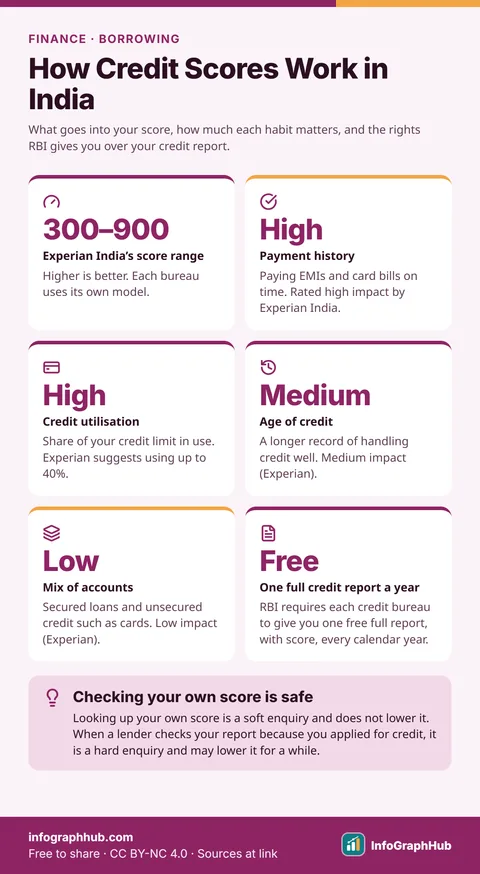
How Credit Scores Work in India: What Moves Your Score
A credit score is a three-digit number, such as Experian India’s 300–900 score, built from your borrowing record. Paying on time and using little of your credit limit matter most; the age and mix of your accounts matter less.
 Tech
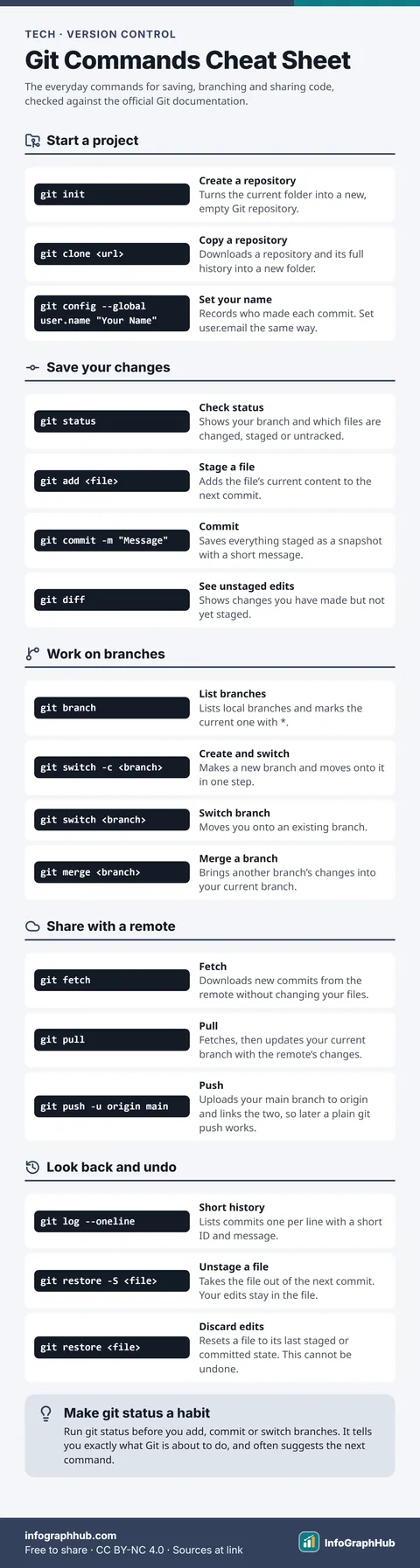
TechGit Commands Cheat Sheet: The Essentials for Beginners
The Git commands beginners use most: set up a repository with init or clone, save work with add and commit, build features on branches with switch and merge, share work with fetch, pull and push, and undo safely with restore.
 Tech
TechHow Large Language Models Work: From Prompt to Answer
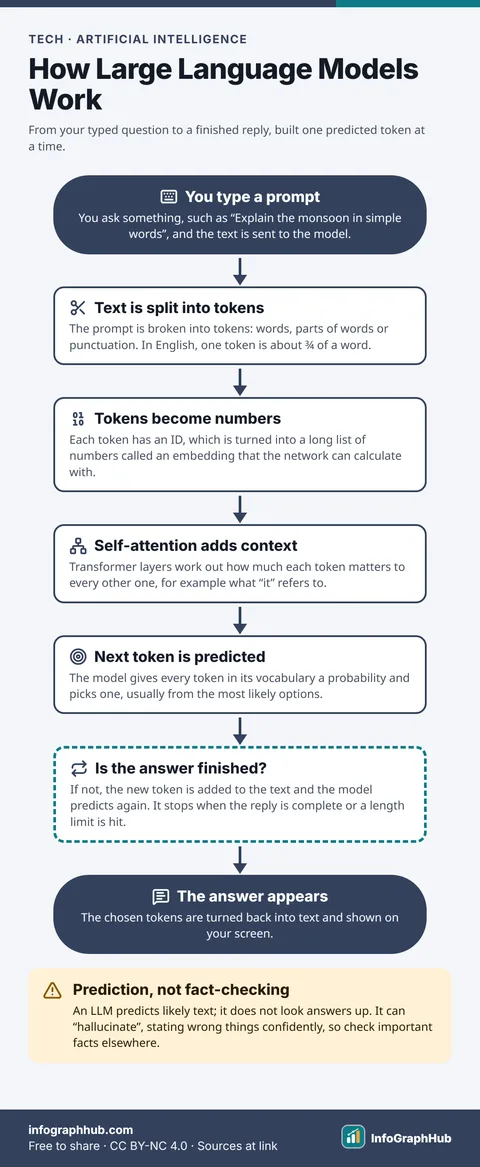
A large language model splits your prompt into tokens, turns them into numbers, uses self-attention to work out context, then predicts the most likely next token. It repeats that prediction, one token at a time, until the answer is complete.
 Science
How Photosynthesis Works: From Sunlight to Sugar
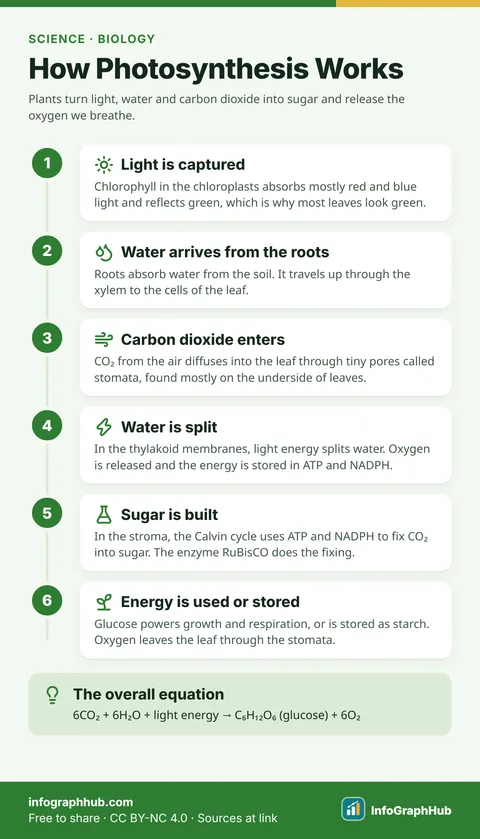
Photosynthesis is how plants use light energy to turn carbon dioxide and water into glucose, releasing oxygen as a by-product. It happens in chloroplasts in two linked stages: the light-dependent reactions and the Calvin cycle.
 Science
How Vaccines Work: Training Your Immune System
Vaccines work by imitating an infection. They show your immune system a harmless antigen from a germ, so it makes matching antibodies and memory cells that can fight the real germ quickly if it ever arrives.
Get new InfoGraphHub resources by email
One short email when new free resources go live. No spam, unsubscribe anytime.