How Photosynthesis Works: From Sunlight to Sugar
Photosynthesis is how plants use light energy to turn carbon dioxide and water into glucose, releasing oxygen as a by-product. It happens in chloroplasts in two linked stages: the light-dependent reactions and the Calvin cycle.

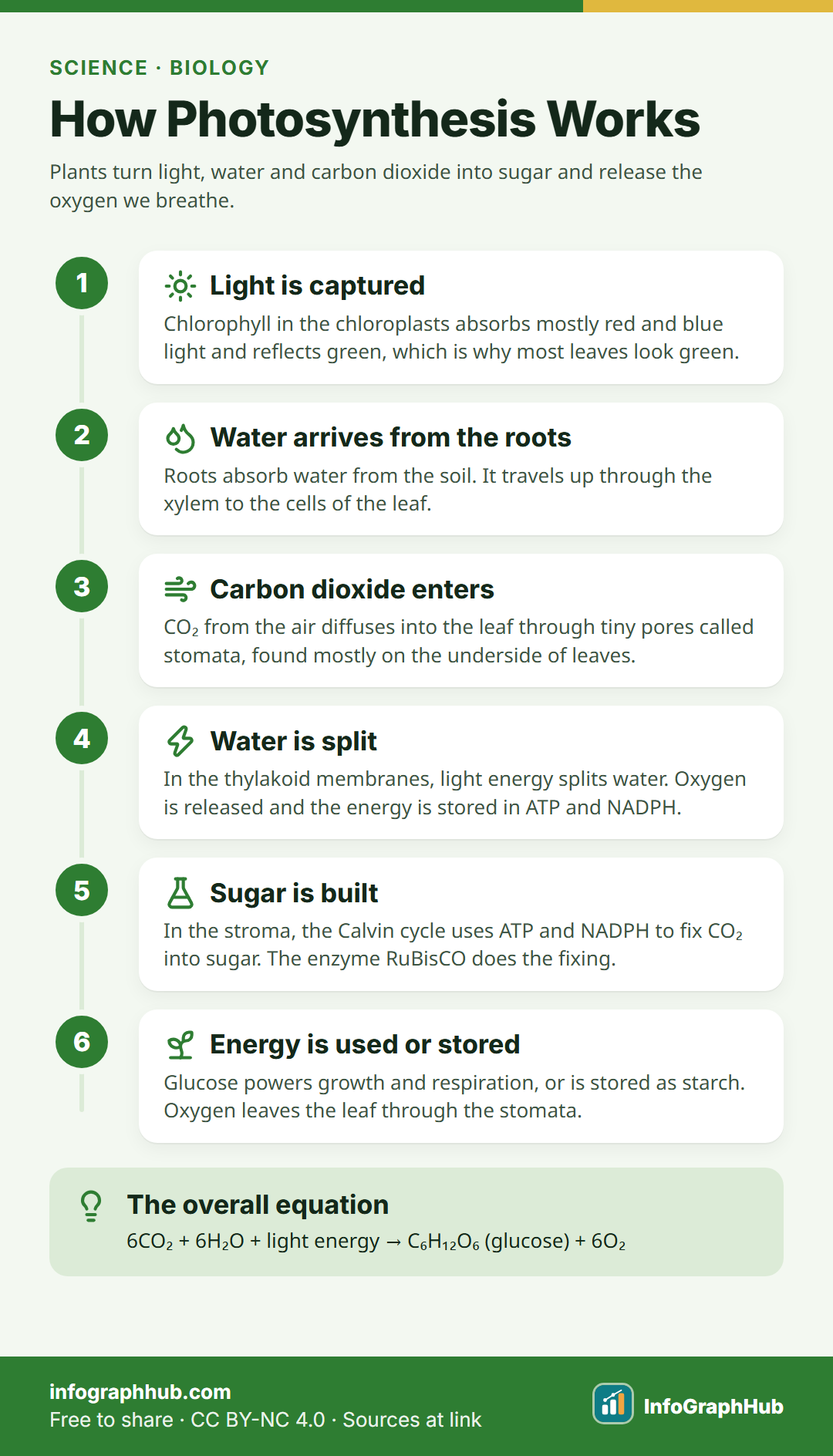
What photosynthesis is
Photosynthesis is the process that green plants, algae and cyanobacteria use to make their own food. They take in carbon dioxide from the air and water from the soil and, using the energy in sunlight, join them into glucose, a sugar that stores chemical energy. Oxygen is released as a by-product.
The whole process can be summed up in one balanced equation:
6CO₂ + 6H₂O + light energy → C₆H₁₂O₆ + 6O₂
In plants it takes place inside chloroplasts, small green structures packed into the cells of leaves. Their colour comes from chlorophyll, the pigment that absorbs light. Chlorophyll absorbs red and blue light most strongly and reflects green, which is why leaves look green to us.
Stage 1: the light-dependent reactions
The first stage happens on the thylakoid membranes, stacks of flattened discs inside each chloroplast. When light hits chlorophyll, it excites electrons and sets off a chain of reactions:
- Water is split into hydrogen ions, electrons and oxygen. This is where the oxygen we breathe comes from.
- The energy is captured in two carrier molecules, ATP and NADPH.
- The oxygen diffuses out of the leaf through the stomata.
This stage needs light, so it only runs while the plant is lit.
Stage 2: the Calvin cycle
The second stage takes place in the stroma, the fluid around the thylakoids. It does not use light directly, but it depends on the ATP and NADPH made in stage 1.
An enzyme called RuBisCO attaches carbon dioxide to a five-carbon molecule called RuBP. Through a cycle of reactions, the carbon ends up in a three-carbon sugar that the plant uses to build glucose, sucrose and starch. Because it fixes carbon from the air into sugar, this stage is also called carbon fixation.
What controls the rate
Three factors limit how fast photosynthesis can run:
- Light intensity: more light means faster reactions, up to a point.
- Carbon dioxide concentration: more CO₂ speeds up the Calvin cycle until another factor becomes limiting.
- Temperature: the enzymes work best in a moderate range; very high temperatures slow them down.
Water matters too. On a hot, dry day a plant closes its stomata to save water, which also cuts off its supply of carbon dioxide.
Worked example: a mango leaf on a sunny morning
Picture a mango tree in an Indian courtyard at 9 a.m. Sunlight falls on its leaves, and chlorophyll starts absorbing red and blue light. Water drawn up from the soil reaches the leaf cells, and carbon dioxide slips in through the stomata on the underside of each leaf.
Inside the chloroplasts, light splits water and releases oxygen into the air. The Calvin cycle then uses the captured energy to fix carbon dioxide into sugar. Some sugar feeds the tree straight away. The rest is moved around the tree as sucrose, and some ends up stored in the fruit, which is part of why a ripe mango tastes sweet.
By the hot afternoon, if the soil is dry, the leaves may partly close their stomata to save water, and photosynthesis slows down.
Why it matters
Photosynthesis is the entry point for almost all the energy in food chains: the rice and wheat we eat and the grass cattle graze both depend on it. It also removes carbon dioxide from the atmosphere and releases oxygen, which makes it central to the carbon cycle and to life on Earth.
Frequently asked questions
Where does photosynthesis take place?
In the chloroplasts of plant cells, mostly in the leaves. The light-dependent reactions happen on the thylakoid membranes, and the Calvin cycle happens in the stroma around them.
Where does the oxygen released in photosynthesis come from?
From water. When light energy splits water molecules in the thylakoids, oxygen is produced as a by-product and leaves the plant through the stomata.
Why are leaves green?
Chlorophyll absorbs mostly red and blue light and reflects green light. The reflected green light is what reaches our eyes.
Does photosynthesis happen at night?
The light-dependent reactions need light, so they stop in the dark. Without fresh ATP and NADPH, the Calvin cycle also slows down and stops soon after.
Sources & methodology
Every fact is checked against the sources below. We write original explanations and draw original graphics; no figures are copied from textbooks. Spotted an error? See our corrections policy.
- 8.1 Overview of Photosynthesis (Biology 2e) (OpenStax, Rice University, accessed 30 Sept 2026)
- 8.3 Using Light Energy to Make Organic Molecules (Biology 2e) (OpenStax, Rice University, accessed 30 Sept 2026)
- Intro to photosynthesis (Khan Academy, accessed 30 Sept 2026)
- Photosynthesis (National Geographic Education, accessed 30 Sept 2026)
Reviewed by Claude (pending owner check) · Updated
Embed this on your site
Paste this HTML into your page. Keep the credit line: it is required by the CC BY-NC 4.0 license.
Related infographics
 Science
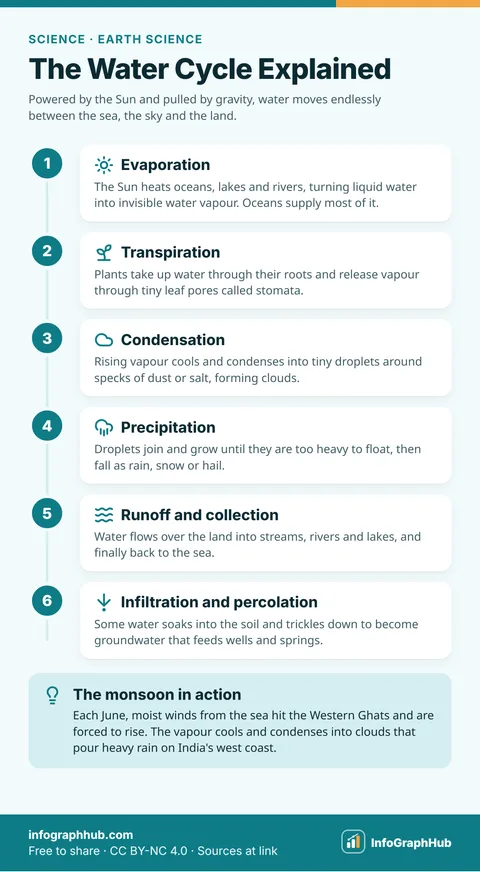
The Water Cycle Explained
The water cycle is the non-stop movement of water between oceans, air and land. Powered by the Sun, water evaporates, condenses into clouds, falls as rain or snow, and flows or soaks back towards rivers, groundwater and the sea.
 Science
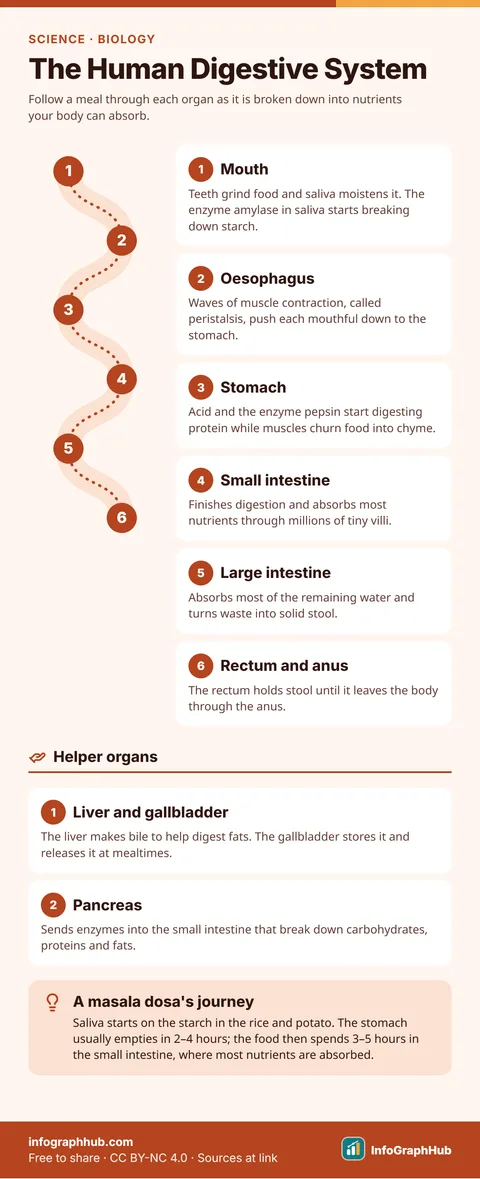
The Human Digestive System: How Food Becomes Energy
The digestive system breaks food into nutrients small enough to enter the blood. Food passes from the mouth through the oesophagus, stomach and intestines, helped by juices from the liver, gallbladder and pancreas.
 Science
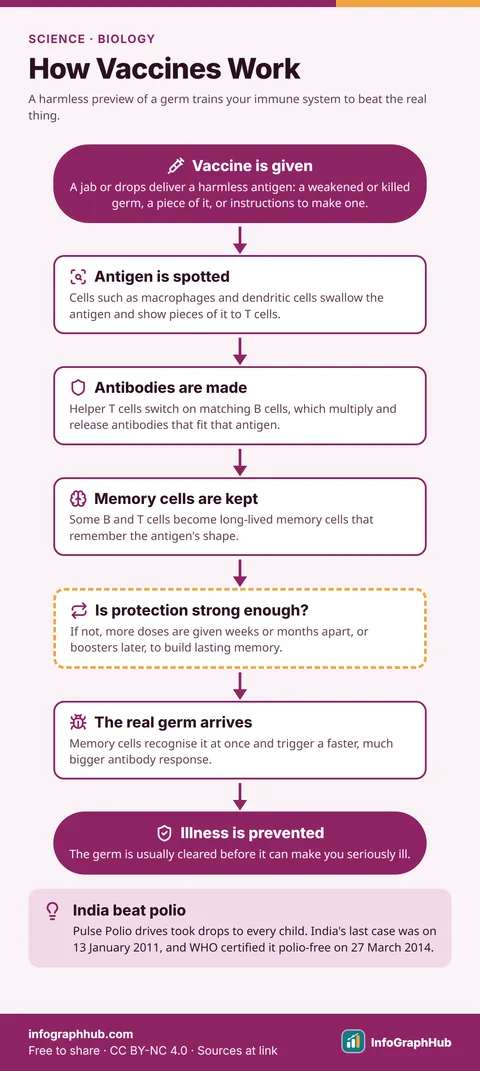
How Vaccines Work: Training Your Immune System
Vaccines work by imitating an infection. They show your immune system a harmless antigen from a germ, so it makes matching antibodies and memory cells that can fight the real germ quickly if it ever arrives.
 Finance
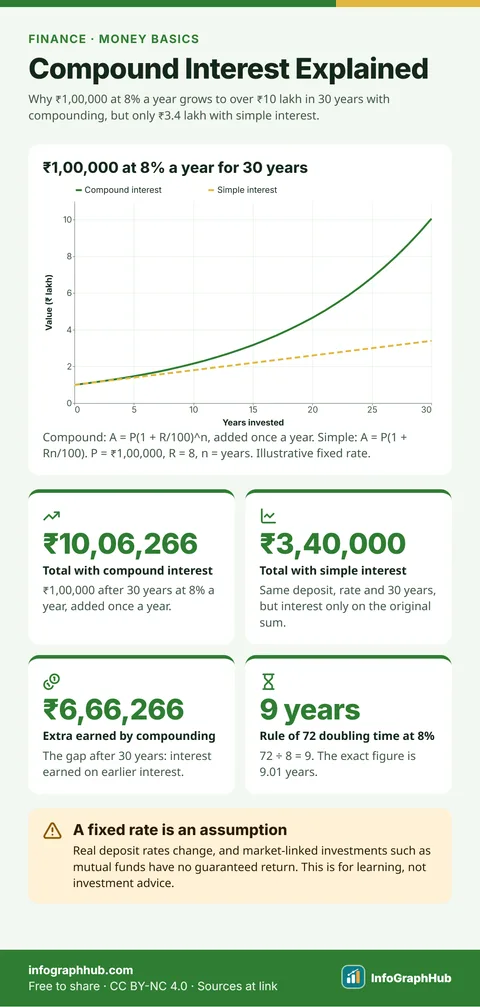
Compound Interest Explained: How Money Grows Over Time
Compound interest is interest earned on your interest. Each year’s interest is added to the balance, so the next year’s interest is worked out on a bigger sum. Over long periods this makes money grow far faster than simple interest.
 Tech
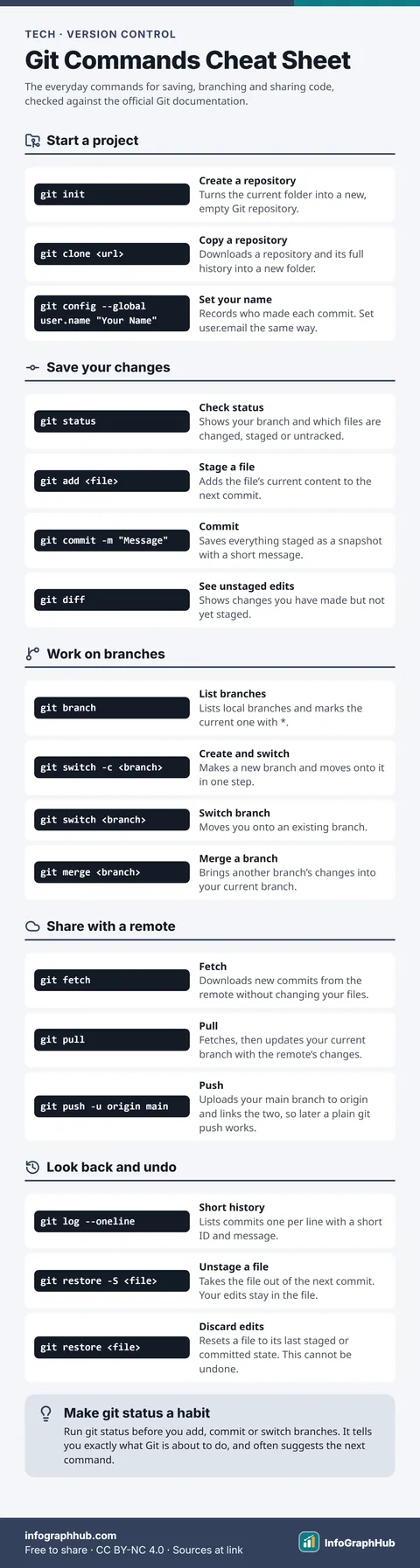
TechGit Commands Cheat Sheet: The Essentials for Beginners
The Git commands beginners use most: set up a repository with init or clone, save work with add and commit, build features on branches with switch and merge, share work with fetch, pull and push, and undo safely with restore.
 Finance
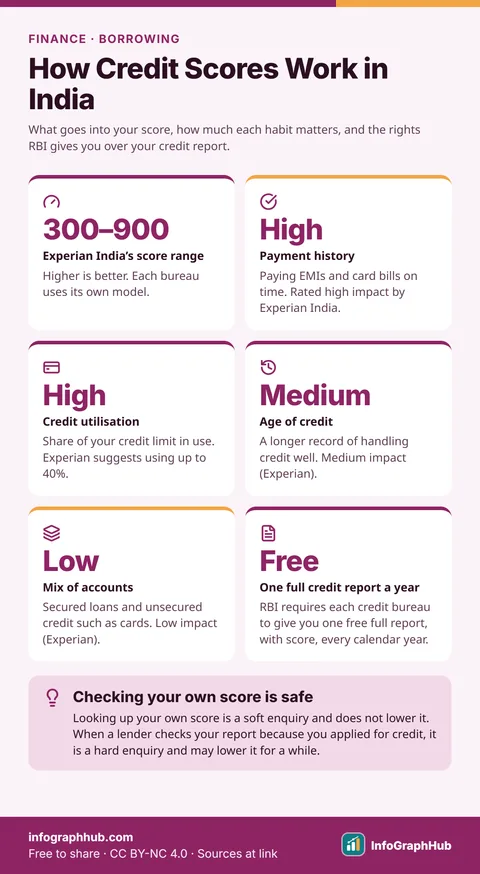
How Credit Scores Work in India: What Moves Your Score
A credit score is a three-digit number, such as Experian India’s 300–900 score, built from your borrowing record. Paying on time and using little of your credit limit matter most; the age and mix of your accounts matter less.
Get new InfoGraphHub resources by email
One short email when new free resources go live. No spam, unsubscribe anytime.