How Vaccines Work: Training Your Immune System
Vaccines work by imitating an infection. They show your immune system a harmless antigen from a germ, so it makes matching antibodies and memory cells that can fight the real germ quickly if it ever arrives.

What a vaccine is
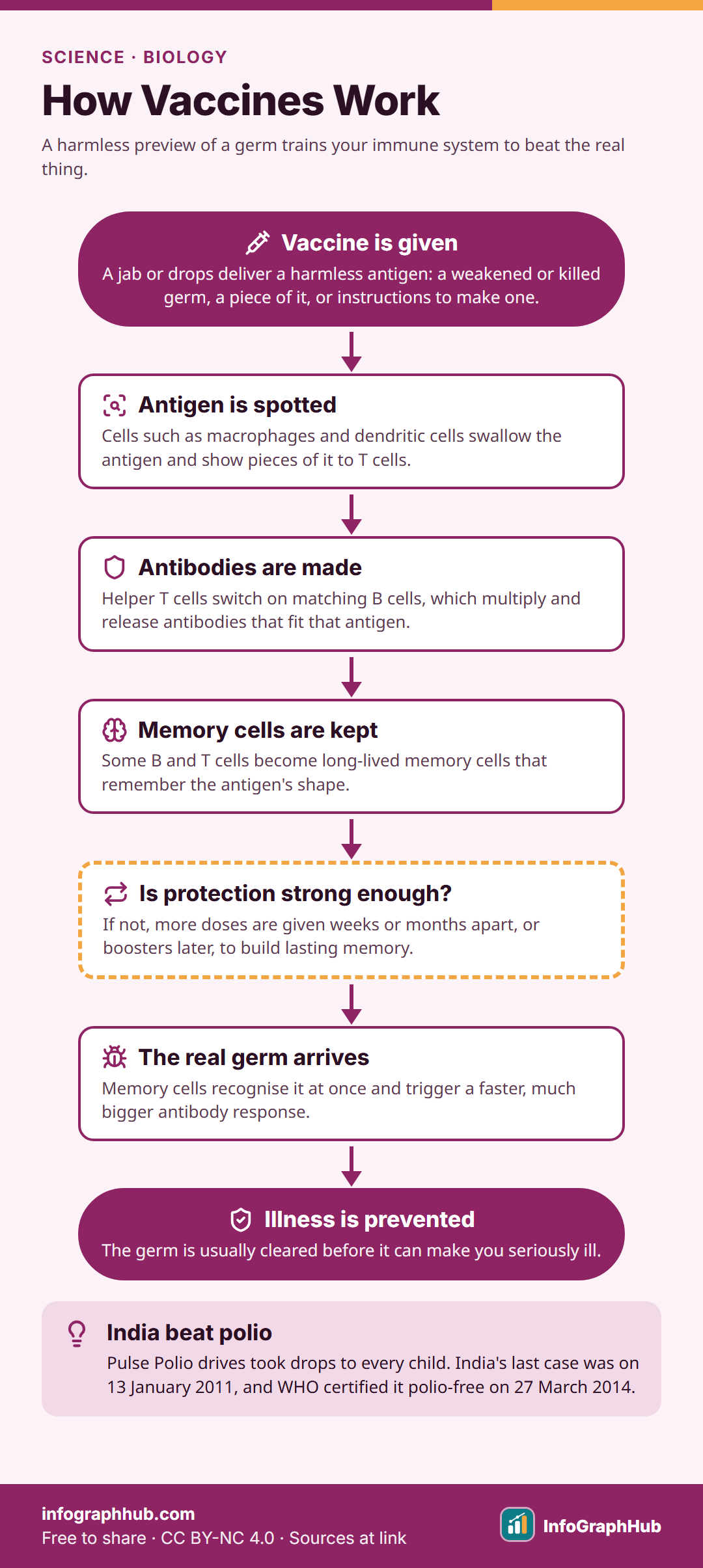
A vaccine is a way of training your immune system before you meet a dangerous germ. It works by imitating an infection without causing the disease.
Different vaccines do this in different ways. Some contain a weakened or inactivated (killed) form of the germ. Others contain just one part of it, such as a surface protein. Newer vaccines carry the genetic instructions (DNA or RNA) that let your own cells make that harmless part for a short time.
The part of a germ that the immune system learns to recognise is called an antigen. Every vaccine is built around one or more antigens.
Step 1: the antigen is spotted
After a jab or oral drops, the antigen is picked up by antigen-presenting cells, such as dendritic cells and macrophages. These cells swallow the antigen, break it up, and display pieces of it on their surface.
They then show these pieces to T cells, a type of white blood cell. This is how the immune system learns that something new has arrived and which shape it needs to fight.
Step 2: antibodies are made
Once alerted, helper T cells switch on the B cells whose receptors fit the antigen. Those B cells multiply, and many of them become plasma cells that release antibodies: Y-shaped proteins that lock onto one specific antigen, a bit like a key that fits only one lock.
This first response is slow. It takes days or even weeks to build up, which is why a vaccine does not protect you immediately and why you can still catch an infection in the weeks straight after vaccination.
Step 3: memory is kept
Some of the B and T cells do not join the first fight. Instead they become long-lived memory cells that remember the antigen.
If the real germ enters your body later, these memory cells recognise it straight away. The second response is much faster and much bigger: memory B cells can produce tens to hundreds of times more antibody than in the first response. The germ is usually cleared before it can make you seriously ill. Many vaccines need two or more doses, given weeks or months apart, to build strong, lasting memory.
Real-world example: how India beat polio
In 1994, India accounted for around 60 per cent of the world's polio cases. Through the Pulse Polio programme, health workers set out to give polio drops to every child, whether at home, at school or while travelling. On a single national immunisation day, around 1.2 million vaccinators took part.
The effort worked. India recorded its last polio case on 13 January 2011, in Howrah, West Bengal, and the World Health Organization certified the country polio-free on 27 March 2014. India has since added an injectable inactivated polio vaccine to its routine immunisation programme.
Why vaccination protects everyone
When enough people in a community are vaccinated, a germ struggles to spread because most of the people it meets are immune. This is called herd immunity. It protects people who cannot be vaccinated, such as newborn babies or those with certain illnesses, which is why every vaccinated person helps keep others safe.
Frequently asked questions
Can a vaccine give you the disease it protects against?
Vaccines are designed not to cause the disease. Feeling tired or having a sore arm for a day or two is common and is a sign that your immune system is responding.
What are memory cells?
Memory cells are B and T lymphocytes that remember a specific antigen. If the same germ returns, they launch a much faster and stronger response than the first time.
How soon after a vaccine am I protected?
Not straight away. Building immunity can take a few weeks, so it is still possible to catch an infection in the weeks just after vaccination.
Why do some vaccines need more than one dose?
Extra doses, given weeks or months apart, help the body make long-lasting antibodies and a stronger pool of memory cells. Some vaccines also need boosters later in life.
What is herd immunity?
When most people in a community are immune, a germ has trouble spreading. This indirectly protects people who cannot be vaccinated, such as very young babies.
Sources & methodology
Every fact is checked against the sources below. We write original explanations and draw original graphics; no figures are copied from textbooks. Spotted an error? See our corrections policy.
- How do vaccines work? (World Health Organization, accessed 30 Sept 2026)
- Explaining How Vaccines Work (Centers for Disease Control and Prevention, accessed 30 Sept 2026)
- 42.2 Adaptive Immune Response (Biology 2e) (OpenStax, Rice University, accessed 30 Sept 2026)
- A push to vaccinate every child, everywhere, ended polio in India (World Health Organization India, accessed 30 Sept 2026)
Reviewed by Claude (pending owner check) · Updated
Embed this on your site
Paste this HTML into your page. Keep the credit line: it is required by the CC BY-NC 4.0 license.
Related infographics
 Science
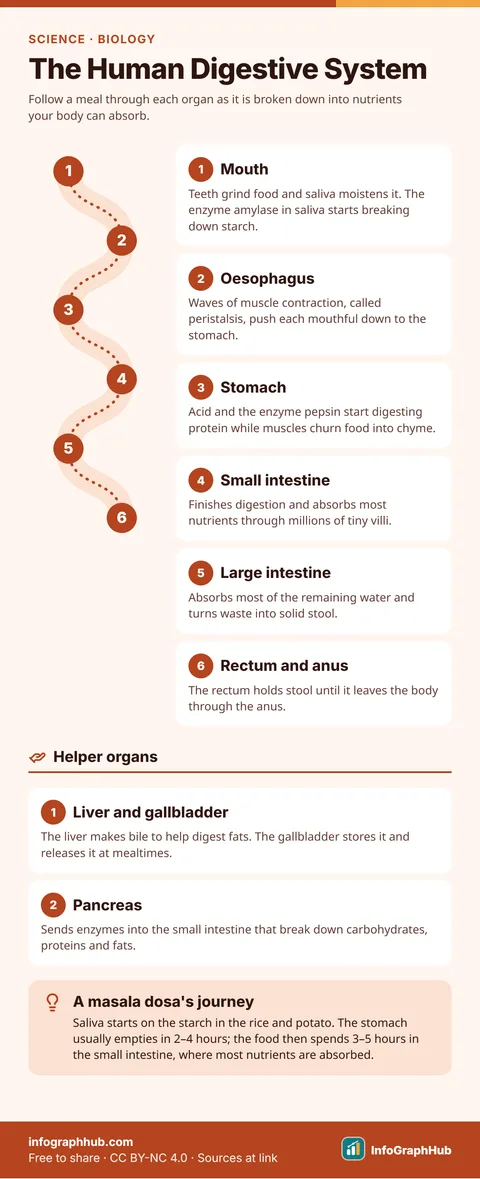
The Human Digestive System: How Food Becomes Energy
The digestive system breaks food into nutrients small enough to enter the blood. Food passes from the mouth through the oesophagus, stomach and intestines, helped by juices from the liver, gallbladder and pancreas.
 Science
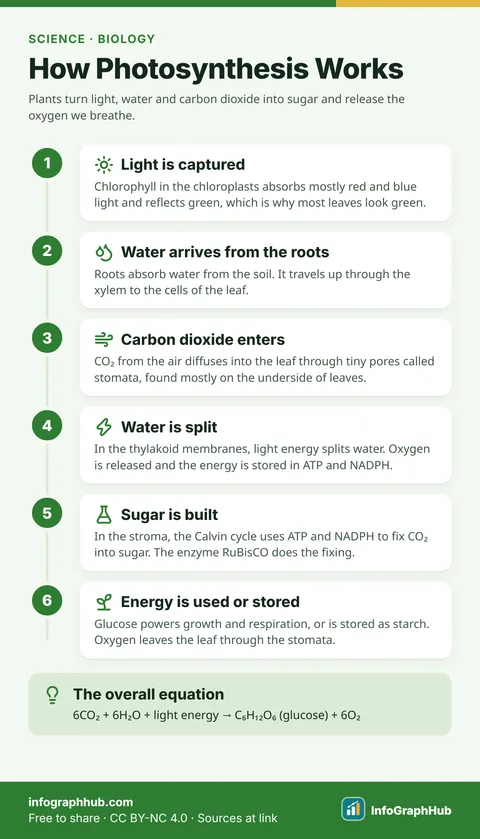
How Photosynthesis Works: From Sunlight to Sugar
Photosynthesis is how plants use light energy to turn carbon dioxide and water into glucose, releasing oxygen as a by-product. It happens in chloroplasts in two linked stages: the light-dependent reactions and the Calvin cycle.
 Science
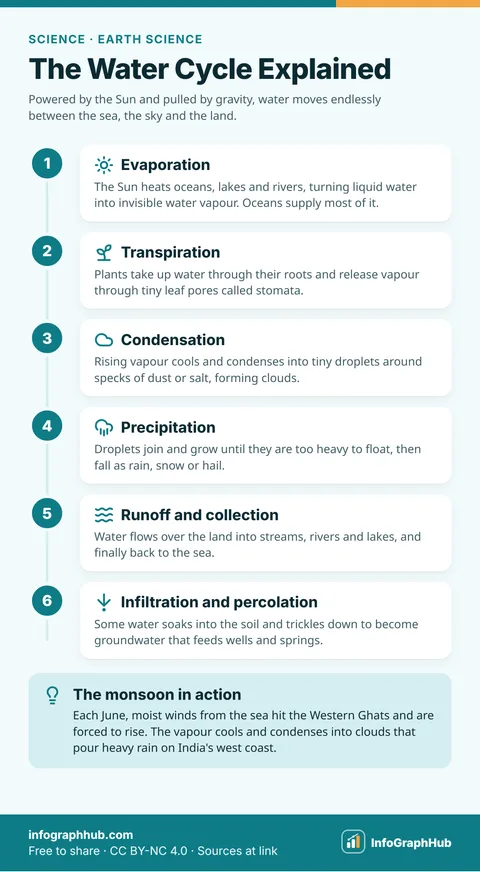
The Water Cycle Explained
The water cycle is the non-stop movement of water between oceans, air and land. Powered by the Sun, water evaporates, condenses into clouds, falls as rain or snow, and flows or soaks back towards rivers, groundwater and the sea.
 Finance
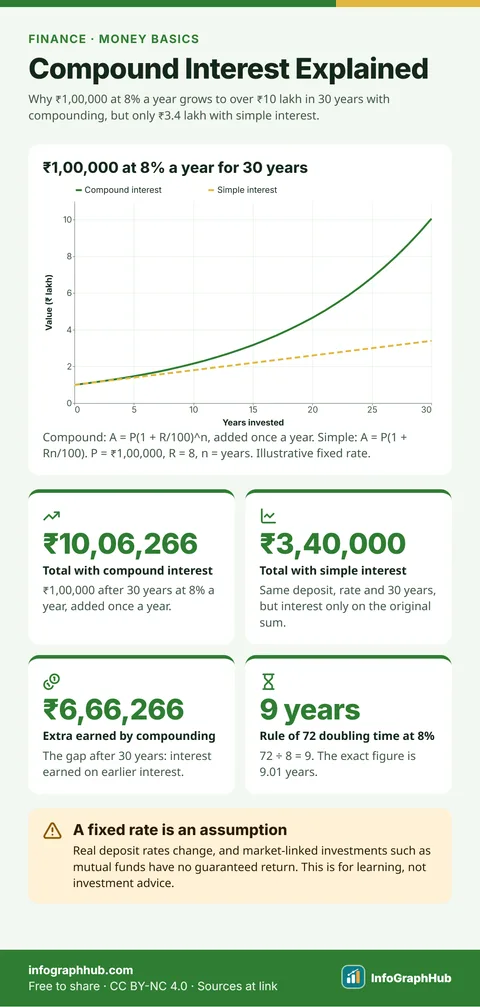
Compound Interest Explained: How Money Grows Over Time
Compound interest is interest earned on your interest. Each year’s interest is added to the balance, so the next year’s interest is worked out on a bigger sum. Over long periods this makes money grow far faster than simple interest.
 Tech
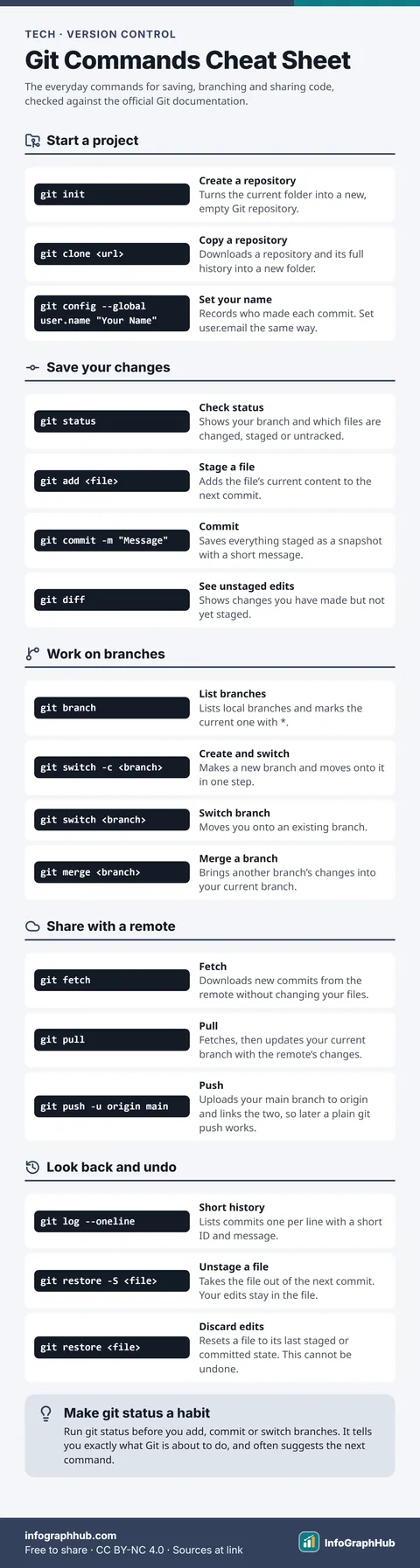
TechGit Commands Cheat Sheet: The Essentials for Beginners
The Git commands beginners use most: set up a repository with init or clone, save work with add and commit, build features on branches with switch and merge, share work with fetch, pull and push, and undo safely with restore.
 Finance
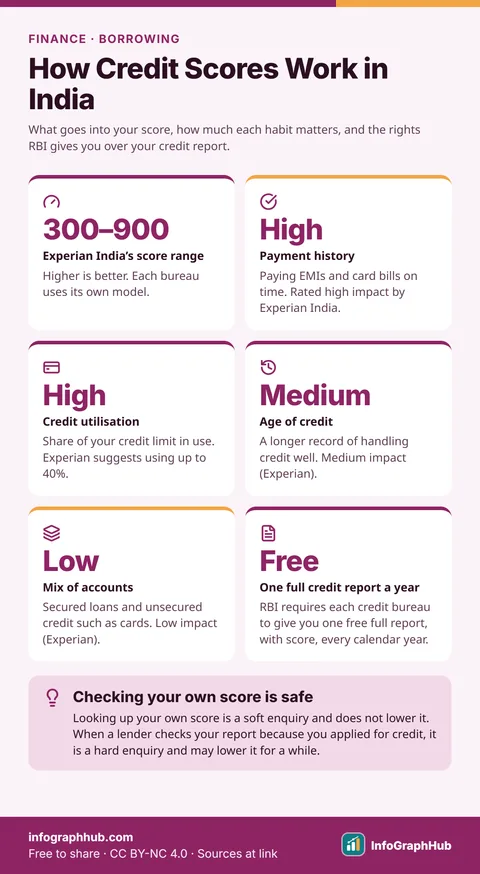
How Credit Scores Work in India: What Moves Your Score
A credit score is a three-digit number, such as Experian India’s 300–900 score, built from your borrowing record. Paying on time and using little of your credit limit matter most; the age and mix of your accounts matter less.
Get new InfoGraphHub resources by email
One short email when new free resources go live. No spam, unsubscribe anytime.