The Water Cycle Explained
The water cycle is the non-stop movement of water between oceans, air and land. Powered by the Sun, water evaporates, condenses into clouds, falls as rain or snow, and flows or soaks back towards rivers, groundwater and the sea.

What the water cycle is
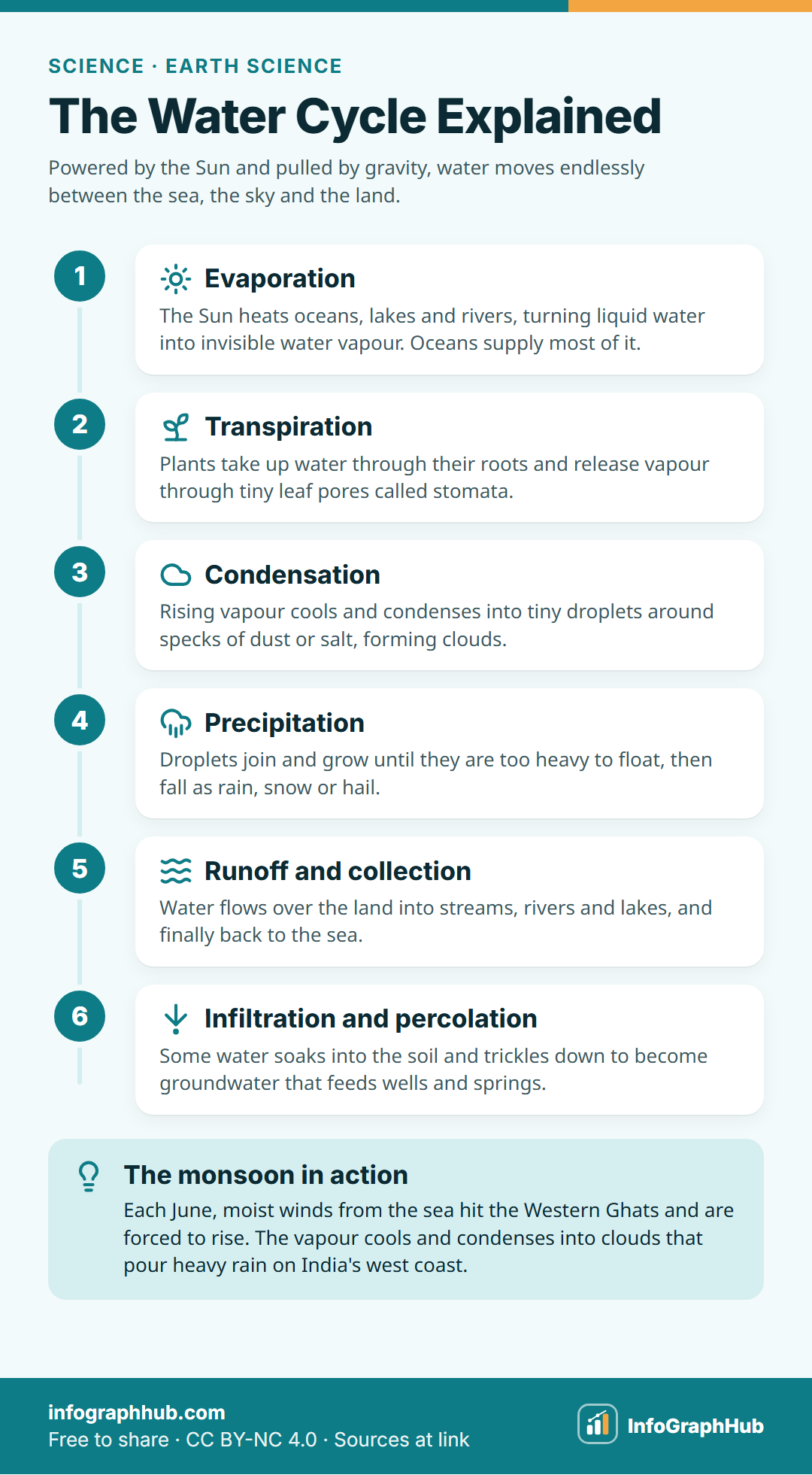
The water cycle, also called the hydrological cycle, is the continuous movement of water between the oceans, the atmosphere and the land. Water keeps changing state along the way: liquid in seas and rivers, gas (water vapour) in the air, and solid ice in glaciers and snow.
The cycle is powered by energy from the Sun, which heats water and lifts it into the air as vapour. Gravity does the rest, pulling rain and snow back down and making rivers run downhill. Across the whole planet, the amount of water that evaporates each year is roughly equal to the amount that falls as precipitation.
Evaporation and transpiration
Water gets into the air in two main ways:
- Evaporation: sunlight warms oceans, lakes and rivers, and liquid water turns into invisible water vapour. Evaporation from oceans, seas and other water bodies supplies nearly 90 per cent of the moisture in the atmosphere.
- Transpiration: plants draw water up from the soil through their roots and release water vapour through tiny pores in their leaves called stomata. Plants supply most of the remaining 10 per cent.
You see evaporation every day when a wet school uniform dries on the balcony, or when a puddle disappears after a sunny afternoon.
Condensation and clouds
As water vapour rises, the air around it gets colder. Cool air cannot hold as much vapour, so some of it condenses back into tiny liquid droplets or ice crystals. The droplets form around specks of dust, salt or pollution in the air, and billions of them together make a cloud.
You can watch condensation happen on the outside of a glass of cold water on a humid day. Water does not stay in the air for long: on average, a water molecule spends only about nine days in the atmosphere before it falls again.
Precipitation, runoff and groundwater
Inside a cloud, droplets bump into each other and join. When they grow too heavy to stay up, they fall as precipitation: rain, snow or hail.
Once on the ground, water can take several paths:
- Runoff: it flows over the surface into streams, rivers and lakes, and eventually back to the sea.
- Infiltration: it soaks into the soil.
- Percolation: water that has entered the soil keeps moving down into groundwater, which feeds wells and springs.
Most of Earth's water, about 96.5 per cent, is salty ocean water. Only about 2.5 per cent is fresh, and most of that is locked up in ice or stored underground.
The Indian monsoon: the cycle on a giant scale
India's south-west monsoon shows every stage of the cycle at once. In summer, the land heats up much faster than the sea, creating an area of low pressure over the subcontinent. Moist winds are drawn in from the Indian Ocean and the Arabian Sea, carrying water that evaporated from the warm sea surface.
These winds reach India's west coast in June. There they meet the Western Ghats, a mountain barrier roughly 1,000 km long. The air is forced upwards, cools, and its vapour condenses into thick clouds that drop very heavy rain on the coast. Over the June to September season, this rain fills rivers and reservoirs and recharges the groundwater that farms and cities depend on.
Why it matters
The water cycle constantly refreshes our supply of fresh water for drinking, farming and industry. It also moves heat around the planet and shapes weather, from daily showers to floods and droughts.
Frequently asked questions
What powers the water cycle?
The Sun. Its energy heats water so that it evaporates and rises as vapour. Gravity then brings rain and snow back down and makes rivers flow towards the sea.
Where does most of the water vapour in the air come from?
Nearly 90 per cent comes from evaporation from oceans, seas, lakes and rivers. Plants release most of the rest through transpiration from their leaves.
What is the difference between infiltration and percolation?
Infiltration is water soaking into the soil from the surface. Percolation is that water continuing to move downwards through soil and rock until it reaches the groundwater.
How long does water stay in the atmosphere?
Only about nine days on average. Water stays far longer in other places, such as the ocean, glaciers and deep groundwater.
How is the monsoon part of the water cycle?
Moist winds carry water that evaporated from the sea towards India. When they rise over hills such as the Western Ghats, the vapour cools and condenses into clouds, which release heavy rain that refills rivers and groundwater.
Sources & methodology
Every fact is checked against the sources below. We write original explanations and draw original graphics; no figures are copied from textbooks. Spotted an error? See our corrections policy.
- The Water Cycle (NASA Earth Observatory, accessed 30 Sept 2026)
- Water cycle (National Oceanic and Atmospheric Administration (NOAA), accessed 30 Sept 2026)
- Hydrologic Cycle (National Geographic Education, accessed 30 Sept 2026)
- Frequently asked Questions (FAQs) on Monsoon (India Meteorological Department, accessed 30 Sept 2026)
Reviewed by Claude (pending owner check) · Updated
Embed this on your site
Paste this HTML into your page. Keep the credit line: it is required by the CC BY-NC 4.0 license.
Related infographics
 Science
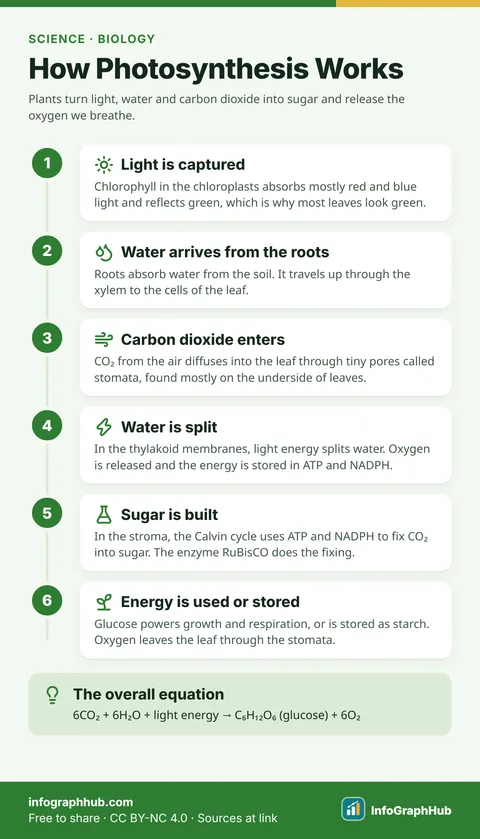
How Photosynthesis Works: From Sunlight to Sugar
Photosynthesis is how plants use light energy to turn carbon dioxide and water into glucose, releasing oxygen as a by-product. It happens in chloroplasts in two linked stages: the light-dependent reactions and the Calvin cycle.
 Science
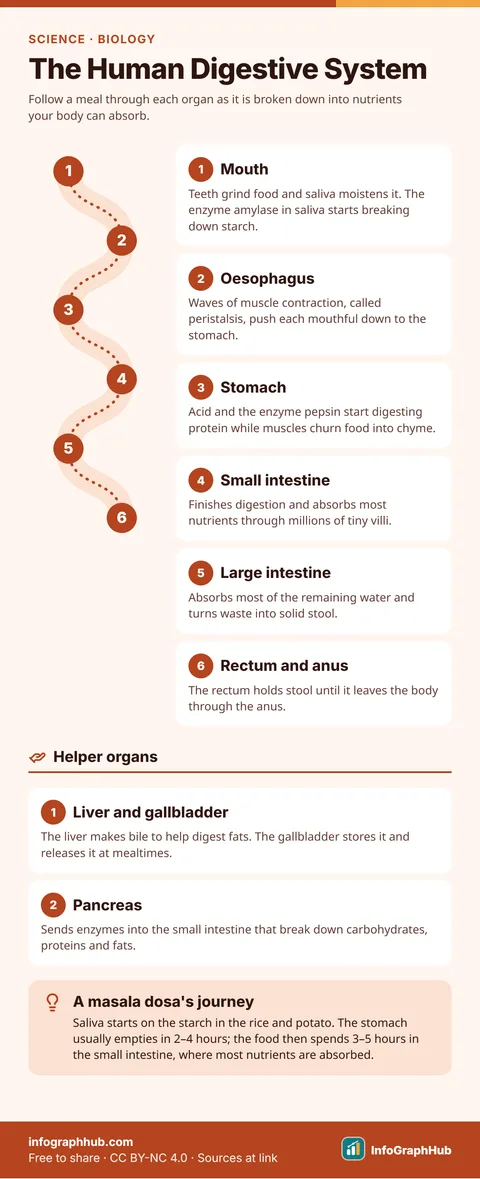
The Human Digestive System: How Food Becomes Energy
The digestive system breaks food into nutrients small enough to enter the blood. Food passes from the mouth through the oesophagus, stomach and intestines, helped by juices from the liver, gallbladder and pancreas.
 Science
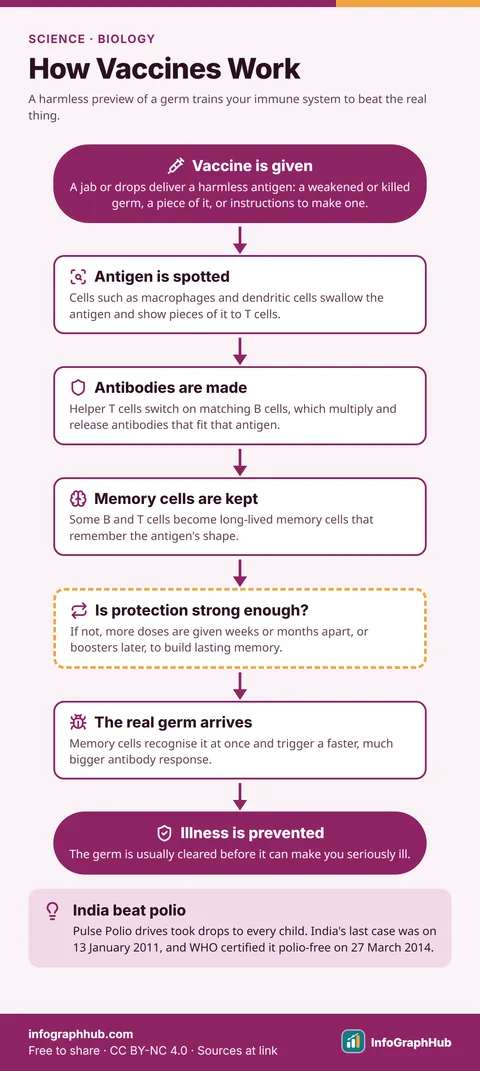
How Vaccines Work: Training Your Immune System
Vaccines work by imitating an infection. They show your immune system a harmless antigen from a germ, so it makes matching antibodies and memory cells that can fight the real germ quickly if it ever arrives.
 Finance
Compound Interest Explained: How Money Grows Over Time
Compound interest is interest earned on your interest. Each year’s interest is added to the balance, so the next year’s interest is worked out on a bigger sum. Over long periods this makes money grow far faster than simple interest.
 Tech
TechGit Commands Cheat Sheet: The Essentials for Beginners
The Git commands beginners use most: set up a repository with init or clone, save work with add and commit, build features on branches with switch and merge, share work with fetch, pull and push, and undo safely with restore.
 Finance
How Credit Scores Work in India: What Moves Your Score
A credit score is a three-digit number, such as Experian India’s 300–900 score, built from your borrowing record. Paying on time and using little of your credit limit matter most; the age and mix of your accounts matter less.
Get new InfoGraphHub resources by email
One short email when new free resources go live. No spam, unsubscribe anytime.