Compound Interest Explained: How Money Grows Over Time
Compound interest is interest earned on your interest. Each year’s interest is added to the balance, so the next year’s interest is worked out on a bigger sum. Over long periods this makes money grow far faster than simple interest.

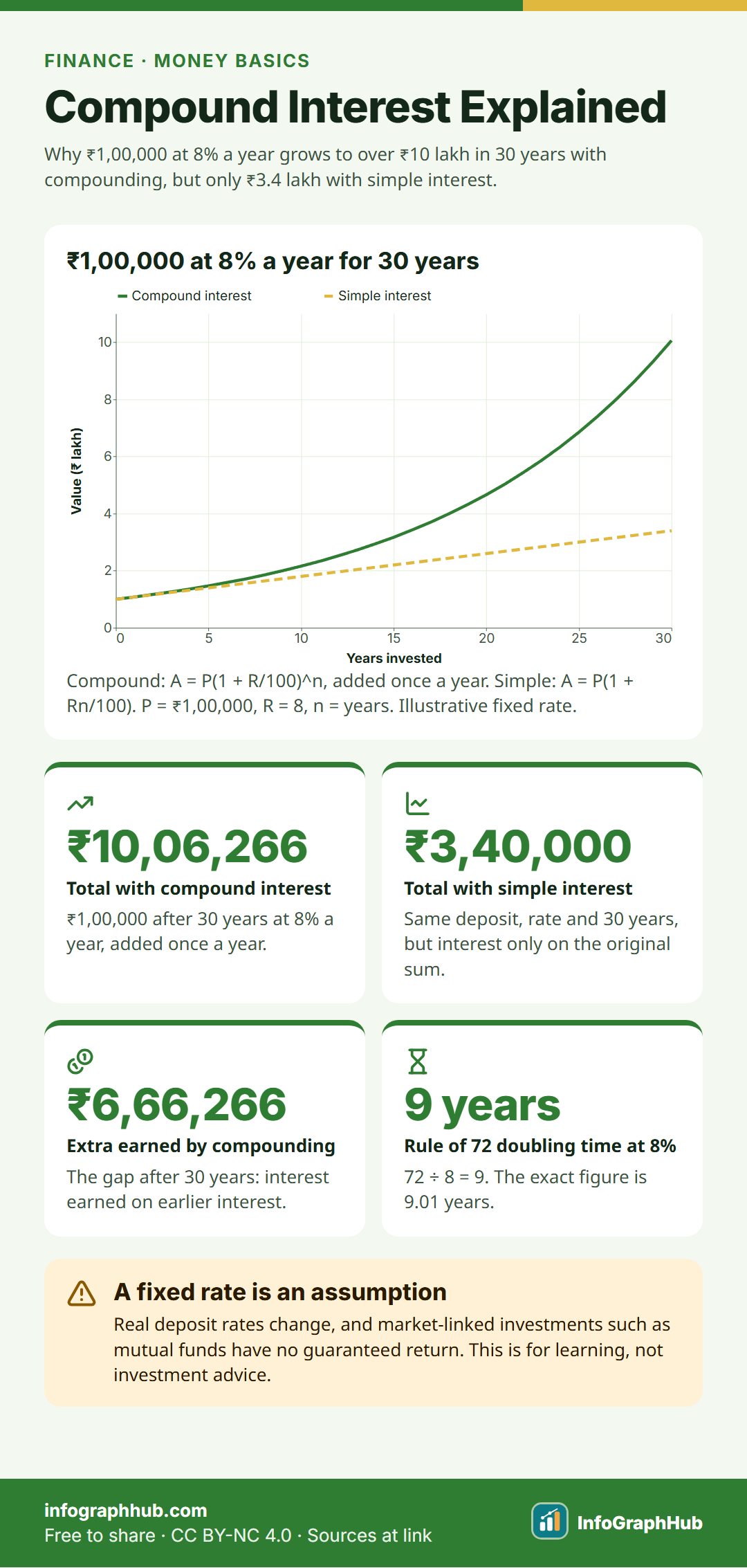
What compound interest means
When you save or lend money, you earn interest: a payment for letting someone else use it. There are two ways to work it out.
- Simple interest is calculated only on the original sum, called the principal. You earn the same amount every year.
- Compound interest is calculated on the principal plus all the interest already added. Each year’s interest joins the balance, so the next year’s interest is worked out on a bigger number.
In short, with compounding your interest starts earning interest of its own.
The formula
When interest is added once a year, the amount after n years is:
A = P × (1 + R/100)^n
Here A is the final amount, P is the principal, R is the yearly rate in per cent and n is the number of years. The compound interest itself is A − P.
Simple interest grows in a straight line instead: A = P × (1 + R × n/100). The two formulas give the same answer after one year, but the gap widens every year after that.
Worked example: ₹1,00,000 at 8% a year
Suppose Meera, who lives in Pune, puts ₹1,00,000 into a scheme that pays an assumed fixed 8% a year, added once a year, and never withdraws it.
| After | Simple interest | Compound interest |
|---|---|---|
| 1 year | ₹1,08,000 | ₹1,08,000 |
| 10 years | ₹1,80,000 | ₹2,15,892 |
| 20 years | ₹2,60,000 | ₹4,66,096 |
| 30 years | ₹3,40,000 | ₹10,06,266 |
In the first year both methods pay the same ₹8,000. In year 30, the compound pot earns ₹74,538 in a single year, because 8% is now being worked out on a balance of more than ₹9 lakh. After 30 years, compounding has produced ₹6,66,266 more than simple interest from exactly the same deposit.
Why starting early matters
Because the growth builds on itself, time is the most powerful ingredient. Compare two friends who each invest ₹1,00,000 once, at the same assumed 8% a year, and both withdraw at age 55:
- Arjun invests at 25, so his money compounds for 30 years and reaches ₹10,06,266.
- Kavya invests at 35, so hers compounds for 20 years and reaches ₹4,66,096.
They put in the same amount, yet Arjun ends up with more than twice as much, simply because his money had ten extra years to grow. Most of the growth happens in the later years, which is why the curve on the chart bends upwards.
The Rule of 72 and how often interest is added
A quick way to estimate how long money takes to double is the Rule of 72: divide 72 by the yearly interest rate. At 8%, 72 ÷ 8 = 9, so money roughly doubles in 9 years. The exact answer is 9.01 years, so the shortcut is close, but it is only an estimate.
Interest can also be added more than once a year. At 8% a year compounded quarterly, 2% is added every three months, so ₹1,00,000 becomes ₹1,08,243 after one year instead of ₹1,08,000. The more often interest is added, the faster the balance grows, although the difference is small.
Real life is less tidy
The examples here assume a fixed 8% every year to keep the maths clear. In reality, deposit rates change over time, and inflation reduces what your money can buy. Market-linked investments, such as equity mutual funds, do not pay a fixed rate at all: their value can rise or fall, and returns are not guaranteed. Compounding works on whatever return you actually get, including losses.
This page is for learning only and is not investment advice. For decisions about your own money, speak to a SEBI-registered investment adviser.
Frequently asked questions
What is the difference between simple and compound interest?
Simple interest is worked out only on the original sum (the principal), so it is the same every year. Compound interest is worked out on the principal plus the interest already earned, so it grows larger each year.
How accurate is the Rule of 72?
It is a quick estimate, not an exact formula. At 8% a year it gives 9 years, while the exact doubling time is 9.01 years. For a precise answer, use the compound interest formula.
Can compound interest work against me?
Yes. When unpaid interest on a loan or credit card is added to what you owe, you end up paying interest on interest, and the debt can grow quickly. Paying on time stops this from happening.
Will an investment really grow like the chart?
Only if it earned exactly 8% every year, which real investments rarely do. Deposit rates change, and market-linked returns are not guaranteed and can be negative. For advice on your own situation, consult a SEBI-registered investment adviser.
Sources & methodology
Every fact is checked against the sources below. We write original explanations and draw original graphics; no figures are copied from textbooks. Spotted an error? See our corrections policy.
- Financial Education Booklet (Power of Compounding; Rule of 72) (Securities and Exchange Board of India (SEBI), accessed 30 Sept 2026)
- Mathematics Class 8, Chapter 7: Comparing Quantities (Compound Interest) (NCERT, accessed 30 Sept 2026)
- Compound Interest Calculator (National Institute of Securities Markets (NISM), accessed 30 Sept 2026)
Reviewed by Claude (pending owner check) · Updated
Embed this on your site
Paste this HTML into your page. Keep the credit line: it is required by the CC BY-NC 4.0 license.
Related infographics
 Finance
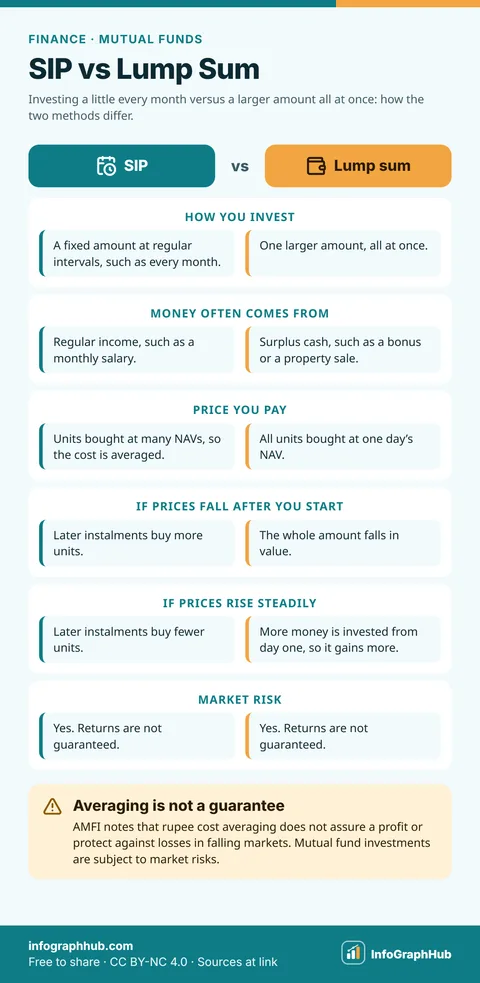
SIP vs Lump Sum: Two Ways to Invest in Mutual Funds
An SIP puts a fixed amount into a mutual fund at regular intervals, so you buy units at many different prices. A lump sum invests one larger amount at once, at a single price. Neither is always better, and neither guarantees a return.
 Finance
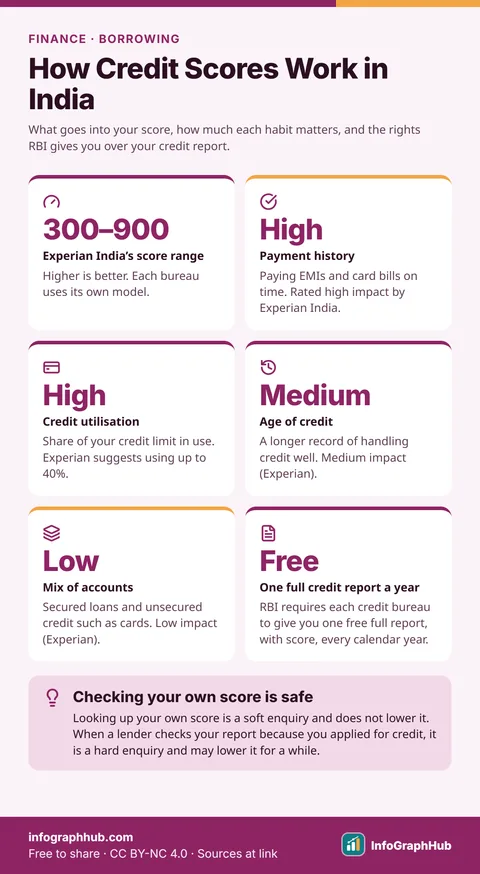
How Credit Scores Work in India: What Moves Your Score
A credit score is a three-digit number, such as Experian India’s 300–900 score, built from your borrowing record. Paying on time and using little of your credit limit matter most; the age and mix of your accounts matter less.
 Tech
TechGit Commands Cheat Sheet: The Essentials for Beginners
The Git commands beginners use most: set up a repository with init or clone, save work with add and commit, build features on branches with switch and merge, share work with fetch, pull and push, and undo safely with restore.
 Tech
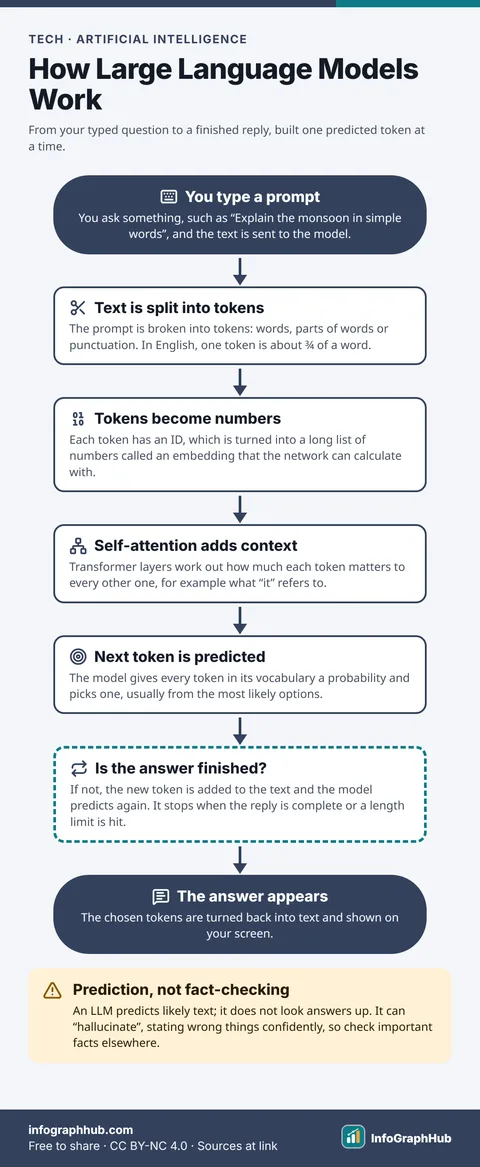
TechHow Large Language Models Work: From Prompt to Answer
A large language model splits your prompt into tokens, turns them into numbers, uses self-attention to work out context, then predicts the most likely next token. It repeats that prediction, one token at a time, until the answer is complete.
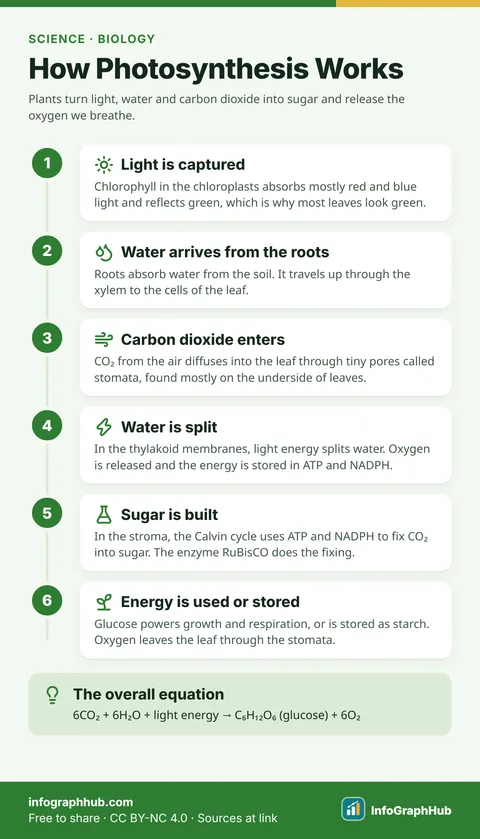 Science
How Photosynthesis Works: From Sunlight to Sugar
Photosynthesis is how plants use light energy to turn carbon dioxide and water into glucose, releasing oxygen as a by-product. It happens in chloroplasts in two linked stages: the light-dependent reactions and the Calvin cycle.
 Science
How Vaccines Work: Training Your Immune System
Vaccines work by imitating an infection. They show your immune system a harmless antigen from a germ, so it makes matching antibodies and memory cells that can fight the real germ quickly if it ever arrives.
Get new InfoGraphHub resources by email
One short email when new free resources go live. No spam, unsubscribe anytime.