States of Matter: Solids, Liquids and Gases in the Particle Model
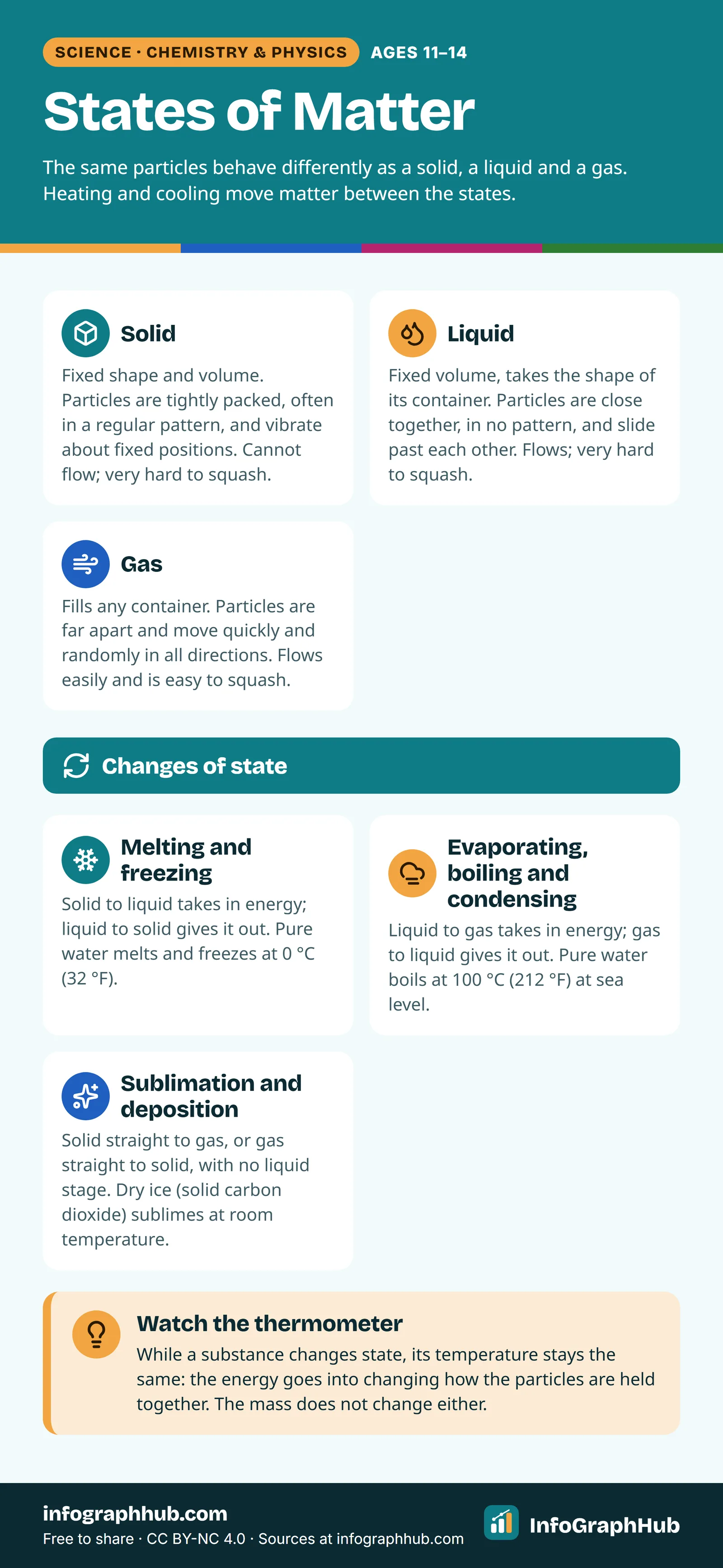
Solids, liquids and gases are made of the same kinds of particles; only their spacing, arrangement and movement differ. This poster compares the three states and shows the changes of state and whether each takes in or gives out energy.
Ages 11–14 · Grades 6–8 (US) · Years 7–9 (UK) · Classes 6–8 (India)
- England KS3 Years 7–9
- AQA GCSE 4.2.2.1
- Cambridge IGCSE 0620 1.1
- Cambridge IGCSE 0625 2.1.1
- NGSS MS-PS1-4
- Australian Curriculum v9 AC9S7U05
- CBSE Class 8
NGSS is a registered trademark of WestEd. Cambridge and IGCSE are trademarks of Cambridge University Press & Assessment. Names and codes are used only to describe curriculum fit; InfoGraphHub is not endorsed by these organisations.
The particle model in one idea
All matter, anything that has mass and takes up space, is made of tiny particles: atoms or molecules. The particles are always moving, and attractions between them pull them together. Whether a substance is a solid, a liquid or a gas depends on the balance between those attractions and how much movement energy the particles have.
The particles themselves stay the same in every state. Ice, liquid water and water vapour are all made of the same water molecules; only their spacing, arrangement and movement change.
Solids, liquids and gases compared
| Solid | Liquid | Gas | |
|---|---|---|---|
| Shape | Fixed | Takes the container's shape | Fills the container |
| Volume | Fixed | Fixed | Fills the container |
| Arrangement | Tightly packed, often regular | Close, no pattern | Far apart, no pattern |
| Movement | Vibrate in place | Slide past each other | Fast and random |
| Flow | No | Yes | Yes |
| Squash | Very hard | Very hard | Easy |
Every property in the table follows from the particle picture. Gases are easy to squash because there is empty space between the particles. Liquids flow because their particles can slide past one another, but they are almost as hard to squash as solids because the particles are still touching.
Changes of state and energy
Heating gives particles more movement energy. A solid melts, then the liquid evaporates or boils. Cooling reverses the process: a gas condenses and a liquid freezes. A few substances skip the liquid stage: solid carbon dioxide (dry ice) sublimes straight into a gas, and the reverse change is called deposition.
Melting, boiling and sublimation take in energy. Freezing, condensing and deposition give it out. During any change of state the temperature stays constant until the change is complete, which is why a heating curve has flat sections. Changes of state are physical changes, so the total mass stays the same.
Worked example: water at sea level and up a mountain
Pure water freezes at 0 °C (32 °F) and boils at 100 °C (212 °F) when the air pressure is normal sea-level pressure. A liquid boils when the pressure of its vapour matches the pressure of the air above it, so the boiling point depends on air pressure.
In the mountain town of Leadville, Colorado, in the US, the air pressure is about 68 kPa, roughly two-thirds of the 101.3 kPa at sea level. There, water boils at about 90 °C (194 °F). The water is boiling, but it is not as hot as boiling water at the coast.
Evaporation is different from boiling. It happens at the surface of a liquid at any temperature, as the fastest particles escape, which is why a puddle dries on a sunny day without ever reaching 100 °C.
Using this poster
Print it on A4 or US Letter as a handout, or on A3 or Tabloid for the classroom wall. Ask students to draw a particle diagram for each state beside the poster, then label every arrow between the states with its name and whether energy goes in or out. It pairs with the free LearnBySlides lesson on states of matter, which has speaker notes, a quiz and a worksheet.
Frequently asked questions
What are the three states of matter?
Solid, liquid and gas. Solids keep their shape and volume, liquids keep their volume but take the shape of their container, and gases spread out to fill any container. Plasma, a very hot gas full of charged particles found in stars and lightning, is often called a fourth state.
Why can you squash a gas but not a liquid?
Gas particles are far apart with empty space between them, so they can be pushed closer together. Liquid particles are already touching, so there is almost no space to squash them into.
What is the difference between evaporation and boiling?
Evaporation happens only at the surface of a liquid and at any temperature. Boiling happens throughout the liquid and only at the boiling point, which for pure water at sea level is 100 °C (212 °F).
Does the temperature change while ice melts?
No. While ice is melting, the energy it takes in goes into separating the particles, so the temperature stays at 0 °C until all the ice has melted. Then it starts to rise again.
Sources & methodology
Every fact is checked against the sources below. We write original explanations and draw original graphics; no figures are copied from textbooks. Spotted an error? See our corrections policy.
- Chemistry 2e, 1.2 Phases and Classification of Matter (OpenStax (Rice University), accessed 1 Oct 2026)
- Chemistry 2e, 10.1 Intermolecular Forces (OpenStax (Rice University), accessed 1 Oct 2026)
- Chemistry 2e, 10.3 Phase Transitions (OpenStax (Rice University), accessed 1 Oct 2026)
- Chemistry 2e, 1.4 Measurements (water's freezing and boiling points) (OpenStax (Rice University), accessed 1 Oct 2026)
- Phases of Matter (NASA Glenn Research Center, accessed 1 Oct 2026)
Editorial review pending · Updated
Embed this on your site
Paste this HTML into your page. Keep the credit line: it is required by the CC BY-NC 4.0 license.
Related infographics
 Science
The Water Cycle Explained
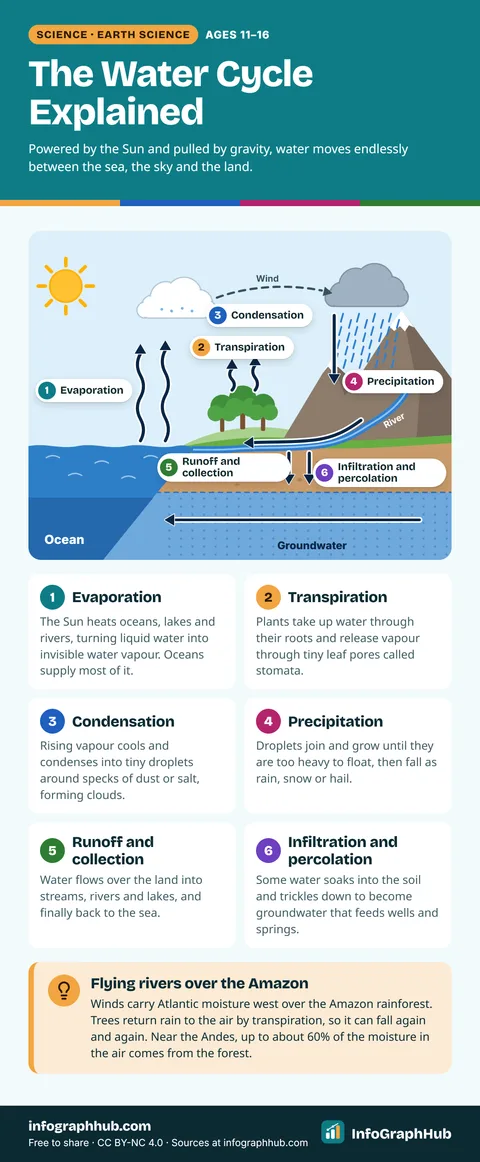
The water cycle is the non-stop movement of water between oceans, air and land. Powered by the Sun, water evaporates, condenses into clouds, falls as rain or snow, and flows or soaks back towards rivers, groundwater and the sea.
 Science
How Photosynthesis Works: From Sunlight to Sugar
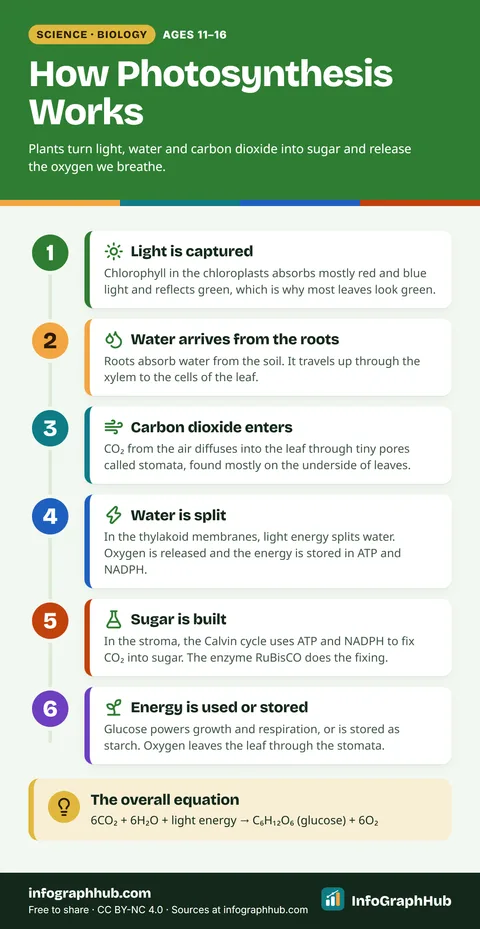
Photosynthesis is how plants use light energy to turn carbon dioxide and water into glucose, releasing oxygen as a by-product. It happens in chloroplasts in two linked stages: the light-dependent reactions and the Calvin cycle.
 Science
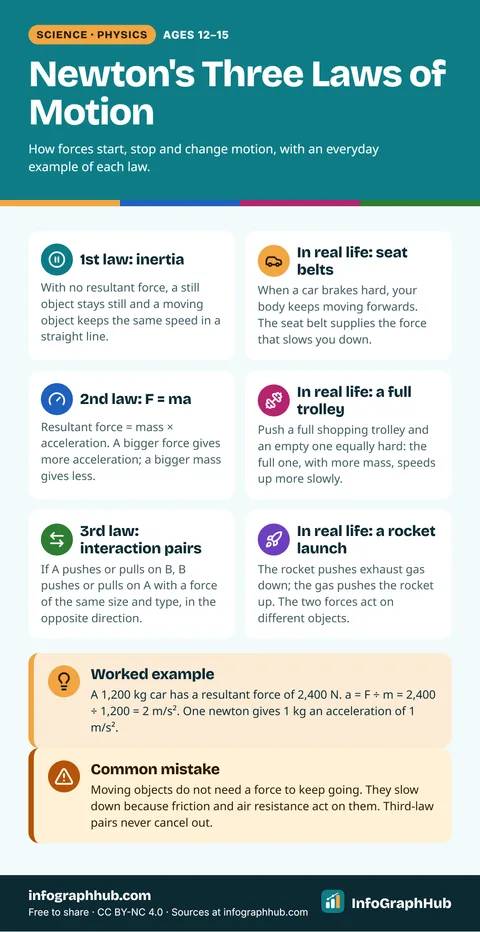
Newton's Three Laws of Motion Explained
Newton's three laws explain how forces change motion: with no resultant force motion does not change, resultant force equals mass times acceleration, and forces always come in equal and opposite pairs acting on different objects.
 Science
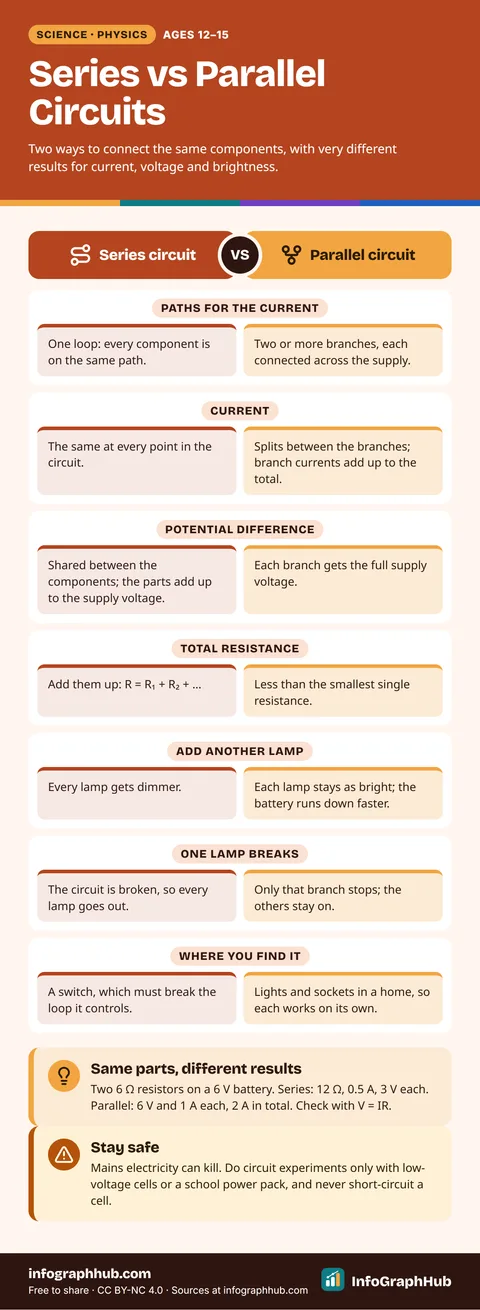
Series vs Parallel Circuits: Key Differences
In a series circuit there is one path, so the current is the same everywhere and the voltage is shared. In a parallel circuit each branch gets the full voltage and the branch currents add up. This poster compares the two side by side.
 Science
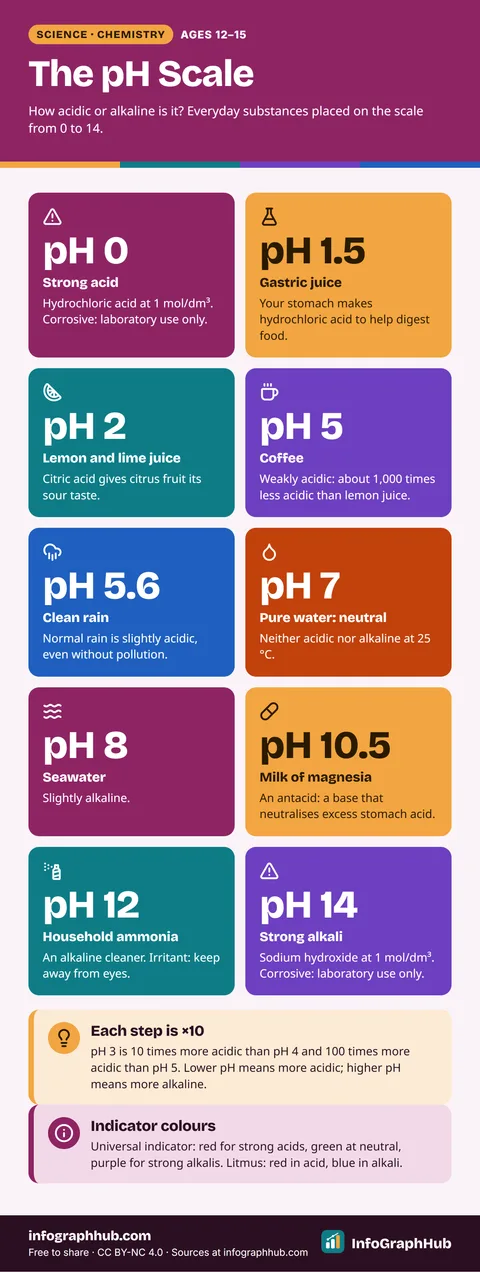
The pH Scale: Acids, Alkalis and Neutral
The pH scale runs from 0 to 14 and shows how acidic or alkaline a solution is. pH 7 is neutral, lower numbers are acidic and higher numbers are alkaline, and each step is a tenfold change. This poster places everyday substances on the scale.
 Science
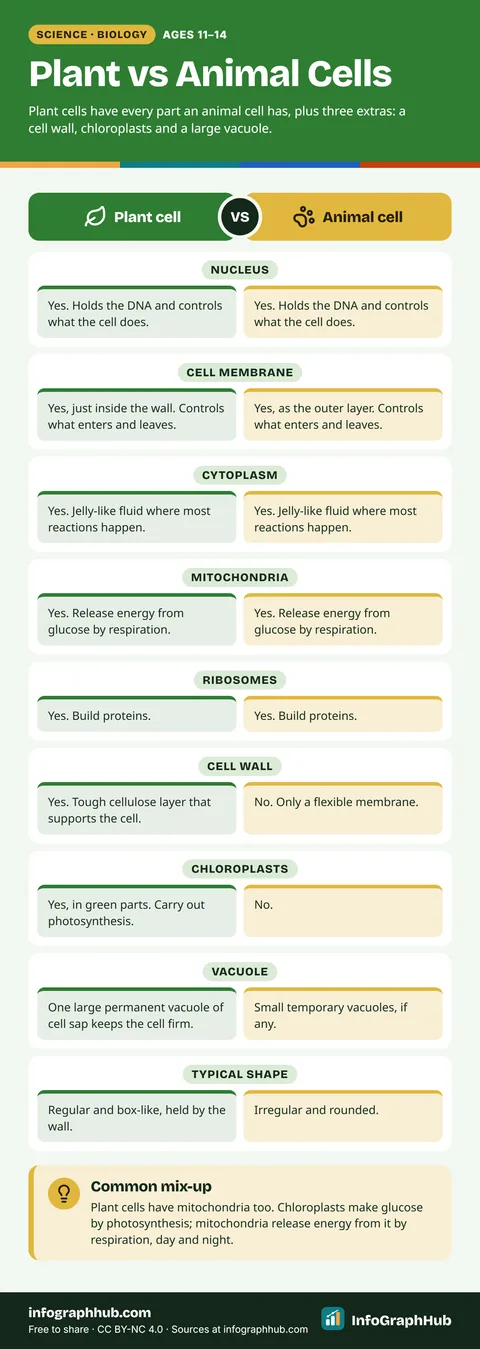
Plant vs Animal Cells: What Each Part Does
Plant and animal cells share a nucleus, cell membrane, cytoplasm, mitochondria and ribosomes. Plant cells also have a cellulose cell wall, chloroplasts and a large permanent vacuole. This comparison poster shows each part and its job.
For teachers and parents: new InfoGraphHub resources by email
One short email when new free resources go live. For adults (18+) only. No spam, no tracking in emails, unsubscribe anytime.