The pH Scale: Acids, Alkalis and Neutral
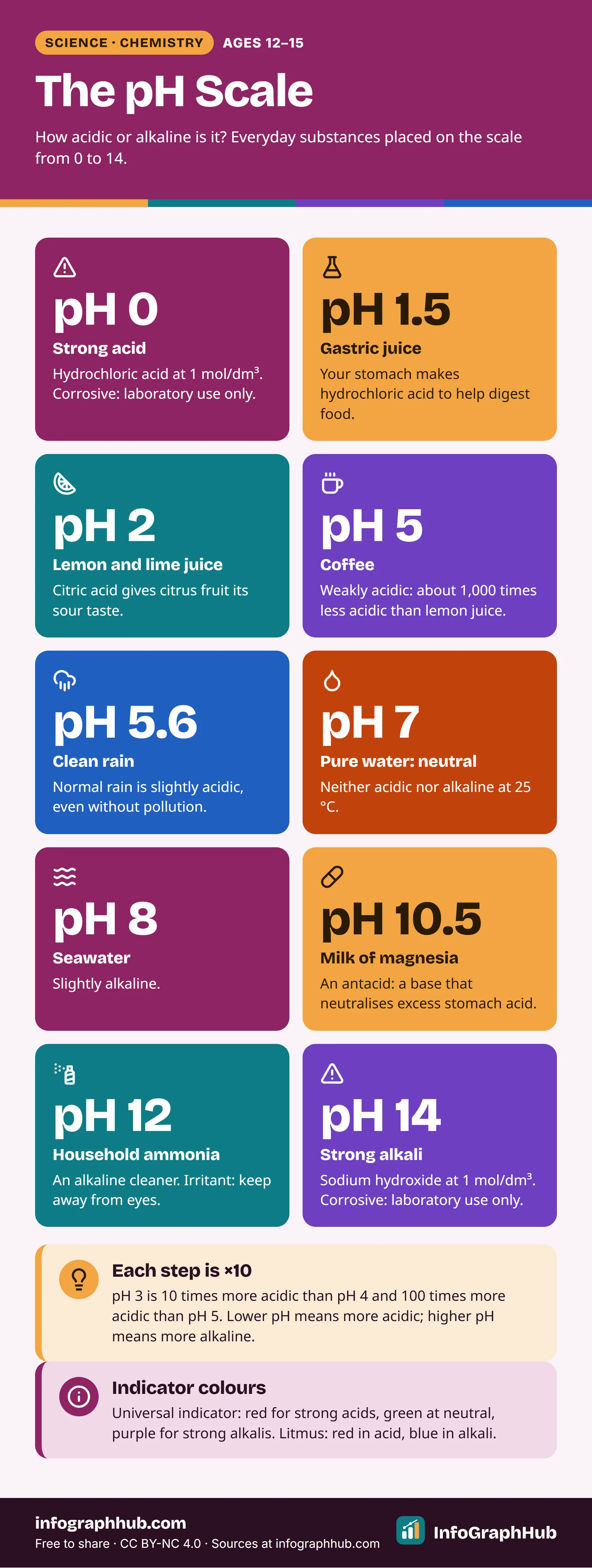
The pH scale runs from 0 to 14 and shows how acidic or alkaline a solution is. pH 7 is neutral, lower numbers are acidic and higher numbers are alkaline, and each step is a tenfold change. This poster places everyday substances on the scale.
Ages 12–15 · Grades 7–9 (US) · Years 8–10 (UK) · Classes 7–9 (India)
NGSS is a registered trademark of WestEd. Cambridge and IGCSE are trademarks of Cambridge University Press & Assessment. Names and codes are used only to describe curriculum fit; InfoGraphHub is not endorsed by these organisations.
What the pH scale measures
The pH scale shows how acidic or alkaline a solution is. It usually runs from 0 to 14:
- pH 7 is neutral, like pure water at 25 °C.
- Below 7 is acidic. The lower the number, the more acidic the solution.
- Above 7 is alkaline (basic). The higher the number, the more alkaline.
pH depends on the concentration of hydrogen ions in the solution. Acids release hydrogen ions in water; alkalis release hydroxide ions. Very concentrated solutions can go slightly beyond 0 or 14, but the 0–14 range covers nearly everything met in school and at home.
Each step is a tenfold change
The pH scale is not like a ruler. Each step of one pH unit is a tenfold change in hydrogen ion concentration. A solution at pH 3 is 10 times more acidic than one at pH 4, and 100 times more acidic than one at pH 5. So lemon juice, at about pH 2, is roughly 1,000 times more acidic than coffee at about pH 5. This is why small changes in pH matter, for example in rivers, oceans and the human body.
Everyday substances on the scale
The values on the poster are typical, not exact; real samples vary. Gastric juice in the stomach is strongly acidic, at about pH 1.5, and lemon and lime juice are about pH 2. Coffee is weakly acidic, at about pH 5, and even clean rain is slightly acidic, at about pH 5.6. Pure water is neutral. Seawater is slightly alkaline, at about pH 8, while milk of magnesia, an antacid, is about pH 10.5 and household ammonia is about pH 12. At the two ends of the scale, laboratory hydrochloric acid and sodium hydroxide are corrosive and are used only with eye protection.
Measuring pH: indicators and meters
An indicator changes colour depending on pH. Litmus is red in acid and blue in alkali, so it shows only whether a solution is acidic or alkaline. Universal indicator is a mixture of indicators that runs from red for strong acids, through green at neutral, to purple for strong alkalis, so it gives an approximate pH. Red cabbage juice works as a homemade indicator. A pH meter gives a more precise number and works with coloured liquids that would hide an indicator's colour.
Neutralisation
When an acid reacts with a base, they cancel each other out: acid + base → salt + water, and the pH moves towards 7. Antacids such as milk of magnesia use this reaction to neutralise excess stomach acid. Hydrochloric acid and sodium hydroxide react to make sodium chloride and water.
Using this poster in class
Print the poster on A4 or US Letter for handouts, or on A3 or Tabloid for a classroom wall. It pairs with the LearnBySlides lesson on acids, bases and pH, which includes a safe universal indicator practical.
Frequently asked questions
What pH is neutral?
pH 7 is neutral at 25 °C. Pure water has a pH of 7. Solutions below 7 are acidic and solutions above 7 are alkaline.
Is a lower pH more acidic or less acidic?
More acidic. The lower the pH number, the higher the concentration of hydrogen ions and the more acidic the solution. Each step down the scale is ten times more acidic.
Why is rain slightly acidic?
Even unpolluted rain has a pH of about 5.6, a little below neutral, because carbon dioxide from the air dissolves in it. Rain that is much more acidic than this is called acid rain.
What colour is universal indicator in an acid and in an alkali?
Universal indicator turns red in strong acids, green at neutral, and blue to purple in alkalis, with other colours in between. Compare the colour with the chart supplied with the indicator to read the approximate pH.
Sources & methodology
Every fact is checked against the sources below. We write original explanations and draw original graphics; no figures are copied from textbooks. Spotted an error? See our corrections policy.
- Chemistry 2e, 14.2 pH and pOH (OpenStax (Rice University), accessed 1 Oct 2026)
- Chemistry 2e, 4.2 Classifying Chemical Reactions (acid-base reactions) (OpenStax (Rice University), accessed 1 Oct 2026)
- pH and Water (U.S. Geological Survey, accessed 1 Oct 2026)
- What is acid rain? (U.S. Geological Survey, accessed 1 Oct 2026)
- Colour by pH (Royal Society of Chemistry (RSC Education), accessed 1 Oct 2026)
- pH scale and universal indicator solution (KS3) (Oak National Academy, accessed 1 Oct 2026)
Editorial review pending · Updated
Embed this on your site
Paste this HTML into your page. Keep the credit line: it is required by the CC BY-NC 4.0 license.
Related infographics
 Science
Newton's Three Laws of Motion Explained
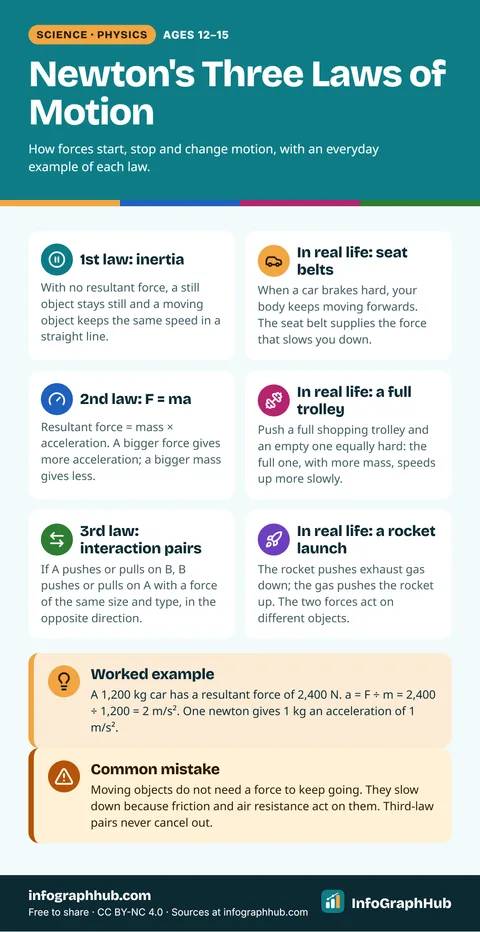
Newton's three laws explain how forces change motion: with no resultant force motion does not change, resultant force equals mass times acceleration, and forces always come in equal and opposite pairs acting on different objects.
 Science
Series vs Parallel Circuits: Key Differences
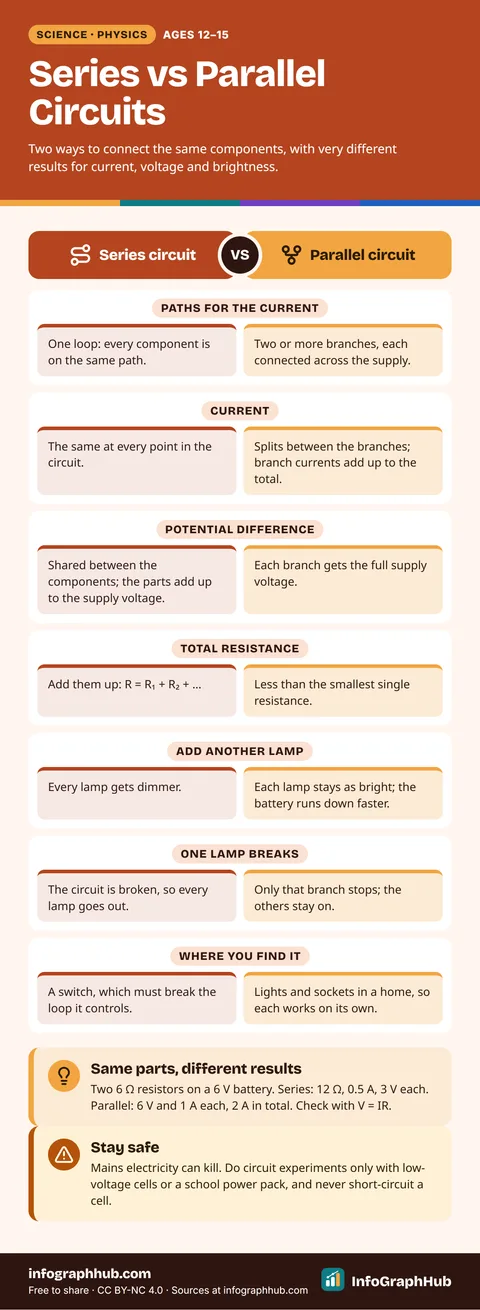
In a series circuit there is one path, so the current is the same everywhere and the voltage is shared. In a parallel circuit each branch gets the full voltage and the branch currents add up. This poster compares the two side by side.
 Science
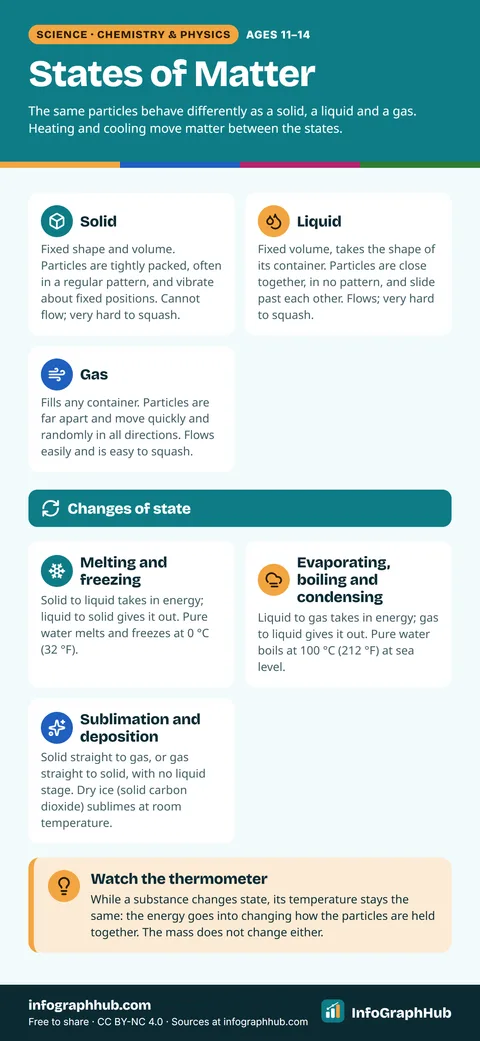
States of Matter: Solids, Liquids and Gases in the Particle Model
Solids, liquids and gases are made of the same kinds of particles; only their spacing, arrangement and movement differ. This poster compares the three states and shows the changes of state and whether each takes in or gives out energy.
 Science
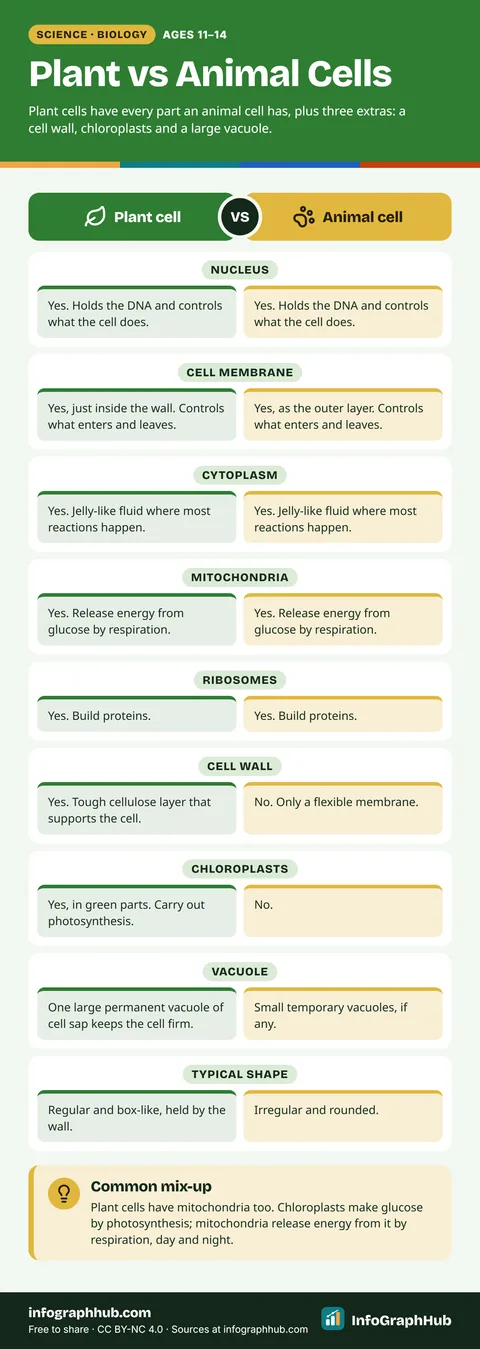
Plant vs Animal Cells: What Each Part Does
Plant and animal cells share a nucleus, cell membrane, cytoplasm, mitochondria and ribosomes. Plant cells also have a cellulose cell wall, chloroplasts and a large permanent vacuole. This comparison poster shows each part and its job.
 Science
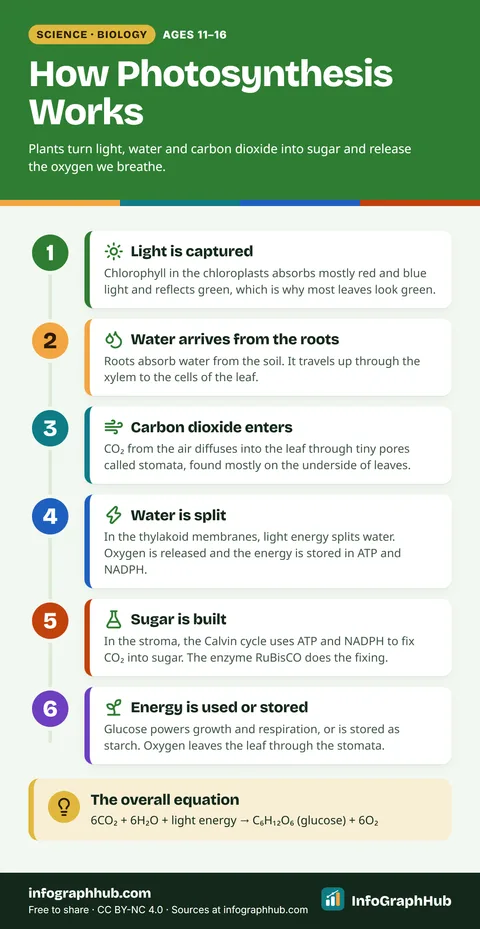
How Photosynthesis Works: From Sunlight to Sugar
Photosynthesis is how plants use light energy to turn carbon dioxide and water into glucose, releasing oxygen as a by-product. It happens in chloroplasts in two linked stages: the light-dependent reactions and the Calvin cycle.
 Science
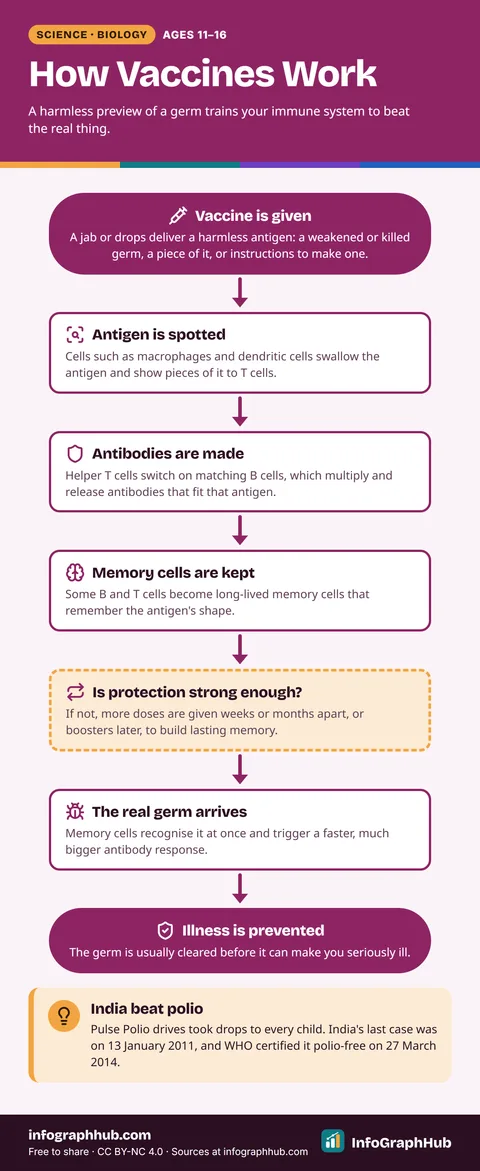
How Vaccines Work: Training Your Immune System
Vaccines work by imitating an infection. They show your immune system a harmless antigen from a germ, so it makes matching antibodies and memory cells that can fight the real germ quickly if it ever arrives.
For teachers and parents: new InfoGraphHub resources by email
One short email when new free resources go live. For adults (18+) only. No spam, no tracking in emails, unsubscribe anytime.