Series vs Parallel Circuits: Key Differences
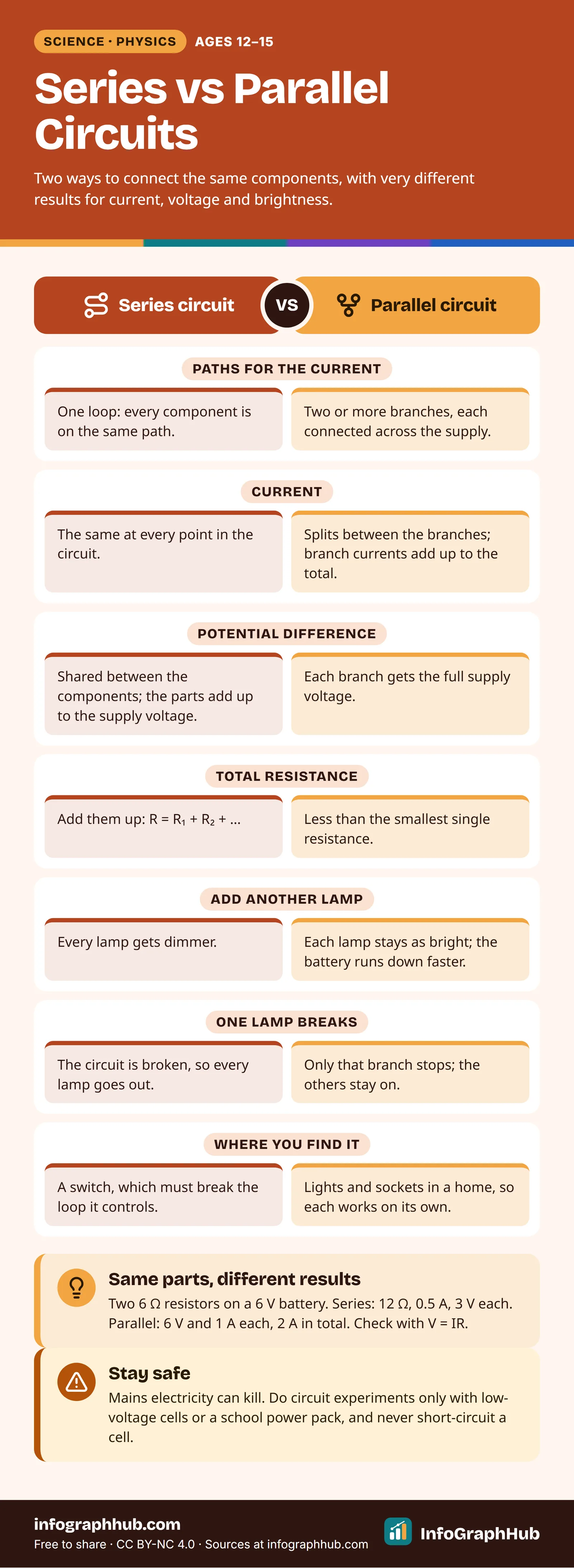
In a series circuit there is one path, so the current is the same everywhere and the voltage is shared. In a parallel circuit each branch gets the full voltage and the branch currents add up. This poster compares the two side by side.
Ages 12–15 · Grades 7–9 (US) · Years 8–10 (UK) · Classes 7–9 (India)
Cambridge and IGCSE are trademarks of Cambridge University Press & Assessment. Names and codes are used only to describe curriculum fit; InfoGraphHub is not endorsed by these organisations.
Two ways to build a circuit
Electric charge flows only around a complete loop, pushed by a cell, battery or power supply. When a circuit has more than one component, there are two basic ways to connect them. In a series circuit the components sit one after another in a single loop. In a parallel circuit each component has its own branch connected across the supply. The same lamps, resistors and battery behave very differently in each arrangement.
Current, voltage and resistance
Three quantities describe what is happening in a circuit:
- Current (I) is the rate of flow of charge, measured in amperes (A) with an ammeter connected in series.
- Potential difference (V), also called voltage, is the energy transferred per unit of charge, measured in volts (V) with a voltmeter connected in parallel across a component.
- Resistance (R) is how much a component opposes the current, measured in ohms (Ω).
They are linked by V = IR. A component with 6 V across it and a resistance of 6 Ω carries a current of 1 A.
Series circuits
With only one path, the current is the same everywhere in a series circuit: an ammeter reads the same before and after each lamp, because current is not used up. The supply voltage is shared between the components, and the total resistance is the sum of the individual resistances. Adding another lamp raises the total resistance, lowers the current and makes every lamp dimmer. If one lamp breaks, the loop is broken and everything goes out.
Parallel circuits
In a parallel circuit, each branch gets the full supply voltage, and the current from the supply splits between the branches. The branch currents add up to the total current. Each extra branch gives the charge another path, so the total resistance falls below that of the smallest resistor. Lamps added in parallel stay as bright as a single lamp, but the battery has to supply more current and runs down faster. For older students, the total resistance of two resistors in parallel comes from 1/R = 1/R₁ + 1/R₂.
Worked example and everyday uses
Take two 6 Ω resistors and a 6 V battery. In series, the total resistance is 12 Ω, so the current is 6 ÷ 12 = 0.5 A and each resistor has 3 V across it. In parallel, each resistor has the full 6 V across it and carries 6 ÷ 6 = 1 A, so the battery supplies 2 A.
The lights and sockets in homes are wired in parallel so that every appliance gets the full mains voltage and can be switched on and off by itself. A switch is placed in series with whatever it controls, because opening it must break that loop and stop the current.
Frequently asked questions
What is the main difference between series and parallel circuits?
A series circuit has one path, so the current is the same everywhere and the voltage is shared. A parallel circuit has several branches, so each branch gets the full voltage and the currents add up.
Which is brighter, two lamps in series or two lamps in parallel?
Lamps in parallel are brighter. Each one gets the full supply voltage, while lamps in series share it, so each series lamp has a smaller voltage and current.
Why are houses wired in parallel?
So that every light and socket gets the full mains voltage, can be switched on or off independently, and keeps working if another appliance fails.
Is current used up in a circuit?
No. The current is the same before and after a lamp in a series circuit. The lamp transfers energy carried by the charge, not the charge itself.
Sources & methodology
Every fact is checked against the sources below. We write original explanations and draw original graphics; no figures are copied from textbooks. Spotted an error? See our corrections policy.
- Physics, 19.1 Ohm's Law (OpenStax (Rice University), accessed 1 Oct 2026)
- Physics, 19.2 Series Circuits (OpenStax (Rice University), accessed 1 Oct 2026)
- Physics, 19.3 Parallel Circuits (OpenStax (Rice University), accessed 1 Oct 2026)
- College Physics 2e, 21.4 DC Voltmeters and Ammeters (OpenStax (Rice University), accessed 1 Oct 2026)
- What gets used up? (electric circuits misconception) (Institute of Physics (IOPSpark), accessed 1 Oct 2026)
Editorial review pending · Updated
Embed this on your site
Paste this HTML into your page. Keep the credit line: it is required by the CC BY-NC 4.0 license.
Related infographics
 Science
Newton's Three Laws of Motion Explained
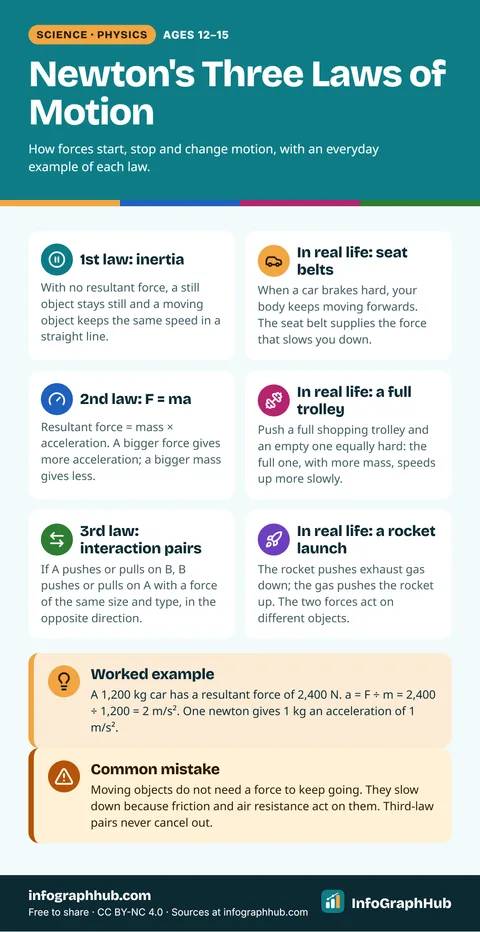
Newton's three laws explain how forces change motion: with no resultant force motion does not change, resultant force equals mass times acceleration, and forces always come in equal and opposite pairs acting on different objects.
 Science
The pH Scale: Acids, Alkalis and Neutral
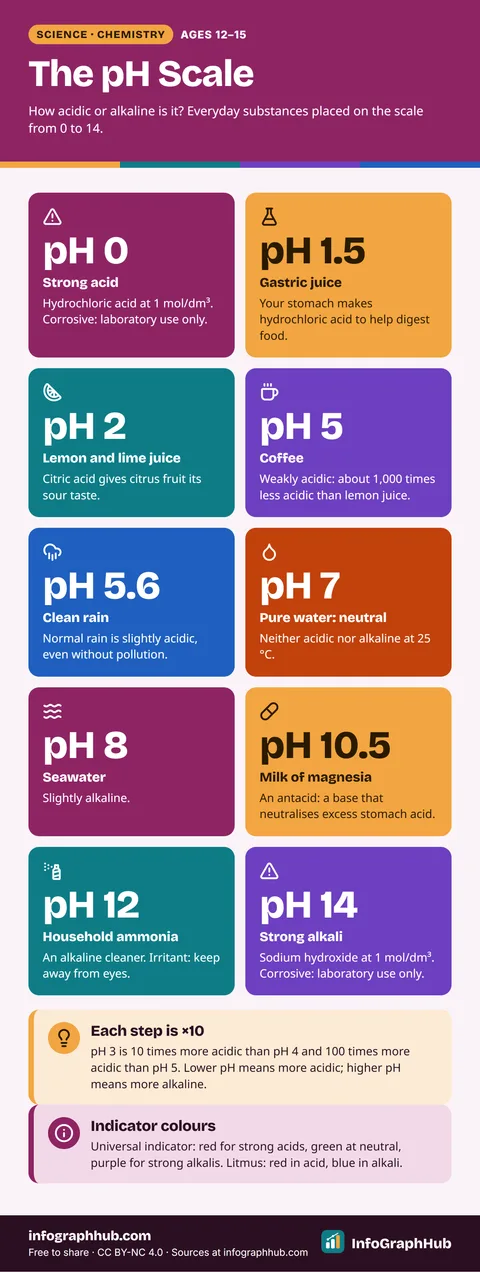
The pH scale runs from 0 to 14 and shows how acidic or alkaline a solution is. pH 7 is neutral, lower numbers are acidic and higher numbers are alkaline, and each step is a tenfold change. This poster places everyday substances on the scale.
 Science
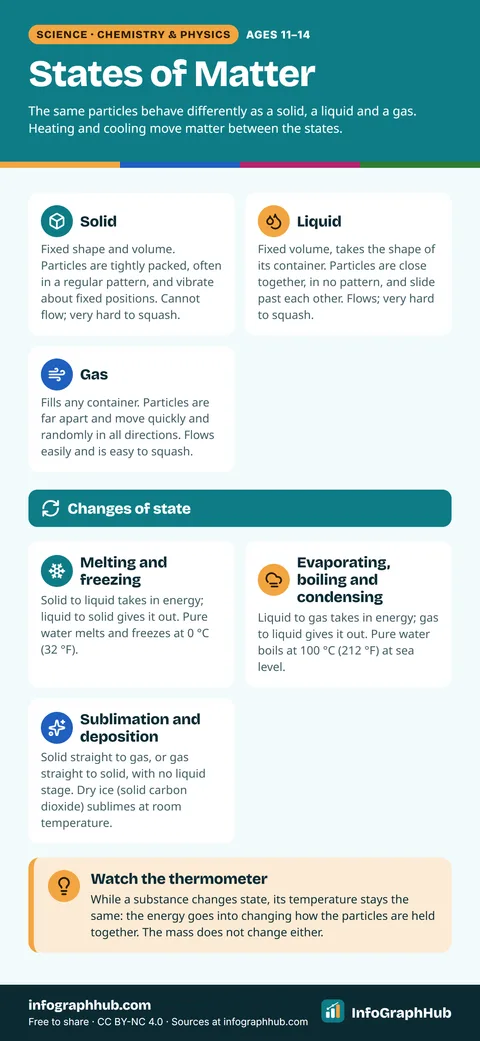
States of Matter: Solids, Liquids and Gases in the Particle Model
Solids, liquids and gases are made of the same kinds of particles; only their spacing, arrangement and movement differ. This poster compares the three states and shows the changes of state and whether each takes in or gives out energy.
 Science
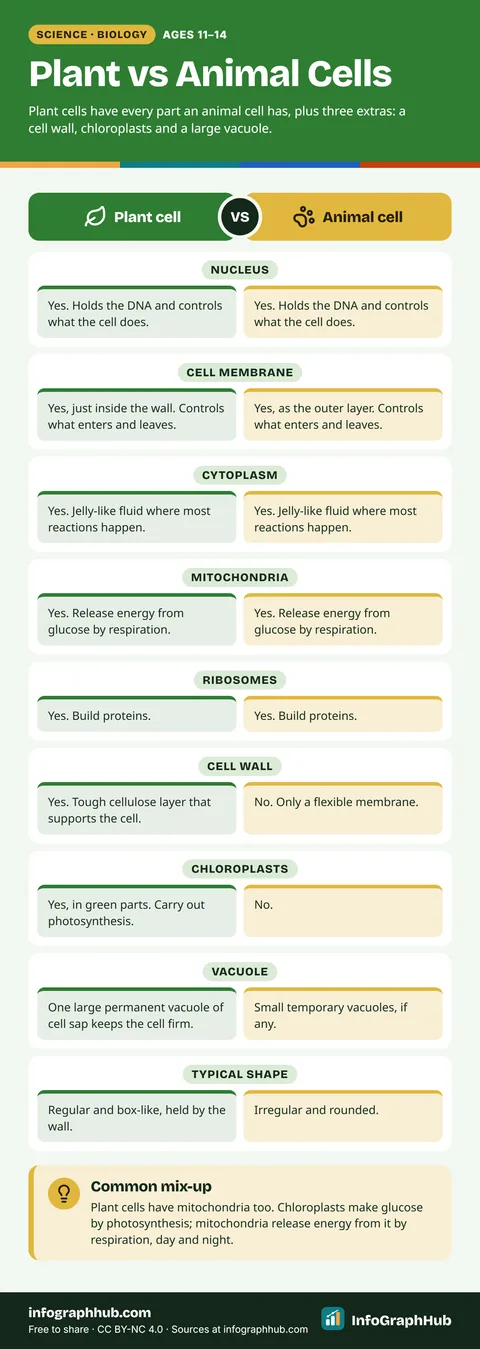
Plant vs Animal Cells: What Each Part Does
Plant and animal cells share a nucleus, cell membrane, cytoplasm, mitochondria and ribosomes. Plant cells also have a cellulose cell wall, chloroplasts and a large permanent vacuole. This comparison poster shows each part and its job.
 Science
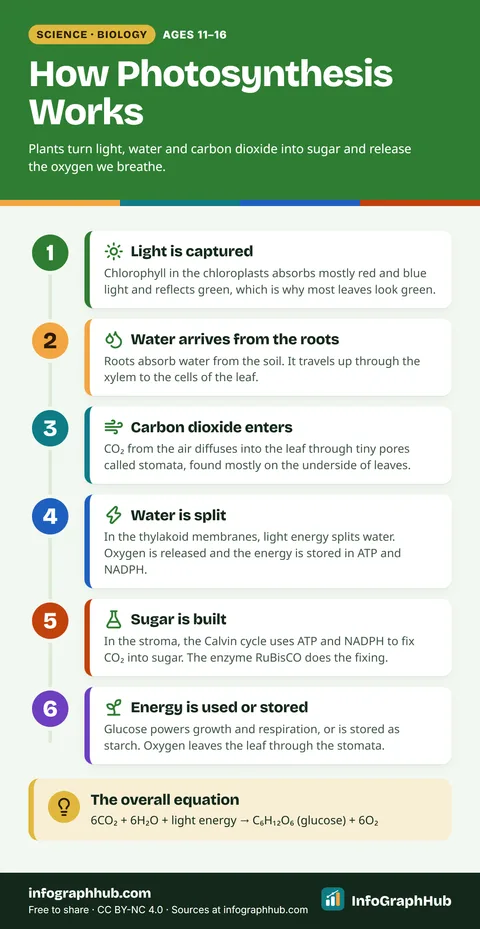
How Photosynthesis Works: From Sunlight to Sugar
Photosynthesis is how plants use light energy to turn carbon dioxide and water into glucose, releasing oxygen as a by-product. It happens in chloroplasts in two linked stages: the light-dependent reactions and the Calvin cycle.
 Science
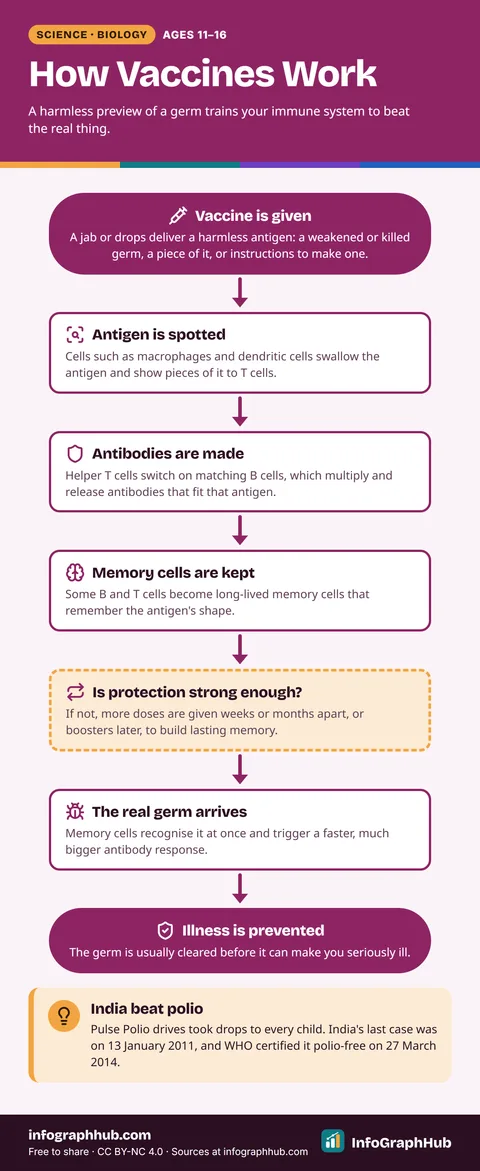
How Vaccines Work: Training Your Immune System
Vaccines work by imitating an infection. They show your immune system a harmless antigen from a germ, so it makes matching antibodies and memory cells that can fight the real germ quickly if it ever arrives.
For teachers and parents: new InfoGraphHub resources by email
One short email when new free resources go live. For adults (18+) only. No spam, no tracking in emails, unsubscribe anytime.