Earth's Water by the Numbers
Where is all of Earth's water, and how long does it stay there? Only 2.5% is fresh, most of that is frozen or underground, and a drop can spend nine days in the air or thousands of years in the ocean or an ice cap.
Part 2 of 8The Water Cycle series
Ages 11–16 · Grades 6–10 (US) · Years 7–11 (UK) · Classes 6–10 (India)
NGSS is a registered trademark of WestEd. Names and codes are used only to describe curriculum fit; InfoGraphHub is not endorsed by these organisations.
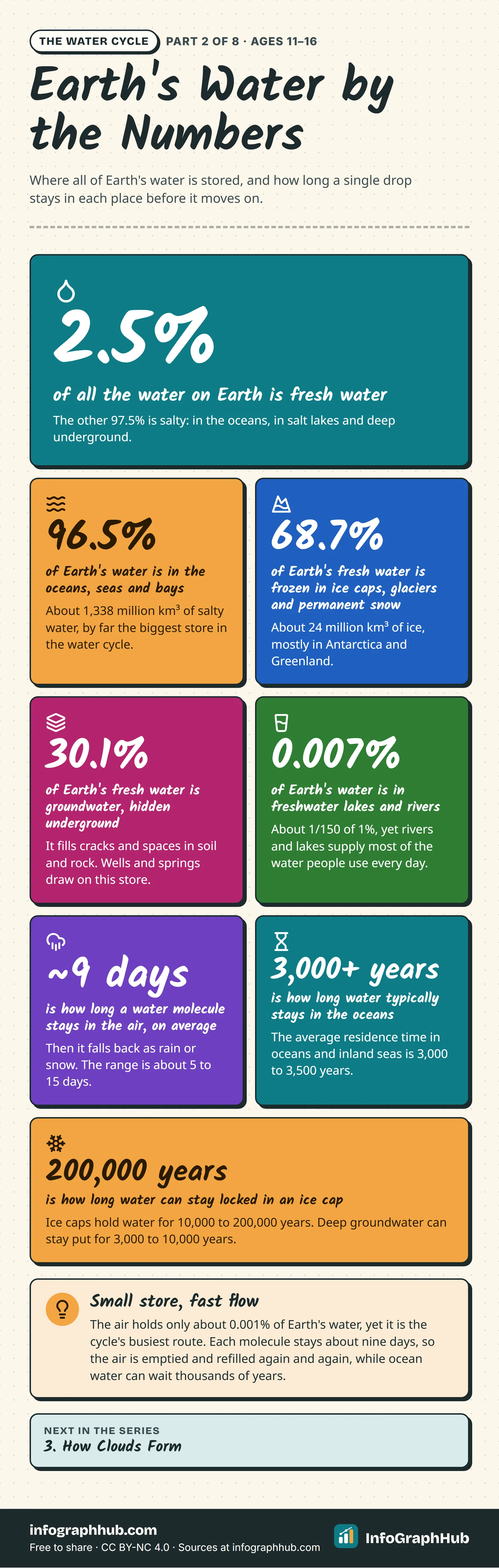
Counting every drop
Scientists estimate that Earth holds about 1,386 million cubic kilometres of water (332.5 million cubic miles). That counts everything: the oceans, ice, water underground, lakes, rivers, the vapour in the air and even the water inside living things. Gathered into one ball, it would be only about 1,385 kilometres across, small next to the planet itself.
The figures on this page come from one widely used estimate, published by the hydrologist Igor Shiklomanov and shared by the US Geological Survey (USGS). They describe Earth at a single moment. Water never stops moving between these stores, and the percentages are rounded, so they do not add up to exactly 100.
Salty or fresh?
About 96.5 per cent of all Earth's water is in the oceans, seas and bays. Add the salty water found underground and in salt lakes, and roughly 97.5 per cent of the planet's water is too salty to drink or use on crops without treatment.
That leaves only about 2.5 per cent as fresh water. Even this small share is mostly out of reach:
- 68.7 per cent of fresh water is frozen in ice caps, glaciers and permanent snow, mainly in Antarctica and Greenland.
- 30.1 per cent is groundwater, held in the cracks and spaces of soil and rock.
- Only a little more than 1.2 per cent is surface water and other fresh water, such as lakes, rivers, swamps, frozen ground, soil moisture and the air.
The water we actually use
Freshwater lakes and rivers together hold about 93,100 cubic kilometres. That is roughly 1/150 of one per cent of all Earth's water. Rivers alone hold about 2,120 cubic kilometres, around 0.0002 per cent of the total.
Yet rivers and lakes supply most of the water people use every day, for drinking, farming and industry. They can do this because they are constantly topped up by rain, snowmelt and groundwater seeping into riverbeds. A small store can still carry a lot of water if water flows through it quickly.
How long does water stay?
The average time a water molecule spends in one store before moving on is called its residence time. It varies hugely from store to store. Typical ranges from the University of California Museum of Paleontology's Understanding Global Change project are:
| Store | Typical residence time |
|---|---|
| Living things | hours to days |
| Atmosphere | 5 to 15 days (about 9 on average) |
| Soil moisture | 1 to 2 months |
| Rivers and streams | 2 to 6 months |
| Valley glaciers | 20 to 100 years |
| Freshwater lakes | 50 to 100 years |
| Shallow groundwater | 100 to 200 years |
| Oceans and inland seas | 3,000 to 3,500 years |
| Deep groundwater | 3,000 to 10,000 years |
| Ice caps | 10,000 to 200,000 years |
The air holds only about 0.001 per cent of Earth's water, but each molecule stays there for only about nine days before it falls as rain or snow. So the atmosphere is a tiny store with a very fast flow.
Why the numbers matter
Residence times help explain why some water sources recover quickly and others do not. A river that runs low in a dry season can refill within months once the rain returns. Water in a deep aquifer may have soaked in thousands of years ago, so it is replaced extremely slowly. If people pump it out faster than rain can top it up, the store shrinks.
The same idea applies to pollution: a polluted river can be flushed clean fairly quickly, but polluted deep groundwater can stay that way for a very long time.
Frequently asked questions
How much of Earth's water is fresh?
About 2.5 per cent. The rest, roughly 97.5 per cent, is salty water in the oceans, salt lakes and underground.
Where is most of Earth's fresh water?
About 68.7 per cent of it is frozen in ice caps, glaciers and permanent snow, and about 30.1 per cent is groundwater. Lakes and rivers hold only a tiny fraction.
What is residence time?
It is the average time a water molecule spends in one store, such as the air, a river or the ocean, before it moves on to another part of the water cycle.
Where does water stay the longest?
In ice caps, where water can stay locked up for 10,000 to 200,000 years. Deep groundwater (3,000 to 10,000 years) and the oceans (3,000 to 3,500 years) also hold water for thousands of years.
Sources & methodology
Every fact is checked against the sources below. We write original explanations and draw original graphics; no figures are copied from textbooks. Spotted an error? See our corrections policy.
- Where is Earth's Water? (U.S. Geological Survey (USGS) Water Science School, accessed 1 Oct 2026)
- How Much Water is There on Earth? (U.S. Geological Survey (USGS) Water Science School, accessed 1 Oct 2026)
- Water Cycle (Understanding Global Change, University of California Museum of Paleontology, accessed 1 Oct 2026)
Editorial review pending · Updated
Embed this on your site
Paste this HTML into your page. Keep the credit line: it is required by the CC BY-NC 4.0 license.
Related infographics
 Science
The Water Cycle Explained
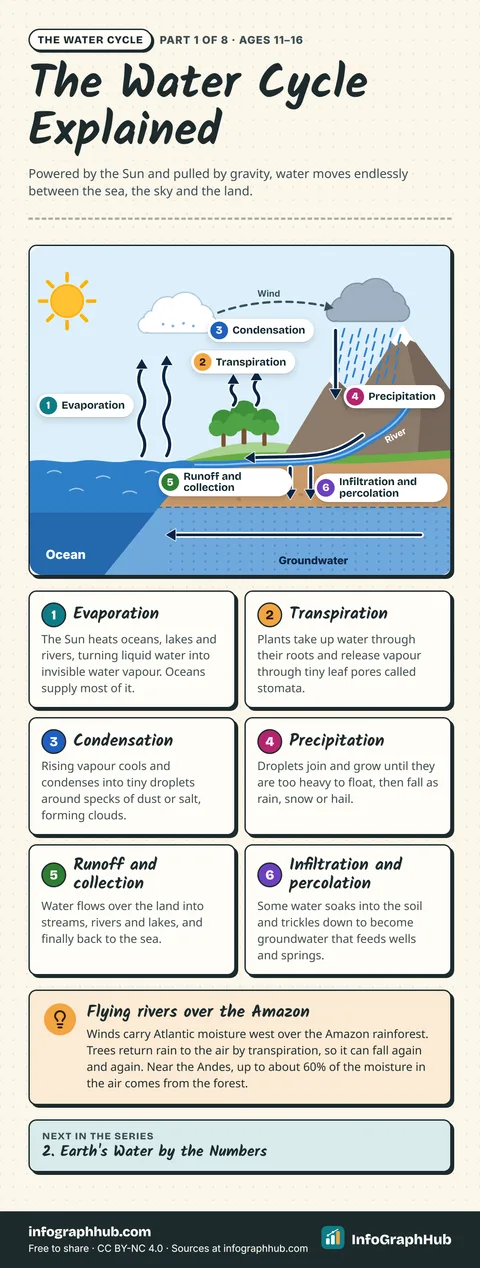
The water cycle is the non-stop movement of water between oceans, air and land. Powered by the Sun, water evaporates, condenses into clouds, falls as rain or snow, and flows or soaks back towards rivers, groundwater and the sea.
 Science
How Clouds Form
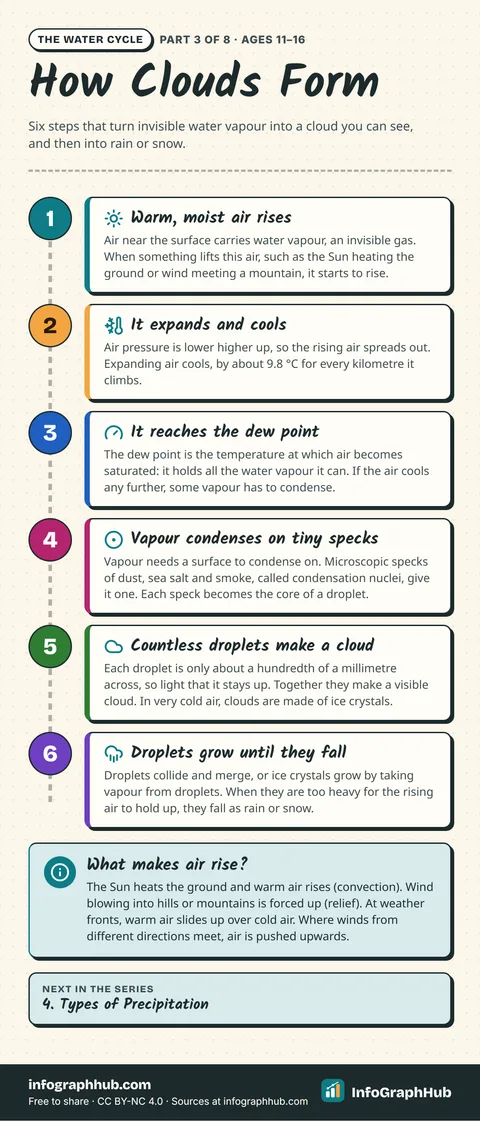
How does invisible water vapour become a cloud? Moist air rises, expands and cools to its dew point, then vapour condenses on specks of dust, salt and smoke into tiny droplets or ice crystals that grow until they fall as rain or snow.
 Science
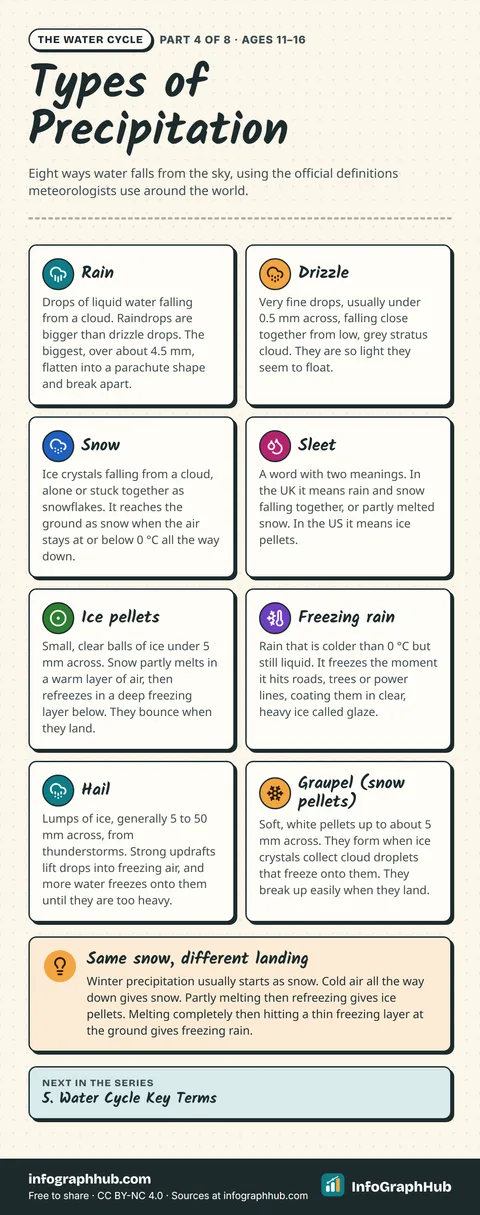
Types of Precipitation
Rain, drizzle, snow, sleet, ice pellets, freezing rain, hail and graupel: what each one is, how it forms and how to tell them apart, with official definitions and a warning that 'sleet' means different things in the UK and the US.
 Science
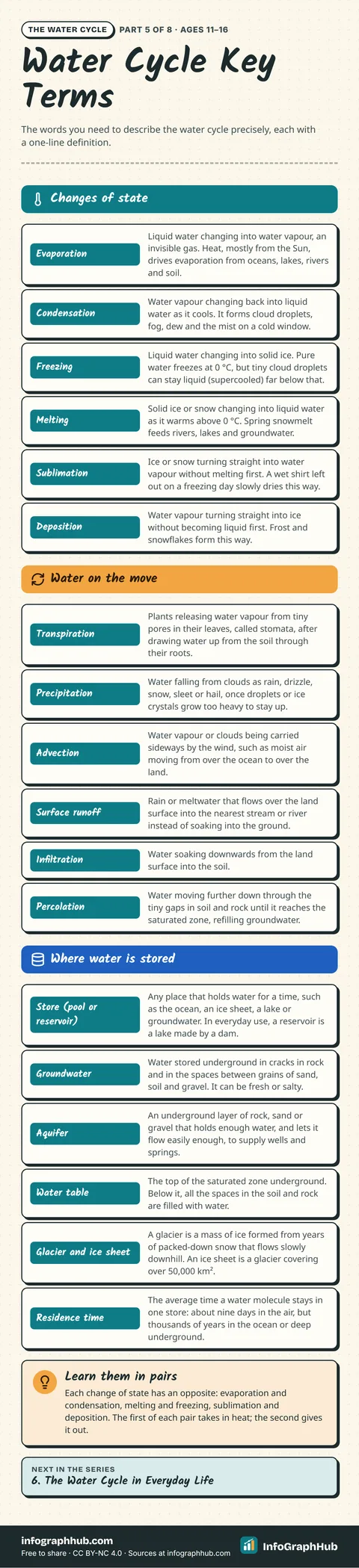
Water Cycle Key Terms
A cheat sheet of 18 water cycle key terms with precise one-line definitions, grouped into changes of state, water on the move and where water is stored, from evaporation and sublimation to advection, aquifers and residence time.
 Science
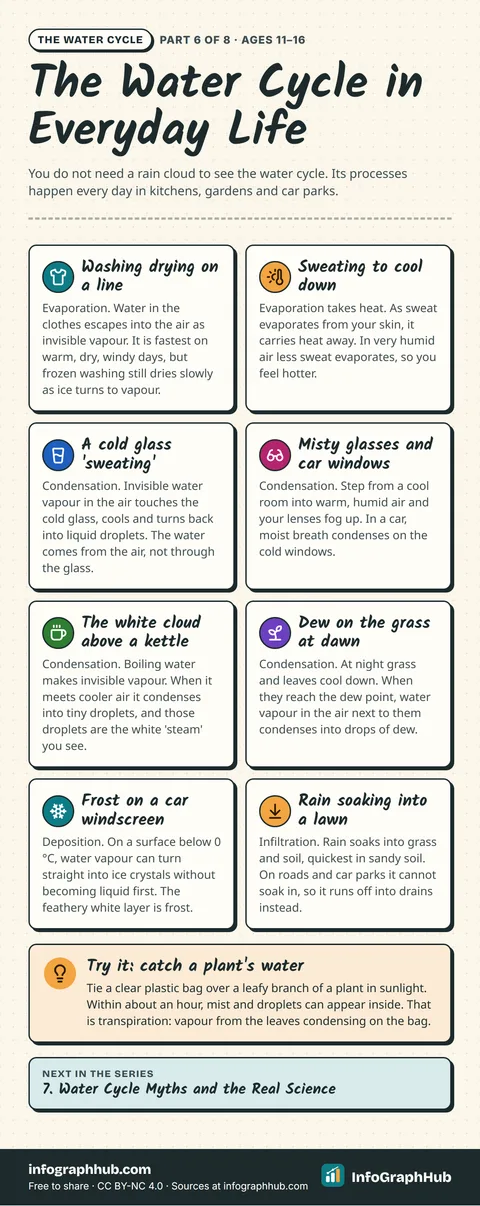
The Water Cycle in Everyday Life
You can watch the water cycle at home and outside every day: washing drying, a cold glass 'sweating', the white cloud above a kettle, dew, frost and rain soaking into a lawn. Each one shows a real process, from evaporation to deposition.
 Science
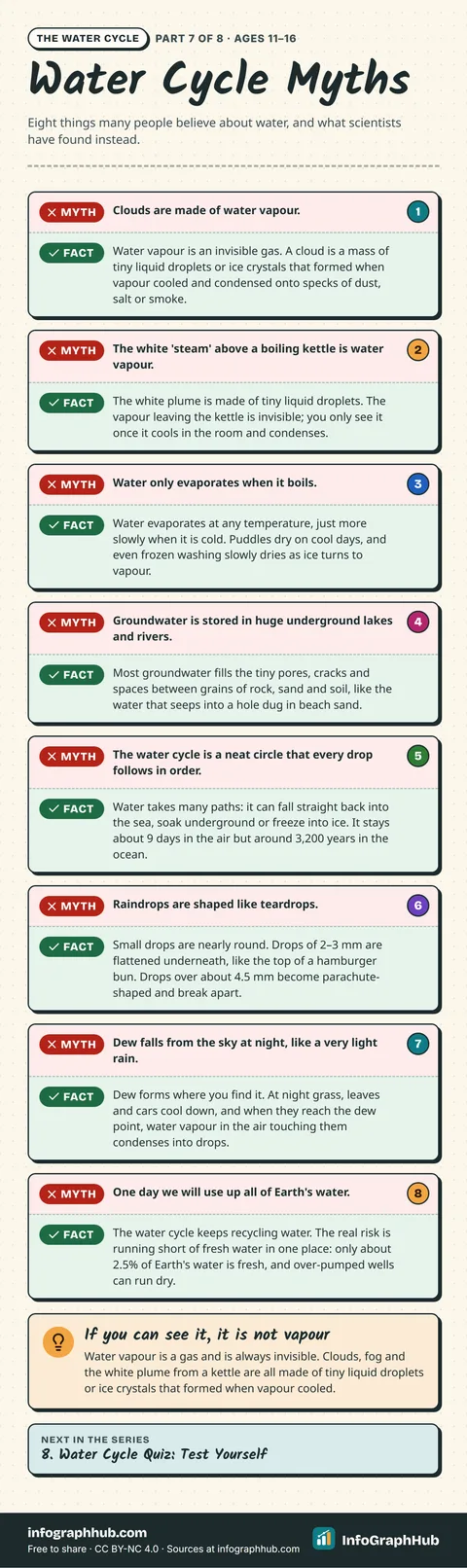
Water Cycle Myths and the Real Science
Eight common water cycle myths, corrected with evidence: clouds are not water vapour, kettle 'steam' is droplets, water evaporates without boiling, groundwater fills pores rather than underground lakes, raindrops are not teardrops, and more.
For teachers and parents: new InfoGraphHub resources by email
One short email when new free resources go live. For adults (18+) only. No spam, no tracking in emails, unsubscribe anytime.