The Water Cycle in Everyday Life
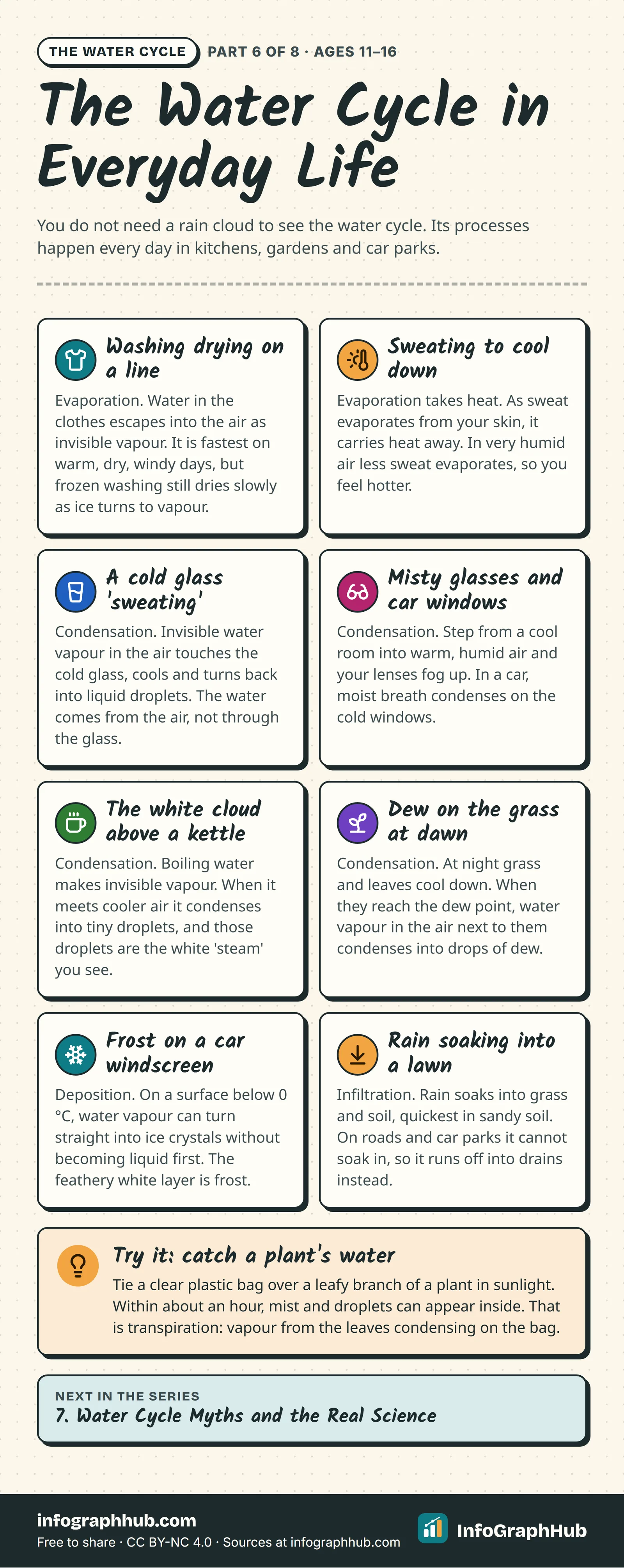
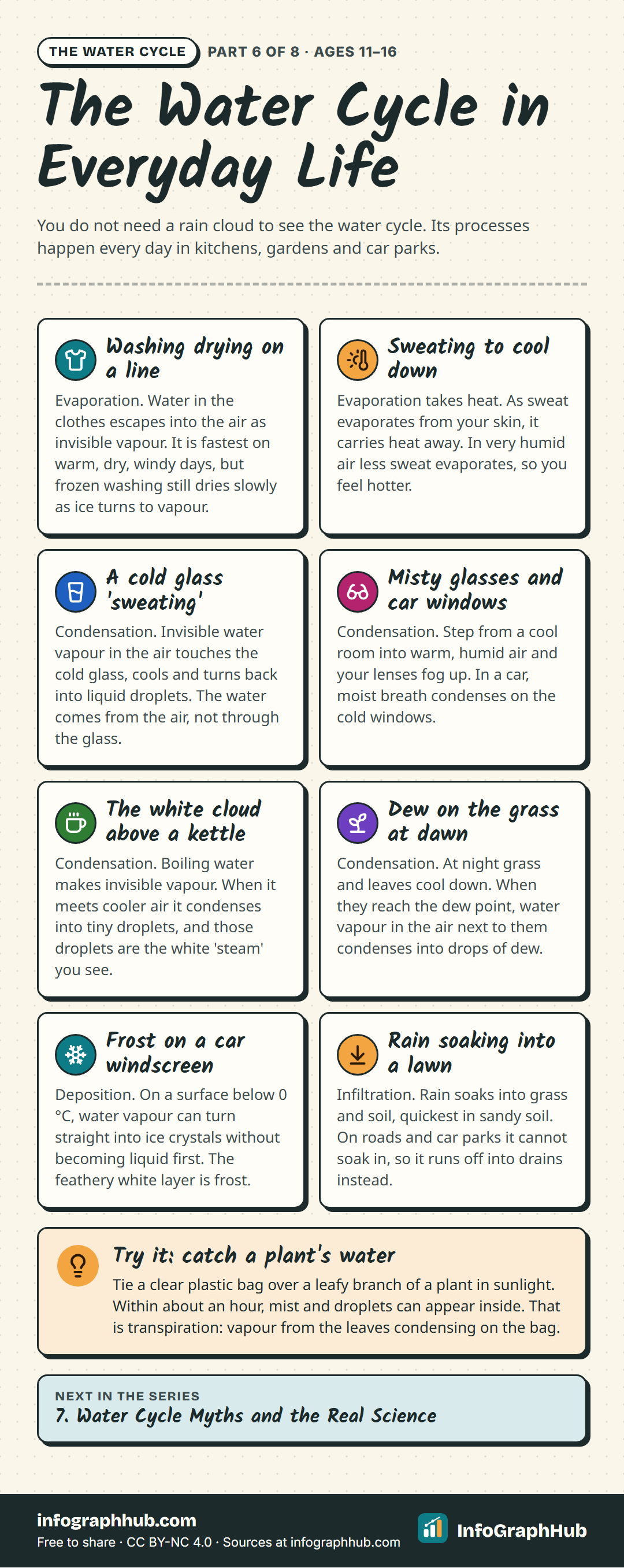
You can watch the water cycle at home and outside every day: washing drying, a cold glass 'sweating', the white cloud above a kettle, dew, frost and rain soaking into a lawn. Each one shows a real process, from evaporation to deposition.
Part 6 of 8The Water Cycle series
Ages 11–16 · Grades 6–10 (US) · Years 7–11 (UK) · Classes 6–10 (India)
NGSS is a registered trademark of WestEd. Names and codes are used only to describe curriculum fit; InfoGraphHub is not endorsed by these organisations.
The same science, closer to home
The water cycle is usually drawn with oceans, mountains and rain clouds. But every stage of it is a change of state: liquid water turning into gas, gas turning back into liquid or ice, and water moving into the ground. Those changes do not need an ocean. They happen on a washing line, on a cold drink and on a frosty car, following exactly the same rules as in the sky.
One idea links almost everything on this infographic: the air around you always contains some water vapour, even on a clear day. You cannot see it, because water vapour is an invisible gas. What you can see are the droplets and ice crystals that form when that vapour cools.
Evaporation: water leaving as vapour
Evaporation happens when water molecules gain enough energy to break away from the liquid and escape into the air as vapour. Water evaporates fastest at its boiling point, 100 °C, but it evaporates at any temperature, only more slowly when it is cold. That is why a puddle dries up on a mild day and wet clothes dry on a line.
Water evaporates more easily into dry air than into air that already holds a lot of vapour, and wind helps by carrying away the damp air next to a wet surface. So washing dries best on a warm, dry, breezy day. Even on a day below freezing, frozen washing slowly dries as the ice turns straight into vapour. This is called sublimation.
Evaporation also takes heat away. The US National Weather Service explains that when sweat evaporates from your skin, it lowers your body temperature. When the air is very humid, sweat evaporates more slowly, which is one reason a humid day feels hotter than a dry day at the same temperature.
Condensation: vapour turning back into liquid
Condensation is the opposite of evaporation. When air containing water vapour is cooled enough, some of the vapour turns back into liquid droplets.
- A cold glass on a humid day gets wet on the outside. The water has not leaked through the glass: it came from vapour in the air that cooled when it touched the cold surface.
- Glasses steam up when you walk from a cool, air-conditioned room into warm, humid air.
- Car windows mist up on the inside, especially after people have been breathing out moist air.
- The white cloud above a boiling kettle is not water vapour. The vapour leaving the kettle is invisible; the white plume is made of tiny liquid droplets that form as it meets the cooler air of the room.
A cloud in the sky forms in a similar way, when rising air cools and vapour condenses onto tiny specks of dust, salt or smoke.
Dew and frost on cold nights
At night, grass, leaves and cars cool down. When a surface cools to the dew point, water vapour in the air touching it condenses into drops of dew. Dew is most likely to form at night, but it can form whenever the dew point is reached.
When the temperature is below freezing (0 °C), something different can happen. Water vapour can change straight into ice crystals on a cold surface, without becoming liquid first. This is deposition, and the feathery white layer it leaves on a windscreen or a lawn is frost. Snowflakes grow by deposition too.
Where the rain goes after it lands
Watch a garden during a shower and you can see infiltration: rain soaking into the soil. How much soaks in depends on the ground. Sandy soil lets water in quickly, while clay absorbs less water and more slowly. Soil that is already soaked from earlier rain behaves like a wet sponge and cannot take much more.
Hard surfaces such as roads and car parks let almost no water in. The rain runs straight off into storm drains, which carry it quickly into streams. That is surface runoff. Water that does soak in can feed groundwater, which seeps slowly into rivers and keeps them flowing even after weeks without rain.
Seeing transpiration for yourself
Plants take water up through their roots and release water vapour through tiny pores in their leaves called stomata. This is transpiration, and because the vapour is invisible you normally cannot see it. A clear plastic bag tied over a leafy branch in sunlight makes it visible: the vapour condenses on the inside of the bag, and mist can appear within about an hour.
The amounts are large. The US Geological Survey estimates that a big oak tree can transpire about 151,000 litres of water in a year.
Frequently asked questions
Why does a cold drink get wet on the outside?
Water vapour in the air touches the cold glass or can, cools and condenses into liquid droplets. The water comes from the air around the glass, not from the drink inside.
Is the white cloud from a kettle water vapour?
No. Water vapour is invisible. The white plume is made of tiny liquid droplets that form when the hot vapour from the kettle meets cooler air and condenses.
Why does washing dry faster on a windy day?
Wind carries away the damp air next to the wet clothes and replaces it with drier air. Water evaporates more easily into dry air, so the clothes dry faster.
What is the difference between dew and frost?
Dew forms when water vapour condenses into liquid drops on a surface that has cooled to the dew point. Frost forms below freezing, when water vapour turns straight into ice crystals without becoming liquid first. That change is called deposition.
Why do I feel hotter on a humid day?
Your body cools down when sweat evaporates from your skin. When the air already holds a lot of water vapour, sweat evaporates more slowly, so less heat is carried away and you feel hotter.
Sources & methodology
Every fact is checked against the sources below. We write original explanations and draw original graphics; no figures are copied from textbooks. Spotted an error? See our corrections policy.
- Evaporation and the Water Cycle (U.S. Geological Survey (USGS) Water Science School, accessed 1 Oct 2026)
- Condensation and the Water Cycle (U.S. Geological Survey (USGS) Water Science School, accessed 1 Oct 2026)
- Sublimation and the Water Cycle (U.S. Geological Survey (USGS) Water Science School, accessed 1 Oct 2026)
- Evapotranspiration and the Water Cycle (U.S. Geological Survey (USGS) Water Science School, accessed 1 Oct 2026)
- Infiltration and the Water Cycle (U.S. Geological Survey (USGS) Water Science School, accessed 1 Oct 2026)
- What is the heat index? (US National Weather Service (NOAA), accessed 1 Oct 2026)
- It's Just a Phase: Modeling the Phases of Water (UCAR Center for Science Education, accessed 1 Oct 2026)
- Dew (National Geographic Education, accessed 1 Oct 2026)
Editorial review pending · Updated
Embed this on your site
Paste this HTML into your page. Keep the credit line: it is required by the CC BY-NC 4.0 license.
Related infographics
 Science
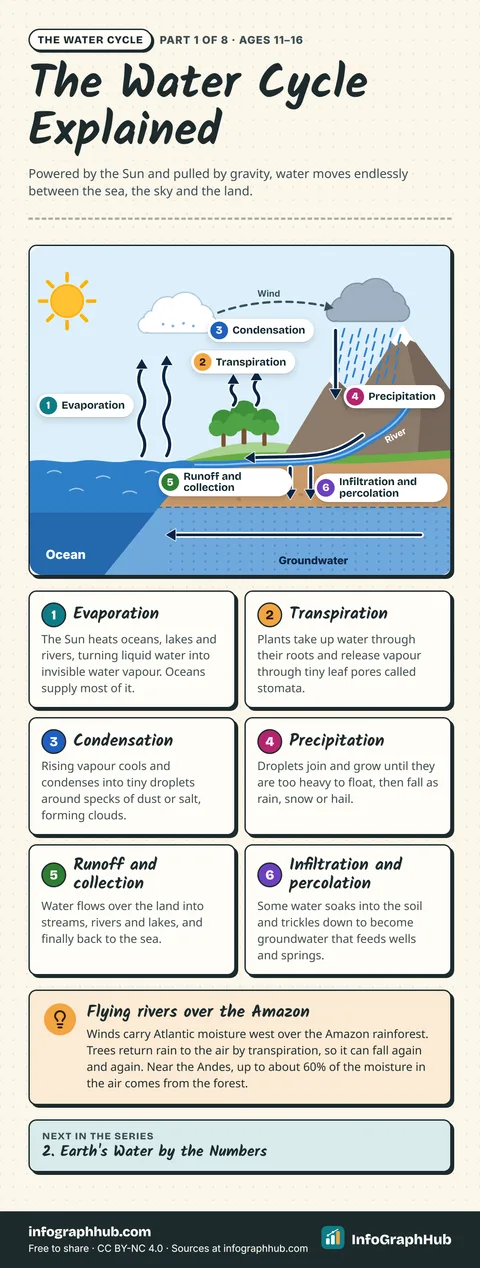
The Water Cycle Explained
The water cycle is the non-stop movement of water between oceans, air and land. Powered by the Sun, water evaporates, condenses into clouds, falls as rain or snow, and flows or soaks back towards rivers, groundwater and the sea.
 Science
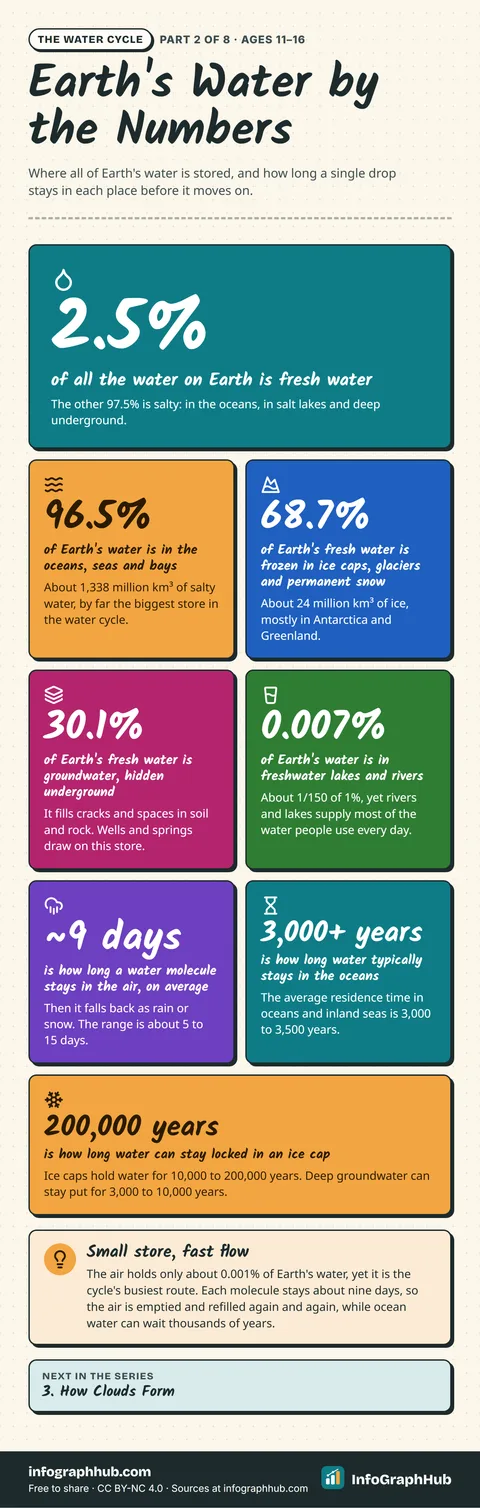
Earth's Water by the Numbers
Where is all of Earth's water, and how long does it stay there? Only 2.5% is fresh, most of that is frozen or underground, and a drop can spend nine days in the air or thousands of years in the ocean or an ice cap.
 Science
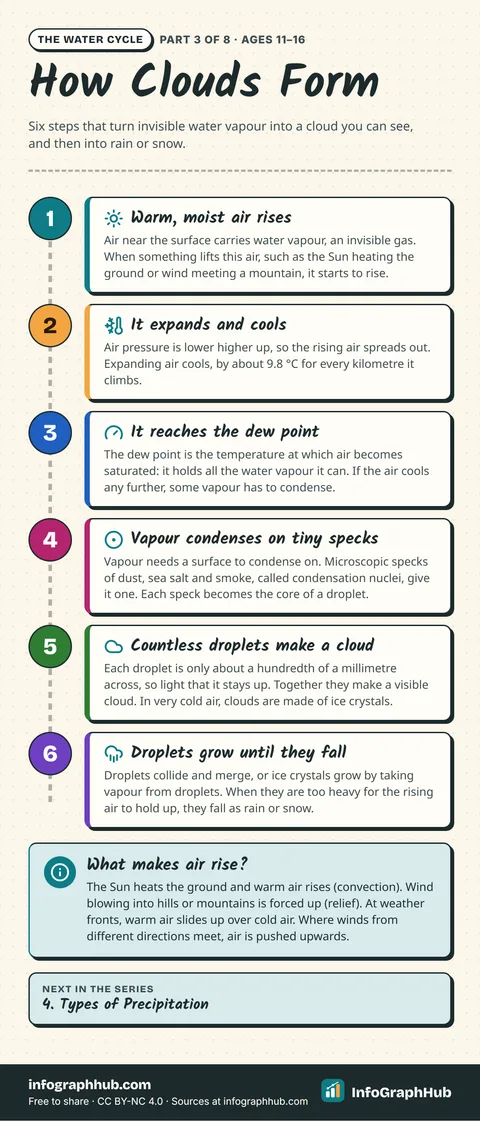
How Clouds Form
How does invisible water vapour become a cloud? Moist air rises, expands and cools to its dew point, then vapour condenses on specks of dust, salt and smoke into tiny droplets or ice crystals that grow until they fall as rain or snow.
 Science
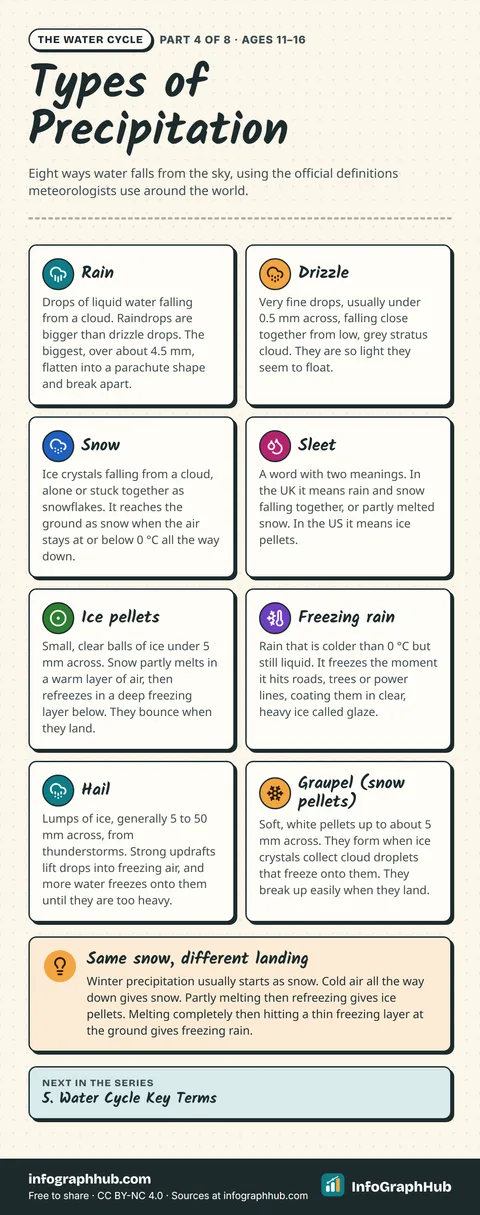
Types of Precipitation
Rain, drizzle, snow, sleet, ice pellets, freezing rain, hail and graupel: what each one is, how it forms and how to tell them apart, with official definitions and a warning that 'sleet' means different things in the UK and the US.
 Science
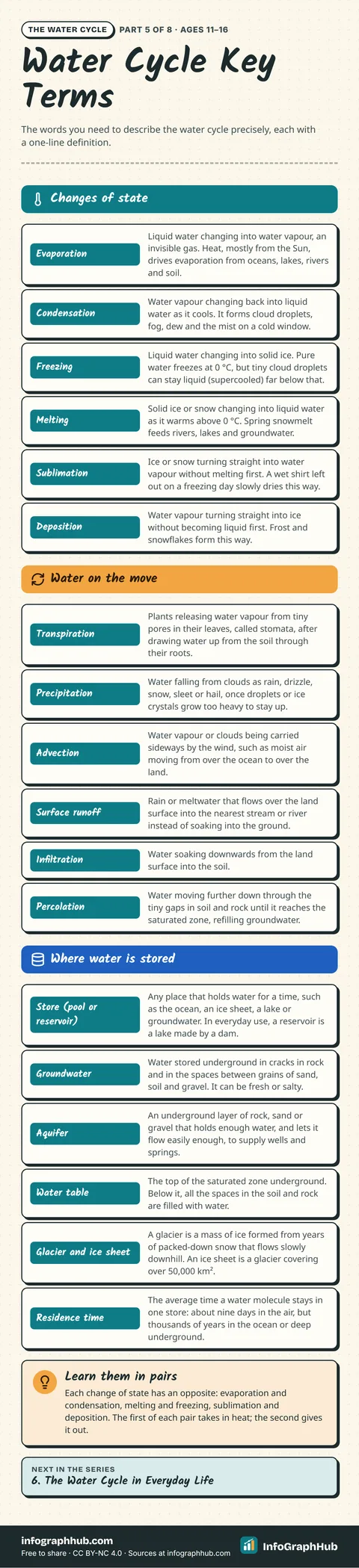
Water Cycle Key Terms
A cheat sheet of 18 water cycle key terms with precise one-line definitions, grouped into changes of state, water on the move and where water is stored, from evaporation and sublimation to advection, aquifers and residence time.
 Science
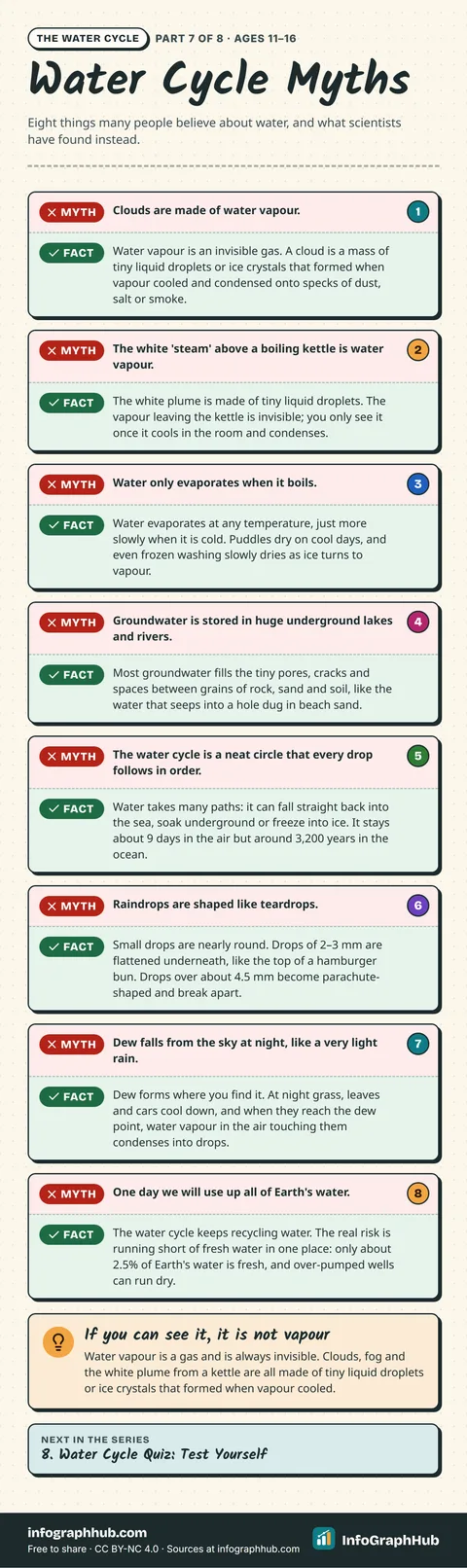
Water Cycle Myths and the Real Science
Eight common water cycle myths, corrected with evidence: clouds are not water vapour, kettle 'steam' is droplets, water evaporates without boiling, groundwater fills pores rather than underground lakes, raindrops are not teardrops, and more.
For teachers and parents: new InfoGraphHub resources by email
One short email when new free resources go live. For adults (18+) only. No spam, no tracking in emails, unsubscribe anytime.