Water Cycle Key Terms
A cheat sheet of 18 water cycle key terms with precise one-line definitions, grouped into changes of state, water on the move and where water is stored, from evaporation and sublimation to advection, aquifers and residence time.
Part 5 of 8The Water Cycle series
Ages 11–16 · Grades 6–10 (US) · Years 7–11 (UK) · Classes 6–10 (India)
NGSS is a registered trademark of WestEd. Names and codes are used only to describe curriculum fit; InfoGraphHub is not endorsed by these organisations.
Why the exact words matter
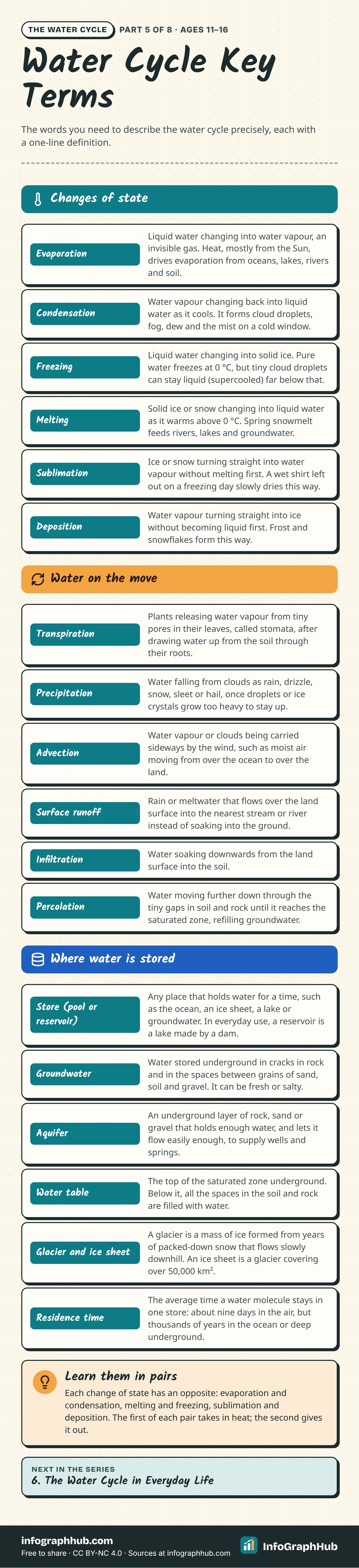
In science, each water cycle word names one particular change or movement. 'The water goes into the ground' could mean infiltration, percolation or groundwater recharge, and each means something slightly different. Using the precise term shows exactly what you mean, and it is what teachers and examiners look for.
This cheat sheet sorts the key terms into three groups: how water changes state, how water moves from place to place, and where water is stored.
Changes of state come in pairs
Water exists as a solid (ice), a liquid and a gas (water vapour). The six changes of state form three pairs of opposites:
| Change | Opposite |
|---|---|
| Evaporation: liquid to gas | Condensation: gas to liquid |
| Melting: solid to liquid | Freezing: liquid to solid |
| Sublimation: solid to gas | Deposition: gas to solid |
The changes in the left-hand column take in heat energy, and their opposites give it out again. That is why evaporation from your skin cools you down, and why the Sun's energy is needed to keep the water cycle running. Sublimation and deposition skip the liquid stage completely. Frost on a cold morning is deposition; snow slowly vanishing on a freezing, sunny day without melting is sublimation.
Words that are easy to mix up
- Evaporation, transpiration and evapotranspiration: evaporation comes from water surfaces and soil, transpiration comes from plant leaves, and evapotranspiration is the two added together.
- Condensation and precipitation: condensation makes cloud droplets; precipitation is when those droplets (or ice crystals) have grown heavy enough to fall.
- Infiltration and percolation: infiltration is water entering the soil at the surface; percolation is its slower journey deeper through gaps in soil and rock.
- Groundwater, water table and aquifer: groundwater is the water itself, the water table is the top of the fully soaked zone, and an aquifer is the rock or sediment layer that holds enough of it to supply wells and springs.
- Store and reservoir: scientists often call any place that holds water a store, pool or reservoir. In everyday language, a reservoir is a lake made by building a dam across a river.
Putting the terms together
Try following one water molecule using the precise words. It evaporates from the sea and is carried inland by the wind (advection). As the air rises and cools, it condenses onto a speck of dust and becomes part of a cloud. It grows, then falls as precipitation. On the ground it infiltrates the soil and percolates down past the water table into an aquifer.
There its residence time might be 100 to 200 years in shallow groundwater, or thousands of years if it sinks deep. One day it seeps into a river, flows back to the sea as runoff and is ready to evaporate again. Telling the story with these words is a good way to revise: if you can explain each step in one sentence, you know the cycle.
Frequently asked questions
What is the opposite of sublimation?
Deposition. Sublimation is ice turning straight into water vapour; deposition is water vapour turning straight into ice, as when frost forms.
What is the difference between an aquifer and the water table?
An aquifer is an underground layer of rock, sand or gravel that holds and passes on enough water to supply wells and springs. The water table is the top of the saturated zone, where the ground becomes completely soaked.
What is evapotranspiration?
It is the total amount of water turned into vapour and released to the air from a piece of land: evaporation from water and soil plus transpiration from plants.
What does advection mean in the water cycle?
It means water vapour or clouds being carried sideways by the wind, for example from over the ocean to over the land, where the water can later fall as precipitation.
Sources & methodology
Every fact is checked against the sources below. We write original explanations and draw original graphics; no figures are copied from textbooks. Spotted an error? See our corrections policy.
- Glossary of Water Cycle Terms (U.S. Geological Survey (USGS) Water Science School, accessed 1 Oct 2026)
- Water Basics Glossary (U.S. Geological Survey (USGS), accessed 1 Oct 2026)
- Sublimation and the Water Cycle (U.S. Geological Survey (USGS) Water Science School, accessed 1 Oct 2026)
- Glossary: Advection (US National Weather Service, accessed 1 Oct 2026)
- Water Cycle (Understanding Global Change, University of California Museum of Paleontology, accessed 1 Oct 2026)
Editorial review pending · Updated
Embed this on your site
Paste this HTML into your page. Keep the credit line: it is required by the CC BY-NC 4.0 license.
Related infographics
 Science
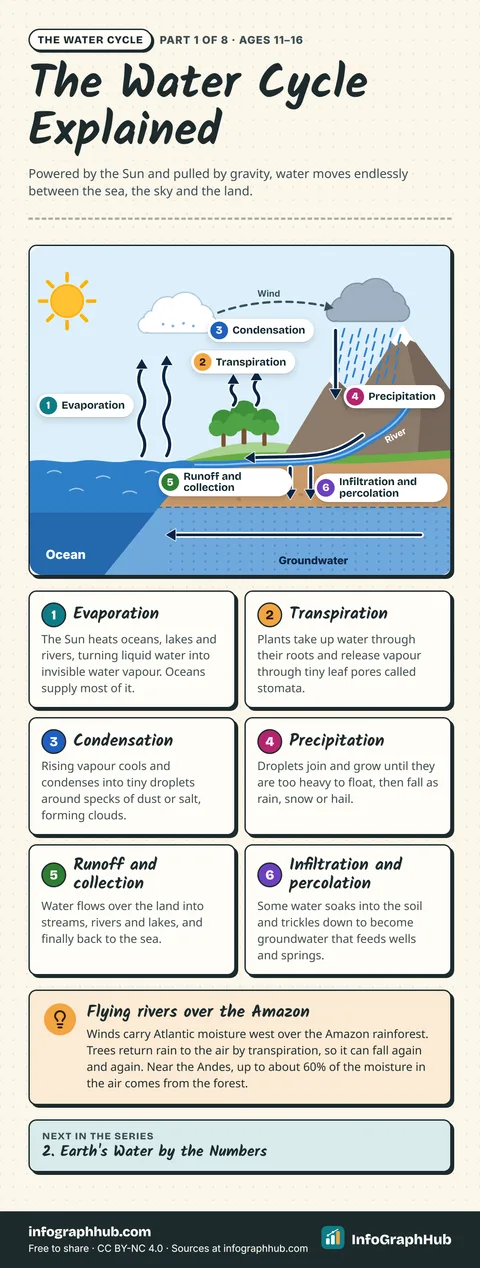
The Water Cycle Explained
The water cycle is the non-stop movement of water between oceans, air and land. Powered by the Sun, water evaporates, condenses into clouds, falls as rain or snow, and flows or soaks back towards rivers, groundwater and the sea.
 Science
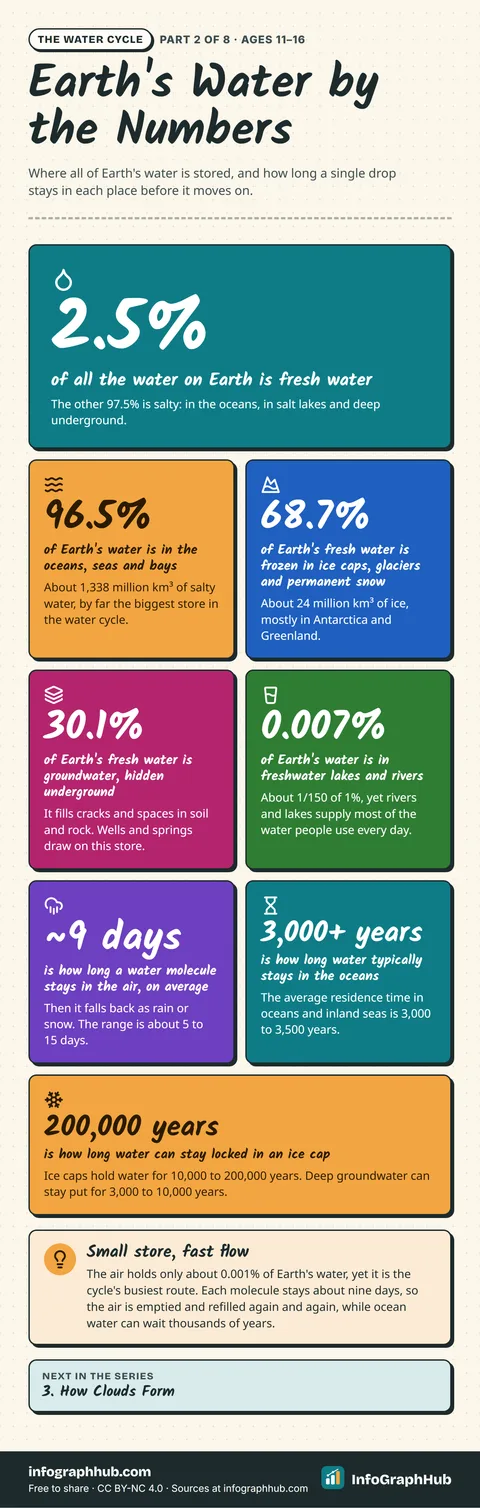
Earth's Water by the Numbers
Where is all of Earth's water, and how long does it stay there? Only 2.5% is fresh, most of that is frozen or underground, and a drop can spend nine days in the air or thousands of years in the ocean or an ice cap.
 Science
How Clouds Form
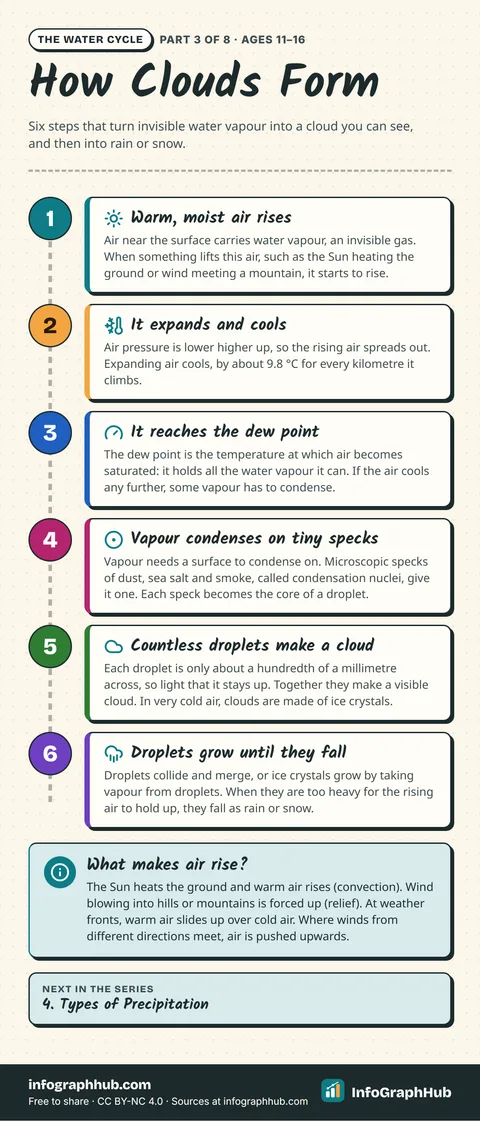
How does invisible water vapour become a cloud? Moist air rises, expands and cools to its dew point, then vapour condenses on specks of dust, salt and smoke into tiny droplets or ice crystals that grow until they fall as rain or snow.
 Science
Types of Precipitation
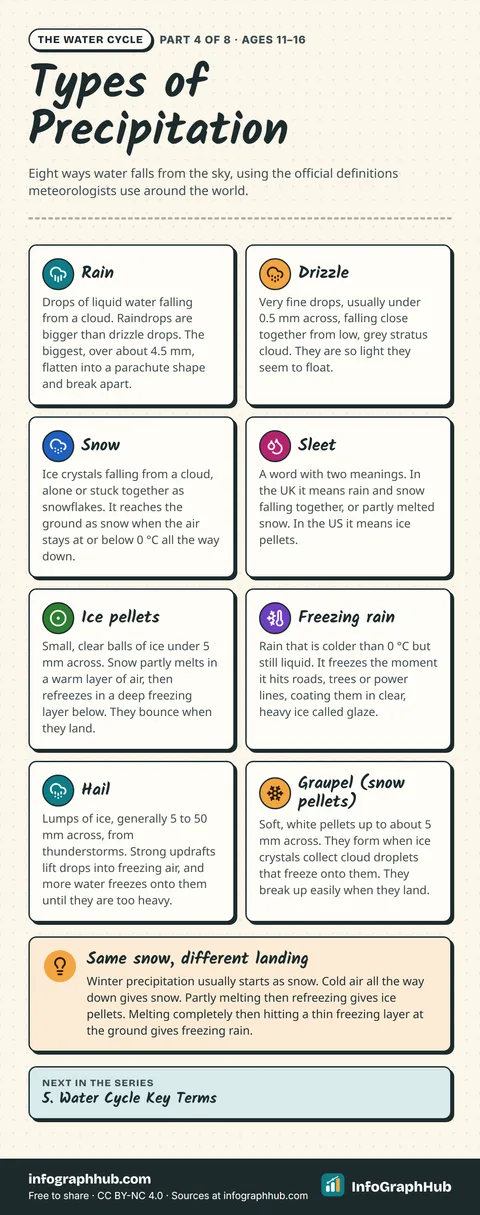
Rain, drizzle, snow, sleet, ice pellets, freezing rain, hail and graupel: what each one is, how it forms and how to tell them apart, with official definitions and a warning that 'sleet' means different things in the UK and the US.
 Science
The Water Cycle in Everyday Life
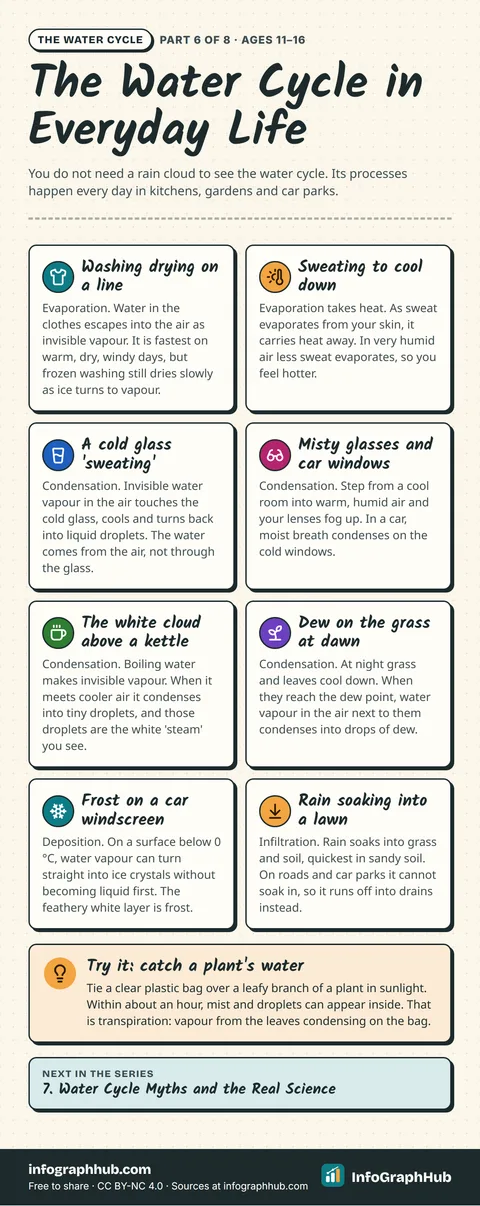
You can watch the water cycle at home and outside every day: washing drying, a cold glass 'sweating', the white cloud above a kettle, dew, frost and rain soaking into a lawn. Each one shows a real process, from evaporation to deposition.
 Science
Water Cycle Myths and the Real Science
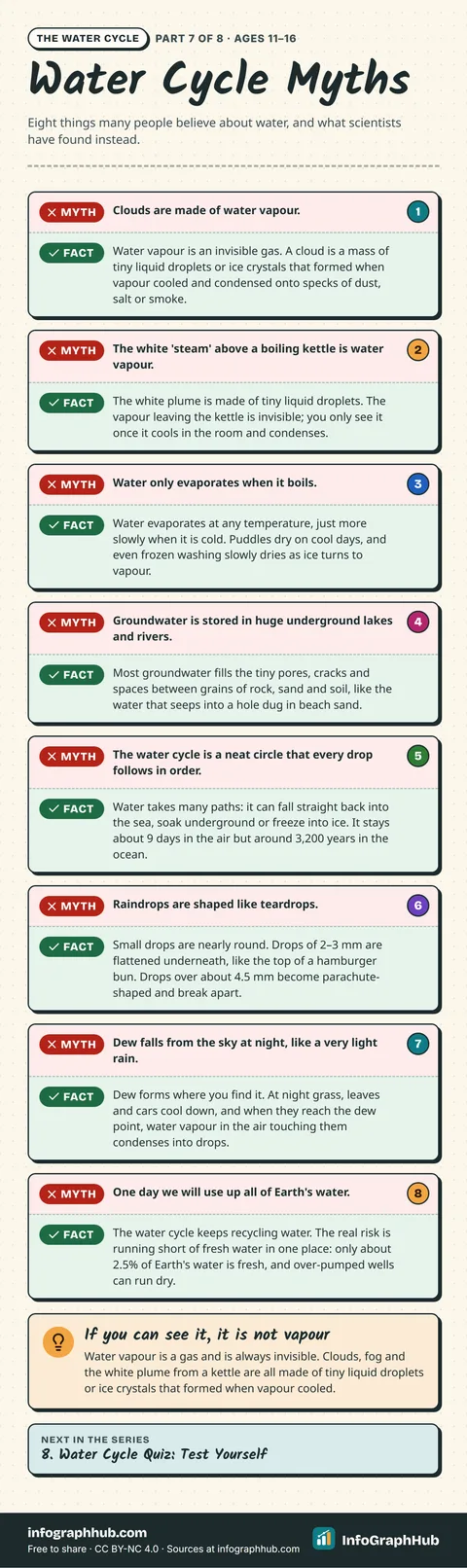
Eight common water cycle myths, corrected with evidence: clouds are not water vapour, kettle 'steam' is droplets, water evaporates without boiling, groundwater fills pores rather than underground lakes, raindrops are not teardrops, and more.
For teachers and parents: new InfoGraphHub resources by email
One short email when new free resources go live. For adults (18+) only. No spam, no tracking in emails, unsubscribe anytime.