How Clouds Form
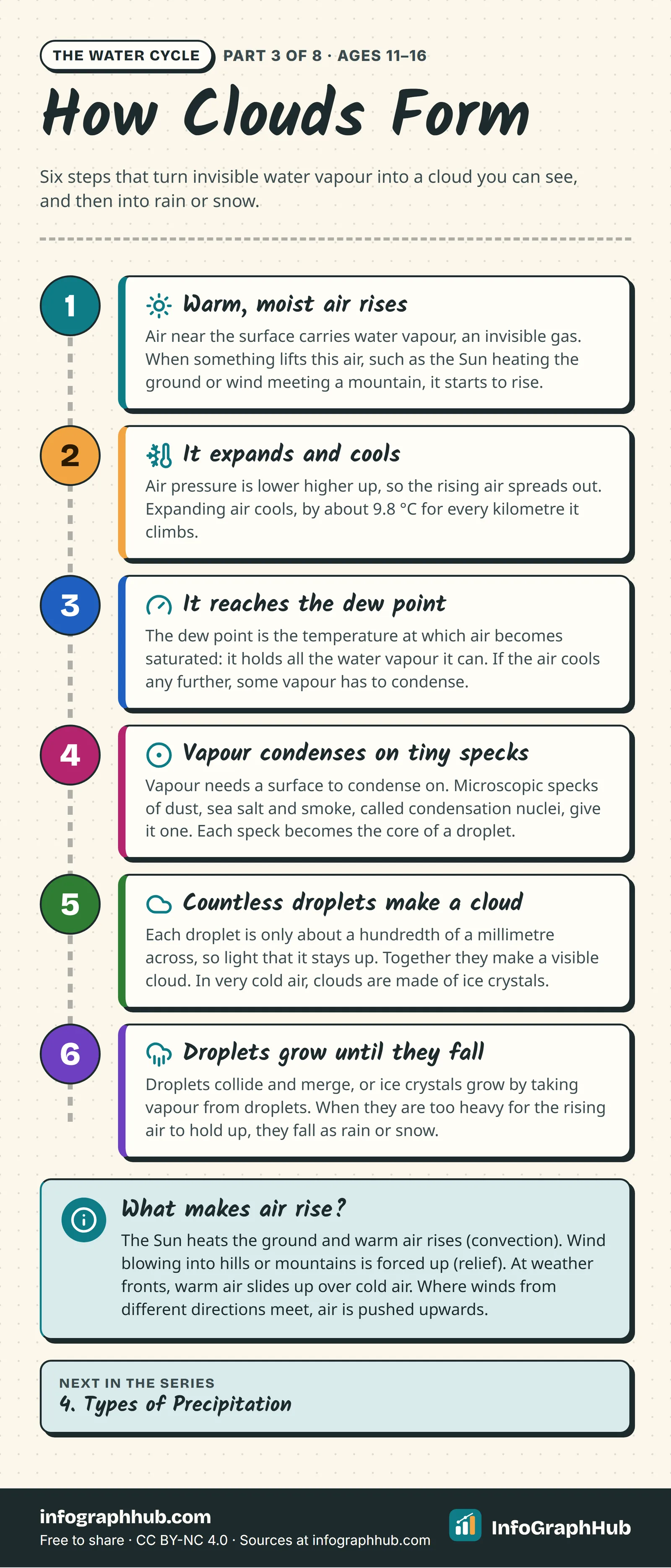
How does invisible water vapour become a cloud? Moist air rises, expands and cools to its dew point, then vapour condenses on specks of dust, salt and smoke into tiny droplets or ice crystals that grow until they fall as rain or snow.
Part 3 of 8The Water Cycle series
Ages 11–16 · Grades 6–10 (US) · Years 7–11 (UK) · Classes 6–10 (India)
NGSS is a registered trademark of WestEd. Names and codes are used only to describe curriculum fit; InfoGraphHub is not endorsed by these organisations.
A cloud is not made of vapour
Many people think clouds are made of water vapour, but water vapour is an invisible gas. It is all around you right now. A cloud is what you see when some of that vapour has condensed into tiny drops of liquid water, or frozen into tiny ice crystals. Every cloud is a huge crowd of these particles, held up in the air.
So the real question is: what makes invisible vapour turn into visible droplets? The answer is cooling, and the usual way air cools is by rising.
Why rising air cools
Air pressure is highest near the ground and falls as you go higher. When a block of air (meteorologists call it a parcel) rises, the pressure around it drops, so it expands. Expanding air cools, even though no heat has been taken away. This is called adiabatic cooling.
Until it becomes saturated, rising air cools by about 9.8 °C for every kilometre it climbs. NOAA gives an example: air at 30 °C near the ground, with a dew point of 18 °C, cools to saturation at about 1,200 metres (4,000 feet). Above that height, condensation can begin.
Reaching the dew point
The dew point is the temperature to which air must be cooled to become saturated. Saturated air holds as much water vapour as it can at that temperature, so any more cooling makes some of the vapour condense.
You can see the same thing at ground level. On a humid day, a glass of iced water quickly becomes wet on the outside. The glass cools the air touching it below its dew point, and vapour condenses on the cold surface. Fog, dew on grass in the morning and misty bathroom mirrors all form in the same way.
Every droplet needs a seed
Water molecules are far too small to clump together on their own. They need a surface to condense on. The air is full of microscopic particles that do this job, called cloud condensation nuclei: sea salt from ocean spray, dust, wind-blown soil, pollen and smoke from fires or volcanoes. Many of them attract water.
A nucleus is about one hundredth of the width of the droplet that forms on it, so a cloud droplet is still almost pure water. But every droplet has a speck of salt, dust or dirt at its heart. Droplets are constantly forming and evaporating at the edges of a cloud, which is why clouds keep changing shape.
From cloud droplet to raindrop
A typical cloud droplet is only about 0.01 to 0.02 millimetres across. It falls so slowly that rising air keeps it up, which is why clouds seem to float. A typical raindrop is about 2 millimetres across, which holds around a million times more water than a 0.02 mm droplet. Droplets grow in two main ways:
- Collision and coalescence: in warm clouds, larger droplets fall a little faster, bump into smaller ones and merge. This is the main way rain forms in the tropics.
- The ice crystal process: in cold clouds, droplets can stay liquid well below 0 °C (they are supercooled). Where ice crystals form among them, the crystals grow by taking up vapour at the droplets' expense. They fall as snow, which melts into rain if the air below is warm enough.
When a drop or crystal becomes too heavy for the rising air to support, it falls. That is precipitation, the subject of Part 4.
Frequently asked questions
Are clouds made of water vapour?
No. Water vapour is an invisible gas. Clouds are made of tiny drops of liquid water or tiny ice crystals that form when vapour condenses or freezes.
Why does rising air cool?
Air pressure is lower higher up, so rising air expands, and expanding air cools. Until it is saturated, it cools by about 9.8 °C for every kilometre it rises.
What are condensation nuclei?
They are microscopic particles in the air, such as sea salt, dust, pollen and smoke, that give water vapour a surface to condense on. Every cloud droplet forms around one.
If clouds are made of water, why don't they fall?
Cloud droplets are only about a hundredth of a millimetre across, so they fall extremely slowly and rising air keeps them up. They fall as rain only after growing much bigger.
Sources & methodology
Every fact is checked against the sources below. We write original explanations and draw original graphics; no figures are copied from textbooks. Spotted an error? See our corrections policy.
- How Clouds Form (NOAA / National Weather Service JetStream, accessed 1 Oct 2026)
- Clouds (Met Office, accessed 1 Oct 2026)
- How Clouds Form (UCAR Center for Science Education, accessed 1 Oct 2026)
- ESCI 241 Meteorology, Lesson 10: Precipitation (training notes) (US National Weather Service (hosted course notes), accessed 1 Oct 2026)
- Glossary: Dew Point (US National Weather Service, accessed 1 Oct 2026)
Editorial review pending · Updated
Embed this on your site
Paste this HTML into your page. Keep the credit line: it is required by the CC BY-NC 4.0 license.
Related infographics
 Science
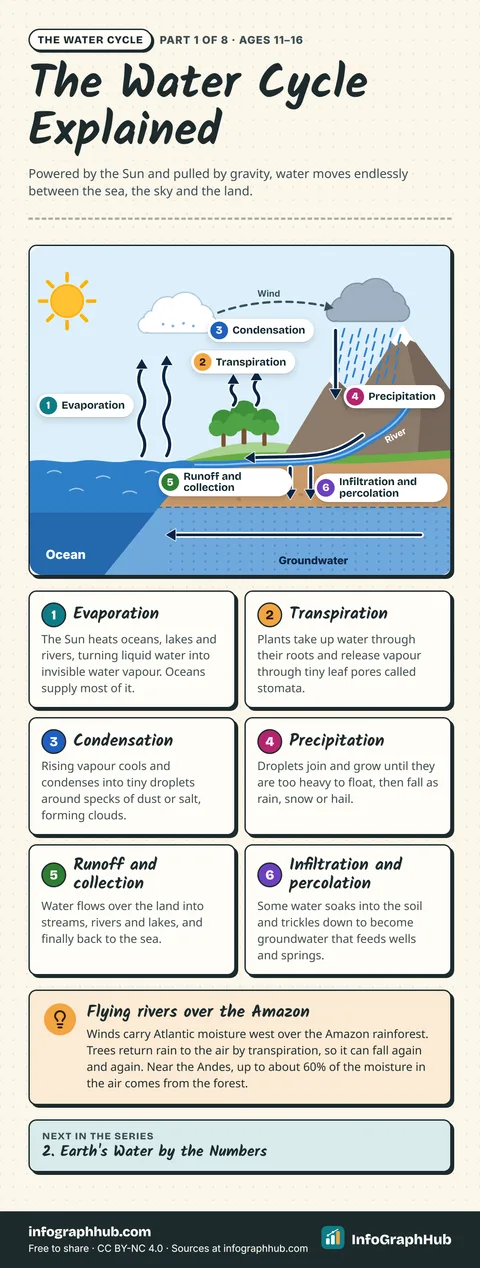
The Water Cycle Explained
The water cycle is the non-stop movement of water between oceans, air and land. Powered by the Sun, water evaporates, condenses into clouds, falls as rain or snow, and flows or soaks back towards rivers, groundwater and the sea.
 Science
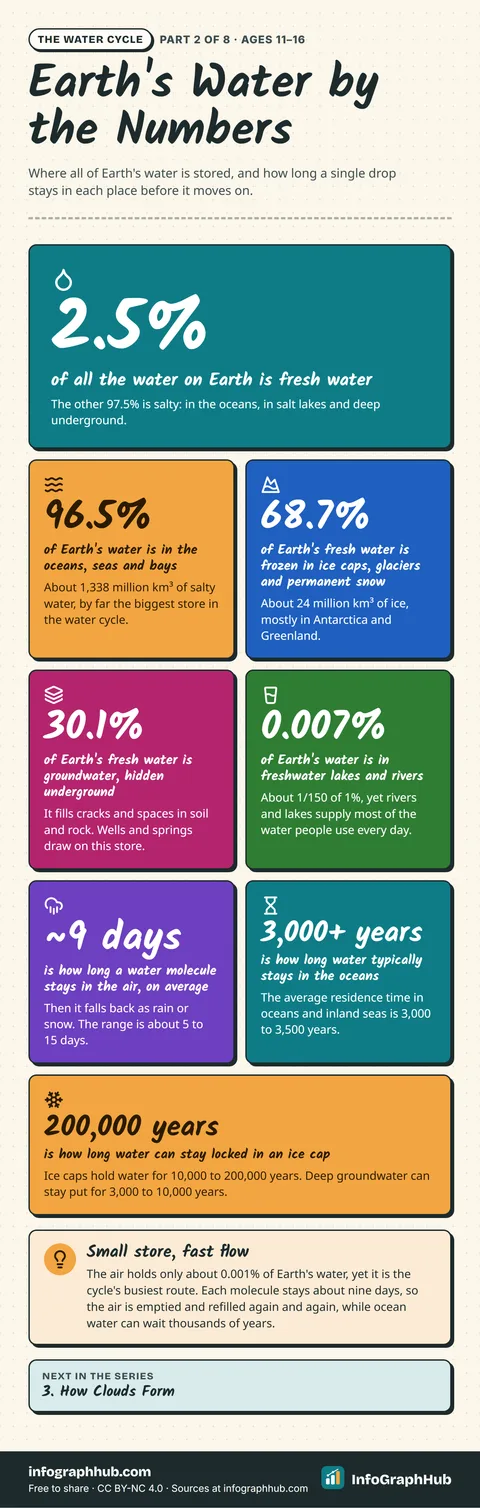
Earth's Water by the Numbers
Where is all of Earth's water, and how long does it stay there? Only 2.5% is fresh, most of that is frozen or underground, and a drop can spend nine days in the air or thousands of years in the ocean or an ice cap.
 Science
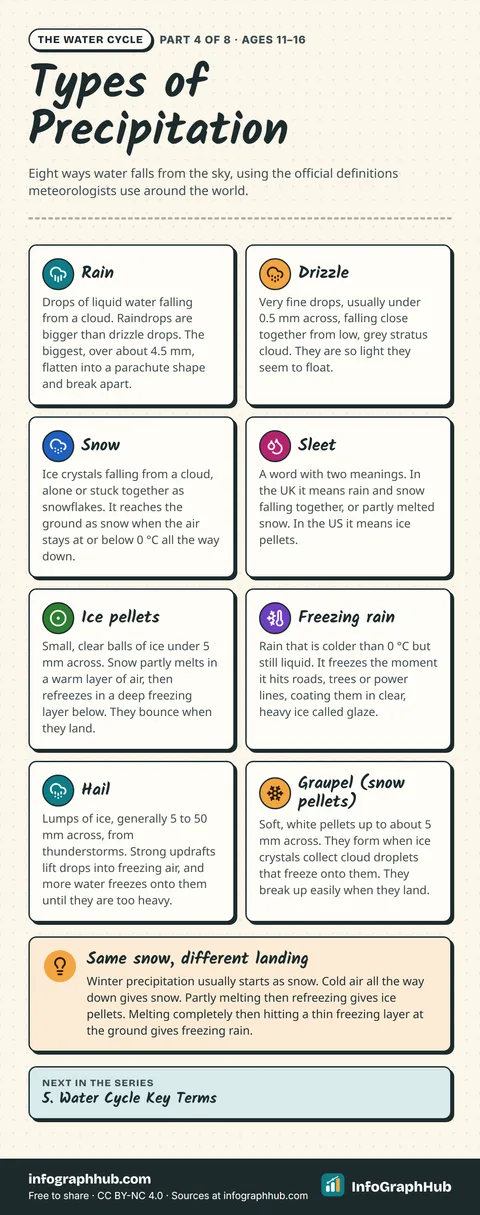
Types of Precipitation
Rain, drizzle, snow, sleet, ice pellets, freezing rain, hail and graupel: what each one is, how it forms and how to tell them apart, with official definitions and a warning that 'sleet' means different things in the UK and the US.
 Science
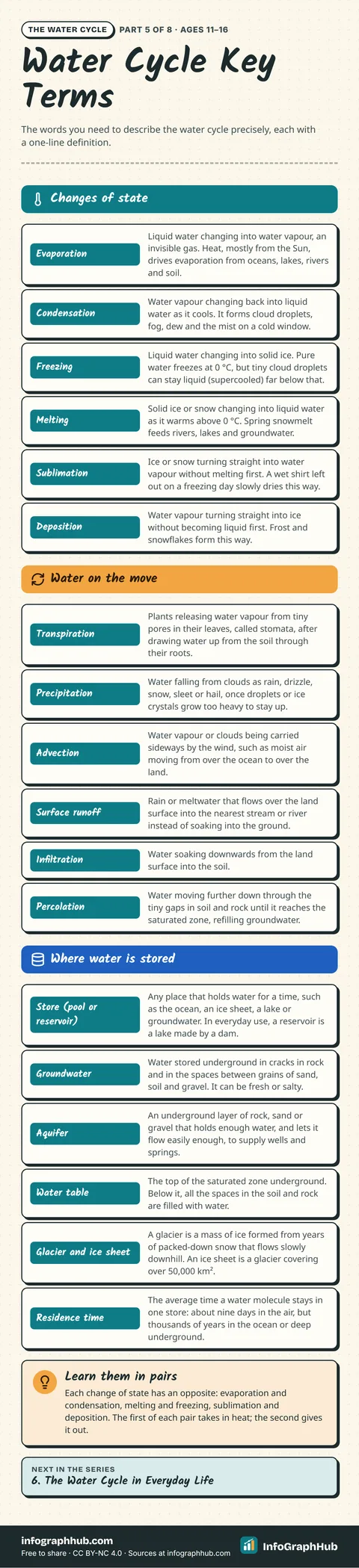
Water Cycle Key Terms
A cheat sheet of 18 water cycle key terms with precise one-line definitions, grouped into changes of state, water on the move and where water is stored, from evaporation and sublimation to advection, aquifers and residence time.
 Science
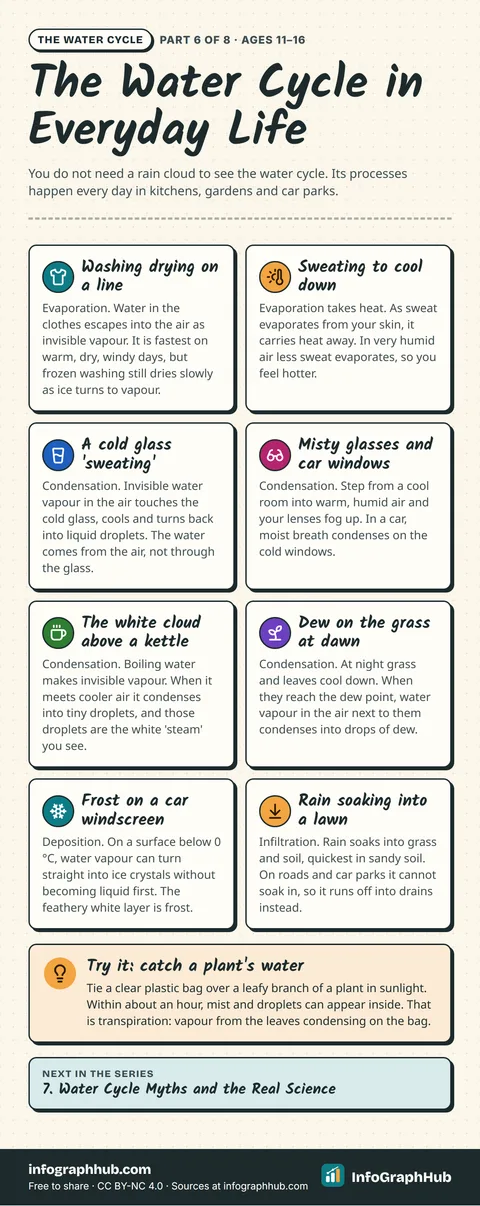
The Water Cycle in Everyday Life
You can watch the water cycle at home and outside every day: washing drying, a cold glass 'sweating', the white cloud above a kettle, dew, frost and rain soaking into a lawn. Each one shows a real process, from evaporation to deposition.
 Science
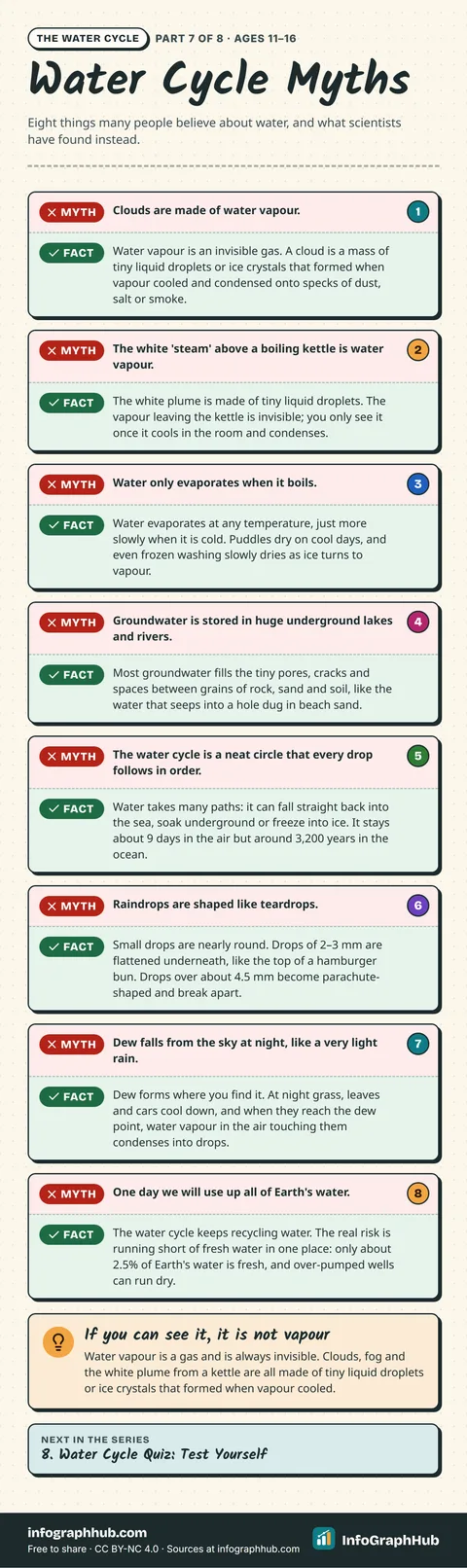
Water Cycle Myths and the Real Science
Eight common water cycle myths, corrected with evidence: clouds are not water vapour, kettle 'steam' is droplets, water evaporates without boiling, groundwater fills pores rather than underground lakes, raindrops are not teardrops, and more.
For teachers and parents: new InfoGraphHub resources by email
One short email when new free resources go live. For adults (18+) only. No spam, no tracking in emails, unsubscribe anytime.