Water Cycle Quiz: Test Yourself
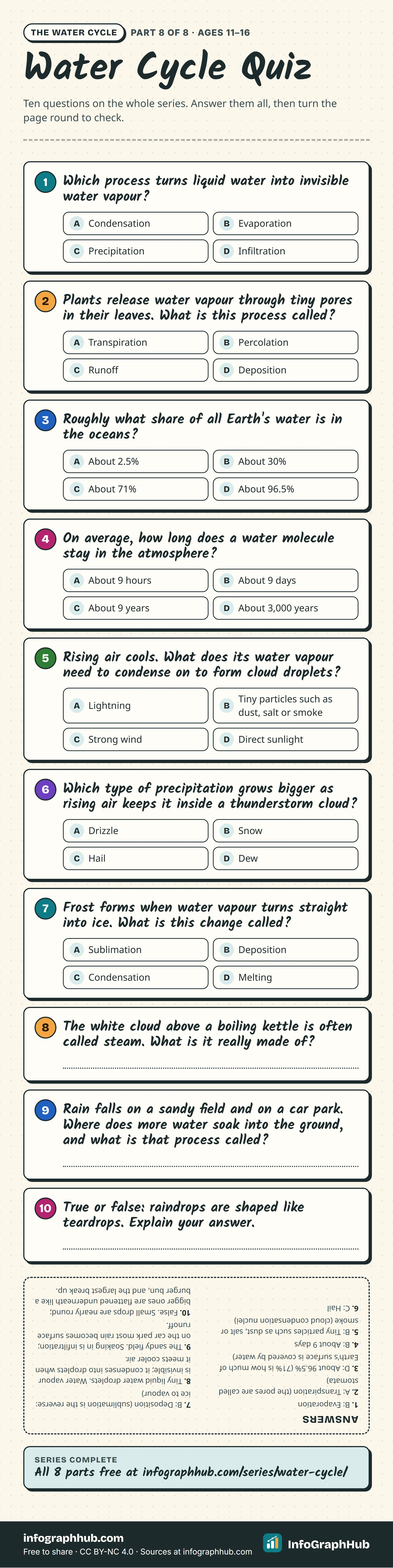
Ten questions covering the whole water cycle series: the main stages, where Earth's water is stored, how clouds form, hail, key terms and common myths. Seven are multiple choice and three need a short written answer, with a full worked answer key.
Part 8 of 8The Water Cycle series
Ages 11–16 · Grades 6–10 (US) · Years 7–11 (UK) · Classes 6–10 (India)
NGSS is a registered trademark of WestEd. Names and codes are used only to describe curriculum fit; InfoGraphHub is not endorsed by these organisations.
How to use this quiz
Try all ten questions before you look at the answers. Questions 1 to 7 are multiple choice; questions 8 to 10 need a short written answer, so write a sentence or two, not just one word. The answers are printed upside down at the foot of the infographic. The worked answers below explain why each answer is right, which is where most of the learning happens.
1. Evaporation
Answer: B, evaporation. Evaporation is the change from liquid water to water vapour, a gas. Heat gives water molecules enough energy to break away from the liquid. It happens fastest at boiling point but also at much lower temperatures, more slowly. Condensation is the opposite change, from vapour back to liquid.
2. Transpiration
Answer: A, transpiration. Plants take up water through their roots, move it through the plant, and release water vapour from their leaves through tiny pores called stomata. Scientists often add transpiration and evaporation from land together and call the total evapotranspiration. Percolation, by contrast, is water moving down through soil and rock.
3. Where Earth's water is
Answer: D, about 96.5 per cent. The oceans hold about 96.5 per cent of all Earth's water, according to the USGS. Option C, about 71 per cent, is a trap: that is how much of Earth's surface is covered by water, not how much of the water is in the oceans. Option A, about 2.5 per cent, is roughly the share of Earth's water that is fresh.
4. Time in the atmosphere
Answer: B, about 9 days. Water passes through the atmosphere quickly: on average a molecule spends only about nine days there before falling as precipitation. Other stores keep water far longer. A drop can spend over 3,000 years in the ocean.
5. How clouds form
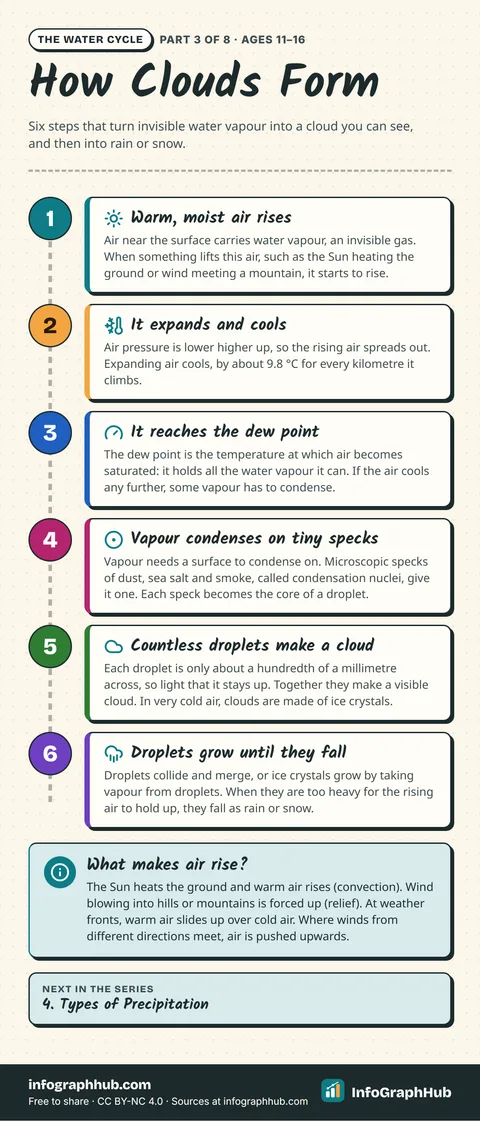
Answer: B, tiny particles such as dust, salt or smoke. As air rises it expands and cools. Once it cools to saturation, water vapour condenses, but water molecules on their own are too small to join up into droplets. They need a surface to condense on. Tiny particles called cloud condensation nuclei provide it. Lightning, wind and sunlight are not what makes the vapour condense.
6. Hail
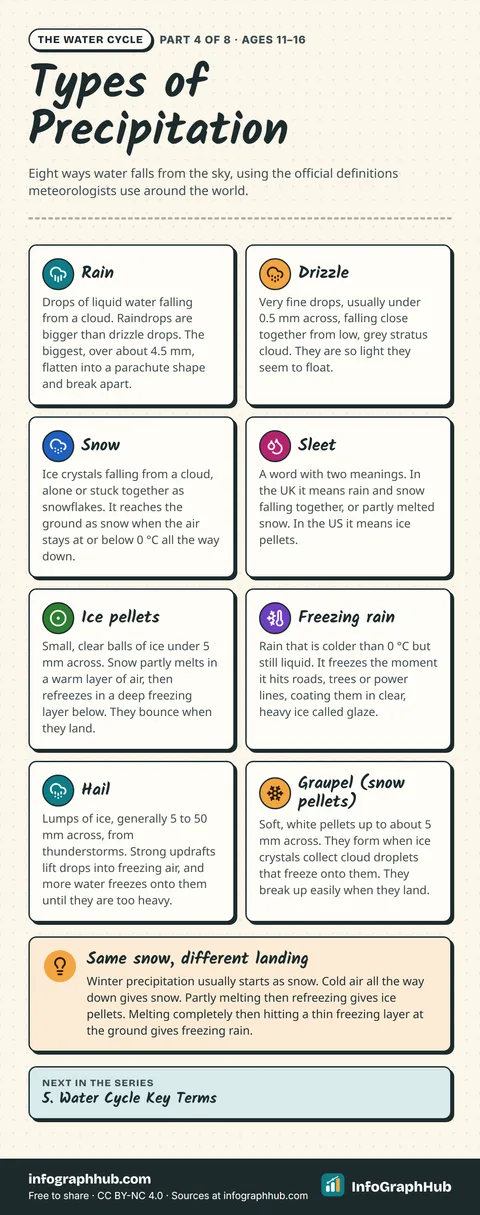
Answer: C, hail. Hail forms in thunderstorms. A frozen raindrop or a small ball of soft ice called graupel is kept from falling by strong rising air, called an updraft. The longer it stays in the cloud, the more water droplets freeze onto it and the bigger it gets. Snow and drizzle do not need a thunderstorm, and dew is not precipitation at all: it forms on surfaces.
7. Deposition
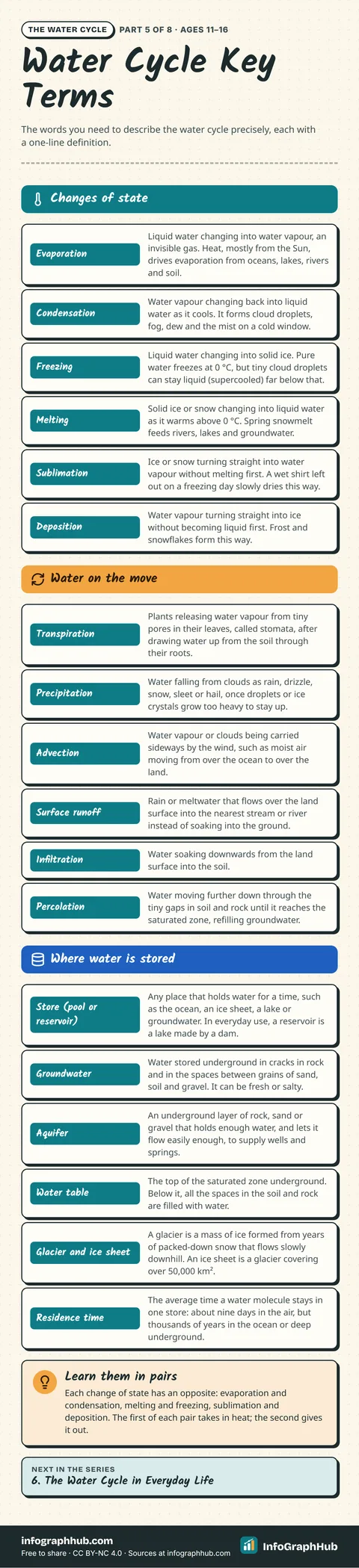
Answer: B, deposition. Deposition is water vapour changing straight into ice without becoming liquid first. It makes frost and snowflakes. Sublimation is the reverse: ice turning straight into vapour. It is easy to swap these two in an exam, so learn them as a pair.
8. Kettle 'steam'
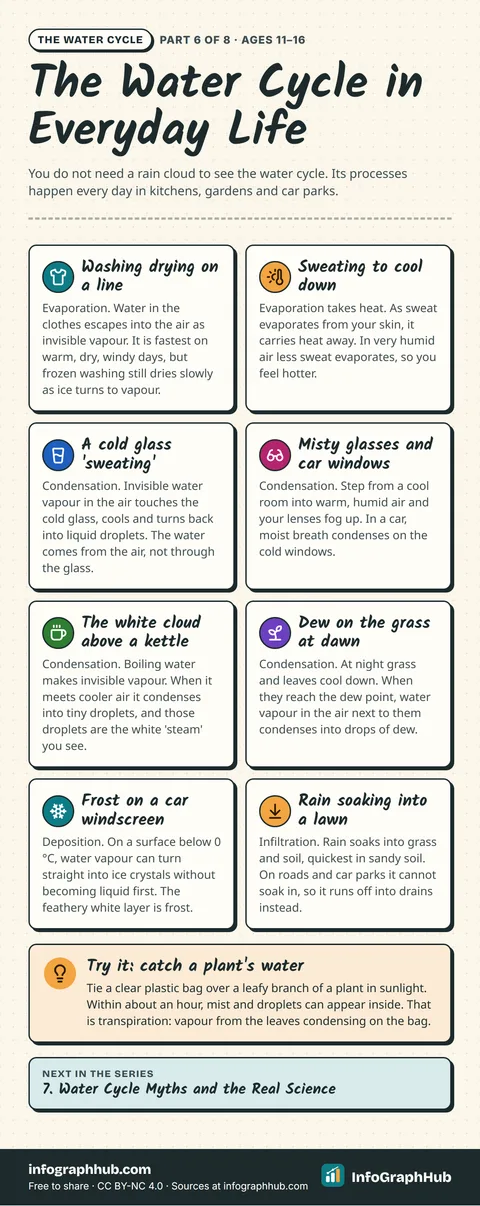
Model answer: The white cloud is made of tiny droplets of liquid water. Water vapour is an invisible gas; when the hot vapour from the kettle meets the cooler air of the room it condenses into droplets, and those are what you see. A good answer names condensation and says that vapour is invisible.
9. Infiltration and runoff
Model answer: More water soaks in on the sandy field. Soaking into the ground is called infiltration. Sandy soil lets water in quickly, while the hard surface of a car park lets almost none in, so the rain there becomes surface runoff and flows into drains. A full answer names both processes.
10. Raindrop shape
Model answer: False. Small raindrops are nearly round, held together by surface tension. As drops of 2 to 3 mm fall, air pushes on their underside and flattens them, so they look like the top of a hamburger bun. Drops larger than about 4.5 mm become parachute-shaped and break up into smaller drops. None of them is a teardrop.
Frequently asked questions
How can teachers use this quiz in class?
It works as a starter or plenary, as a check at the end of the water cycle topic, or as homework. Students can mark each other's answers using the answer strip, then use the worked answers to discuss any they got wrong.
Which parts of the series does the quiz cover?
All of them: the stages of the cycle, where Earth's water is stored and for how long, how clouds form, types of precipitation, key terms such as deposition and infiltration, the water cycle in everyday life, and common myths.
Why are the answers printed upside down?
So you can answer every question without seeing the answers by accident. When you have finished, turn the page round to check.
What should I do if I get a question wrong?
Read the worked answer for that question, then go back to the matching part of the series. For example, a wrong answer on hail points to the types of precipitation infographic.
Sources & methodology
Every fact is checked against the sources below. We write original explanations and draw original graphics; no figures are copied from textbooks. Spotted an error? See our corrections policy.
- Evaporation and the Water Cycle (U.S. Geological Survey (USGS) Water Science School, accessed 1 Oct 2026)
- Evapotranspiration and the Water Cycle (U.S. Geological Survey (USGS) Water Science School, accessed 1 Oct 2026)
- How Much Water is There on Earth? (U.S. Geological Survey (USGS) Water Science School, accessed 1 Oct 2026)
- Water cycle (National Oceanic and Atmospheric Administration (NOAA), accessed 1 Oct 2026)
- The Water Cycle (UCAR Center for Science Education, accessed 1 Oct 2026)
- How Clouds Form (NOAA JetStream (US National Weather Service), accessed 1 Oct 2026)
- Icy Precipitation (UCAR Center for Science Education, accessed 1 Oct 2026)
- Sublimation and the Water Cycle (U.S. Geological Survey (USGS) Water Science School, accessed 1 Oct 2026)
- It's Just a Phase: Modeling the Phases of Water (UCAR Center for Science Education, accessed 1 Oct 2026)
- Infiltration and the Water Cycle (U.S. Geological Survey (USGS) Water Science School, accessed 1 Oct 2026)
- The Anatomy of a Raindrop (NASA Global Precipitation Measurement (GPM), accessed 1 Oct 2026)
Editorial review pending · Updated
Embed this on your site
Paste this HTML into your page. Keep the credit line: it is required by the CC BY-NC 4.0 license.
Related infographics
 Science
The Water Cycle Explained
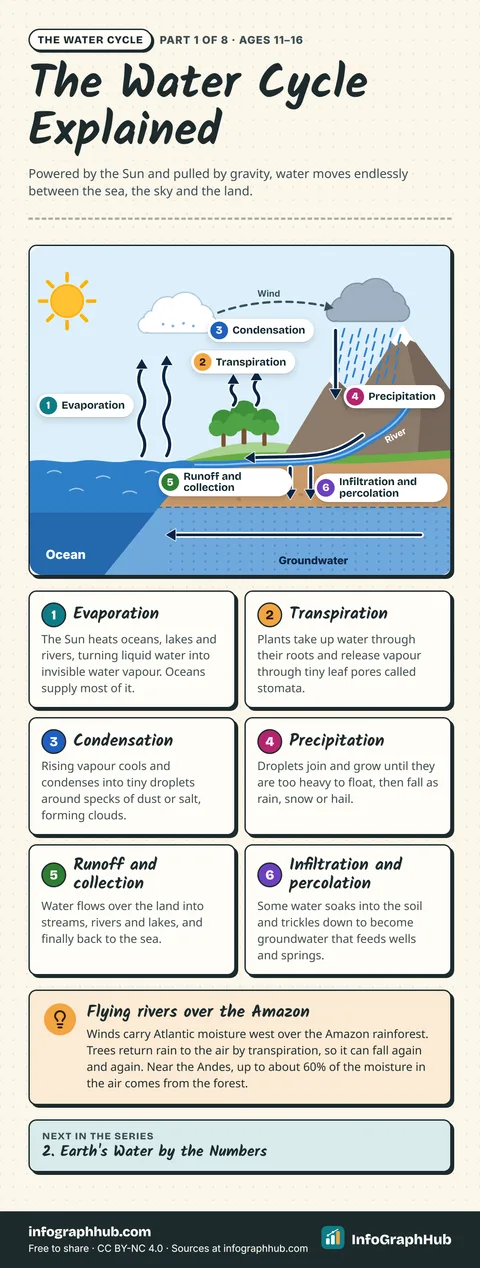
The water cycle is the non-stop movement of water between oceans, air and land. Powered by the Sun, water evaporates, condenses into clouds, falls as rain or snow, and flows or soaks back towards rivers, groundwater and the sea.
 Science
Earth's Water by the Numbers
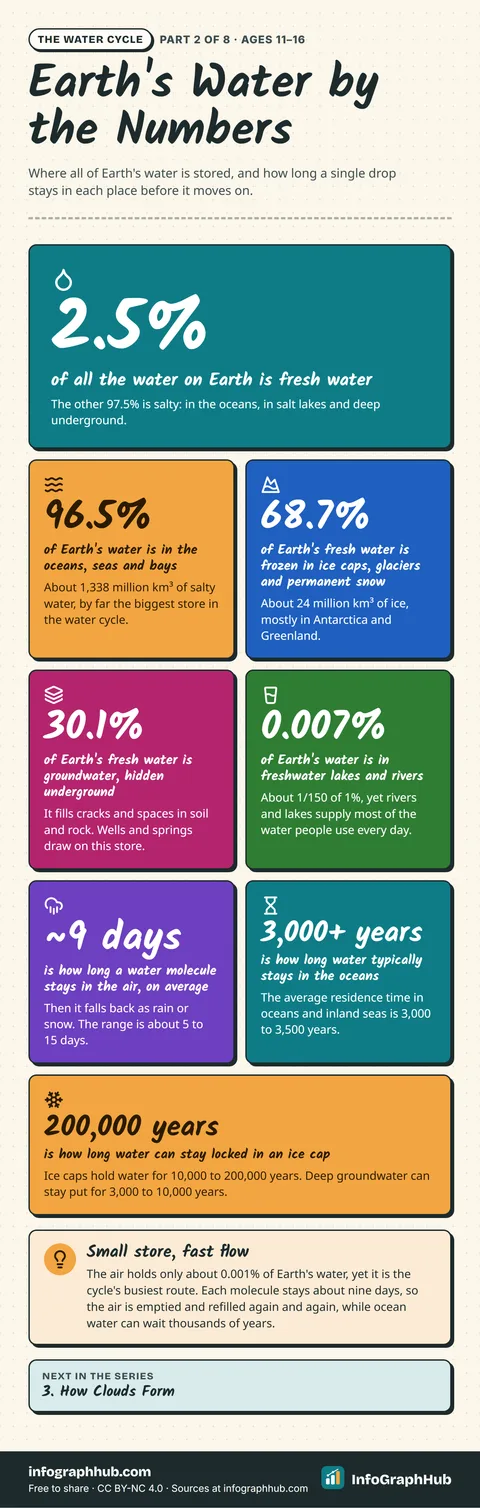
Where is all of Earth's water, and how long does it stay there? Only 2.5% is fresh, most of that is frozen or underground, and a drop can spend nine days in the air or thousands of years in the ocean or an ice cap.
 Science
How Clouds Form
How does invisible water vapour become a cloud? Moist air rises, expands and cools to its dew point, then vapour condenses on specks of dust, salt and smoke into tiny droplets or ice crystals that grow until they fall as rain or snow.
 Science
Types of Precipitation
Rain, drizzle, snow, sleet, ice pellets, freezing rain, hail and graupel: what each one is, how it forms and how to tell them apart, with official definitions and a warning that 'sleet' means different things in the UK and the US.
 Science
Water Cycle Key Terms
A cheat sheet of 18 water cycle key terms with precise one-line definitions, grouped into changes of state, water on the move and where water is stored, from evaporation and sublimation to advection, aquifers and residence time.
 Science
The Water Cycle in Everyday Life
You can watch the water cycle at home and outside every day: washing drying, a cold glass 'sweating', the white cloud above a kettle, dew, frost and rain soaking into a lawn. Each one shows a real process, from evaporation to deposition.
For teachers and parents: new InfoGraphHub resources by email
One short email when new free resources go live. For adults (18+) only. No spam, no tracking in emails, unsubscribe anytime.