8-part series · Ages 11–16
The Water Cycle
Eight infographics that follow water from the sea to the sky and back again.
Complete pack: all 8 parts in one PDF
Printable, with the quiz answers. Free under CC BY-NC 4.0.
The 8 parts


Watch the whole series

The complete guide
The Water Cycle explained
Water never stops moving. This series takes the water cycle one question at a time: what happens at each stage, where all of Earth's water is stored, how a cloud actually forms, why some days bring drizzle and others hail, and which words examiners expect you to use.
Each part is a printable infographic with sources, written for ages 11–16 and their teachers. Work through them in order, or jump to the part you need, then test yourself with the quiz at the end. The complete pack puts all eight on paper in one download.
What the water cycle is and what powers it
The water cycle, or hydrological cycle, describes where Earth's water is kept and how it travels between those places. Scientists split it into stores (also called pools), such as the ocean, ice sheets, soil and the air, and flows (fluxes) that carry water from one store to another, such as evaporation, rainfall and river flow.
Two forces keep it going. The first is energy from the Sun. Turning liquid water into vapour takes a lot of energy, and sunlight supplies it, lifting water from the sea and the land into the air. The second is gravity, which pulls rain, snow and hail out of clouds, sends rivers and glaciers downhill and draws water down through the soil.
Nothing is used up: Earth's water only changes place, and changes state between liquid water, solid ice and invisible vapour. Over a whole year, the water that evaporates across the planet roughly balances the water that falls back as precipitation.
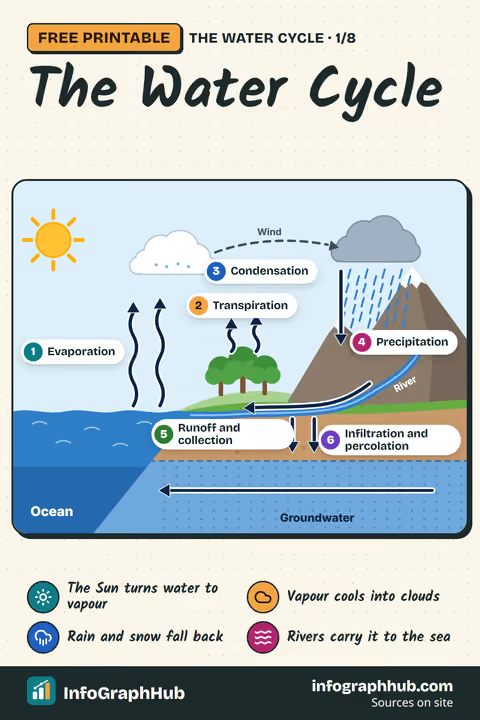
Most classroom diagrams show four main stages:
- Evaporation, with transpiration from plants
- Condensation into clouds
- Precipitation as rain, snow or hail
- Collection in oceans, lakes, rivers, ice and groundwater
Evaporation and transpiration: water into the air
Evaporation is liquid water becoming water vapour. Molecules at the surface of a sea, lake or puddle are always moving; the ones that gain enough energy break free and escape into the air. Warmth speeds this up, but it happens at any temperature, which is why a puddle can vanish on a cool day. Dry air and wind help too, because they sweep away the damp air sitting just above the water.
The oceans dominate. Evaporation from oceans, seas, lakes and rivers provides nearly 90 per cent of the moisture in the atmosphere. Most of the rest comes from plants through transpiration: roots take water from the soil, it rises through the stem, and vapour escapes through tiny pores in the leaves called stomata. On land it is hard to measure soil evaporation and plant transpiration separately, so scientists often add them together as evapotranspiration.
A smaller route is sublimation, where ice or snow turns straight into vapour without melting first.
Evaporation also moves energy. The heat used to turn liquid into vapour is not lost: it travels with the vapour as latent heat ('hidden heat') and is given out again when the vapour condenses. That is why sweating cools you down.
Condensation: how clouds form
Water vapour is an invisible gas. To become a cloud, it must cool until some of it condenses into liquid droplets or freezes into ice crystals. The usual way air cools is by rising. Air pressure falls with height, so a rising parcel of air expands, and expanding air cools. Until it becomes saturated, rising air cools by about 9.8 °C for every kilometre it climbs.
Something has to push the air upwards first. There are four common triggers:
- Convection: the Sun heats the ground, and bubbles of warm air rise from it.
- Relief (orographic) lifting: wind meets hills or mountains and is forced up the slope.
- Fronts: where a warm air mass meets a cold one, the lighter warm air slides up over the colder air.
- Convergence: where winds from different directions meet, the air has nowhere to go but up.
Once the air has cooled to its dew point, it is saturated, and any further cooling makes vapour condense. It still needs a surface: each droplet forms on a microscopic condensation nucleus, such as a grain of sea salt, dust, pollen or smoke. A typical cloud droplet is only 0.01 to 0.02 mm across, so it sinks so slowly that gently rising air holds it up.
Condensation gives back the latent heat that evaporation took in. This warms the air inside the cloud and helps it keep rising, feeding tall shower and thunderstorm clouds.
Precipitation: why rain, snow and hail fall
Cloud droplets are far too small to fall against rising air; millions must combine to make one raindrop. A typical raindrop is about 2 mm across, a hundred times wider than a 0.02 mm cloud droplet. Volume grows with the cube of width, so the raindrop holds 100 × 100 × 100 = 1,000,000 times as much water.
Droplets grow in two main ways. In warm clouds, common in the tropics, bigger droplets fall slightly faster, collide with smaller ones and merge: collision and coalescence. In cold clouds, droplets can stay liquid well below 0 °C. Ice crystals growing among these supercooled droplets take up vapour at the droplets' expense, grow quickly and fall as snow, which melts into rain if the air below is warm enough. This is the Bergeron–Findeisen process.
What finally lands depends on the temperature of the air the precipitation falls through:
- Rain, or finer drizzle with drops usually under 0.5 mm, when the air is above freezing.
- Snow when the air stays at or below 0 °C from the cloud to the ground.
- Ice pellets when snow partly melts in a warm layer, then refreezes in a deep cold layer below.
- Freezing rain when drops arrive supercooled and freeze on contact, coating roads and power lines in glaze.
- Hail, generally 5 to 50 mm across, which grows only in thunderstorms with strong updrafts.
Take care with sleet: in the UK it means rain and snow falling together, but in the United States it means ice pellets.
Most precipitation falls as rain, and amounts vary enormously. In 2017, Colombia received about 3,240 mm of precipitation, while Egypt received just 18 mm.
After it lands: runoff, infiltration and groundwater
Rain or meltwater that reaches the ground takes one of three main routes.
- Surface runoff: water flows over the land into streams and rivers. Runoff is greatest when rain is heavy, slopes are steep, the ground is already soaked, or the surface is hard, such as roads, roofs and car parks.
- Infiltration: water soaks into the soil. Sandy soils let it in quickly; clay soils take it in more slowly. Some is held as soil moisture, where roots can reach it, and much of that returns to the air through evapotranspiration.
- Percolation: water keeps moving down through gaps in soil and rock until it reaches the saturated zone, where every space is full. The top of this zone is the water table. A layer of rock or sediment that holds and passes on enough water to supply wells and springs is an aquifer.
Groundwater creeps through the rock, from several metres a day in very permeable layers to a few centimetres a century in clay, and eventually seeps out into springs, rivers, lakes and the sea. This slow release is why many rivers keep flowing through dry spells.
Rivers carry the water back to the sea, closing one loop of the cycle. In cold places, some precipitation waits for months as snowpack, or for many years as glacier ice, before it is released as meltwater.
Where Earth's water is stored, and for how long
One widely used estimate, from the hydrologist Igor Shiklomanov and published by the US Geological Survey (USGS), puts Earth's total water at about 1,386 million km³. It is spread very unevenly:
| Store | Share |
|---|---|
| Oceans, seas and bays | 96.5% of all water |
| All salty water | about 97.5% of all water |
| Fresh water | about 2.5% of all water |
| Ice caps, glaciers and permanent snow | 68.7% of fresh water |
| Groundwater | 30.1% of fresh water |
| Lakes, rivers, soil moisture, air and other fresh water | a little over 1.2% of fresh water |
Freshwater lakes and rivers together hold only about 93,100 km³, roughly 1/150 of one per cent of the total. Yet they supply most of the water people use, because rain, snowmelt and groundwater keep refilling them.
The average time water spends in a store is its residence time. It ranges from about 9 days in the atmosphere (5 to 15 days), through 2 to 6 months in rivers, to 3,000 to 3,500 years in the oceans and 10,000 to 200,000 years in ice caps.
You can check the nine-day figure yourself. The air holds about 12,900 km³ of water at any moment, and NASA estimates that about 495,000 km³ passes through it each year. So the air's water is replaced 495,000 ÷ 12,900 ≈ 38 times a year, and each turnover takes about 365 ÷ 38.4 ≈ 9.5 days, very close to the average.
The water cycle in everyday life
Every process in the cycle can be seen without leaving home:
- Evaporation: washing drying on a line, fastest on a warm, dry, breezy day. Sweat cooling your skin is evaporation carrying heat away.
- Condensation: droplets on a cold can, a bathroom mirror misting up, or the white plume above a kettle, which is liquid droplets, not vapour.
- Dew and frost: on clear nights, grass and car windows cool to the dew point and collect dew. Below 0 °C, vapour can turn directly into ice crystals as frost, a change called deposition.
- Infiltration and runoff: rain soaking into a lawn but streaming off a car park into a drain.
- Transpiration: a clear plastic bag tied over a leafy branch in sunshine soon mists up as the leaves give off vapour.
A cloud forms for the same reason a cold glass gets wet: air has cooled below its dew point. The USGS estimates that a large oak tree can transpire about 151,000 litres of water in a year.
For a classroom model, cover a bowl of warm water with cling film and put a few ice cubes on top. Water evaporates, condenses on the cold film and drips back down like rain: the whole cycle in miniature.
See the infographic: Part 6, The Water Cycle in Everyday Life →
Common misconceptions
Several wrong ideas about the water cycle are widespread, among adults as well as students:
- 'Clouds are made of water vapour.' Vapour is invisible. Clouds, fog and mist are liquid droplets or ice crystals. If you can see it, it is not vapour.
- 'Water only evaporates when it boils.' It evaporates at any temperature, just more slowly when it is cold.
- 'Every drop goes round the circle in order.' Most water that evaporates from the ocean falls straight back into the ocean. A molecule might spend days in the air, then thousands of years deep underground or locked in ice.
- 'Groundwater sits in underground lakes.' Most of it fills tiny pores and cracks in rock and sediment.
- 'Raindrops are teardrop-shaped.' Small drops are round; larger ones flatten underneath, and the biggest break apart.
- 'Dew falls from the sky.' It condenses where you find it, on surfaces that have cooled overnight.
- 'One day we will run out of water.' Water is recycled, not destroyed. The real risk is a shortage of clean fresh water in a particular place at a particular time.
See the infographic: Part 7, Water Cycle Myths and the Real Science →
Why the water cycle matters
Fresh water. When seawater evaporates, the salt stays behind, so the cycle works like a huge solar-powered still that turns salty ocean water into fresh rain. This constant renewal supplies drinking water, farms, industry and wildlife. The USGS points out that how much water is available depends on three things: quantity (how much is in each store), timing (when and how fast it moves) and quality (how clean it is).
Weather. Clouds, rain, snow, storms, floods and droughts are all the water cycle at work. Latent heat taken up during evaporation is released when the vapour condenses, often far from where it evaporated, so the cycle carries heat around the planet and helps power storms.
Climate. Water vapour is a greenhouse gas, and warmer air can hold more of it. As the climate warms, evaporation increases and the cycle speeds up. NOAA and NASA describe the effects: more intense downpours, longer dry spells between them, and more winter precipitation falling as rain instead of snow, which changes when meltwater reaches rivers.
People. Humans change the cycle too, by building dams, irrigating fields, draining wetlands, covering land with hard surfaces and pumping groundwater from aquifers faster than rain refills them. Runoff from farms and towns also washes fertilisers, chemicals and sediment into rivers.
Ready to check what you have learned? The quiz covers every stage in this guide.
See the infographic: Part 8, Water Cycle Quiz: Test Yourself →
Frequently asked questions
What are the 4 main stages of the water cycle?
Evaporation (water turning into vapour, with transpiration from plants), condensation (vapour cooling into cloud droplets), precipitation (rain, snow, sleet or hail falling from clouds) and collection (water gathering in oceans, lakes, rivers, ice and groundwater before it evaporates again).
What is the water cycle in simple terms?
It is the non-stop journey of Earth's water between the oceans, the air and the land. The Sun's energy turns water into vapour, the vapour cools into clouds, water falls as rain or snow, and gravity carries it back through rivers and the ground towards the sea.
Why is the water cycle important?
It constantly renews the fresh water that people, farms and wildlife depend on, because evaporation leaves salt behind. It also produces all our weather, moves heat around the planet and plays a big part in shaping the climate.
How does climate change affect the water cycle?
Warmer air can hold more water vapour, so evaporation increases and the cycle speeds up. This brings more intense downpours, longer dry spells between them and more winter precipitation falling as rain instead of snow, which changes when rivers receive meltwater.
Where does rain come from?
From clouds. Water evaporates, mostly from the oceans, and rises as invisible vapour. As the air rises and cools, the vapour condenses on tiny specks of dust or salt to form cloud droplets. Millions of droplets join to make each raindrop, which falls when it is too heavy for the rising air to hold up.
Sources & methodology
Every fact is checked against the sources below. We write original explanations and draw original graphics; no figures are copied from textbooks. Spotted an error? See our corrections policy.
- Where is Earth's Water? (U.S. Geological Survey (USGS) Water Science School, accessed 1 Oct 2026)
- Precipitation and the Water Cycle (U.S. Geological Survey (USGS) Water Science School, accessed 1 Oct 2026)
- The water cycle (National Oceanic and Atmospheric Administration (NOAA), accessed 1 Oct 2026)
- The Water Cycle (NASA Earth Observatory, accessed 1 Oct 2026)
- The water cycle (Met Office, accessed 1 Oct 2026)
- Hydrologic Cycle (National Geographic Education, accessed 1 Oct 2026)
Editorial review pending · Updated
For teachers and parents: new InfoGraphHub resources by email
One short email when new free resources go live. For adults (18+) only. No spam, no tracking in emails, unsubscribe anytime.