9-part series · Ages 11–16
Photosynthesis
Nine infographics on how plants turn light, water and air into sugar, and why every living thing depends on it.
The 2 parts (7 more coming soon)
The complete guide
Photosynthesis explained
A tree is built mostly from thin air. This series takes photosynthesis one question at a time: what happens inside a chloroplast, how a leaf is built for the job, what sets the speed, how it compares with respiration, and which words and equations examiners expect you to use.
Each part is a printable infographic with sources, written for ages 11–16 and their teachers. Follow the story of how scientists worked it out, see where photosynthesis turns up in daily life, clear up the most common myths, then test yourself with the quiz at the end.
What photosynthesis is
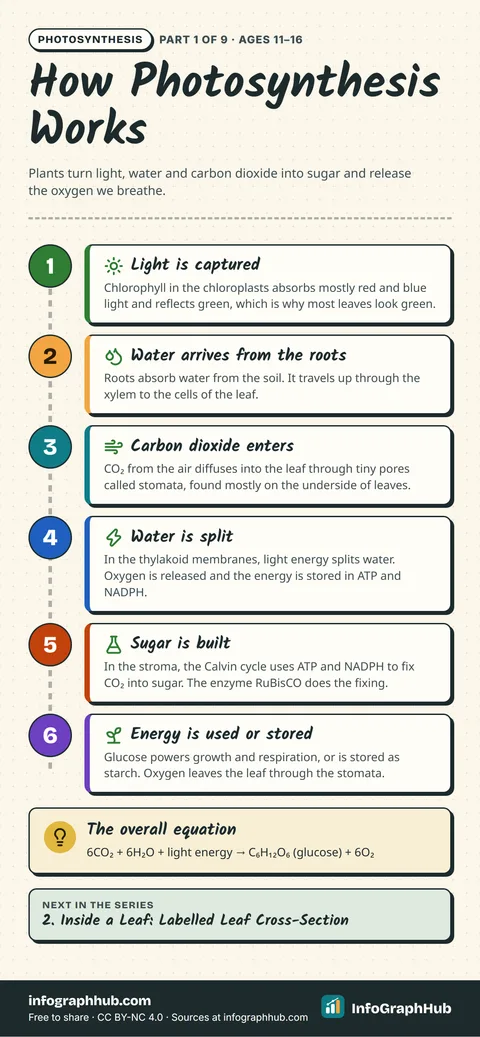
Photosynthesis is the process in which green plants, algae and some bacteria use the energy in light to make their own food. They take in carbon dioxide from the air and water, usually from the soil, and join them to make glucose, a sugar that stores chemical energy. Oxygen is released as a by-product. The name says it all: photo means light and synthesis means putting together.
The whole process is summed up in one equation:
- Word equation: carbon dioxide + water → glucose + oxygen (with light energy)
- Balanced symbol equation:
6CO₂ + 6H₂O → C₆H₁₂O₆ + 6O₂
In plants, photosynthesis takes place in chloroplasts, tiny green structures inside the cells of leaves and other green parts. Their colour comes from chlorophyll, the pigment that absorbs the light. Chlorophyll absorbs red and blue light most strongly and reflects much of the green, which is why leaves look green.
Organisms that make their own food in this way are called producers. Animals, fungi and most bacteria cannot do it, so they depend on producers, directly or indirectly, for their food.
See the infographic: Part 1, How Photosynthesis Works: From Sunlight to Sugar →
The two stages inside a chloroplast
Photosynthesis happens in two linked stages.
- The light-dependent reactions take place on the thylakoid membranes, stacks of flattened discs inside the chloroplast. Light energy absorbed by chlorophyll splits water molecules. This releases oxygen and stores the captured energy in two carrier molecules, ATP and NADPH.
- The Calvin cycle takes place in the stroma, the fluid around the thylakoids. Using the ATP and NADPH from stage 1, an enzyme called RuBisCO fixes carbon dioxide from the air into a three-carbon sugar, which the plant then builds into glucose and other sugars.
The first stage needs light directly, so it stops in the dark. The second does not use light itself, but it soon stops too once the supply of ATP and NADPH runs out. Overall, photosynthesis is an endothermic reaction: it takes in energy from light and stores it in glucose.
You do not need every detail of these reactions for most courses at ages 11–16, but it helps to know the big idea: light energy is first captured as chemical energy in carrier molecules, and that energy is then used to build sugar from carbon dioxide.
See the infographic: Part 1, How Photosynthesis Works: From Sunlight to Sugar →
How a leaf is built for photosynthesis
A leaf is an organ made of several tissues, stacked in the same order in almost every leaf.
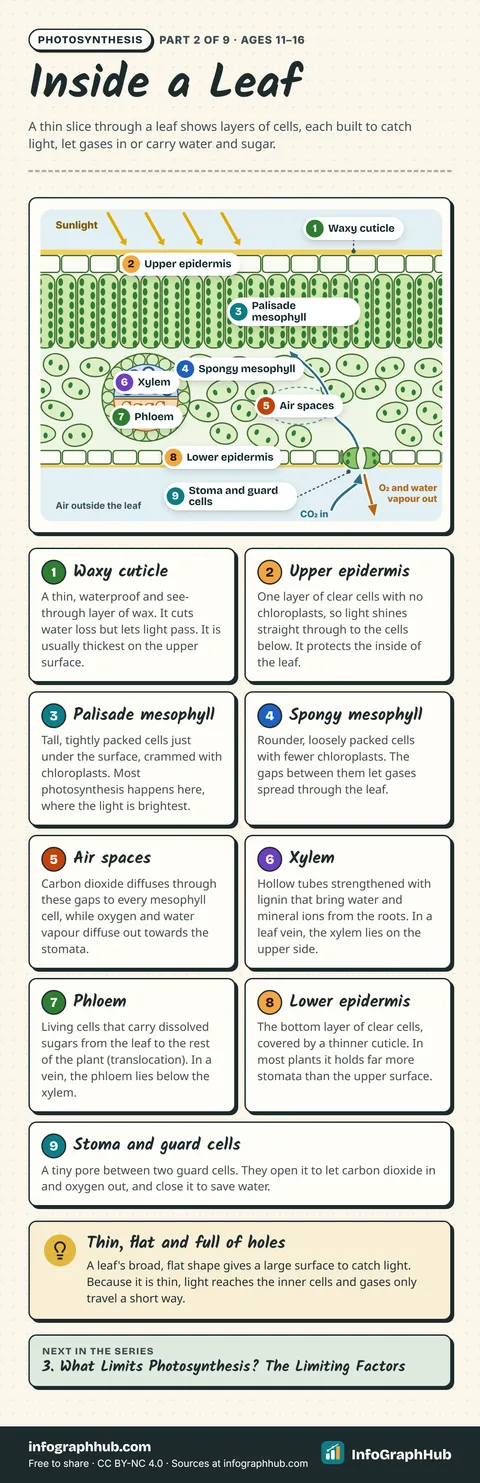
- A waxy, see-through cuticle cuts water loss while letting light in.
- The upper epidermis is a layer of clear cells with no chloroplasts.
- The palisade mesophyll is a layer of tall, tightly packed cells crammed with chloroplasts. Most photosynthesis happens here.
- The spongy mesophyll has rounder, loosely packed cells with air spaces between them, so gases can diffuse through the leaf.
- Veins contain xylem, which brings water and mineral ions from the roots, and phloem, which carries dissolved sugars away to the rest of the plant.
- The lower epidermis contains most of the stomata, tiny pores each surrounded by two guard cells that open and close them.
The overall shape helps too. A leaf is broad and flat, giving a large surface to catch light, and thin, so gases only have a short distance to diffuse. Stomata are a compromise: open, they let carbon dioxide in, but they also let water vapour out, so a plant short of water closes them and photosynthesis slows.
See the infographic: Part 2, Inside a Leaf: Labelled Leaf Cross-Section →
What limits the rate
Photosynthesis can only run as fast as its scarcest ingredient allows. The factor in shortest supply is called the limiting factor. The main ones are:
- Light intensity: more light speeds up photosynthesis until another factor runs short.
- Carbon dioxide concentration: air is only about 0.04% carbon dioxide, so it often limits the rate on bright, warm days.
- Temperature: the enzymes work faster as it warms up to an optimum, then are damaged (denatured) if it gets too hot.
- The amount of chlorophyll: leaves short of chlorophyll, for example from a lack of magnesium, absorb less light.
On a graph of rate against light intensity, the line rises while light is limiting and then levels off when something else becomes limiting.
In school experiments, pondweed is often lit by a lamp at different distances. Light intensity follows the inverse square law: it is proportional to 1 ÷ distance². Moving a lamp from 10 cm to 20 cm doubles the distance, so the light intensity falls to 1 ÷ 2² = one quarter. Commercial growers use the same ideas, adding heat, light or extra carbon dioxide to greenhouses when the extra yield is worth the cost.
Photosynthesis and respiration
Aerobic respiration is the reverse of photosynthesis:
C₆H₁₂O₆ + 6O₂ → 6CO₂ + 6H₂O
Photosynthesis stores energy in glucose; respiration releases it so cells can use it. Photosynthesis happens only in cells with chloroplasts and only in the light. Respiration happens all the time, mainly in the mitochondria, in every living cell of plants and animals alike.
This means a plant does both during the day. In bright light it photosynthesises faster than it respires, so overall it takes in carbon dioxide and gives out oxygen. In the dark it only respires, so it gives out carbon dioxide. At one dim light level, the compensation point, the two rates are equal and there is no overall exchange of gases. A plant only grows if, across a whole day, photosynthesis makes more glucose than respiration uses.
Two words cause confusion here. Respiration is a chemical reaction inside cells; breathing is moving air in and out of lungs, and plants do not breathe at all. When oxygen runs short, for example in waterlogged soil, plant cells can also respire anaerobically, turning glucose into ethanol and carbon dioxide and releasing much less energy.
What plants do with their glucose
The glucose made in photosynthesis is the raw material for almost everything a plant contains. It is:
- used in respiration to release energy;
- turned into starch, an insoluble store kept in leaves, seeds and tubers;
- turned into fats and oils, energy stores found especially in seeds;
- built into cellulose, which strengthens cell walls;
- combined with nitrate ions from the soil to make amino acids, which are joined into proteins.
The iodine test for starch is a simple way to show that a leaf has been photosynthesising: where starch is present, iodine solution changes from orange-brown to blue-black. Leaves kept in the dark, or the white parts of variegated leaves, give a negative result.
How scientists worked it out
Photosynthesis was pieced together over more than 300 years.
- Van Helmont (published 1648) grew a willow in a weighed pot of soil for five years. The tree gained about 74 kg while the soil lost only about 57 g, so he concluded, wrongly, that the mass came from water alone.
- Priestley (1771) found that a sprig of mint could 'restore' air in which a candle had burned out.
- Ingenhousz (1779) showed that plants only do this in light, and only with their green parts.
- Senebier (1782) showed that plants take in carbon dioxide, and de Saussure (1804) that water is a reactant too.
- Engelmann (1882) used oxygen-seeking bacteria to show that red and blue light drive photosynthesis, and Blackman (1905) described limiting factors.
- Ruben, Kamen and colleagues (1941) used an oxygen isotope to prove that the oxygen released comes from water.
- Calvin, Benson and Bassham (1948–1954) traced radioactive carbon to map the Calvin cycle; Calvin won the 1961 Nobel Prize in Chemistry.
Why it matters every day
Almost every food chain starts with a producer, so nearly all the energy in your food was first captured by photosynthesis. It also keeps the air supplied with oxygen, and not only from forests: according to NOAA, about half of Earth's oxygen comes from the ocean, made by phytoplankton, seaweeds and photosynthetic bacteria.
Many materials are stored photosynthesis too. Wood, paper and cotton are mostly cellulose, and coal, oil and natural gas formed from ancient plants and plankton, so burning them releases energy captured from sunlight millions of years ago. Photosynthesis even shows up in the atmosphere as a whole: carbon dioxide levels fall each northern spring and summer as plants grow, and rise again each winter.
Farmers and growers put this knowledge to work. In greenhouses they raise the temperature, add lighting and pump in extra carbon dioxide so that crops photosynthesise faster, and in places with very short winter days, such as Iceland, tomatoes can be grown under glass all year round. Even the colours of autumn are a lesson in photosynthesis: as trees stop making chlorophyll and it breaks down, the yellow and orange pigments it was hiding show through.
Common misconceptions
Some ideas about plants feel right but are wrong:
- Plants do not get their food from the soil. They make it; the soil supplies water and minerals.
- Most of a plant's mass does not come from the soil but from carbon dioxide in the air, together with water.
- The oxygen plants release comes from water, not from carbon dioxide.
- Plants respire all the time, not only at night, and they do not 'breathe': gases diffuse through their stomata.
- The Amazon rainforest does not make 20% of the world's oxygen, and its net effect on the air is close to zero.
- Leaves are not green because chlorophyll absorbs green light. It absorbs mostly red and blue light and reflects much of the green.
- Leaves are not the only place photosynthesis happens. Any green part with chloroplasts can do it, and leafless algae and cyanobacteria in the ocean make about half of Earth's oxygen.
A good test for any claim about plants is to ask where each atom comes from and goes to, and what happens at night.
Test yourself
When you have worked through the series, try the ten-question quiz. It covers the equation, leaf structure, the source of the oxygen, limiting factors, the inverse square law, respiration, uses of glucose and the history of discovery. The answers are printed upside down at the foot of the page, each explained on the quiz page, so you can see which part to revisit.
Frequently asked questions
What is photosynthesis in simple terms?
It is how plants, algae and some bacteria make their own food. They use energy from light to turn carbon dioxide and water into glucose, a sugar, and release oxygen as a by-product.
What is the equation for photosynthesis?
The word equation is carbon dioxide + water → glucose + oxygen, driven by light energy. The balanced symbol equation is 6CO₂ + 6H₂O → C₆H₁₂O₆ + 6O₂.
What are the two stages of photosynthesis?
The light-dependent reactions, on the thylakoid membranes, use light to split water, release oxygen and make ATP and NADPH. The Calvin cycle, in the stroma, uses these to fix carbon dioxide into sugar.
What are the limiting factors of photosynthesis?
Light intensity, carbon dioxide concentration and temperature are the main ones; the amount of chlorophyll can also limit the rate. Whichever is in shortest supply sets how fast photosynthesis can go.
Why is photosynthesis important?
It provides almost all the energy in food chains, supplies the oxygen most living things need for respiration, removes carbon dioxide from the air and is the origin of materials such as wood and of the energy in fossil fuels.
Do plants photosynthesise at night?
No. Photosynthesis needs light, so it stops in the dark. Plants keep respiring day and night, so at night they give out carbon dioxide.
Sources & methodology
Every fact is checked against the sources below. We write original explanations and draw original graphics; no figures are copied from textbooks. Spotted an error? See our corrections policy.
- 8.1 Overview of Photosynthesis (Biology 2e) (OpenStax, Rice University, accessed 1 Oct 2026)
- 30.4 Leaves (Biology 2e) (OpenStax, Rice University, accessed 1 Oct 2026)
- GCSE Biology (8461) specification: 4.4 Bioenergetics (AQA, accessed 1 Oct 2026)
- What is photosynthesis and how does it affect plants? (CCEA) (BBC Bitesize, accessed 1 Oct 2026)
- Discoveries in oxygenic photosynthesis (1727–2003): a perspective (Photosynthesis Research 80: 15–57, 2004) (Govindjee and D. Krogmann, University of Illinois at Urbana-Champaign, accessed 1 Oct 2026)
- How much oxygen comes from the ocean? (NOAA National Ocean Service, accessed 1 Oct 2026)
- The Carbon Cycle (NASA Earth Observatory, accessed 1 Oct 2026)
Editorial review pending · Updated
For teachers and parents: new InfoGraphHub resources by email
One short email when new free resources go live. For adults (18+) only. No spam, no tracking in emails, unsubscribe anytime.