Inside a Leaf: Labelled Leaf Cross-Section
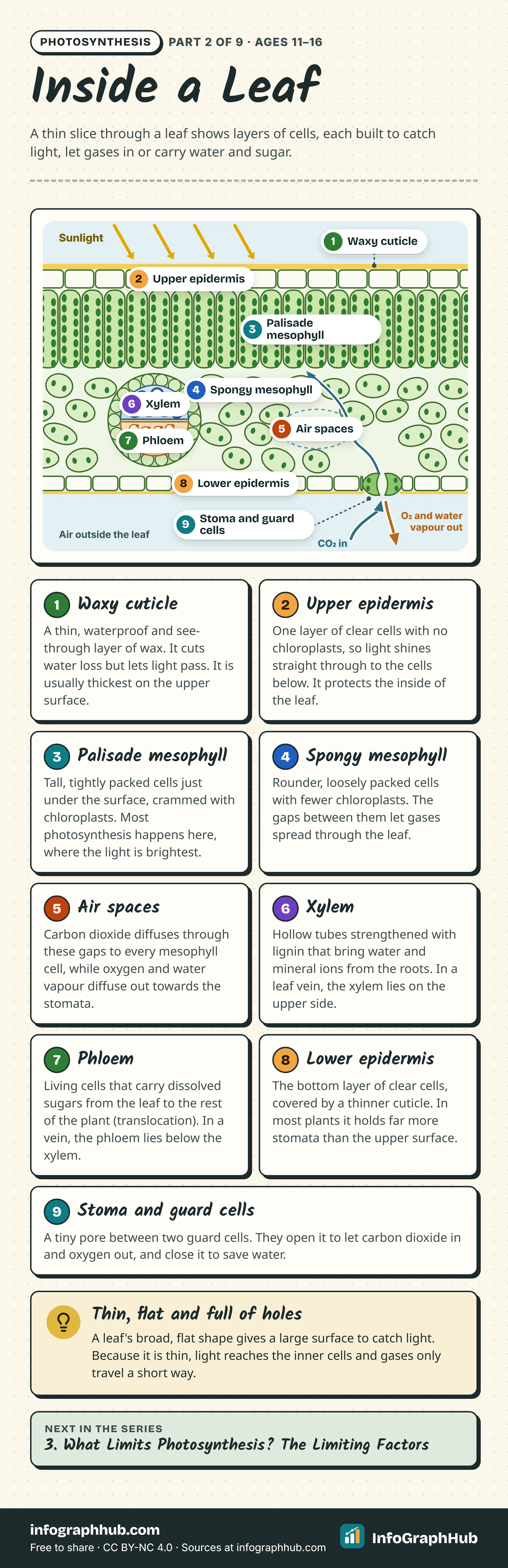
A labelled cross-section of a leaf, from the waxy cuticle to the stomata. See how each layer, from palisade cells packed with chloroplasts to air spaces, veins and guard cells, helps the leaf photosynthesise.
Part 2 of 9Photosynthesis series
Ages 11–16 · Grades 6–10 (US) · Years 7–11 (UK) · Classes 6–10 (India)
A leaf is built in layers
If you cut very thinly across a leaf and look at the slice under a microscope, you see that it is not one solid sheet. It is a stack of different tissues, each a group of similar cells doing one job. Together they make the leaf an organ that is very good at one thing: photosynthesis.
From the top surface to the bottom, the layers are always in the same order: cuticle, upper epidermis, palisade mesophyll, spongy mesophyll (with the veins running through it), lower epidermis and a second, thinner cuticle. The tiny pores called stomata sit mostly in the lower epidermis.
The top layers: let light in, keep water in
The cuticle is a thin layer of wax made by the epidermis. It is waterproof, so it cuts down the water lost by evaporation, and it is transparent, so light passes straight through.
The upper epidermis is usually a single layer of cells. Its cells have no chloroplasts, so they do not block the light. Their job is to protect the softer cells underneath, a bit like a clear plastic cover over a solar panel.
The mesophyll: where the chloroplasts are
Mesophyll means 'middle of the leaf', and it is where most chloroplasts are found.
- Palisade mesophyll cells are tall and column-shaped. They stand side by side in one to three tightly packed rows just under the upper surface, where the light is brightest, and each one is crammed with chloroplasts. Most of a leaf's photosynthesis happens here.
- Spongy mesophyll cells are rounder and irregular, with fewer chloroplasts. They are packed loosely, leaving air spaces between them.
The air spaces matter as much as the cells. Carbon dioxide that enters through the stomata spreads (diffuses) through these spaces until it reaches the damp surface of a mesophyll cell and dissolves. Oxygen and water vapour travel the opposite way and leave the leaf.
Veins: the leaf's transport system
Each vein is a bundle of two transport tissues wrapped in a layer of cells:
- Xylem is a set of hollow tubes strengthened with a tough substance called lignin. It brings water and mineral ions up from the roots. In a leaf vein, the xylem is on the upper side.
- Phloem is made of living cells. It carries dissolved sugars made in the leaf to the rest of the plant, for example to roots, growing tips and fruit. This is called translocation. In a leaf vein, the phloem is on the lower side.
Veins also act like the ribs of an umbrella, holding the thin leaf out flat so it catches as much light as possible.
Stomata and guard cells
A stoma (plural stomata) is a tiny pore surrounded by two curved guard cells. Unlike other epidermis cells, guard cells contain chloroplasts. They change shape to open or close the pore, which lets the plant control two things at once:
- Gas exchange: when the stomata are open, carbon dioxide can diffuse in for photosynthesis and oxygen can diffuse out.
- Water loss: open stomata also let water vapour escape. When the plant is short of water, the guard cells close the stomata to save it.
That is a trade-off: a thirsty plant that shuts its stomata also cuts off its own supply of carbon dioxide.
Structure matches function
Almost every feature of a leaf helps photosynthesis. It is broad and flat, so it has a large surface area to catch light. It is thin, so light reaches the inner cells and gases only have a short distance to travel. The light-catching cells are packed near the top, the air spaces sit next to the stomata, and the veins reach every part of the leaf. When you learn the layers, ask of each one: how does this help the leaf catch light, get carbon dioxide and water in, or send sugar out?
Frequently asked questions
Where does most photosynthesis happen in a leaf?
In the palisade mesophyll, the layer of tall, tightly packed cells just under the upper epidermis. These cells contain the most chloroplasts and get the most light.
What is the difference between xylem and phloem?
Xylem carries water and mineral ions up from the roots; it is made of hollow tubes strengthened with lignin. Phloem is made of living cells and carries dissolved sugars from the leaves to other parts of the plant.
Why are most stomata on the underside of a leaf?
The lower surface is usually shaded and cooler than the top, so having most stomata there helps the leaf take in carbon dioxide while losing less water by evaporation.
What do guard cells do?
Each stoma is surrounded by two guard cells. They open the pore so carbon dioxide can enter and oxygen can leave, and close it to reduce water loss, for example when the plant is short of water.
Sources & methodology
Every fact is checked against the sources below. We write original explanations and draw original graphics; no figures are copied from textbooks. Spotted an error? See our corrections policy.
- 30.4 Leaves (Biology 2e) (OpenStax, Rice University, accessed 1 Oct 2026)
- GCSE Biology (8461) specification: 4.2 Organisation (AQA, accessed 1 Oct 2026)
- What is respiration and photosynthesis in plants? (BBC Bitesize, accessed 1 Oct 2026)
- What is photosynthesis and how does it affect plants? (CCEA) (BBC Bitesize, accessed 1 Oct 2026)
Editorial review pending · Updated
Embed this on your site
Paste this HTML into your page. Keep the credit line: it is required by the CC BY-NC 4.0 license.
Related infographics
 Science
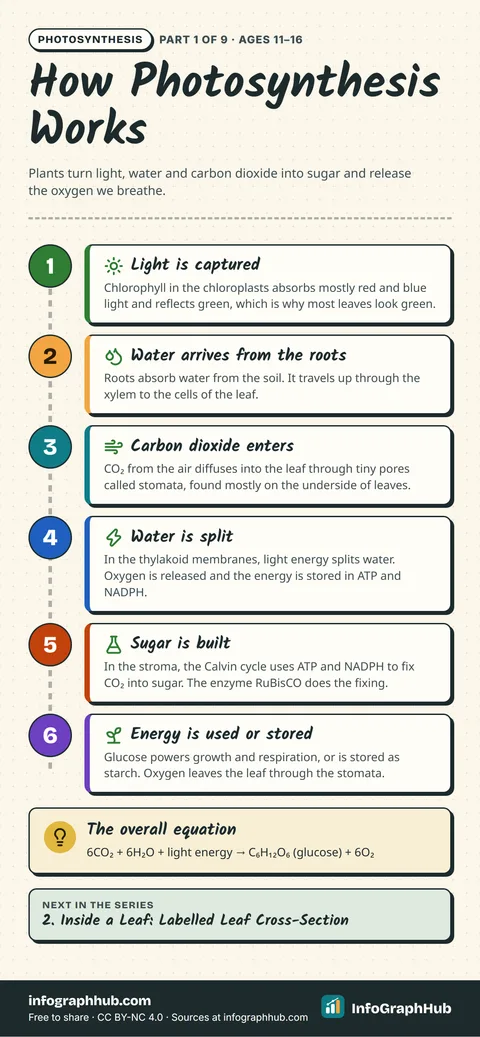
How Photosynthesis Works: From Sunlight to Sugar
Photosynthesis is how plants use light energy to turn carbon dioxide and water into glucose, releasing oxygen as a by-product. It happens in chloroplasts in two linked stages: the light-dependent reactions and the Calvin cycle.
 Science
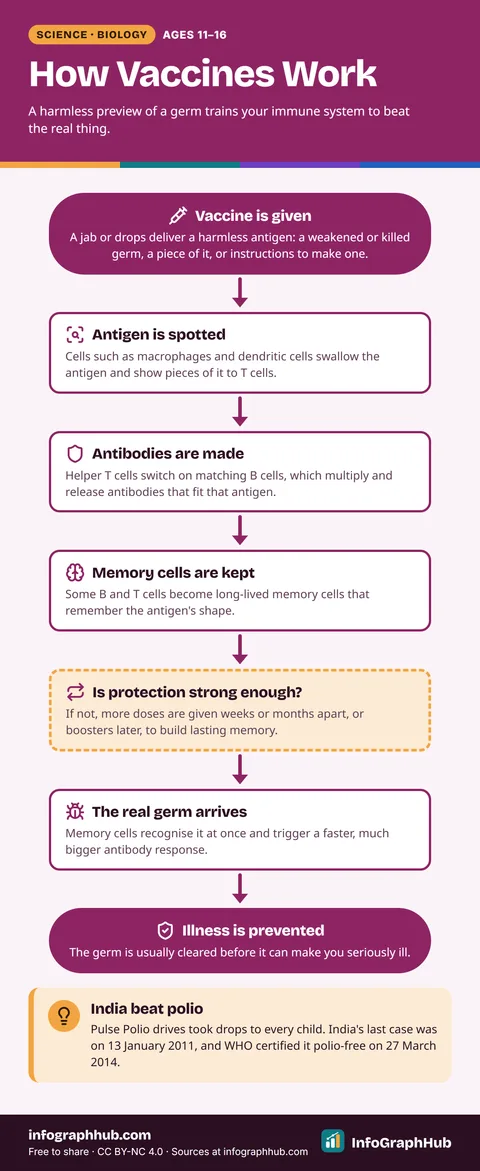
How Vaccines Work: Training Your Immune System
Vaccines work by imitating an infection. They show your immune system a harmless antigen from a germ, so it makes matching antibodies and memory cells that can fight the real germ quickly if it ever arrives.
 Science
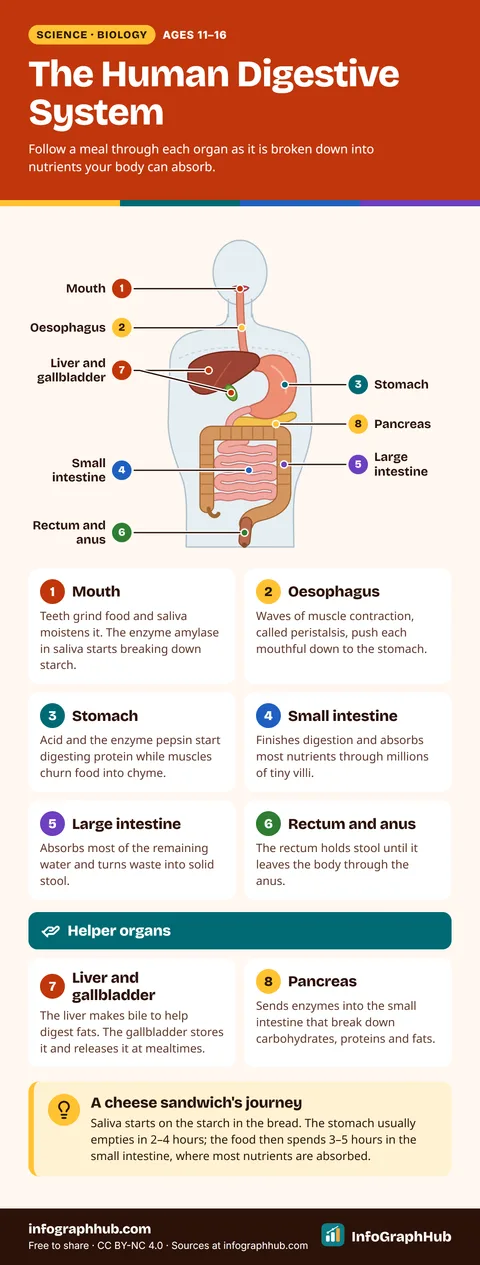
The Human Digestive System: How Food Becomes Energy
The digestive system breaks food into nutrients small enough to enter the blood. Food passes from the mouth through the oesophagus, stomach and intestines, helped by juices from the liver, gallbladder and pancreas.
 Science
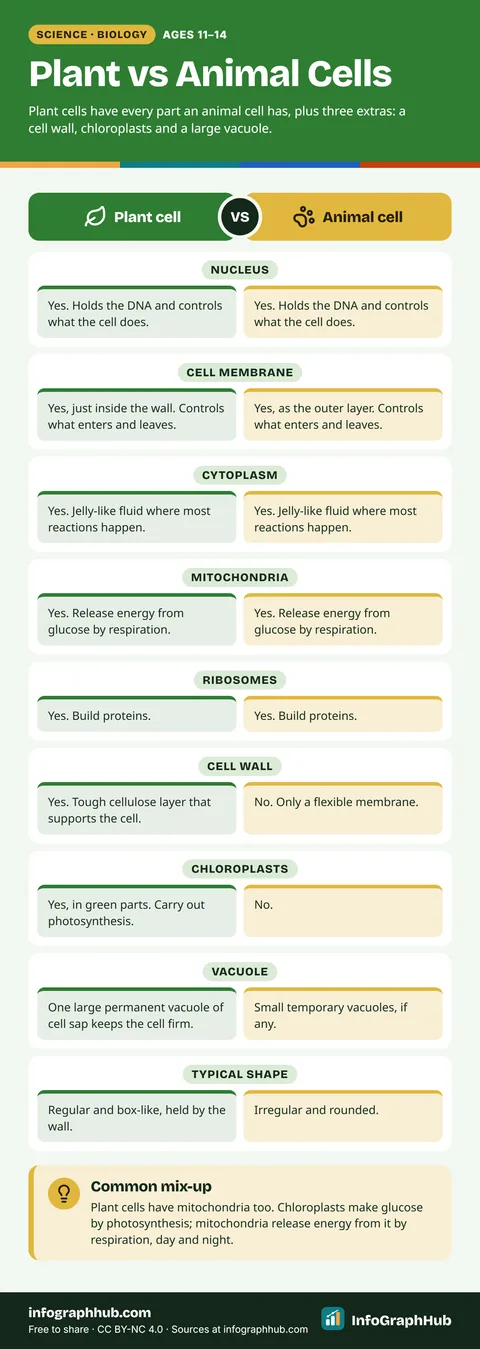
Plant vs Animal Cells: What Each Part Does
Plant and animal cells share a nucleus, cell membrane, cytoplasm, mitochondria and ribosomes. Plant cells also have a cellulose cell wall, chloroplasts and a large permanent vacuole. This comparison poster shows each part and its job.
 Science
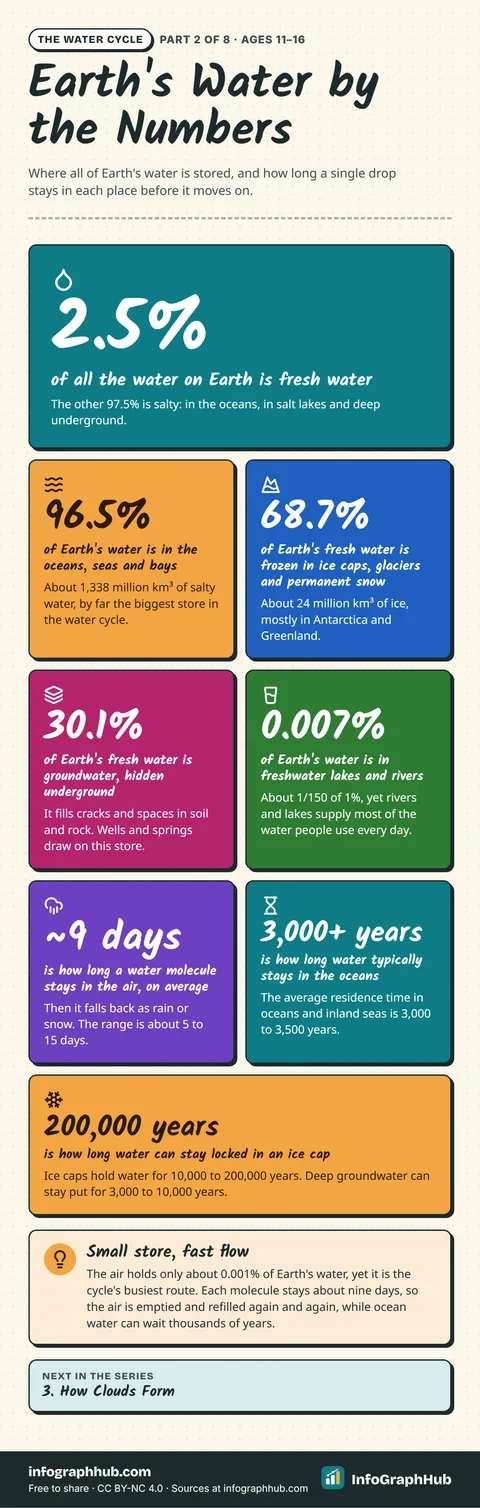
Earth's Water by the Numbers
Where is all of Earth's water, and how long does it stay there? Only 2.5% is fresh, most of that is frozen or underground, and a drop can spend nine days in the air or thousands of years in the ocean or an ice cap.
 Science
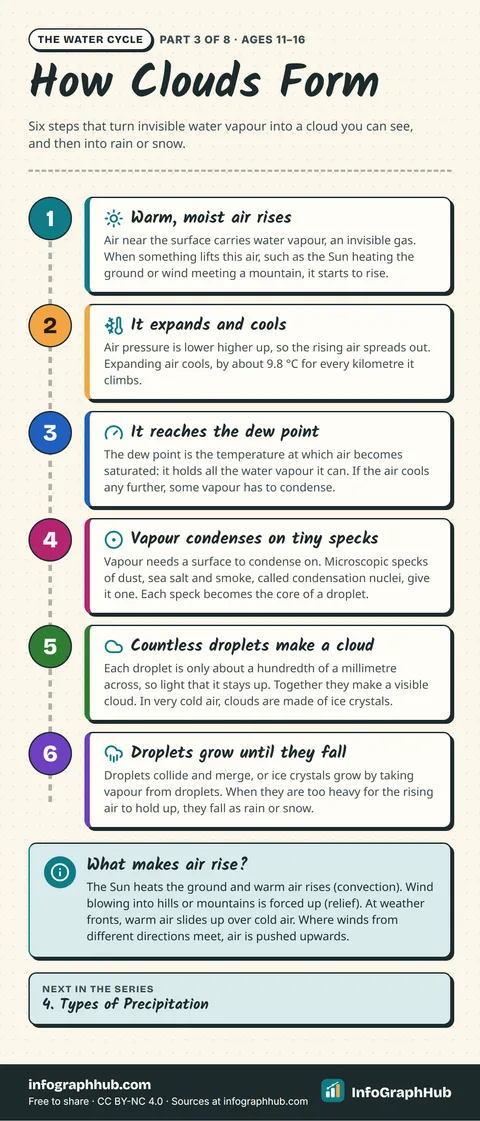
How Clouds Form
How does invisible water vapour become a cloud? Moist air rises, expands and cools to its dew point, then vapour condenses on specks of dust, salt and smoke into tiny droplets or ice crystals that grow until they fall as rain or snow.
For teachers and parents: new InfoGraphHub resources by email
One short email when new free resources go live. For adults (18+) only. No spam, no tracking in emails, unsubscribe anytime.