Photosynthesis vs Respiration: Key Differences
Photosynthesis stores energy in glucose; respiration releases it. Compare where and when each happens, what goes in and comes out, and why plants do both, plus the compensation point and the day and night gas exchange of a leaf.
Part 4 of 9Photosynthesis series
Ages 11–16 · Grades 6–10 (US) · Years 7–11 (UK) · Classes 6–10 (India)
NGSS is a registered trademark of WestEd. Names and codes are used only to describe curriculum fit; InfoGraphHub is not endorsed by these organisations.
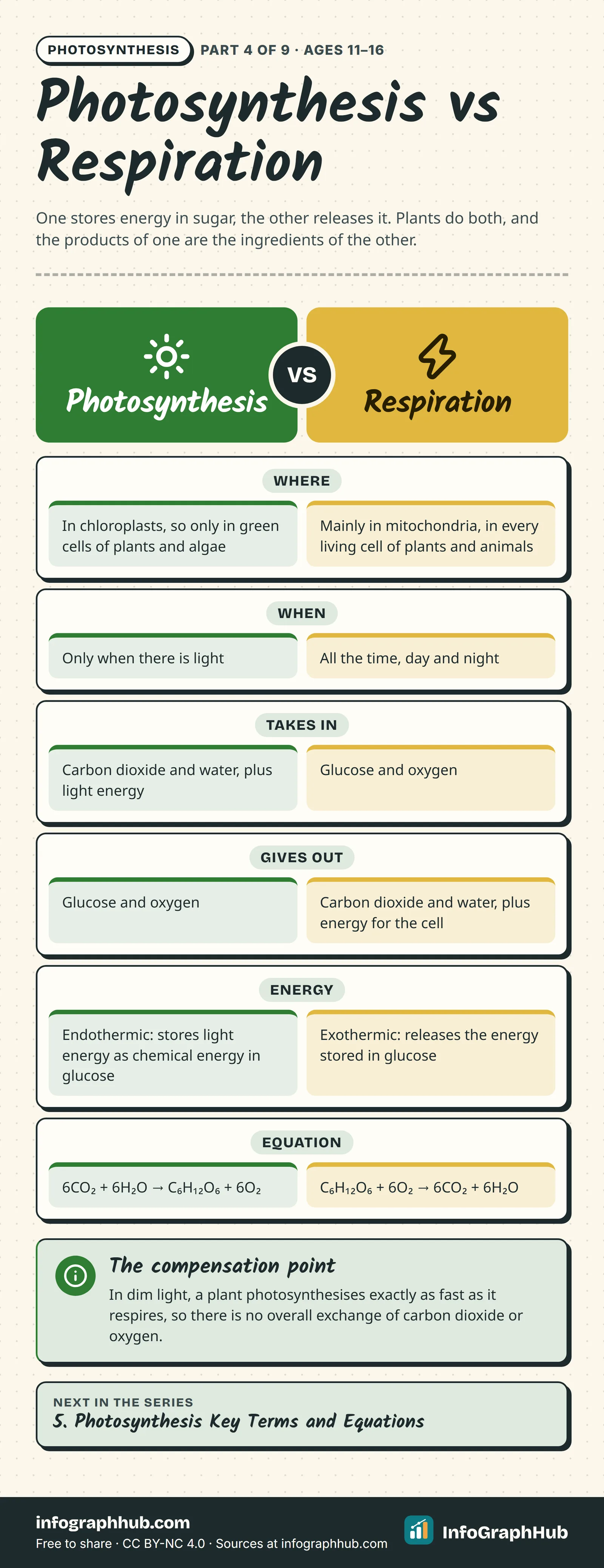
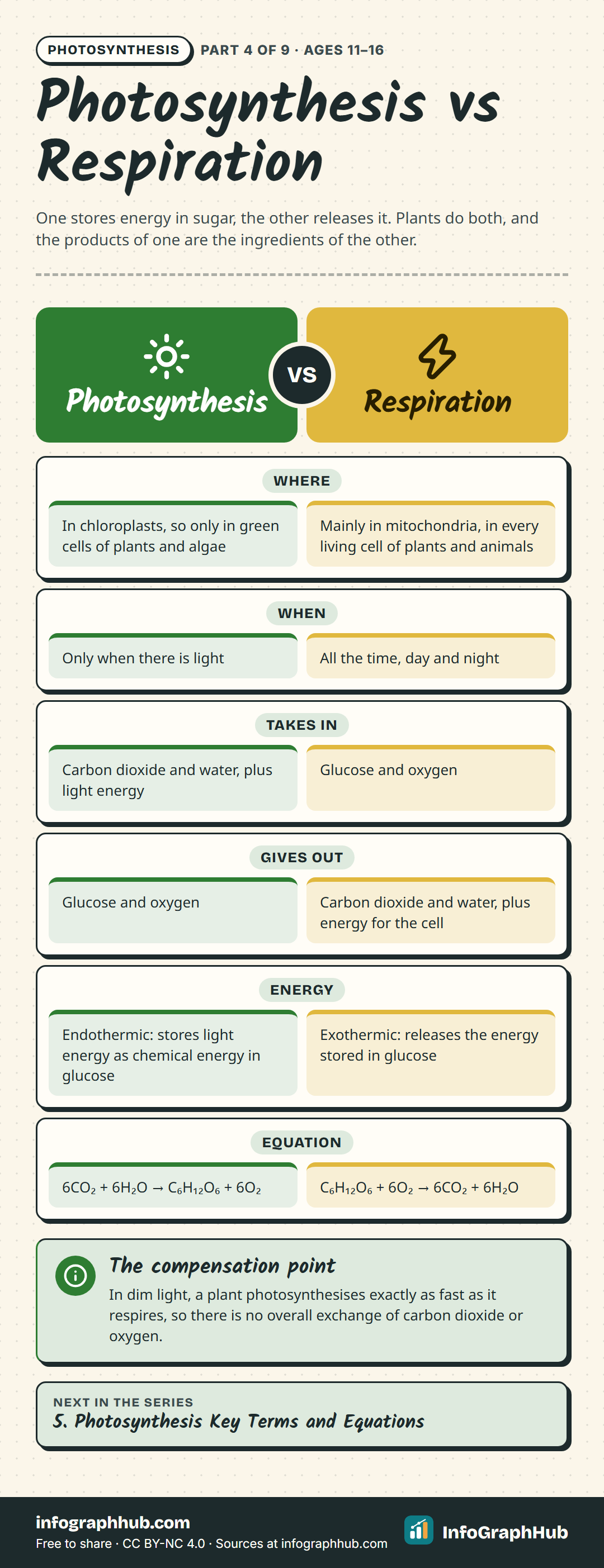
Two reactions that mirror each other
Photosynthesis and aerobic respiration are almost exact opposites. Put their equations side by side:
- Photosynthesis:
6CO₂ + 6H₂O → C₆H₁₂O₆ + 6O₂(light energy is taken in) - Aerobic respiration:
C₆H₁₂O₆ + 6O₂ → 6CO₂ + 6H₂O(energy is released)
The products of one are the reactants of the other. Photosynthesis is endothermic: it takes in energy from light and stores it as chemical energy in glucose. Respiration is exothermic: it releases that stored energy so cells can use it for building molecules, moving and, in animals such as mammals, keeping warm. If you learn one equation, you can write the other by reading it backwards.
Plants respire too
A very common mistake is to think that plants photosynthesise while animals respire. In fact respiration goes on all the time in every living cell, in plants as well as animals, by day and by night. Most of it happens in the mitochondria.
Photosynthesis only happens in cells with chloroplasts, and only when there is light. So during the day a green leaf is doing both at once. It is easy to miss the respiration because, in bright light, photosynthesis runs much faster and hides it.
Watching the balance change
You can see the balance shift with hydrogencarbonate indicator, which is red at normal carbon dioxide levels, turns yellow when carbon dioxide rises and purple when it falls. Put a leaf in a sealed tube with the indicator:
| Conditions | What the leaf is doing | Indicator |
|---|---|---|
| Dark | Respiration only, so CO₂ builds up | Turns yellow |
| Dim light | Photosynthesis equals respiration | Stays red |
| Bright light | Photosynthesis faster than respiration, so CO₂ is used up | Turns purple |
The point in dim light where the two rates are exactly equal is called the compensation point. At this light level there is no overall gain or loss of gases.
Why the balance matters
A plant can only grow if, over a whole day, it makes more glucose by photosynthesis than it uses up in respiration. A seedling kept in deep shade, below its compensation point for most of the day, slowly uses up its stores.
The same balance works on a global scale. In the Northern Hemisphere, where most of the land is, carbon dioxide in the air falls in spring and summer when plants are growing fast and rises again in winter when growth stops and dead leaves decay.
Respiration is not breathing
In everyday speech, 'respiration' and 'breathing' mean the same thing, but in biology they do not. Breathing (ventilation) is moving air in and out of the lungs. Respiration is a chemical reaction inside cells. Plants do not breathe at all: gases simply diffuse in and out of their leaves through the stomata.
When oxygen is short, for example in waterlogged soil around roots, plant cells can also respire anaerobically, turning glucose into ethanol and carbon dioxide. This releases much less energy than aerobic respiration.
Frequently asked questions
Do plants respire?
Yes. Plants respire all the time, day and night, in every living cell. In the light they also photosynthesise, usually faster than they respire, so overall they take in carbon dioxide and give out oxygen.
What is the compensation point?
It is the light intensity at which a plant's rate of photosynthesis exactly equals its rate of respiration. At that point there is no net uptake or release of carbon dioxide or oxygen.
What is the main difference between photosynthesis and respiration?
Photosynthesis uses light energy to make glucose and oxygen from carbon dioxide and water, so it stores energy. Respiration breaks glucose down with oxygen into carbon dioxide and water, releasing energy for the cell.
Where does respiration happen in a cell?
Aerobic respiration happens mainly in the mitochondria, which are found in almost all plant and animal cells. Photosynthesis happens in chloroplasts, which only green plant cells and algae have.
Sources & methodology
Every fact is checked against the sources below. We write original explanations and draw original graphics; no figures are copied from textbooks. Spotted an error? See our corrections policy.
- GCSE Biology (8461) specification: 4.4 Bioenergetics (AQA, accessed 1 Oct 2026)
- What is respiration and photosynthesis in plants? (BBC Bitesize, accessed 1 Oct 2026)
- What is photosynthesis and how does it affect plants? (CCEA) (BBC Bitesize, accessed 1 Oct 2026)
- Respiration and photosynthesis: animation (Science & Plants for Schools (SAPS), accessed 1 Oct 2026)
- The Carbon Cycle (NASA Earth Observatory, accessed 1 Oct 2026)
Editorial review pending · Updated
Embed this on your site
Paste this HTML into your page. Keep the credit line: it is required by the CC BY-NC 4.0 license.
Related infographics
 Science
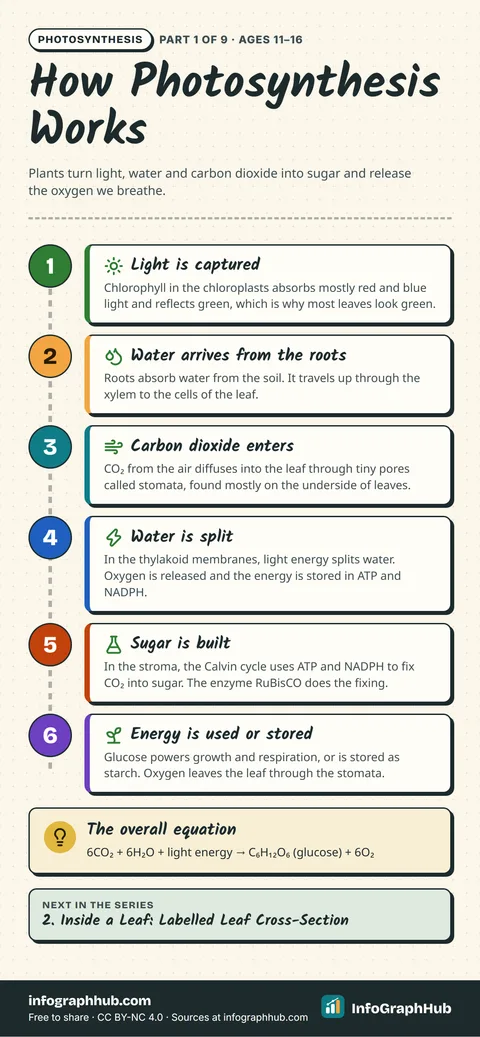
How Photosynthesis Works: From Sunlight to Sugar
Photosynthesis is how plants use light energy to turn carbon dioxide and water into glucose, releasing oxygen as a by-product. It happens in chloroplasts in two linked stages: the light-dependent reactions and the Calvin cycle.
 Science
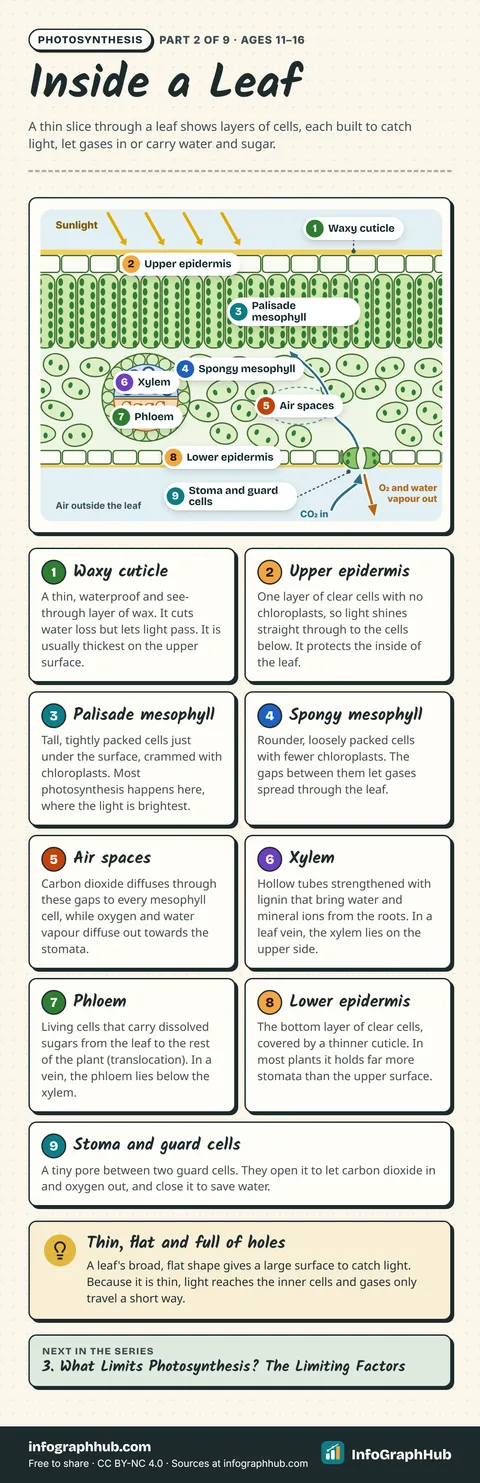
Inside a Leaf: Labelled Leaf Cross-Section
A labelled cross-section of a leaf, from the waxy cuticle to the stomata. See how each layer, from palisade cells packed with chloroplasts to air spaces, veins and guard cells, helps the leaf photosynthesise.
 Science
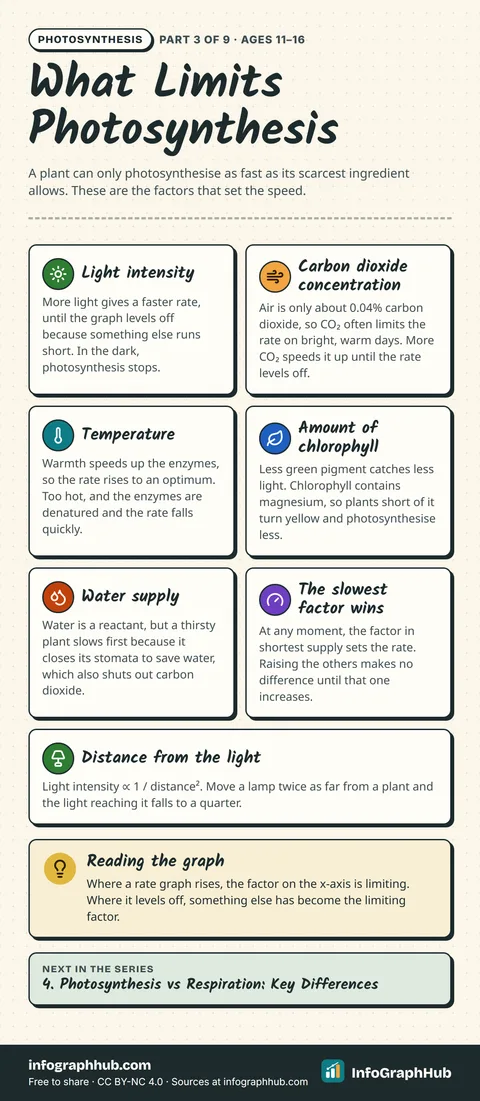
What Limits Photosynthesis? The Limiting Factors
The rate of photosynthesis is set by whatever is in shortest supply: light intensity, carbon dioxide, temperature, chlorophyll or water. See how each factor works, how to read rate graphs and how the inverse square law applies.
 Science
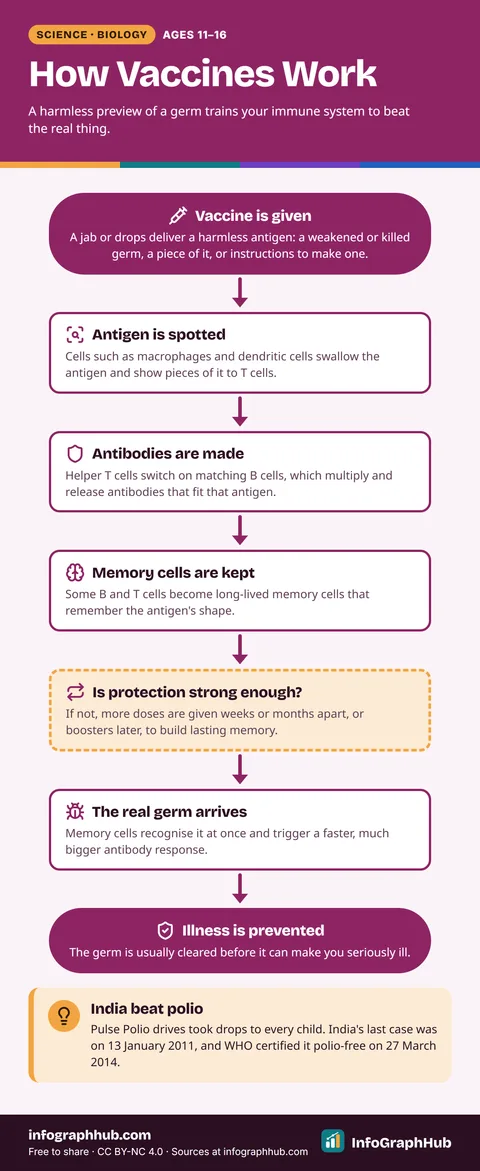
How Vaccines Work: Training Your Immune System
Vaccines work by imitating an infection. They show your immune system a harmless antigen from a germ, so it makes matching antibodies and memory cells that can fight the real germ quickly if it ever arrives.
 Science
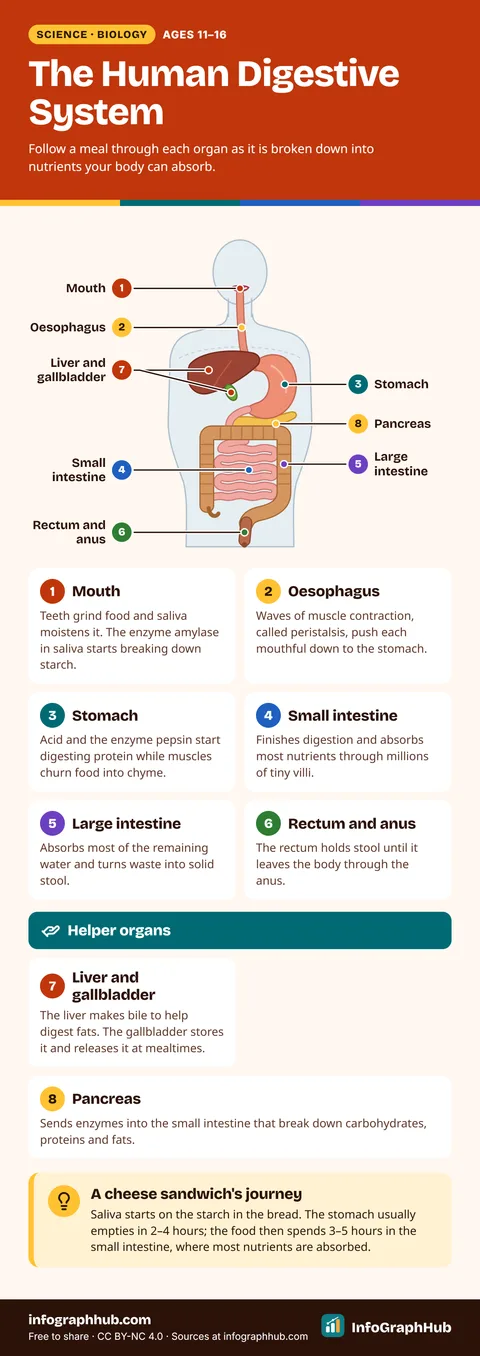
The Human Digestive System: How Food Becomes Energy
The digestive system breaks food into nutrients small enough to enter the blood. Food passes from the mouth through the oesophagus, stomach and intestines, helped by juices from the liver, gallbladder and pancreas.
 Science
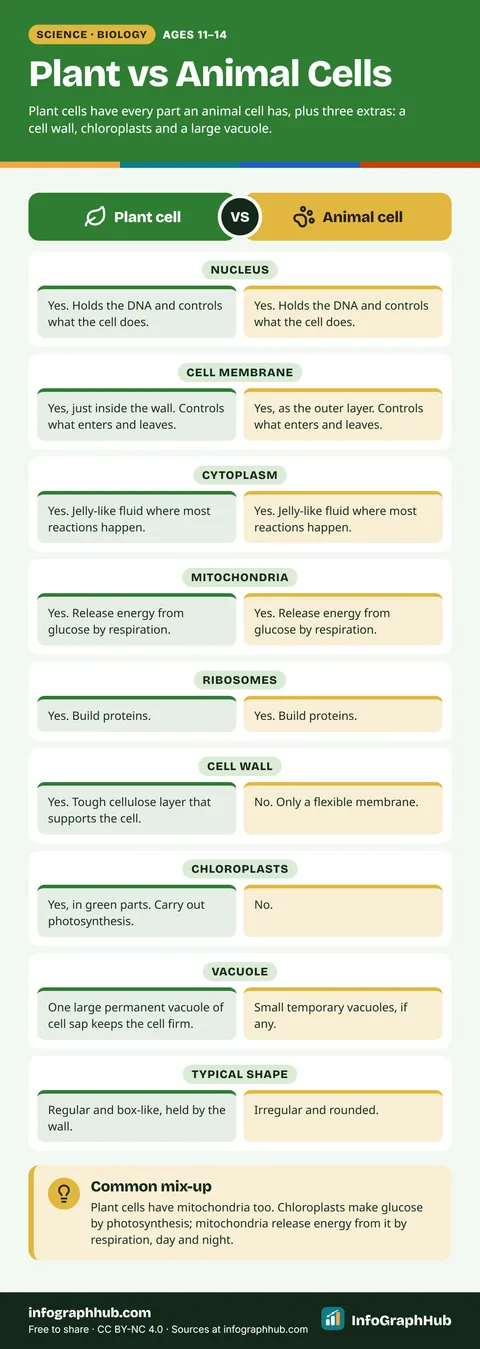
Plant vs Animal Cells: What Each Part Does
Plant and animal cells share a nucleus, cell membrane, cytoplasm, mitochondria and ribosomes. Plant cells also have a cellulose cell wall, chloroplasts and a large permanent vacuole. This comparison poster shows each part and its job.
For teachers and parents: new InfoGraphHub resources by email
One short email when new free resources go live. For adults (18+) only. No spam, no tracking in emails, unsubscribe anytime.