Photosynthesis in Everyday Life: 8 Places You Meet It
Photosynthesis is behind your breakfast, the air you breathe, the paper you write on and the fuel in many engines. Eight everyday examples, from ocean plankton and greenhouse tomatoes to autumn colours and the planet's yearly 'breath'.
Part 7 of 9Photosynthesis series
Ages 11–16 · Grades 6–10 (US) · Years 7–11 (UK) · Classes 6–10 (India)
NGSS is a registered trademark of WestEd. Names and codes are used only to describe curriculum fit; InfoGraphHub is not endorsed by these organisations.
You are solar-powered
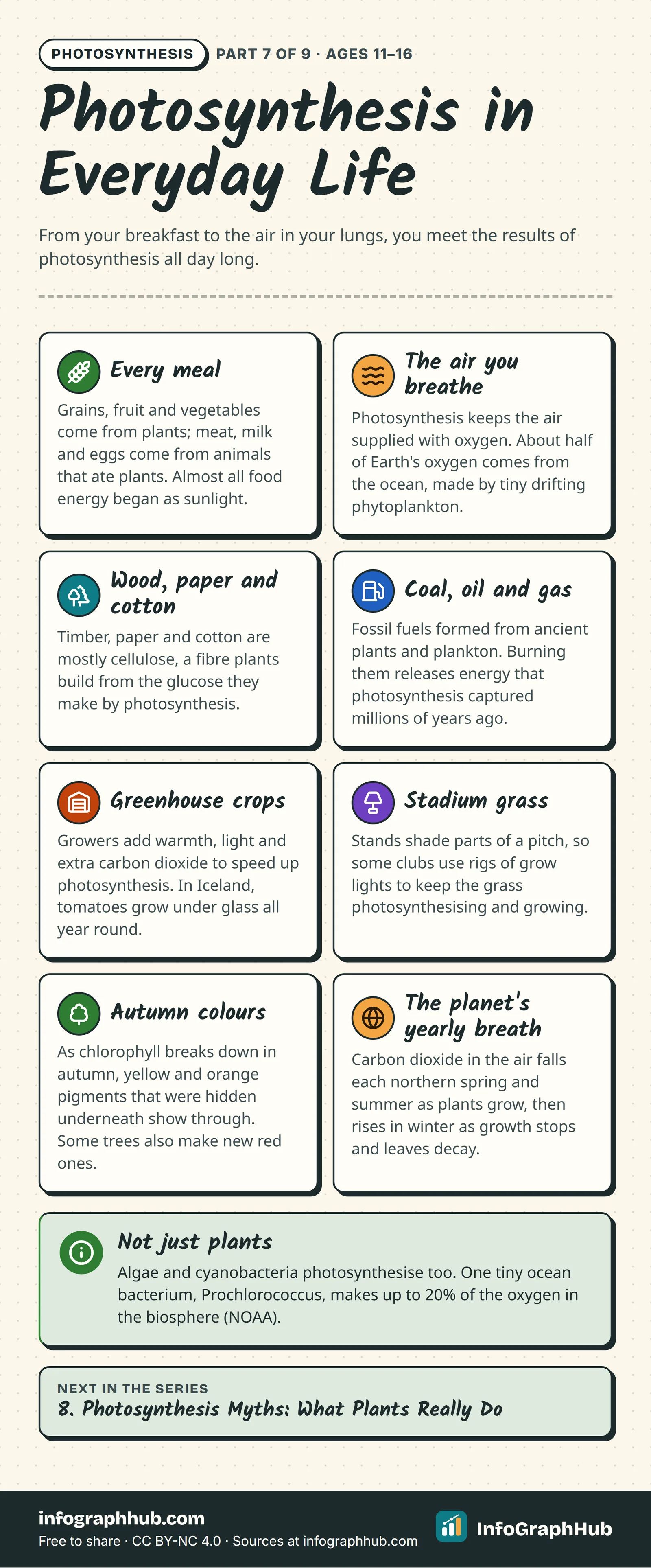
Every time you eat, you are using energy that a plant or alga captured from sunlight. Rice, wheat, maize, fruit and vegetables come straight from plants. Meat, milk and eggs come from animals that ate plants, or ate animals that did. Photosynthetic organisms are the producers at the start of almost every food chain, so almost all the chemical energy in food began as light.
The oxygen in each breath has the same origin. Photosynthesis is the main source of the oxygen in the air, and the ocean matters as much as forests: according to NOAA, about half of Earth's oxygen comes from the ocean, made by tiny drifting phytoplankton, seaweeds and cyanobacteria. One ocean bacterium, Prochlorococcus, produces up to 20% of the oxygen in the biosphere.
Things made from sugar
Plants turn some of the glucose they make into cellulose, the tough fibre in their cell walls. That is why so many materials around you are, in a sense, stored photosynthesis: wooden furniture, paper and cardboard, and cotton clothes (cotton fibres are almost pure cellulose). Natural rubber and plant oils used in cooking and cosmetics are also built from the products of photosynthesis.
Fossil fuels are photosynthesis from the deep past. Coal formed from the remains of ancient plants, and oil and natural gas mostly from tiny marine organisms, buried before they could decay. When they burn, they release energy that was captured from sunlight millions of years ago, along with the carbon dioxide those organisms once took from the air.
Growing more with science
Farmers and growers use what they know about photosynthesis every day. In greenhouses they can raise the temperature, add lighting and pump in extra carbon dioxide so crops photosynthesise faster. In Iceland, where winter days are very short, growers use electricity and heat from geothermal energy to grow tomatoes under glass all year round.
The same idea appears in sports stadiums. Tall stands shade parts of the pitch, so some clubs wheel in rigs of grow lights at night. The extra light (and a little warmth) lets the grass keep photosynthesising and recover between matches.
Seeing it in nature
Autumn colours are a lesson in leaf pigments. Through spring and summer, green chlorophyll hides yellow and orange pigments called carotenoids. As days shorten and temperatures fall, many trees stop making chlorophyll and it breaks down, so the yellow and orange show through. Some trees also make new red pigments, called anthocyanins, in autumn.
On a planetary scale, you can even see photosynthesis in the air. NASA measurements show that the amount of carbon dioxide in the atmosphere falls each northern spring and summer as plants grow, and rises again each winter when growth stops and dead leaves decay. It is as if the whole planet takes a slow breath each year.
Frequently asked questions
How does photosynthesis affect our daily lives?
It provides almost all the energy in our food, most of the oxygen we breathe, materials such as wood, paper and cotton, and the energy stored in fossil fuels, which formed from ancient plants and plankton.
How much of Earth's oxygen comes from the ocean?
About half, according to NOAA. It is made by phytoplankton, seaweeds and photosynthetic bacteria. Marine life also uses about the same amount for respiration.
Why do leaves change colour in autumn?
Trees stop making green chlorophyll and it breaks down, revealing yellow and orange pigments that were there all along. Some trees also make new red pigments called anthocyanins.
Why do greenhouse growers add carbon dioxide?
Carbon dioxide is often the limiting factor in a closed greenhouse on a bright day. Adding more lets the crop photosynthesise faster and grow more, as long as there is enough light and warmth.
Sources & methodology
Every fact is checked against the sources below. We write original explanations and draw original graphics; no figures are copied from textbooks. Spotted an error? See our corrections policy.
- How much oxygen comes from the ocean? (NOAA National Ocean Service, accessed 1 Oct 2026)
- The Carbon Cycle (NASA Earth Observatory, accessed 1 Oct 2026)
- What is photosynthesis? (KS3 Biology) (BBC Bitesize, accessed 1 Oct 2026)
- What are limiting factors in photosynthesis? (BBC Bitesize, accessed 1 Oct 2026)
- Why Leaves Change Color (SUNY College of Environmental Science and Forestry, accessed 1 Oct 2026)
- 8.1 Overview of Photosynthesis (Biology 2e) (OpenStax, Rice University, accessed 1 Oct 2026)
Editorial review pending · Updated
Embed this on your site
Paste this HTML into your page. Keep the credit line: it is required by the CC BY-NC 4.0 license.
Related infographics
 Science
How Photosynthesis Works: From Sunlight to Sugar
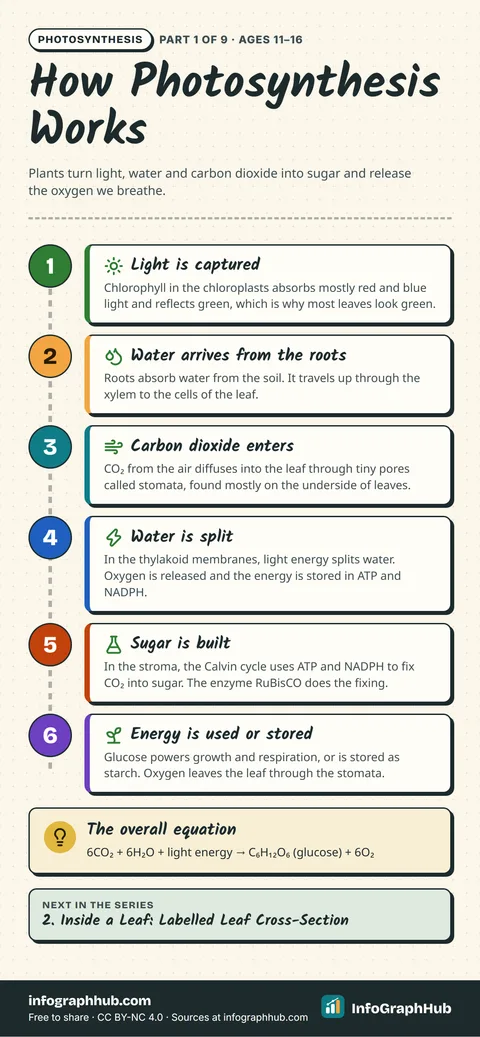
Photosynthesis is how plants use light energy to turn carbon dioxide and water into glucose, releasing oxygen as a by-product. It happens in chloroplasts in two linked stages: the light-dependent reactions and the Calvin cycle.
 Science
Inside a Leaf: Labelled Leaf Cross-Section
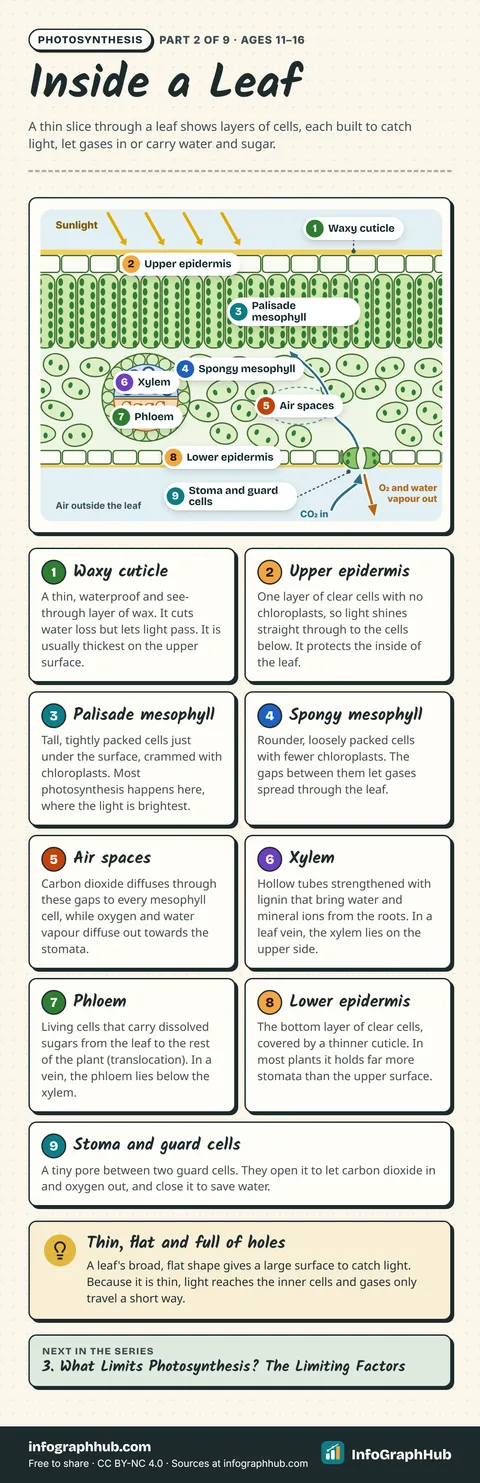
A labelled cross-section of a leaf, from the waxy cuticle to the stomata. See how each layer, from palisade cells packed with chloroplasts to air spaces, veins and guard cells, helps the leaf photosynthesise.
 Science
What Limits Photosynthesis? The Limiting Factors
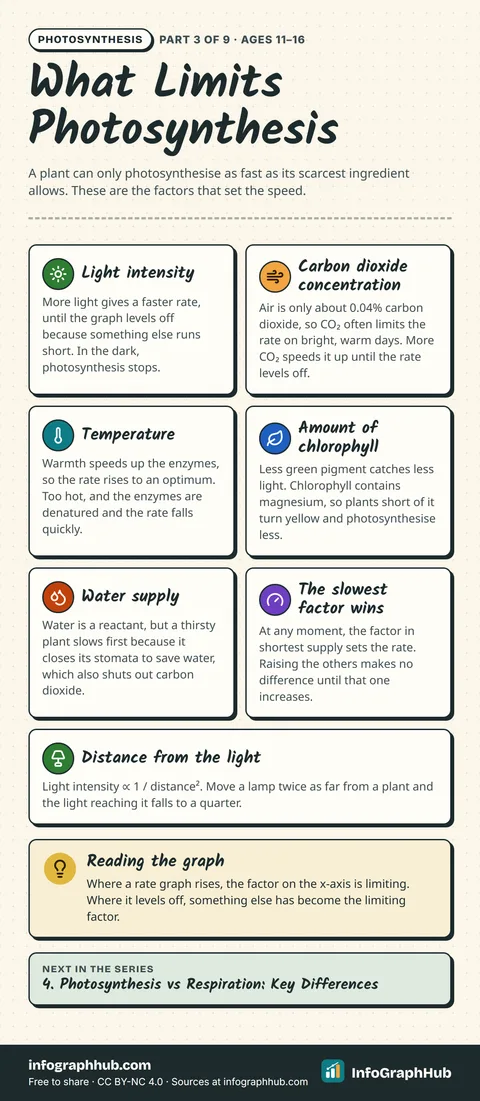
The rate of photosynthesis is set by whatever is in shortest supply: light intensity, carbon dioxide, temperature, chlorophyll or water. See how each factor works, how to read rate graphs and how the inverse square law applies.
 Science
Photosynthesis vs Respiration: Key Differences
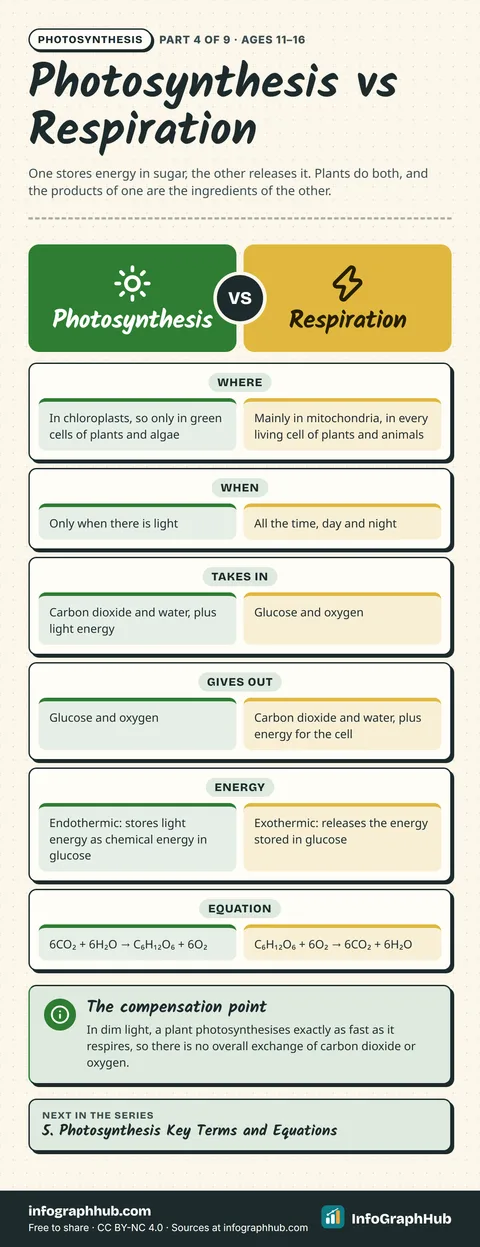
Photosynthesis stores energy in glucose; respiration releases it. Compare where and when each happens, what goes in and comes out, and why plants do both, plus the compensation point and the day and night gas exchange of a leaf.
 Science
Photosynthesis Key Terms and Equations
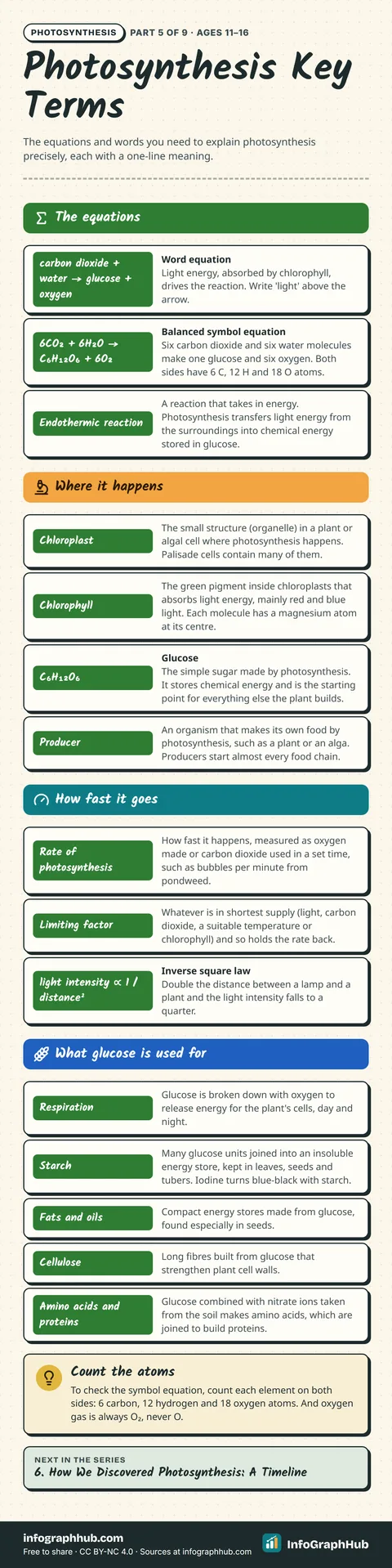
A revision cheat sheet for photosynthesis: the word and balanced symbol equations, key terms such as chlorophyll, chloroplast, glucose and limiting factor, the inverse square law, and the five ways a plant uses its glucose.
 Science
How We Discovered Photosynthesis: A Timeline
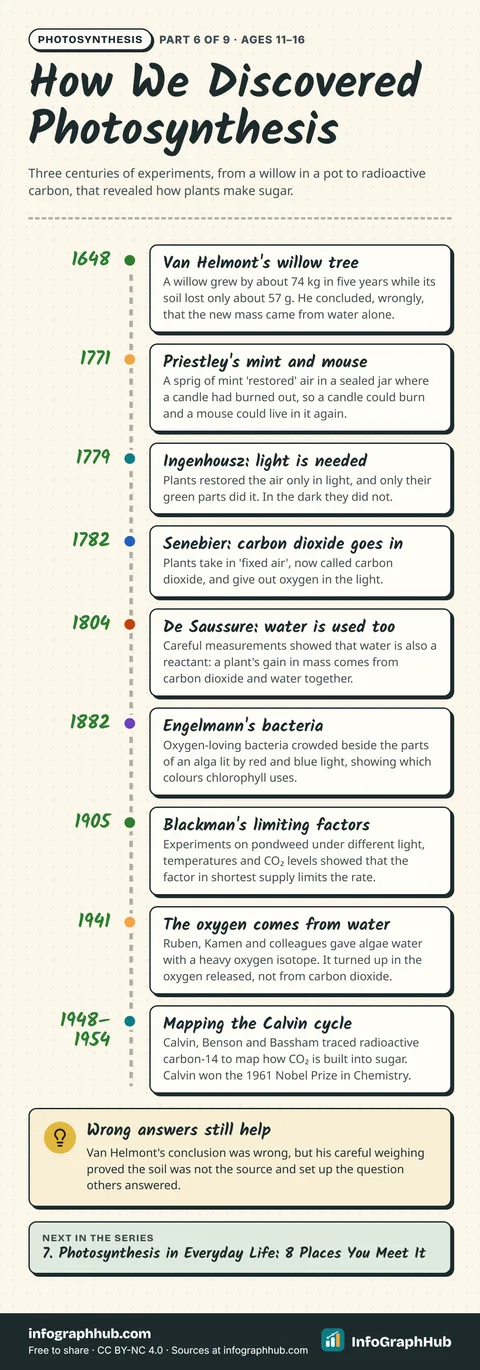
From van Helmont's willow tree to the Calvin cycle: nine experiments over three centuries that revealed how plants use light, carbon dioxide and water to make sugar, and showed that the oxygen they release comes from water.
For teachers and parents: new InfoGraphHub resources by email
One short email when new free resources go live. For adults (18+) only. No spam, no tracking in emails, unsubscribe anytime.