How We Discovered Photosynthesis: A Timeline
From van Helmont's willow tree to the Calvin cycle: nine experiments over three centuries that revealed how plants use light, carbon dioxide and water to make sugar, and showed that the oxygen they release comes from water.
Part 6 of 9Photosynthesis series
Ages 11–16 · Grades 6–10 (US) · Years 7–11 (UK) · Classes 6–10 (India)
NGSS is a registered trademark of WestEd. Names and codes are used only to describe curriculum fit; InfoGraphHub is not endorsed by these organisations.
A puzzle that took 300 years
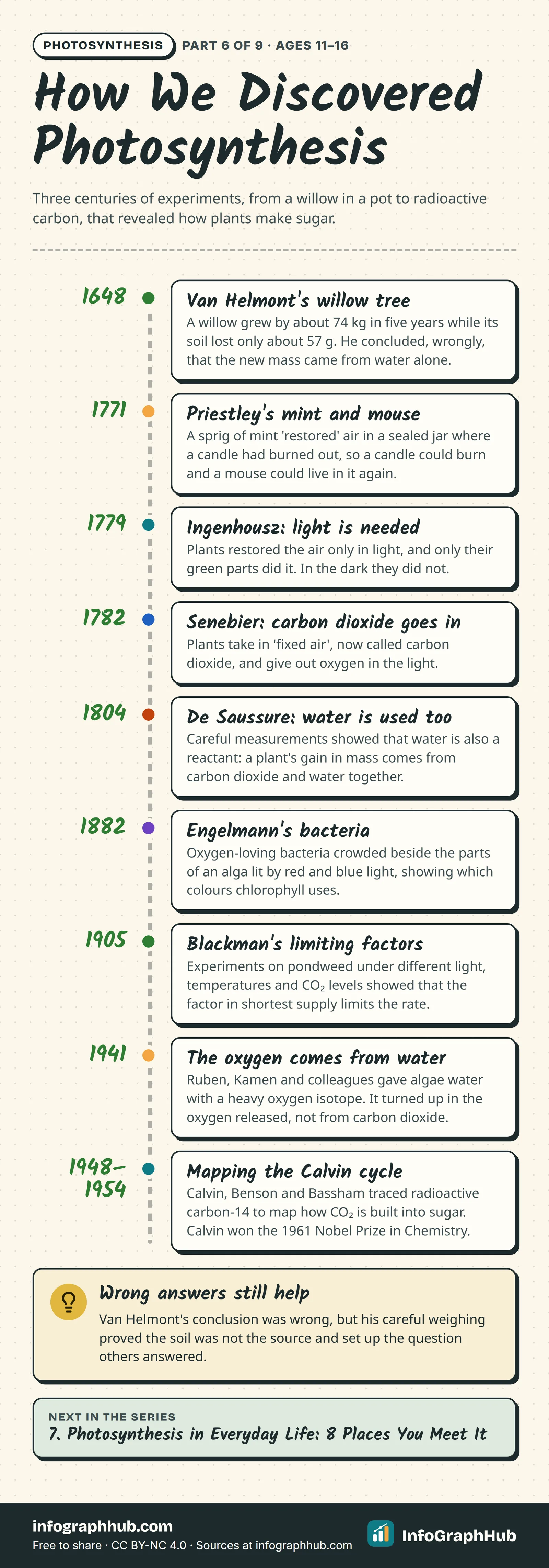
Where does a tree's wood come from? For most of history, people assumed plants simply took their food from the soil. Working out what really happens took more than three centuries and the work of many scientists, each testing an idea, finding part of the answer and leaving a new question for the next. The story is a good example of how science moves forward: careful measurement, a wrong conclusion, and then better experiments that correct it.
Water, air and light (1600s–1700s)
The Flemish scientist Jan Baptist van Helmont planted a willow weighing about 5 pounds (roughly 2.3 kg) in 200 pounds (about 91 kg) of dried soil and gave it only rainwater for five years. The tree grew to about 169 pounds (roughly 77 kg), yet the soil lost only about 2 ounces (around 57 g). His account was published in 1648, after his death. He concluded that the new wood came from water alone. He was right that it did not come from the soil, but he missed the air.
In 1771 the English chemist Joseph Priestley found that a candle burned out in a sealed jar and a mouse could not survive in the 'injured' air. A sprig of mint left in the jar 'restored' it. In 1779 the Dutch physician Jan Ingenhousz showed that plants only restore air in light, and only their green parts do it.
The ingredients are found (1782–1804)
The Swiss pastor and naturalist Jean Senebier showed in 1782 that plants take in 'fixed air', which we now call carbon dioxide, and give out oxygen. In 1804 another Swiss scientist, Nicolas-Théodore de Saussure, used careful measurements to show that water is also a reactant: a plant's gain in mass comes from carbon dioxide and water together. By then, all the ingredients of the modern word equation were known.
Colours and limits (1882–1905)
In the 1880s the German scientist Theodor Engelmann shone a spectrum of light across a strand of the green alga Spirogyra. Bacteria that need oxygen gathered most thickly beside the parts lit by red and blue light, showing which colours chlorophyll uses to make oxygen.
In 1905 the English plant scientist Frederick Blackman measured photosynthesis in pondweed while changing light, temperature and carbon dioxide. He proposed that the factor in shortest supply limits the whole rate, the idea of the limiting factor that students still use today.
Tracing the atoms (1941–1961)
New tools in the 20th century let scientists follow individual atoms. In 1941, Samuel Ruben, Martin Kamen and colleagues in California gave algae water containing a heavy form (isotope) of oxygen. The heavy oxygen turned up in the oxygen gas released, showing that the oxygen comes from water, not from carbon dioxide.
From 1948 to 1954, Melvin Calvin, Andrew Benson, James Bassham and their team fed algae carbon dioxide made with radioactive carbon-14 and tracked where the carbon went. They mapped the cycle of reactions that builds carbon dioxide into sugar, now called the Calvin cycle. Calvin received the 1961 Nobel Prize in Chemistry for this work.
Frequently asked questions
Who discovered photosynthesis?
No single person. Van Helmont, Priestley, Ingenhousz, Senebier and de Saussure each discovered part of it between the 1640s and 1804, and 20th-century scientists such as Ruben, Kamen and Calvin worked out the chemistry.
What did van Helmont's willow tree experiment show?
A willow gained about 164 pounds (roughly 74 kg) in five years while its soil lost only about 2 ounces (around 57 g), so the mass did not come from the soil. Van Helmont wrongly concluded it came from water alone; most of it actually comes from carbon dioxide in the air.
How did scientists prove the oxygen comes from water?
In 1941 Ruben, Kamen and colleagues gave algae water containing a heavy isotope of oxygen. The heavy oxygen appeared in the oxygen gas the algae released, so the oxygen must come from water rather than carbon dioxide.
Why did Melvin Calvin win a Nobel Prize?
He won the 1961 Nobel Prize in Chemistry for his research on how plants take up carbon dioxide. Using radioactive carbon-14, his team traced the cycle of reactions that turns carbon dioxide into sugar.
Sources & methodology
Every fact is checked against the sources below. We write original explanations and draw original graphics; no figures are copied from textbooks. Spotted an error? See our corrections policy.
- Discoveries in oxygenic photosynthesis (1727–2003): a perspective (Photosynthesis Research 80: 15–57, 2004) (Govindjee and D. Krogmann, University of Illinois at Urbana-Champaign, accessed 1 Oct 2026)
- Analyzing van Helmont's Classic Experiment (S. G. Saupe, College of Saint Benedict and Saint John's University, accessed 1 Oct 2026)
- Discovery of Photosynthesis (A. Shipunov, Minot State University (Introduction to Botany, LibreTexts), accessed 1 Oct 2026)
- A paradigm of fragile Earth in Priestley's bell jar (Extreme Physiology & Medicine (2012), via PubMed Central, accessed 1 Oct 2026)
- The Nobel Prize in Chemistry 1961 (Nobel Prize Outreach, accessed 1 Oct 2026)
Editorial review pending · Updated
Embed this on your site
Paste this HTML into your page. Keep the credit line: it is required by the CC BY-NC 4.0 license.
Related infographics
 Science
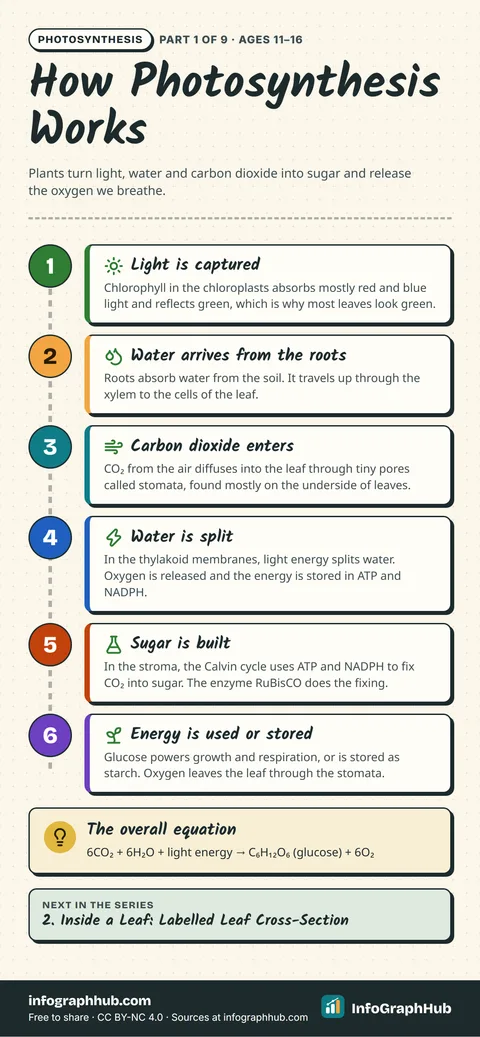
How Photosynthesis Works: From Sunlight to Sugar
Photosynthesis is how plants use light energy to turn carbon dioxide and water into glucose, releasing oxygen as a by-product. It happens in chloroplasts in two linked stages: the light-dependent reactions and the Calvin cycle.
 Science
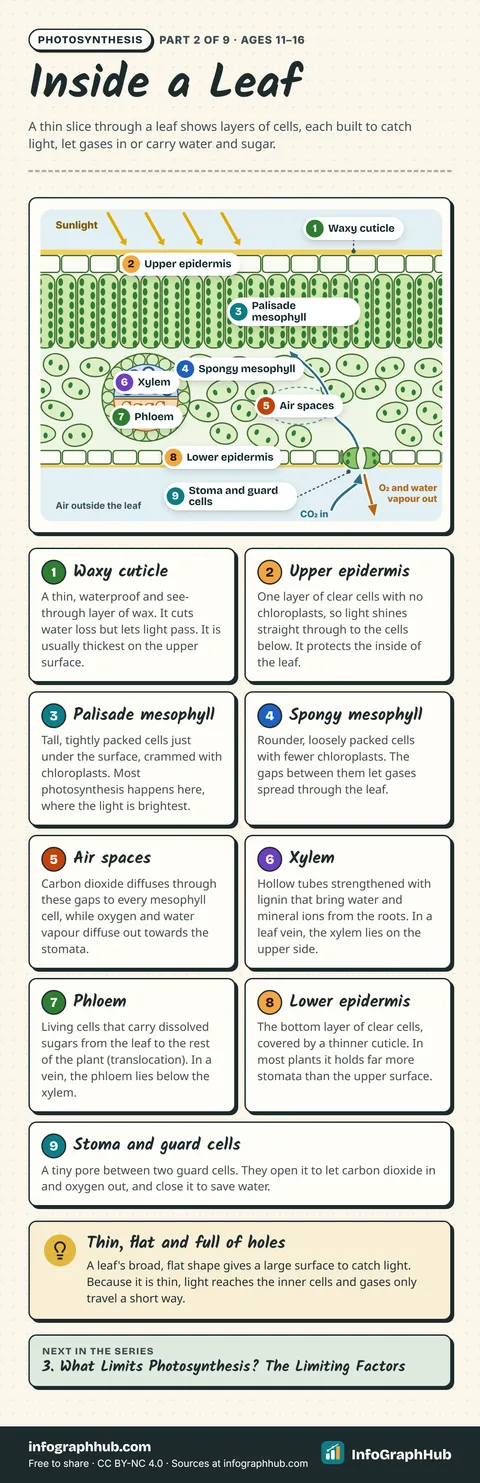
Inside a Leaf: Labelled Leaf Cross-Section
A labelled cross-section of a leaf, from the waxy cuticle to the stomata. See how each layer, from palisade cells packed with chloroplasts to air spaces, veins and guard cells, helps the leaf photosynthesise.
 Science
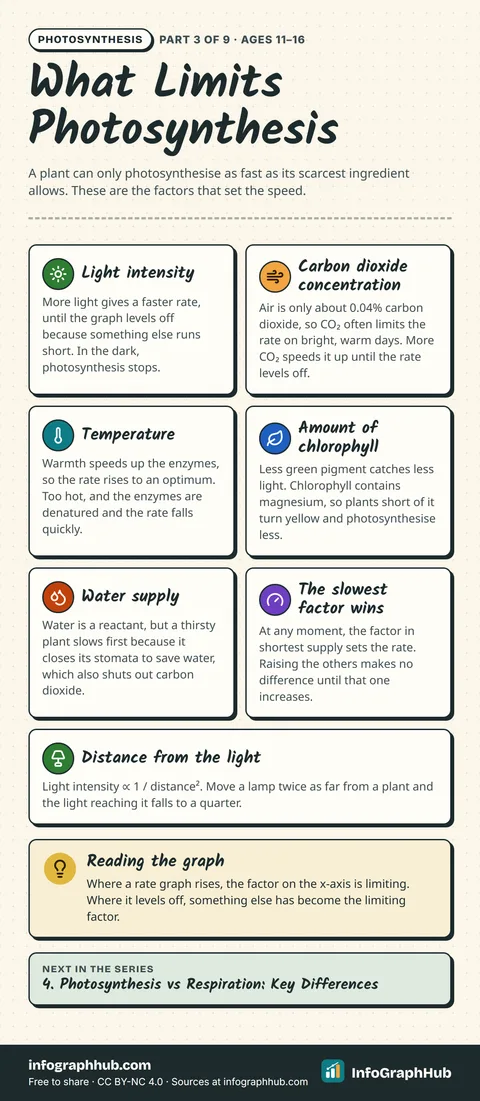
What Limits Photosynthesis? The Limiting Factors
The rate of photosynthesis is set by whatever is in shortest supply: light intensity, carbon dioxide, temperature, chlorophyll or water. See how each factor works, how to read rate graphs and how the inverse square law applies.
 Science
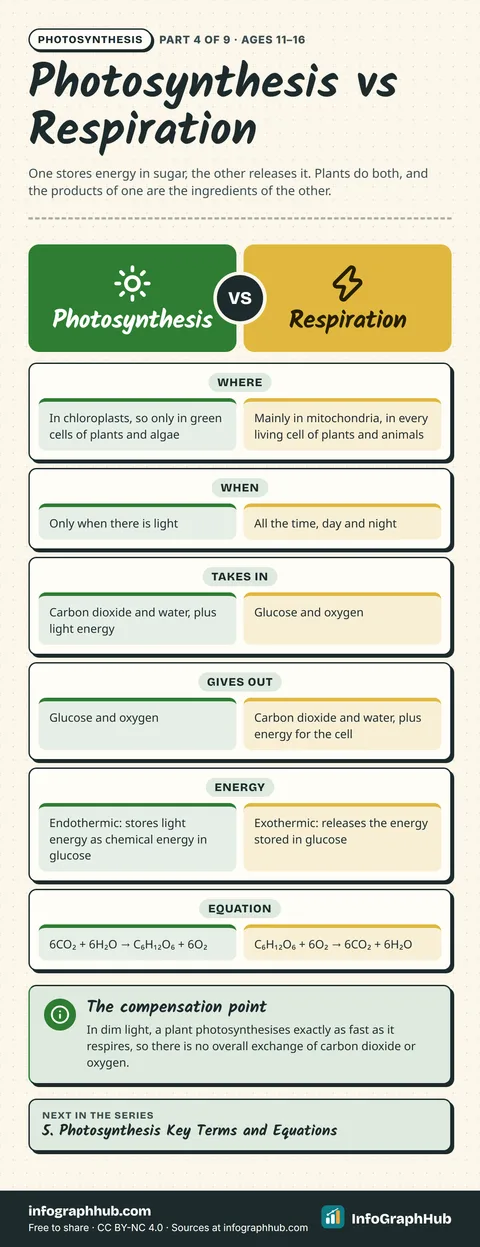
Photosynthesis vs Respiration: Key Differences
Photosynthesis stores energy in glucose; respiration releases it. Compare where and when each happens, what goes in and comes out, and why plants do both, plus the compensation point and the day and night gas exchange of a leaf.
 Science
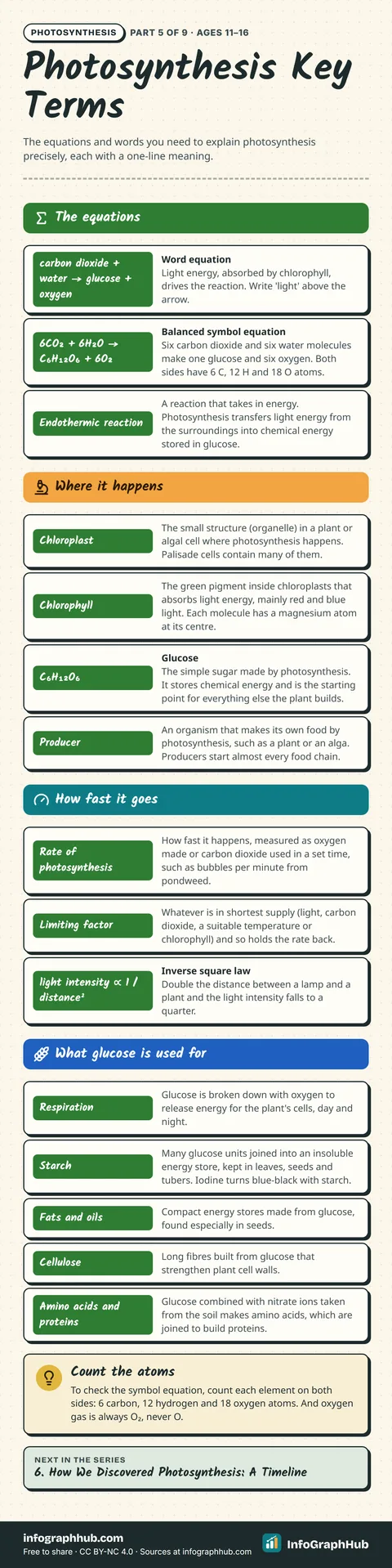
Photosynthesis Key Terms and Equations
A revision cheat sheet for photosynthesis: the word and balanced symbol equations, key terms such as chlorophyll, chloroplast, glucose and limiting factor, the inverse square law, and the five ways a plant uses its glucose.
 Science
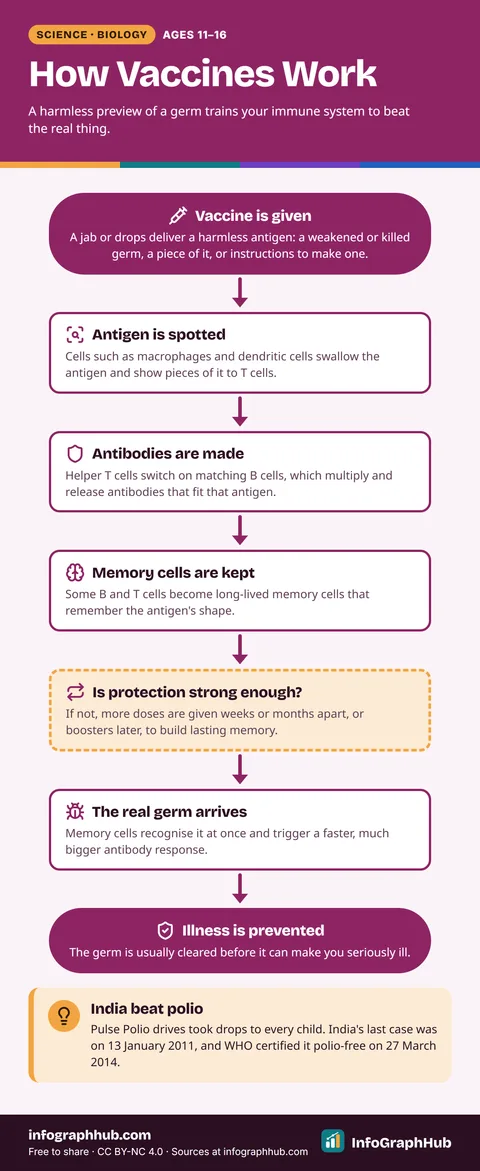
How Vaccines Work: Training Your Immune System
Vaccines work by imitating an infection. They show your immune system a harmless antigen from a germ, so it makes matching antibodies and memory cells that can fight the real germ quickly if it ever arrives.
For teachers and parents: new InfoGraphHub resources by email
One short email when new free resources go live. For adults (18+) only. No spam, no tracking in emails, unsubscribe anytime.