Photosynthesis Key Terms and Equations
A revision cheat sheet for photosynthesis: the word and balanced symbol equations, key terms such as chlorophyll, chloroplast, glucose and limiting factor, the inverse square law, and the five ways a plant uses its glucose.
Part 5 of 9Photosynthesis series
Ages 11–16 · Grades 6–10 (US) · Years 7–11 (UK) · Classes 6–10 (India)
Two equations to know by heart
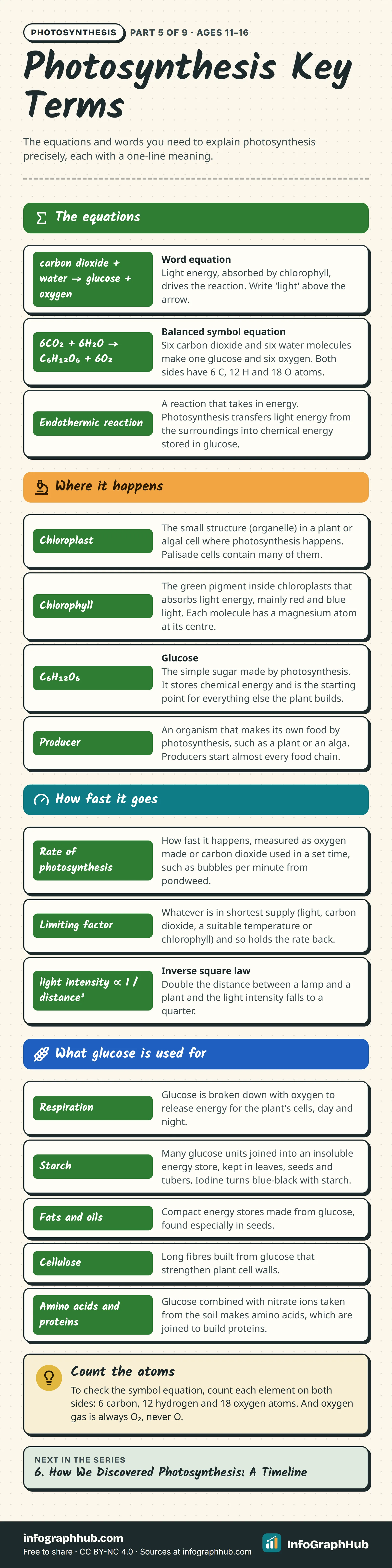
Every photosynthesis question starts from the same reaction, written in two ways.
- Word equation: carbon dioxide + water → glucose + oxygen, with light written above the arrow because light energy drives it and chlorophyll absorbs that light.
- Balanced symbol equation:
6CO₂ + 6H₂O → C₆H₁₂O₆ + 6O₂
The symbols you need to recognise are CO₂ (carbon dioxide), H₂O (water), C₆H₁₂O₆ (glucose) and O₂ (oxygen).
Balancing it step by step
A balanced equation has the same number of each kind of atom on both sides, because atoms are only rearranged, never made or destroyed. Check it like this:
| Atom | Left side | Right side |
|---|---|---|
| Carbon | 6 × 1 in 6CO₂ = 6 | 6 in C₆H₁₂O₆ = 6 |
| Hydrogen | 6 × 2 in 6H₂O = 12 | 12 in C₆H₁₂O₆ = 12 |
| Oxygen | 6 × 2 + 6 × 1 = 18 | 6 + 6 × 2 = 18 |
Each glucose molecule needs six carbon dioxide molecules because glucose has six carbon atoms, and each carbon atom comes from one CO₂. A common slip is to write O instead of O₂ for oxygen gas: oxygen in the air is always made of pairs of atoms.
Words that are easy to mix up
- Chlorophyll and chloroplast: chlorophyll is the green pigment; a chloroplast is the tiny structure in a cell that contains it.
- Glucose and starch: glucose is a small, soluble sugar; starch is a large, insoluble molecule made of many glucose units joined together, so it can be stored without being washed around the cell.
- Stoma and stomata: one pore is a stoma; two or more are stomata.
- Endothermic and exothermic: photosynthesis is endothermic (it takes in energy, from light); respiration is exothermic (it releases energy).
What happens to the glucose
A plant does not keep its glucose as glucose for long. It uses it in five main ways:
- Respiration, to release energy for its cells.
- Starch, an insoluble store in leaves, seeds and organs such as potato tubers.
- Fats and oils, compact energy stores, especially in seeds.
- Cellulose, the fibres that strengthen cell walls.
- Amino acids, to build proteins. For this, the plant also needs nitrate ions taken from the soil, because amino acids contain nitrogen and glucose does not.
The starch test is a simple way to show that a leaf has been photosynthesising: iodine solution turns from orange-brown to blue-black where starch is present.
Using the terms in an answer
Precise words earn marks because they show exactly what you mean. Compare these two answers to the question "Why does a plant in a dark cupboard stop growing?"
- Vague: "It has no sunlight, so it cannot make food."
- Precise: "Without light, chlorophyll cannot absorb energy, so photosynthesis stops and no glucose is made. The plant still respires, so it uses up its stored starch."
The second answer names the pigment, the process, the product and the store, and it remembers that respiration carries on in the dark.
Frequently asked questions
What is the balanced symbol equation for photosynthesis?
6CO₂ + 6H₂O → C₆H₁₂O₆ + 6O₂. Six molecules of carbon dioxide and six of water react, using light energy, to make one molecule of glucose and six of oxygen.
What is the difference between chlorophyll and a chloroplast?
Chlorophyll is the green pigment that absorbs light. A chloroplast is the small structure (organelle) inside a plant cell where photosynthesis happens, and it contains the chlorophyll.
What do plants use glucose for?
For respiration, to make starch for storage, to make fats and oils for storage, to make cellulose for cell walls, and, together with nitrate ions from the soil, to make amino acids for proteins.
Why is photosynthesis called endothermic?
Because it takes in energy from its surroundings. Light energy is transferred to the chloroplasts and stored as chemical energy in glucose.
Sources & methodology
Every fact is checked against the sources below. We write original explanations and draw original graphics; no figures are copied from textbooks. Spotted an error? See our corrections policy.
- GCSE Biology (8461) specification: 4.4 Bioenergetics (AQA, accessed 1 Oct 2026)
- What is photosynthesis and how does it affect plants? (CCEA) (BBC Bitesize, accessed 1 Oct 2026)
- What is photosynthesis? (KS3 Biology) (BBC Bitesize, accessed 1 Oct 2026)
- 8.1 Overview of Photosynthesis (Biology 2e) (OpenStax, Rice University, accessed 1 Oct 2026)
- Magnesium Deficiencies in Vegetables (University of Delaware Cooperative Extension, Weekly Crop Update, accessed 1 Oct 2026)
Editorial review pending · Updated
Embed this on your site
Paste this HTML into your page. Keep the credit line: it is required by the CC BY-NC 4.0 license.
Related infographics
 Science
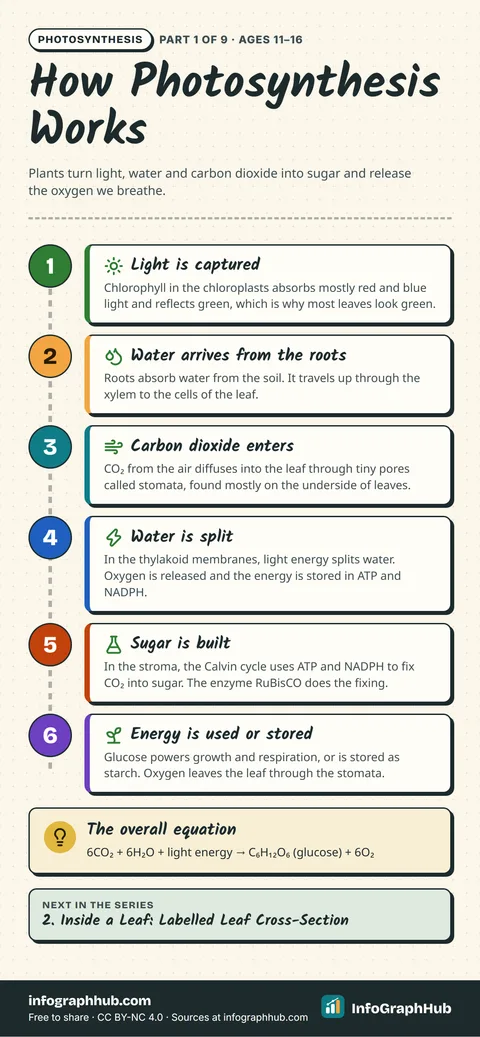
How Photosynthesis Works: From Sunlight to Sugar
Photosynthesis is how plants use light energy to turn carbon dioxide and water into glucose, releasing oxygen as a by-product. It happens in chloroplasts in two linked stages: the light-dependent reactions and the Calvin cycle.
 Science
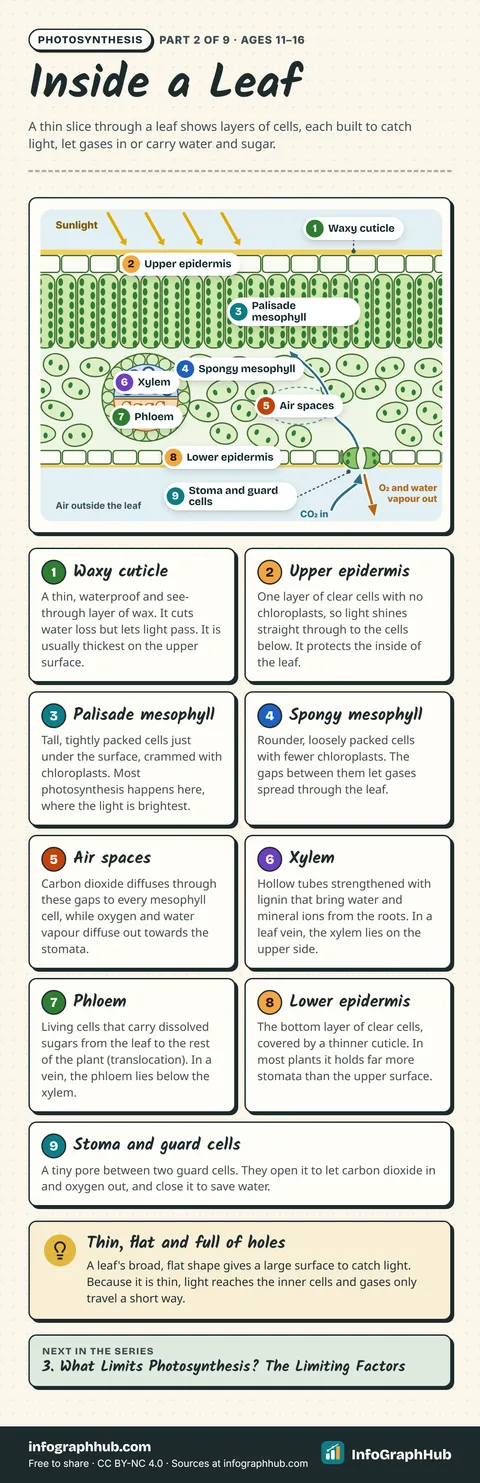
Inside a Leaf: Labelled Leaf Cross-Section
A labelled cross-section of a leaf, from the waxy cuticle to the stomata. See how each layer, from palisade cells packed with chloroplasts to air spaces, veins and guard cells, helps the leaf photosynthesise.
 Science
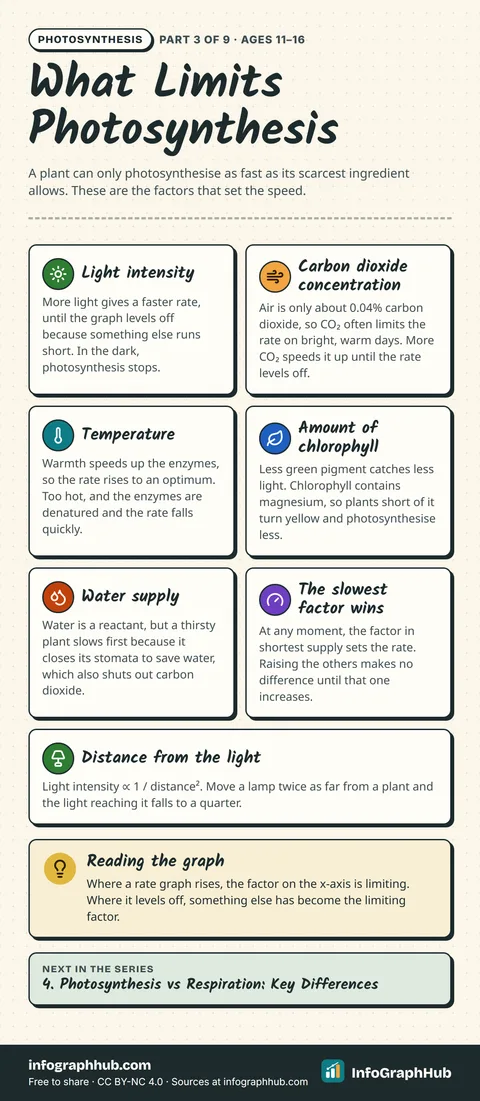
What Limits Photosynthesis? The Limiting Factors
The rate of photosynthesis is set by whatever is in shortest supply: light intensity, carbon dioxide, temperature, chlorophyll or water. See how each factor works, how to read rate graphs and how the inverse square law applies.
 Science
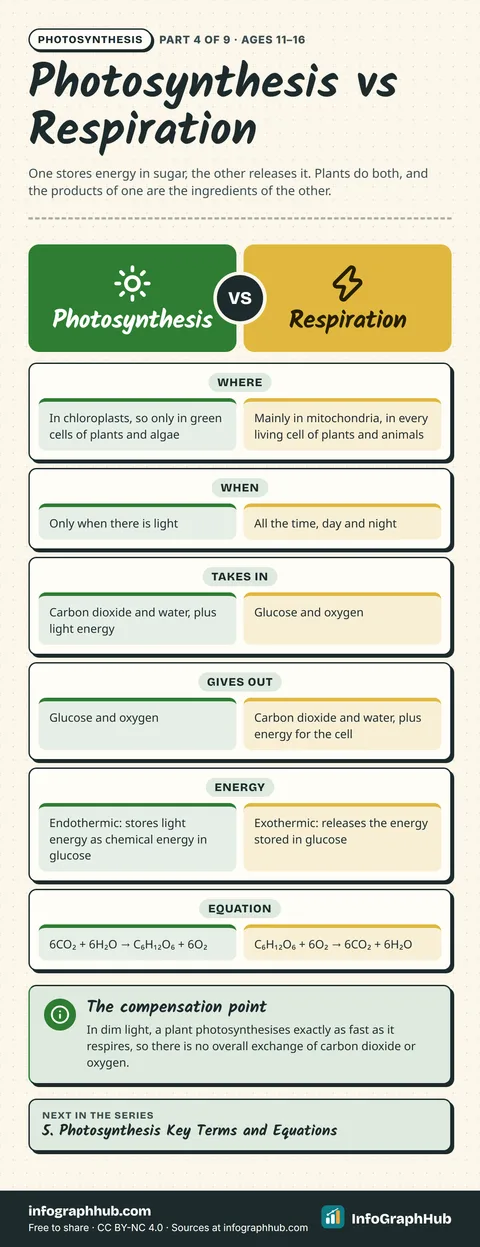
Photosynthesis vs Respiration: Key Differences
Photosynthesis stores energy in glucose; respiration releases it. Compare where and when each happens, what goes in and comes out, and why plants do both, plus the compensation point and the day and night gas exchange of a leaf.
 Science
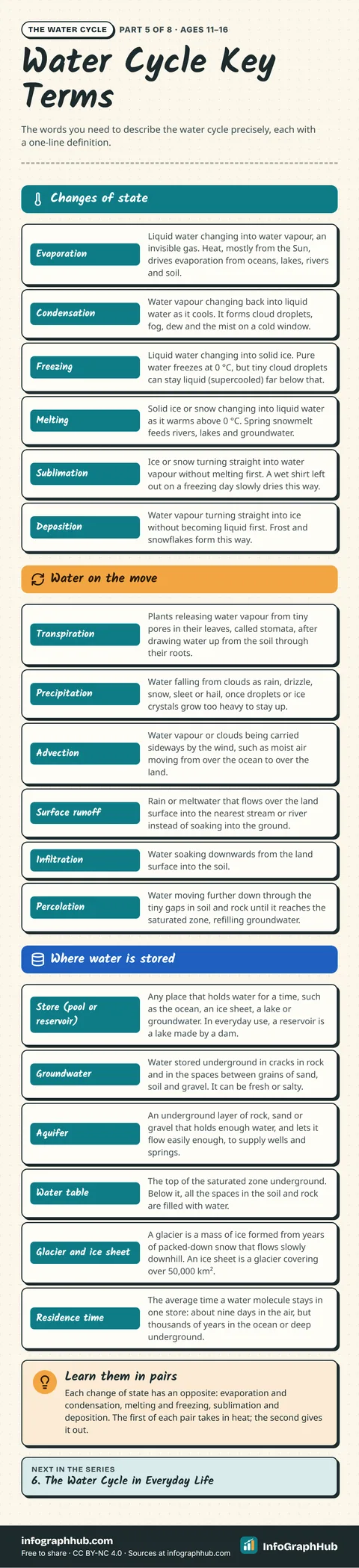
Water Cycle Key Terms
A cheat sheet of 18 water cycle key terms with precise one-line definitions, grouped into changes of state, water on the move and where water is stored, from evaporation and sublimation to advection, aquifers and residence time.
 Science
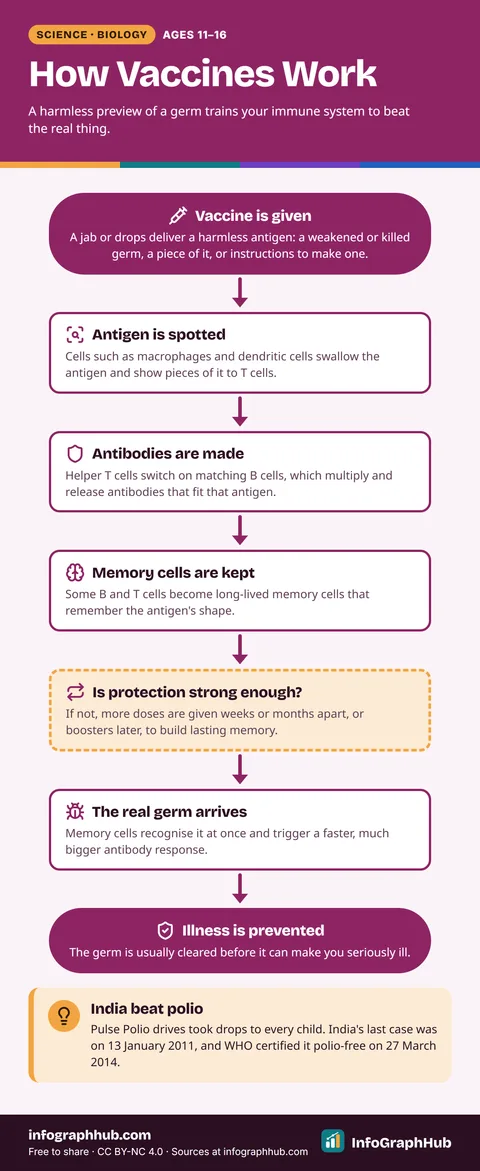
How Vaccines Work: Training Your Immune System
Vaccines work by imitating an infection. They show your immune system a harmless antigen from a germ, so it makes matching antibodies and memory cells that can fight the real germ quickly if it ever arrives.
For teachers and parents: new InfoGraphHub resources by email
One short email when new free resources go live. For adults (18+) only. No spam, no tracking in emails, unsubscribe anytime.