Science, human bodyQuizPart 8 of 8, The Human HeartUpdated 1 October 2026
Human Heart Quiz: Test Yourself
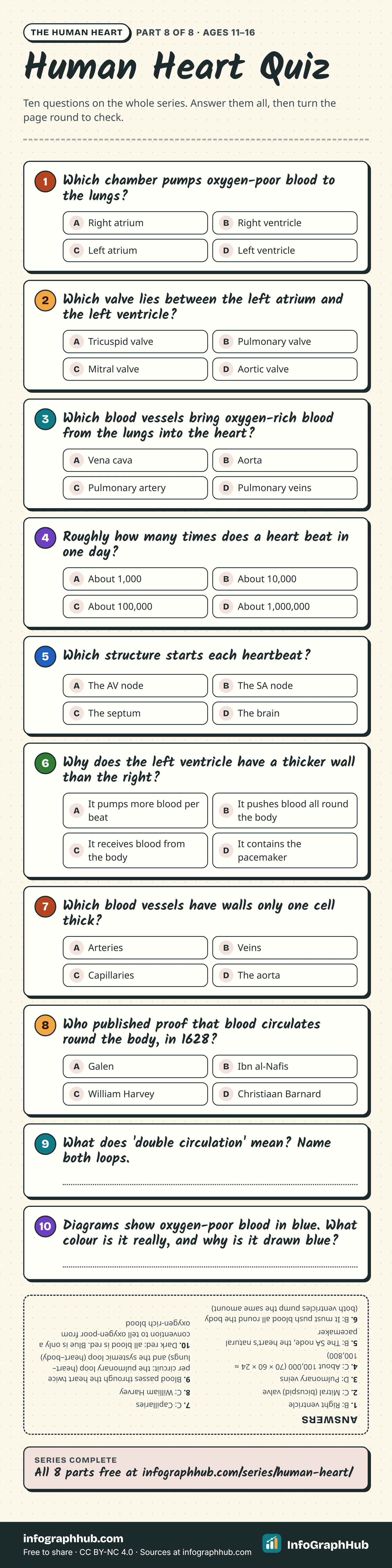
Ten questions covering the whole Human Heart series: chambers, valves and vessels, the route of blood, heart numbers, capillaries, the SA node, the history of discovery and common myths. Eight are multiple choice and two need a short written answer.
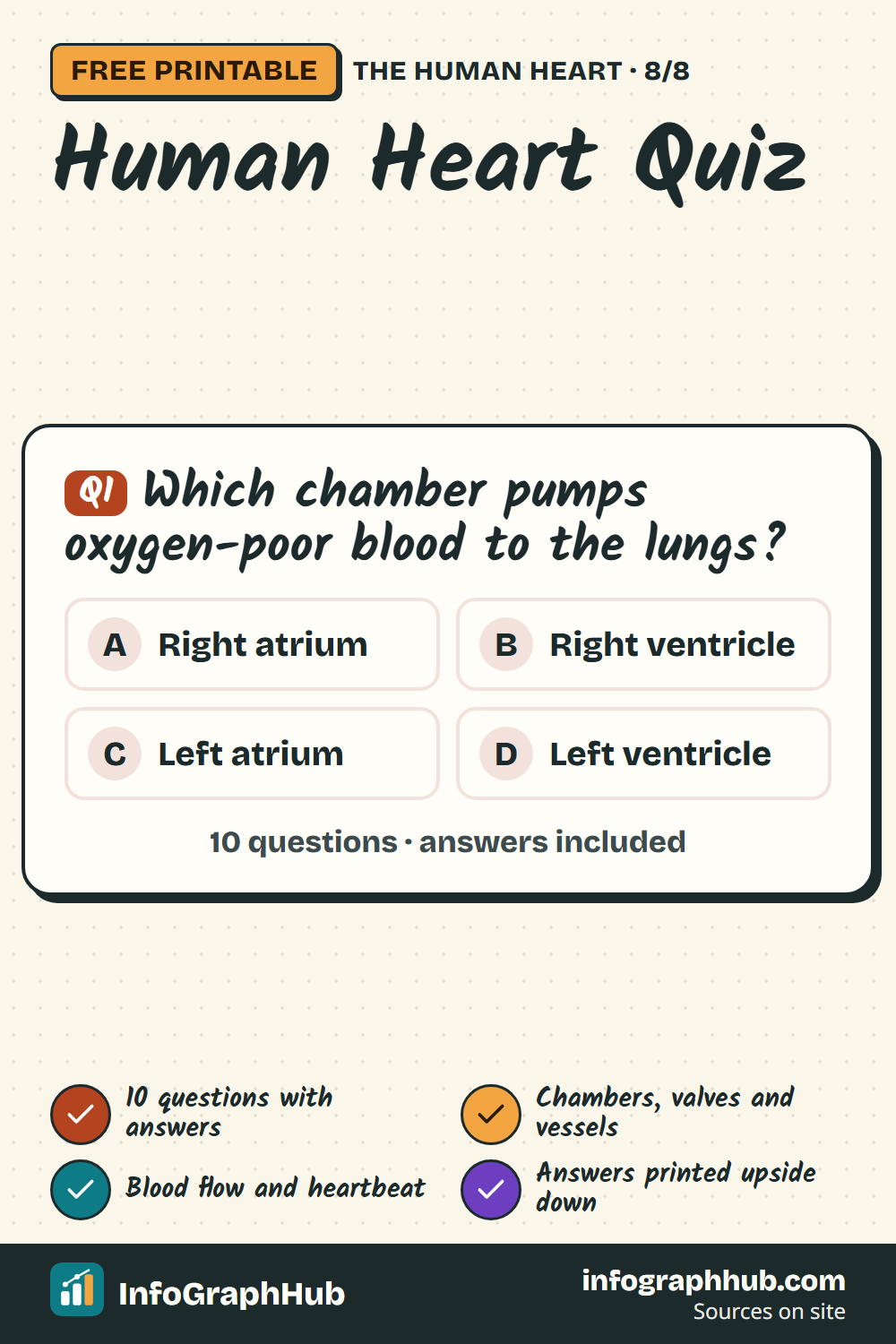
Use this infographic
Free under CC BY-NC 4.0, with credit to InfoGraphHub.
How to use this quiz
Try all ten questions before you look at the answers. Questions 1 to 8 are multiple choice; questions 9 and 10 need a short written answer, so write a sentence or two rather than a single word. The answers are printed upside down at the foot of the infographic. The worked answers below explain why each answer is right, which is where most of the learning happens.
1. Pumping to the lungs
Answer: B, the right ventricle. Oxygen-poor blood from the body collects in the right atrium, passes into the right ventricle, and the right ventricle pumps it through the pulmonary valve into the pulmonary artery and on to the lungs. The atria are receiving chambers, and the left ventricle pumps oxygen-rich blood to the body.
2. The mitral valve
Answer: C, the mitral valve. It is also called the bicuspid valve because it has two flaps. Its partner on the right side, between the right atrium and right ventricle, is the tricuspid valve, with three flaps. The pulmonary and aortic valves sit at the exits of the ventricles.
3. Back from the lungs
Answer: D, the pulmonary veins. Veins carry blood towards the heart, and the pulmonary veins carry it from the lungs, so their blood is rich in oxygen. The pulmonary artery is the trap: it carries oxygen-poor blood the other way, from the heart to the lungs.
4. Beats in a day
Answer: C, about 100,000. You can work it out: at about 70 beats a minute, 70 × 60 × 24 = 100,800 beats in a day. Over a long life that adds up to more than 3.5 billion beats.
5. Starting the beat
Answer: B, the SA node. The sinoatrial node is a group of pacemaker cells in the wall of the right atrium. It fires by itself and starts every beat. The AV node passes the signal on to the ventricles after a short delay. The brain can speed the heart up or slow it down, but it does not start each beat.
6. The thicker wall
Answer: B. The left ventricle needs a thicker, more muscular wall because it has to create enough pressure to push blood all the way round the body. Option A is a common mistake: both ventricles pump the same amount of blood with each beat.
7. One cell thick
Answer: C, capillaries. A capillary wall is a single layer of thin cells, and the narrowest capillaries are barely wide enough for one red blood cell. The short distance lets oxygen and glucose pass out to the cells and carbon dioxide pass in. Arteries, including the aorta, have thick muscular walls, and veins have thinner walls but still several layers.
8. Proving circulation
Answer: C, William Harvey. His book De Motu Cordis appeared in 1628. Galen (2nd century AD) believed the liver made blood that the body used up. Ibn al-Nafis (13th century) correctly described the route through the lungs. Christiaan Barnard led the first human heart transplant in 1967.
9. Double circulation
Model answer: Blood flows in two loops. In the pulmonary circulation it goes from the heart to the lungs and back; in the systemic circulation it goes from the heart round the rest of the body and back. So blood passes through the heart twice on each complete circuit. A full answer names both loops and says where each one goes.
10. Red or blue?
Model answer: The blood is really dark red. All blood is red; it is bright red when it carries a lot of oxygen and darker red when it carries less. Diagrams colour oxygen-poor blood blue only as a convention, so the two streams are easy to tell apart. A good answer says both that the blood is red and that the blue is just a convention.
Frequently asked questions
What topics does this heart quiz cover?
The whole Human Heart series: the parts of the heart, the route blood takes, heart numbers, blood vessels, key terms such as the SA node, the history of discovery and common myths.
Where are the answers?
They are printed upside down at the foot of the infographic. This page also gives a worked answer for every question, explaining why it is right.
Which chamber of the heart pumps blood to the lungs?
The right ventricle. It pumps oxygen-poor blood through the pulmonary valve into the pulmonary artery, which carries it to the lungs.
Why is the wall of the left ventricle thicker?
Because it has to create much more pressure to push blood all round the body. Both ventricles pump the same amount of blood with each beat.
Sources & methodology
Every fact is checked against the sources below. We write original explanations and draw original graphics; no figures are copied from textbooks. Spotted an error? See our corrections policy.
- How the Heart Works: How Blood Flows through the Heart (US National Heart, Lung, and Blood Institute (NHLBI), accessed 1 Oct 2026)
- How the Heart Works: How the Heart Beats (US National Heart, Lung, and Blood Institute (NHLBI), accessed 1 Oct 2026)
- How your heart works (British Heart Foundation, accessed 1 Oct 2026)
- Anatomy and Physiology 2e, 19.1 Heart Anatomy (OpenStax, Rice University, accessed 1 Oct 2026)
- Anatomy and Physiology 2e, 20.1 Structure and Function of Blood Vessels (OpenStax, Rice University, accessed 1 Oct 2026)
- Why are veins blue? (Science Questions with Surprising Answers, West Texas A&M University, accessed 1 Oct 2026)
Editorial review pending · Updated
Made by the InfoGraphHub editorial team (how we research and check: editorial and AI policy). First published 1 October 2026, last reviewed 1 October 2026. Found a mistake? Tell the editors.
For teachers: ages and curriculum fit
Ages 11–16 · Grades 6–10 (US) · Years 7–11 (UK) · Classes 6–10 (India)
NGSS is a registered trademark of WestEd. Cambridge and IGCSE are trademarks of Cambridge University Press & Assessment. Names and codes are used only to describe curriculum fit; InfoGraphHub is not endorsed by these organisations.
Embed this on your site
Paste this HTML into your page. Keep the credit line: it is required by the CC BY-NC 4.0 license.
Related infographics


For teachers and parents: new InfoGraphHub resources by email
One short email when new free resources go live. For adults (18+) only. No spam, no tracking in emails, unsubscribe anytime.