Science, human bodyCyclePart 2 of 8, The Human HeartUpdated 1 October 2026
How Blood Flows Through the Heart
Follow one drop of blood through the heart in seven steps: in through the vena cava, through the right side to the lungs, back to the left side and out through the aorta. Includes double circulation and what keeps each beat in order.
Interactive
Explore it step by step
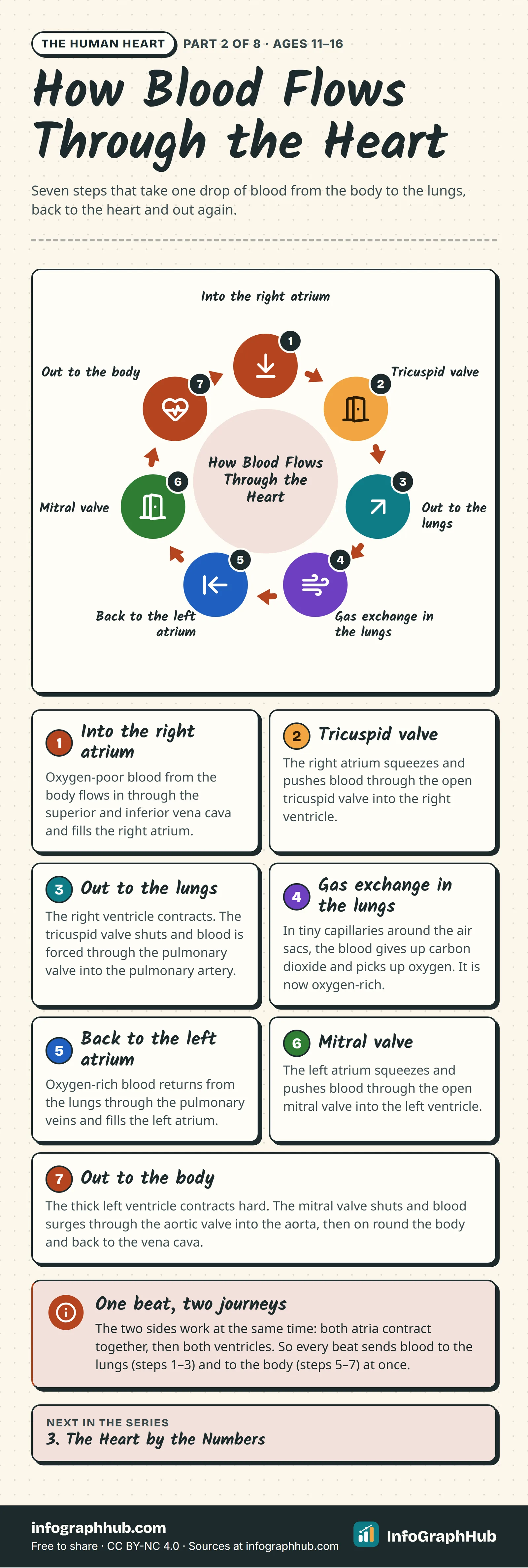
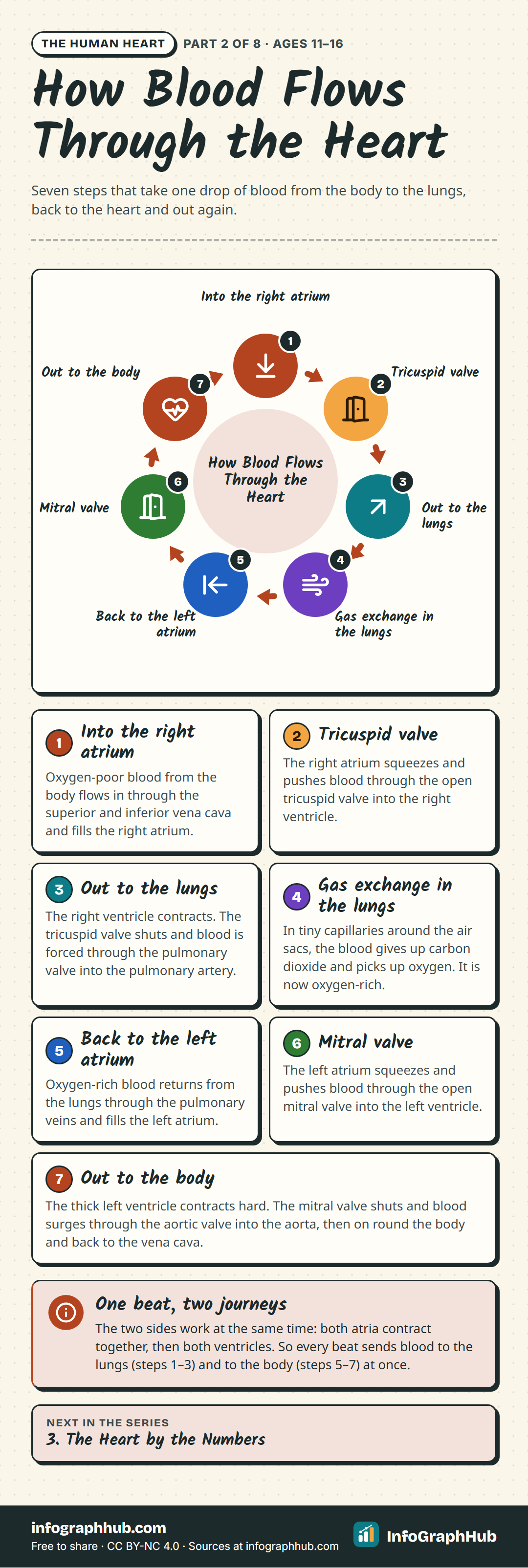
7 stages: Into the right atrium → Tricuspid valve → Out to the lungs → Gas exchange in the lungs → Back to the left atrium → Mitral valve → Out to the body. Press play, or choose a number to explore.
Step 1 of 7: Into the right atrium
Oxygen-poor blood from the body flows in through the superior and inferior vena cava and fills the right atrium.
Step 2 of 7: Tricuspid valve
The right atrium squeezes and pushes blood through the open tricuspid valve into the right ventricle.
Step 3 of 7: Out to the lungs
The right ventricle contracts. The tricuspid valve shuts and blood is forced through the pulmonary valve into the pulmonary artery.
Step 4 of 7: Gas exchange in the lungs
In tiny capillaries around the air sacs, the blood gives up carbon dioxide and picks up oxygen. It is now oxygen-rich.
Step 5 of 7: Back to the left atrium
Oxygen-rich blood returns from the lungs through the pulmonary veins and fills the left atrium.
Step 6 of 7: Mitral valve
The left atrium squeezes and pushes blood through the open mitral valve into the left ventricle.
Step 7 of 7: Out to the body
The thick left ventricle contracts hard. The mitral valve shuts and blood surges through the aortic valve into the aorta, then on round the body and back to the vena cava.
Use this infographic
Free under CC BY-NC 4.0, with credit to InfoGraphHub.
A figure-of-eight journey
Blood in humans travels in two linked loops, which is why our system is called a double circulation:
- the pulmonary circulation runs from the heart to the lungs and back;
- the systemic circulation runs from the heart to the rest of the body and back.
The heart sits where the two loops cross, like the middle of a figure of eight. On one complete trip round the body, a drop of blood passes through the heart twice: once through the right side and once through the left.
The right side: a short trip to the lungs
Blood coming back from the body has given up much of its oxygen to the organs and is carrying carbon dioxide. It enters the heart through two large veins, the superior and inferior vena cava, and collects in the right atrium.
From there it passes through the tricuspid valve into the right ventricle. When the right ventricle contracts, the tricuspid valve closes so nothing leaks backwards, and the blood is pushed through the pulmonary valve into the pulmonary artery. This artery splits in two and carries the blood to both lungs.
In the lungs the blood flows through very thin capillaries wrapped around the air sacs. Carbon dioxide passes out of the blood to be breathed out, and oxygen passes in.
The left side: a long trip round the body
Now rich in oxygen, the blood returns through the pulmonary veins into the left atrium. It passes through the mitral valve into the left ventricle.
The left ventricle has the thickest muscle wall in the heart. When it contracts, the mitral valve shuts and the blood is driven through the aortic valve into the aorta. The aorta branches into smaller and smaller arteries that reach every organ. In the capillaries, oxygen is handed over to the body's cells, and the oxygen-poor blood flows back through the veins to the vena cava to start again.
What happens in one heartbeat
The two sides of the heart work at the same time. The two atria contract together, then a moment later the two ventricles contract together. So a single beat pushes blood into the lungs and into the body at once.
Doctors call the squeezing phase systole and the relaxing, filling phase diastole. Most of the filling actually happens while the whole heart is relaxed: blood flows straight through the open valves into the ventricles. The atria's contraction only tops them up with the last 20 to 30 per cent. At a rate of 75 beats a minute, one full cycle of filling and squeezing takes about 0.8 seconds.
What keeps the order right
Each beat starts with an electrical signal from the sinoatrial (SA) node, a small patch of pacemaker cells in the wall of the right atrium. The signal spreads across both atria, which contract. It then reaches the atrioventricular (AV) node, which holds it back for a split second so the ventricles can finish filling. Finally it spreads down through the walls of the ventricles, which contract and pump blood out of the heart. Then the heart relaxes and the process starts again.
Why two loops are better than one
A fish has a single circulation: its two-chambered heart pumps blood through the gills and then straight on round the body, so the blood is not pumped again after it collects oxygen. That limits how much oxygen reaches the fish's organs.
In our double circulation, blood comes back to the heart after the lungs and the left ventricle pumps it out again, hard. Because the right and left sides are completely separated by the septum, the body receives only oxygen-rich blood, and the lungs receive only oxygen-poor blood.
Frequently asked questions
What is double circulation?
It means blood flows in two loops: from the heart to the lungs and back (pulmonary circulation), and from the heart to the rest of the body and back (systemic circulation). Blood passes through the heart twice on each complete circuit.
What is the correct order of blood flow through the heart?
Vena cava, right atrium, tricuspid valve, right ventricle, pulmonary valve, pulmonary artery, lungs, pulmonary veins, left atrium, mitral valve, left ventricle, aortic valve, aorta, then the body.
Do both sides of the heart beat at the same time?
Yes. The two atria contract together, and then the two ventricles contract together. One beat sends blood to the lungs and to the body at the same moment.
Why does blood go back to the heart after the lungs?
So it can be pumped again. The left ventricle gives oxygen-rich blood a strong push to send it all round the body. In a fish's single circulation, blood goes from the gills straight to the body without this second pump.

Sources & methodology
Every fact is checked against the sources below. We write original explanations and draw original graphics; no figures are copied from textbooks. Spotted an error? See our corrections policy.
- How the Heart Works: How Blood Flows through the Heart (US National Heart, Lung, and Blood Institute (NHLBI), accessed 1 Oct 2026)
- How the Heart Works: How the Heart Beats (US National Heart, Lung, and Blood Institute (NHLBI), accessed 1 Oct 2026)
- How your heart works (British Heart Foundation, accessed 1 Oct 2026)
- Anatomy and Physiology 2e, 19.3 Cardiac Cycle (OpenStax, Rice University, accessed 1 Oct 2026)
- Biology 2e, 40.1 Overview of the Circulatory System (OpenStax, Rice University, accessed 1 Oct 2026)
Editorial review pending · Updated
Made by the InfoGraphHub editorial team (how we research and check: editorial and AI policy). First published 1 October 2026, last reviewed 1 October 2026. Found a mistake? Tell the editors.
For teachers: ages and curriculum fit
Ages 11–16 · Grades 6–10 (US) · Years 7–11 (UK) · Classes 6–10 (India)
NGSS is a registered trademark of WestEd. Cambridge and IGCSE are trademarks of Cambridge University Press & Assessment. Names and codes are used only to describe curriculum fit; InfoGraphHub is not endorsed by these organisations.
Embed this on your site
Paste this HTML into your page. Keep the credit line: it is required by the CC BY-NC 4.0 license.
Related infographics


For teachers and parents: new InfoGraphHub resources by email
One short email when new free resources go live. For adults (18+) only. No spam, no tracking in emails, unsubscribe anytime.