Science, human bodyCheat sheetPart 5 of 8, The Human HeartUpdated 1 October 2026
Heart Key Terms and Definitions
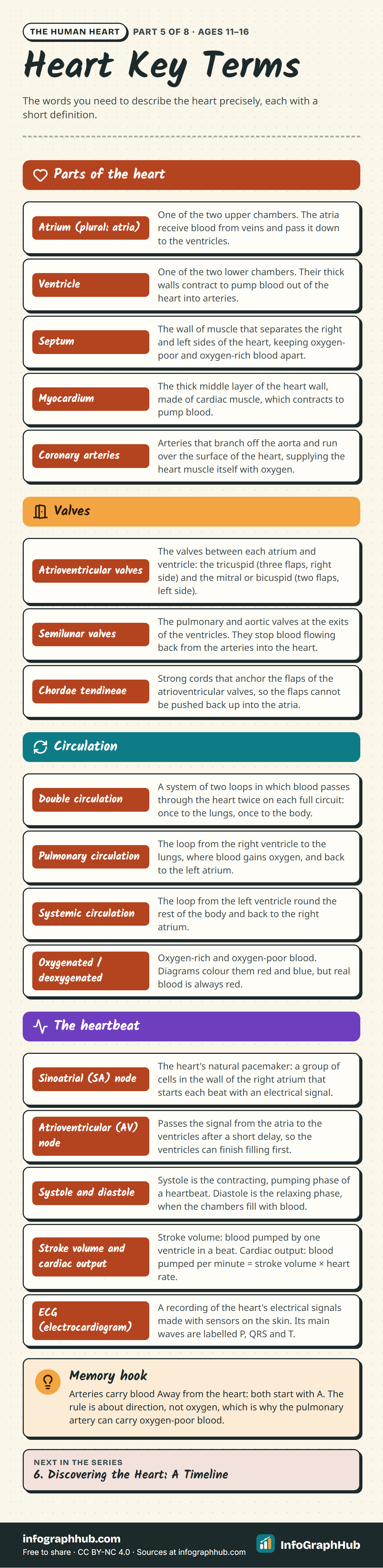
Seventeen words you need to describe the heart precisely, from atrium and septum to semilunar valves, double circulation, the SA node, systole, cardiac output and the ECG, each with a short, exam-ready definition.
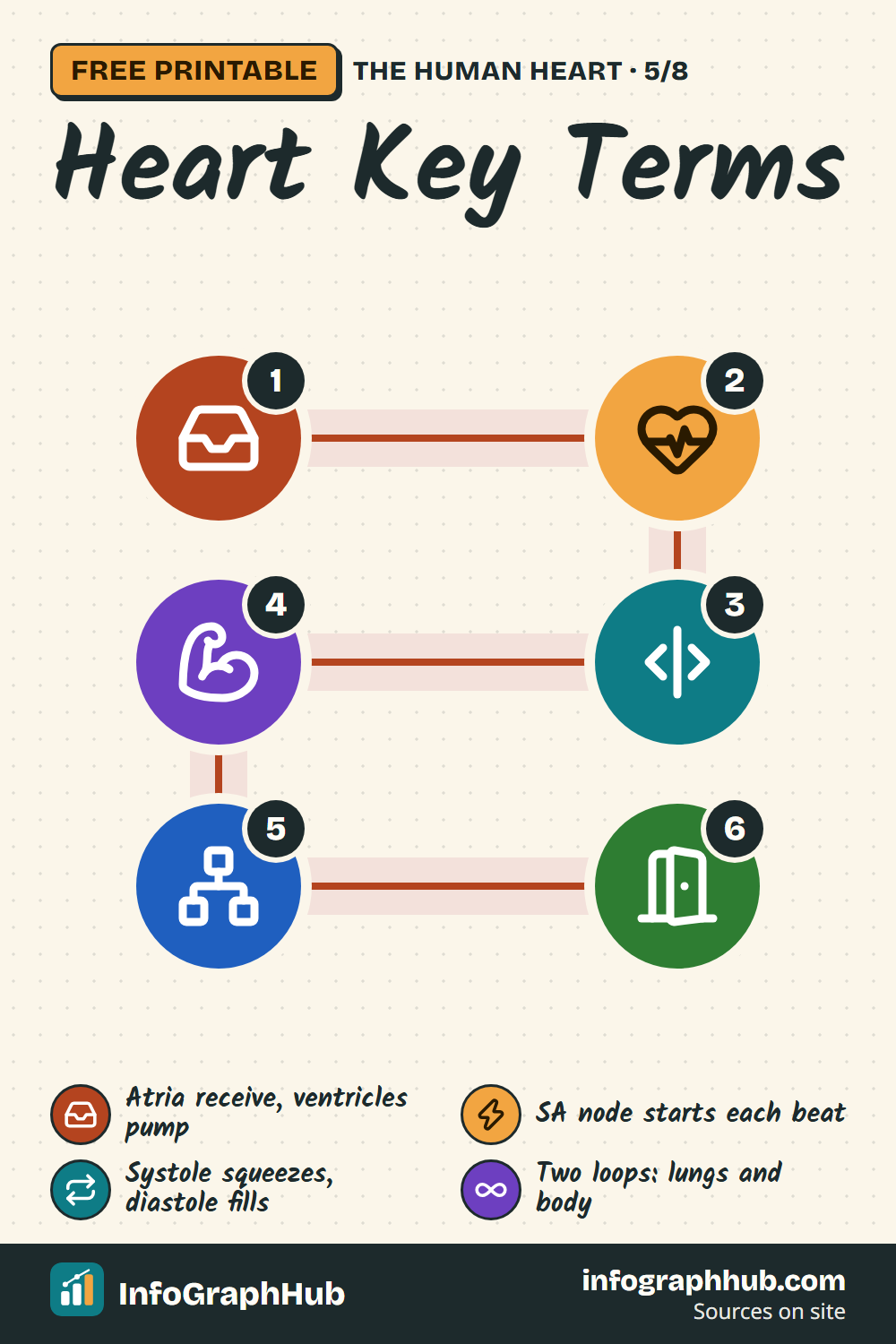
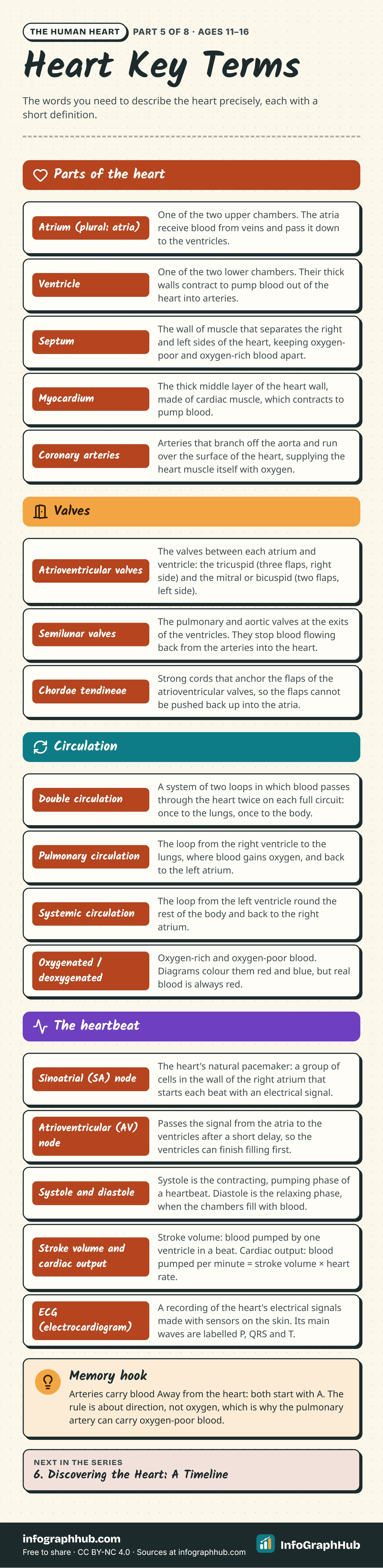
Use this infographic
Free under CC BY-NC 4.0, with credit to InfoGraphHub.
Why the exact words matter
Describing the heart well is mostly about using the right word in the right place. 'The heart pumps blood to the lungs' is true, but 'the right ventricle contracts and pumps oxygen-poor blood through the pulmonary valve into the pulmonary artery' shows exactly where, how and what kind of blood. Examiners and teachers look for this precision, and it also makes your own thinking clearer.
The terms on this sheet fall into four groups: the parts of the heart, its valves, the routes blood takes, and the words used to describe each heartbeat.
Pairs that are easy to mix up
Many heart words come in pairs. Learn them together and check which is which:
| Pair | How to tell them apart |
|---|---|
| Atrium / ventricle | Atria are the upper, receiving chambers; ventricles are the lower, pumping chambers. |
| Artery / vein | Arteries carry blood away from the heart; veins carry it back. |
| Tricuspid / bicuspid | Tricuspid has three flaps (right side); bicuspid, or mitral, has two (left side). |
| Pulmonary / systemic | Pulmonary means the lungs loop; systemic means the loop round the rest of the body. |
| SA node / AV node | The SA node starts each beat; the AV node passes the signal on to the ventricles. |
| Systole / diastole | Systole is contraction; diastole is relaxation and filling. |
Clues hidden in the names
Some names describe the structure. 'Atrioventricular' simply means 'between the atrium and the ventricle', which is exactly where the tricuspid and mitral valves sit. 'Sinoatrial' tells you that the pacemaker is in the wall of an atrium. 'Tri-' and 'bi-' count the flaps of the two atrioventricular valves.
Words people use loosely
A few everyday words have a sharper meaning in biology:
- Pulse and heart rate. Your pulse is the beat you can feel where an artery runs close to the skin, such as at the wrist or the side of the neck. Counting it for one minute gives your heart rate in beats per minute.
- Valve and septum. A valve is a flap that opens and closes; the septum is a fixed wall that never opens.
- Contract and relax. The heart pumps blood out when its muscle contracts and fills up again when the muscle relaxes. It never pushes blood by expanding.
Putting the terms together
Here is one heartbeat described with the words from this sheet:
The SA node sends a signal that makes both atria contract. After a short delay at the AV node, both ventricles contract: this is ventricular systole. The atrioventricular valves close and the semilunar valves open, so blood is pushed into the pulmonary artery and the aorta. Then the heart relaxes in diastole and the chambers fill again.
The volume each ventricle pushes out in that beat is the stroke volume. Multiply it by the heart rate and you have the cardiac output, the volume pumped each minute. The whole sequence of electrical signals can be recorded on an ECG.
Frequently asked questions
What is the difference between an atrium and a ventricle?
Atria are the two upper chambers. They receive blood from veins and pass it down. Ventricles are the two lower chambers with thicker walls. They pump blood out of the heart into arteries.
What does the SA node do?
The sinoatrial (SA) node is a group of pacemaker cells in the wall of the right atrium. It starts every heartbeat by sending out an electrical signal.
What is the difference between systole and diastole?
Systole is the part of the heartbeat when the heart muscle contracts and pumps blood out. Diastole is the part when the muscle relaxes and the chambers fill with blood.
How do you calculate cardiac output?
Cardiac output = stroke volume × heart rate. For example, 70 mL per beat × 75 beats a minute = 5,250 mL, or about 5.25 litres a minute.
Sources & methodology
Every fact is checked against the sources below. We write original explanations and draw original graphics; no figures are copied from textbooks. Spotted an error? See our corrections policy.
- Anatomy and Physiology 2e, 19.1 Heart Anatomy (OpenStax, Rice University, accessed 1 Oct 2026)
- Anatomy and Physiology 2e, 19.2 Cardiac Muscle and Electrical Activity (OpenStax, Rice University, accessed 1 Oct 2026)
- Anatomy and Physiology 2e, 19.3 Cardiac Cycle (OpenStax, Rice University, accessed 1 Oct 2026)
- How the Heart Works: Heart Anatomy (US National Heart, Lung, and Blood Institute (NHLBI), accessed 1 Oct 2026)
- How the Heart Works: How the Heart Beats (US National Heart, Lung, and Blood Institute (NHLBI), accessed 1 Oct 2026)
- Pulse (MedlinePlus, US National Library of Medicine, accessed 1 Oct 2026)
Editorial review pending · Updated
Made by the InfoGraphHub editorial team (how we research and check: editorial and AI policy). First published 1 October 2026, last reviewed 1 October 2026. Found a mistake? Tell the editors.
For teachers: ages and curriculum fit
Ages 11–16 · Grades 6–10 (US) · Years 7–11 (UK) · Classes 6–10 (India)
Cambridge and IGCSE are trademarks of Cambridge University Press & Assessment. Names and codes are used only to describe curriculum fit; InfoGraphHub is not endorsed by these organisations.
Embed this on your site
Paste this HTML into your page. Keep the credit line: it is required by the CC BY-NC 4.0 license.
Related infographics


For teachers and parents: new InfoGraphHub resources by email
One short email when new free resources go live. For adults (18+) only. No spam, no tracking in emails, unsubscribe anytime.