Science, human bodyTimelinePart 6 of 8, The Human HeartUpdated 1 October 2026
Discovering the Heart: A Timeline
How we found out what the heart does, from Galen's 'pores in the septum' and Ibn al-Nafis's lung circuit to William Harvey's proof of circulation in 1628, Malpighi's capillaries, the first ECGs and the first heart transplant in 1967.
Interactive
Explore it step by step
8 events: Galen's model → Ibn al-Nafis traces the lung circuit → Vesalius doubts Galen → Harvey proves circulation → Malpighi sees capillaries → First human ECG → Einthoven's string galvanometer → First heart transplant. Press play, or choose a number to explore.
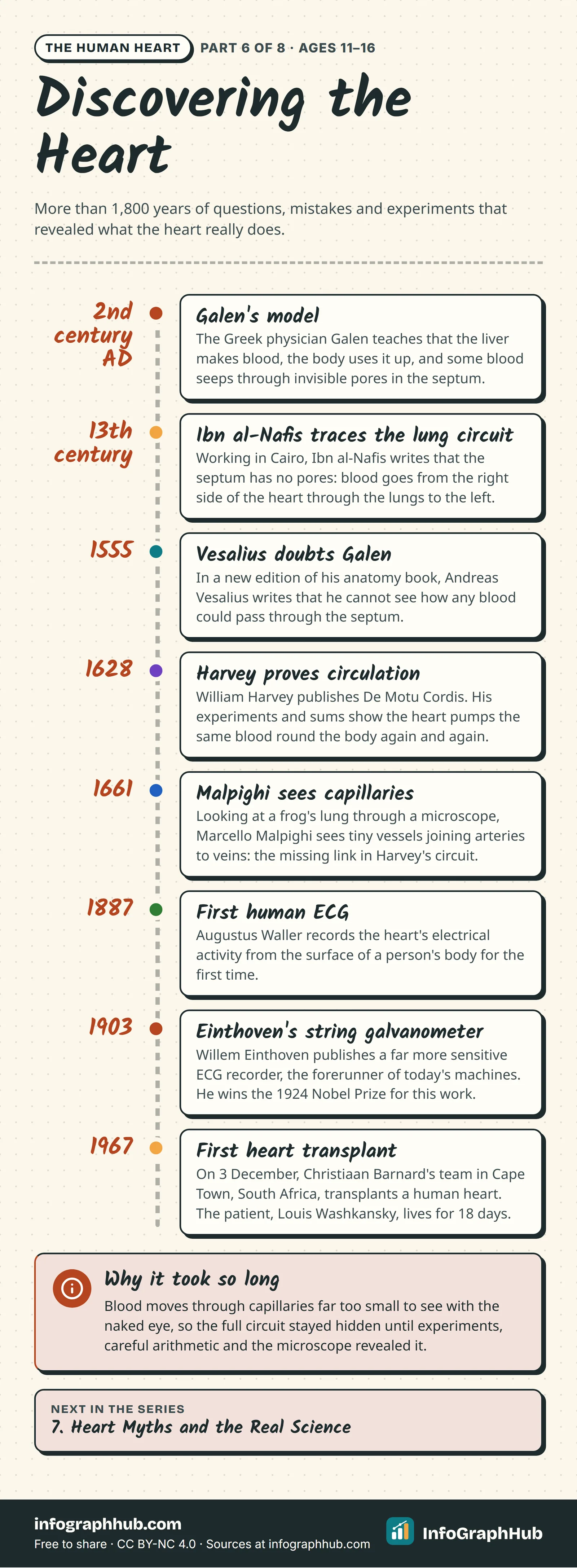
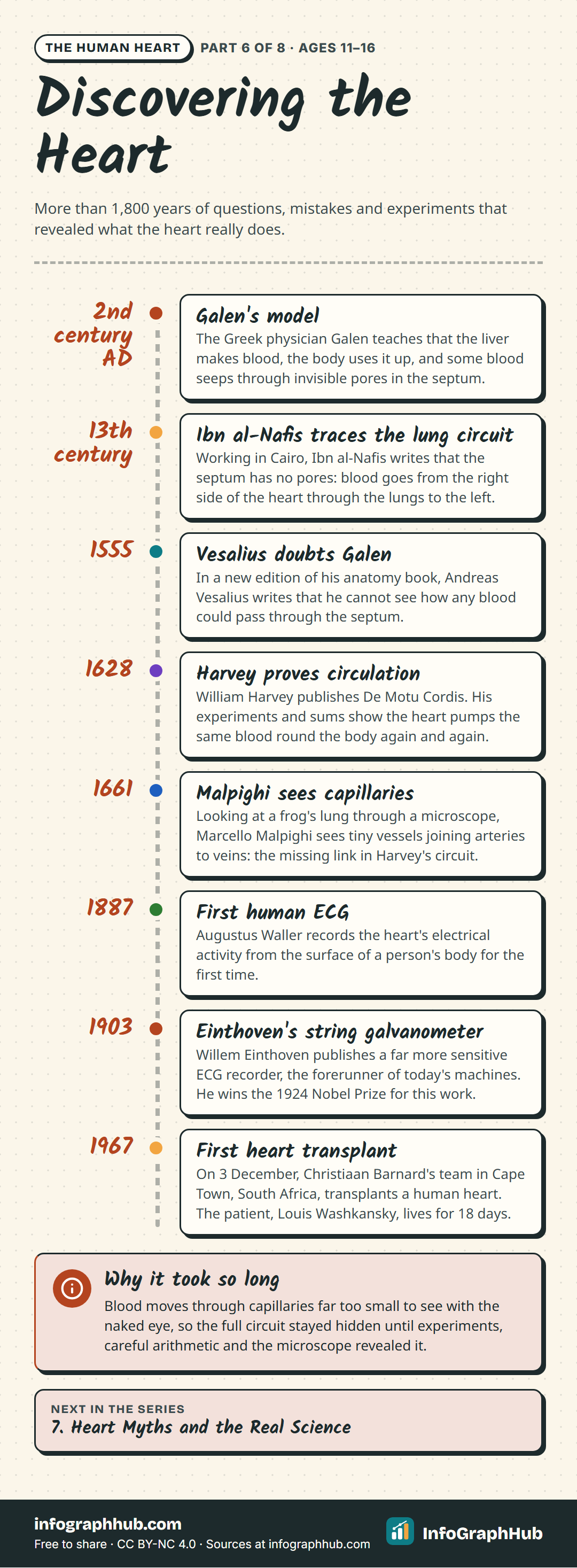
2nd century ADEvent 1 of 8: Galen's model
The Greek physician Galen teaches that the liver makes blood, the body uses it up, and some blood seeps through invisible pores in the septum.
13th centuryEvent 2 of 8: Ibn al-Nafis traces the lung circuit
Working in Cairo, Ibn al-Nafis writes that the septum has no pores: blood goes from the right side of the heart through the lungs to the left.
1555Event 3 of 8: Vesalius doubts Galen
In a new edition of his anatomy book, Andreas Vesalius writes that he cannot see how any blood could pass through the septum.
1628Event 4 of 8: Harvey proves circulation
William Harvey publishes De Motu Cordis. His experiments and sums show the heart pumps the same blood round the body again and again.
1661Event 5 of 8: Malpighi sees capillaries
Looking at a frog's lung through a microscope, Marcello Malpighi sees tiny vessels joining arteries to veins: the missing link in Harvey's circuit.
1887Event 6 of 8: First human ECG
Augustus Waller records the heart's electrical activity from the surface of a person's body for the first time.
1903Event 7 of 8: Einthoven's string galvanometer
Willem Einthoven publishes a far more sensitive ECG recorder, the forerunner of today's machines. He wins the 1924 Nobel Prize for this work.
1967Event 8 of 8: First heart transplant
On 3 December, Christiaan Barnard's team in Cape Town, South Africa, transplants a human heart. The patient, Louis Washkansky, lives for 18 days.
Use this infographic
Free under CC BY-NC 4.0, with credit to InfoGraphHub.
Galen's model: blood made in the liver
For well over a thousand years, the best-known explanation of the heart came from Galen, a Greek physician born in Pergamon in AD 129 who later worked in Rome. He watched the beating hearts of injured gladiators and dissected animals. He taught that blood was made in the liver and used up by the body, and that some blood passed from the right side of the heart to the left through invisible pores in the septum. Both ideas turned out to be wrong, but they were taught for centuries.
Ibn al-Nafis: the lung circuit
In the 13th century, Ibn al-Nafis, a physician who worked in Cairo and died there in 1288, challenged Galen directly. In a commentary on the anatomy section of Ibn Sina's Canon of Medicine, he wrote that the septum is thick and solid, with no visible or invisible passage. Blood from the right side, he argued, must travel through the pulmonary artery to the lungs, mix with air there, and return to the left side of the heart. This is the earliest known description of the pulmonary circulation.
For a long time, European writers credited the idea to the Spanish physician Michael Servetus, who described it in the 1500s. Ibn al-Nafis had written it down roughly three centuries earlier.
Doubts in Renaissance Europe
In 1543 the anatomist Andreas Vesalius still repeated Galen's claim that blood soaks through the septum. In the second edition of his great anatomy book, in 1555, he changed his mind and wrote that he could not see how even the smallest amount of blood could pass through it. Other anatomists, such as Realdo Colombo, confirmed the lung circuit and noted that the heart's valves let blood go only one way.
William Harvey's proof, 1628
The English physician William Harvey put the pieces together. In 1628 he published De Motu Cordis ('On the Motion of the Heart and Blood'), backed by experiments rather than old authority.
One of his strongest arguments was a simple sum. He estimated how much blood the heart pushes out with each beat and multiplied it by the number of beats. The answer was far more blood in a single day than the body could possibly make from food. So the blood could not be used up and replaced: it had to go round and round in a circuit. Harvey also showed, by pressing on the veins of a bound arm, that the valves in veins let blood flow only towards the heart.
Malpighi finds the missing link, 1661
Harvey could not see how blood got from the arteries to the veins; he had no microscope good enough. In 1661 the Italian scientist Marcello Malpighi studied a frog's lung under the microscope and saw tiny vessels joining the two: the capillaries. His observation confirmed Harvey's circuit.
Reading the heart's electricity
In 1887 the physiologist Augustus Waller recorded the first human electrocardiogram, picking up the heart's weak electrical signals from the surface of the body. The Dutch physiologist Willem Einthoven, who had watched that recording, named the five main waves P, Q, R, S and T in 1895, and in 1903 published his string galvanometer, a far more sensitive recorder that became the forerunner of modern ECG machines. He received the Nobel Prize in Physiology or Medicine in 1924 for his work on the electrocardiogram.
The first heart transplant, 1967
On 3 December 1967, at Groote Schuur Hospital in Cape Town, South Africa, a team of about thirty led by surgeon Christiaan Barnard carried out the first human-to-human heart transplant. The patient, Louis Washkansky, was 53. The new heart worked, but he died of pneumonia 18 days later. The operation showed that a heart could be replaced, and it opened a new field of surgery.
Frequently asked questions
Who discovered the circulation of the blood?
William Harvey, an English physician, showed by experiment that the heart pumps blood round the body in a circuit. He published his work in 1628 in De Motu Cordis.
Who first described the pulmonary circulation?
Ibn al-Nafis, a 13th-century physician working in Cairo, gave the earliest known description: blood goes from the right side of the heart through the lungs to the left side, not through pores in the septum.
Who discovered capillaries?
Marcello Malpighi, in 1661. Looking at a frog's lung under a microscope, he saw tiny vessels connecting arteries to veins, which completed Harvey's picture of circulation.
When was the first heart transplant?
On 3 December 1967, at Groote Schuur Hospital in Cape Town, South Africa, by a team led by Christiaan Barnard. The patient, Louis Washkansky, lived for 18 days.

Sources & methodology
Every fact is checked against the sources below. We write original explanations and draw original graphics; no figures are copied from textbooks. Spotted an error? See our corrections policy.
- Ibn al-Nafis: discoverer of the pulmonary circulation (Annals of Saudi Medicine, 2007) (Amr S. S. and Tbakhi A., via PubMed Central, accessed 1 Oct 2026)
- Discovery of the function of the heart and circulation of blood (Cardiovascular Journal of Africa, 2009) (Friedland G., via PubMed Central, accessed 1 Oct 2026)
- Malpighi: the capillaries as a bridge between veins and arteries (iHEART project, Politecnico di Milano, accessed 1 Oct 2026)
- Commemorating the 1924 Nobel Prize awarded to Willem Einthoven (EP Europace, 2024) (EP Europace (Oxford University Press), via PubMed Central, accessed 1 Oct 2026)
- Willem Einthoven: Facts (The Nobel Prize, accessed 1 Oct 2026)
- Dr Chris Barnard performs the world's first human heart transplant (South African History Online, accessed 1 Oct 2026)
Editorial review pending · Updated
Made by the InfoGraphHub editorial team (how we research and check: editorial and AI policy). First published 1 October 2026, last reviewed 1 October 2026. Found a mistake? Tell the editors.
For teachers: ages and curriculum fit
Ages 11–16 · Grades 6–10 (US) · Years 7–11 (UK) · Classes 6–10 (India)
Embed this on your site
Paste this HTML into your page. Keep the credit line: it is required by the CC BY-NC 4.0 license.
Related infographics


For teachers and parents: new InfoGraphHub resources by email
One short email when new free resources go live. For adults (18+) only. No spam, no tracking in emails, unsubscribe anytime.