Science, human bodyNumbersPart 3 of 8, The Human HeartUpdated 1 October 2026
The Heart by the Numbers
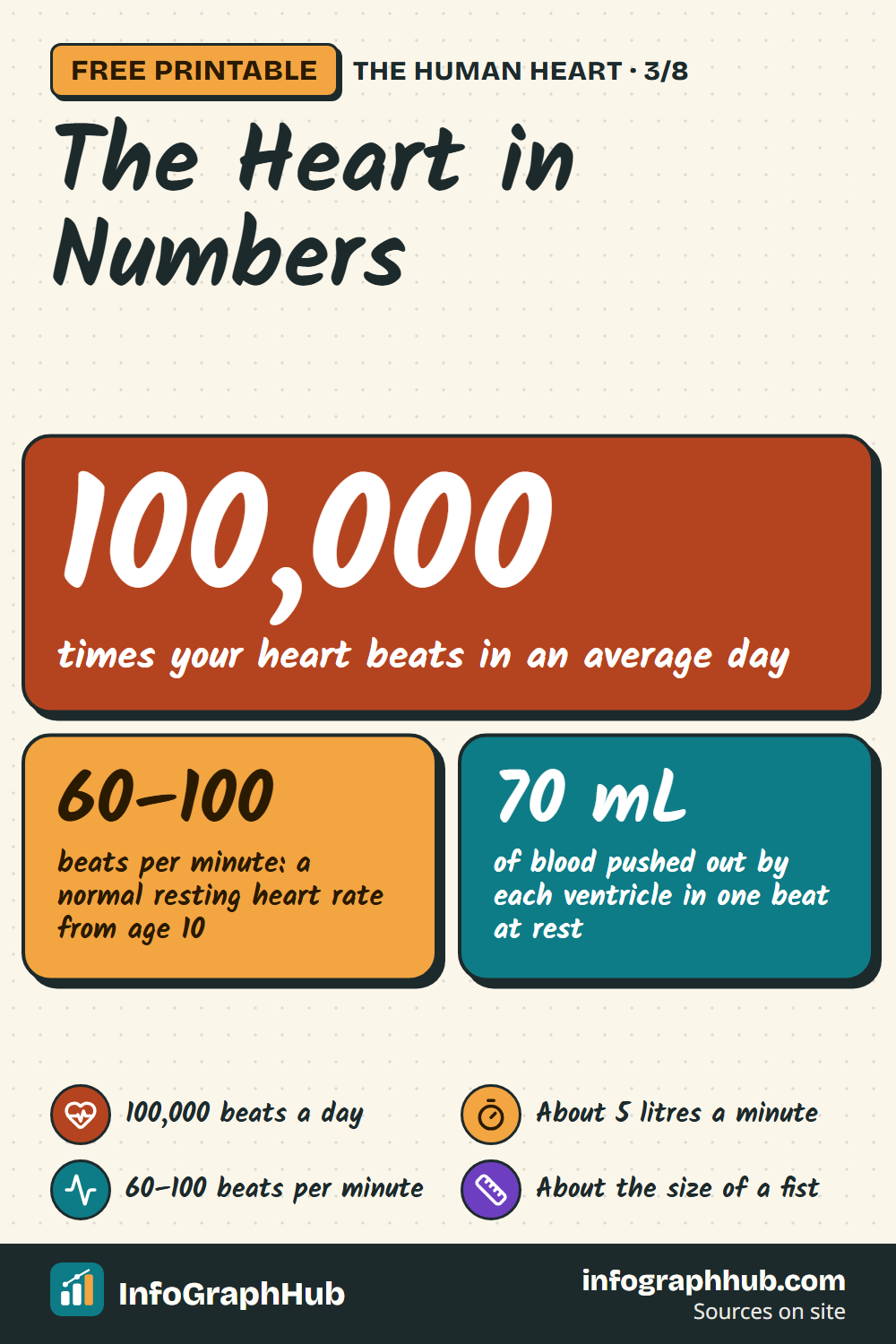
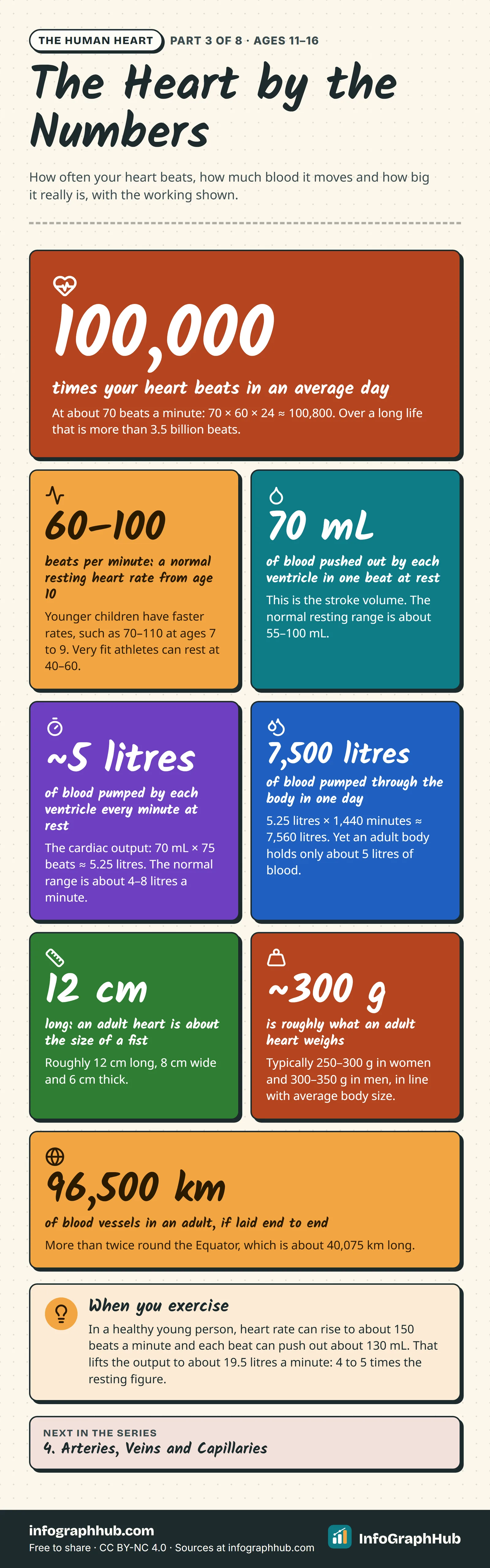
How often does your heart beat, and how much blood does it move? About 100,000 beats a day, roughly 5 litres a minute at rest and some 7,500 litres a day, from an organ about the size of your fist. Every figure is sourced and worked through.
Use this infographic
Free under CC BY-NC 4.0, with credit to InfoGraphHub.
Counting heartbeats
Your heart beats around 100,000 times a day. You can check that figure yourself. At about 70 beats a minute:
70 beats × 60 minutes × 24 hours = 100,800 beats a day
Keep that up for decades and the total becomes enormous: the Texas Heart Institute estimates that a heart may beat more than 3.5 billion times in a long lifetime. Unlike your arm or leg muscles, heart muscle never gets a long rest. It relaxes for a fraction of a second between beats and then contracts again.
What counts as a normal heart rate
Heart rate is the number of beats in a minute. For adults and children aged 10 and over, a resting rate of 60 to 100 beats per minute is normal. Younger children have faster hearts, according to the US National Library of Medicine:
| Age | Normal resting rate (beats per minute) |
|---|---|
| Newborn (up to 1 month) | 70–190 |
| 1–11 months | 80–160 |
| 1–2 years | 80–130 |
| 3–4 years | 80–120 |
| 5–6 years | 75–115 |
| 7–9 years | 70–110 |
| 10 years and over, adults | 60–100 |
| Well-trained athletes | 40–60 |
These are ranges for people at rest. Your own rate changes all day: it rises when you exercise, feel excited or nervous, and falls when you relax or sleep.
How much blood the heart moves
With each beat at rest, each ventricle pushes out about 70 millilitres of blood. This amount is called the stroke volume. The volume pumped by one ventricle in a minute is the cardiac output:
cardiac output = stroke volume × heart rate
For a resting adult: 70 mL × 75 beats a minute = 5,250 mL, or about 5.25 litres a minute. OpenStax gives this as the average, with a normal range of about 4 to 8 litres a minute.
Over a day that adds up to 5.25 litres × 1,440 minutes ≈ 7,560 litres. The Texas Heart Institute's figure is about 7,571 litres a day. An adult body holds only about 5 litres of blood in total, so at rest your whole blood supply passes through each side of the heart roughly once every minute.
Size and weight
A typical adult heart is about the size of a fist: roughly 12 cm long, 8 cm wide and 6 cm thick. It weighs about 250 to 300 grams in women and 300 to 350 grams in men, which matches the difference in average body size. A child's heart is smaller and grows with the rest of the body.
The wall of the left ventricle is the thickest part, because that chamber pushes blood all round the body.
A network longer than the Equator
The blood that leaves the heart travels through arteries, tiny capillaries and veins. According to the Texas Heart Institute, an adult's blood vessels laid end to end would stretch for more than 96,500 kilometres. The Earth's Equator is about 40,075 km long, so that is more than twice round the planet.
Frequently asked questions
How many times does the heart beat in a day?
About 100,000 times. At 70 beats a minute, 70 × 60 × 24 gives 100,800 beats in a day.
What is a normal resting heart rate for a teenager?
For anyone aged 10 or over, including adults, a normal resting heart rate is 60 to 100 beats per minute. Very fit athletes can be lower, around 40 to 60.
How much blood does the heart pump in a minute?
At rest, each ventricle pumps about 5 litres a minute (an average of about 5.25 litres). That is about 70 mL per beat multiplied by about 75 beats a minute.
How big is the human heart?
About the size of your fist: roughly 12 cm long, 8 cm wide and 6 cm thick. An adult heart weighs about 250 to 350 grams.
Sources & methodology
Every fact is checked against the sources below. We write original explanations and draw original graphics; no figures are copied from textbooks. Spotted an error? See our corrections policy.
- Heart Anatomy (Texas Heart Institute, accessed 1 Oct 2026)
- How your heart works (British Heart Foundation, accessed 1 Oct 2026)
- How the Heart Works: How the Heart Beats (US National Heart, Lung, and Blood Institute (NHLBI), accessed 1 Oct 2026)
- Pulse (MedlinePlus, US National Library of Medicine, accessed 1 Oct 2026)
- Anatomy and Physiology 2e, 19.4 Cardiac Physiology (OpenStax, Rice University, accessed 1 Oct 2026)
- Anatomy and Physiology 2e, 19.1 Heart Anatomy (OpenStax, Rice University, accessed 1 Oct 2026)
Editorial review pending · Updated
Made by the InfoGraphHub editorial team (how we research and check: editorial and AI policy). First published 1 October 2026, last reviewed 1 October 2026. Found a mistake? Tell the editors.
For teachers: ages and curriculum fit
Ages 11–16 · Grades 6–10 (US) · Years 7–11 (UK) · Classes 6–10 (India)
Cambridge and IGCSE are trademarks of Cambridge University Press & Assessment. Names and codes are used only to describe curriculum fit; InfoGraphHub is not endorsed by these organisations.
Embed this on your site
Paste this HTML into your page. Keep the credit line: it is required by the CC BY-NC 4.0 license.
Related infographics


For teachers and parents: new InfoGraphHub resources by email
One short email when new free resources go live. For adults (18+) only. No spam, no tracking in emails, unsubscribe anytime.