Science, human bodyMyths and factsPart 7 of 8, The Human HeartUpdated 1 October 2026
Heart Myths and the Real Science
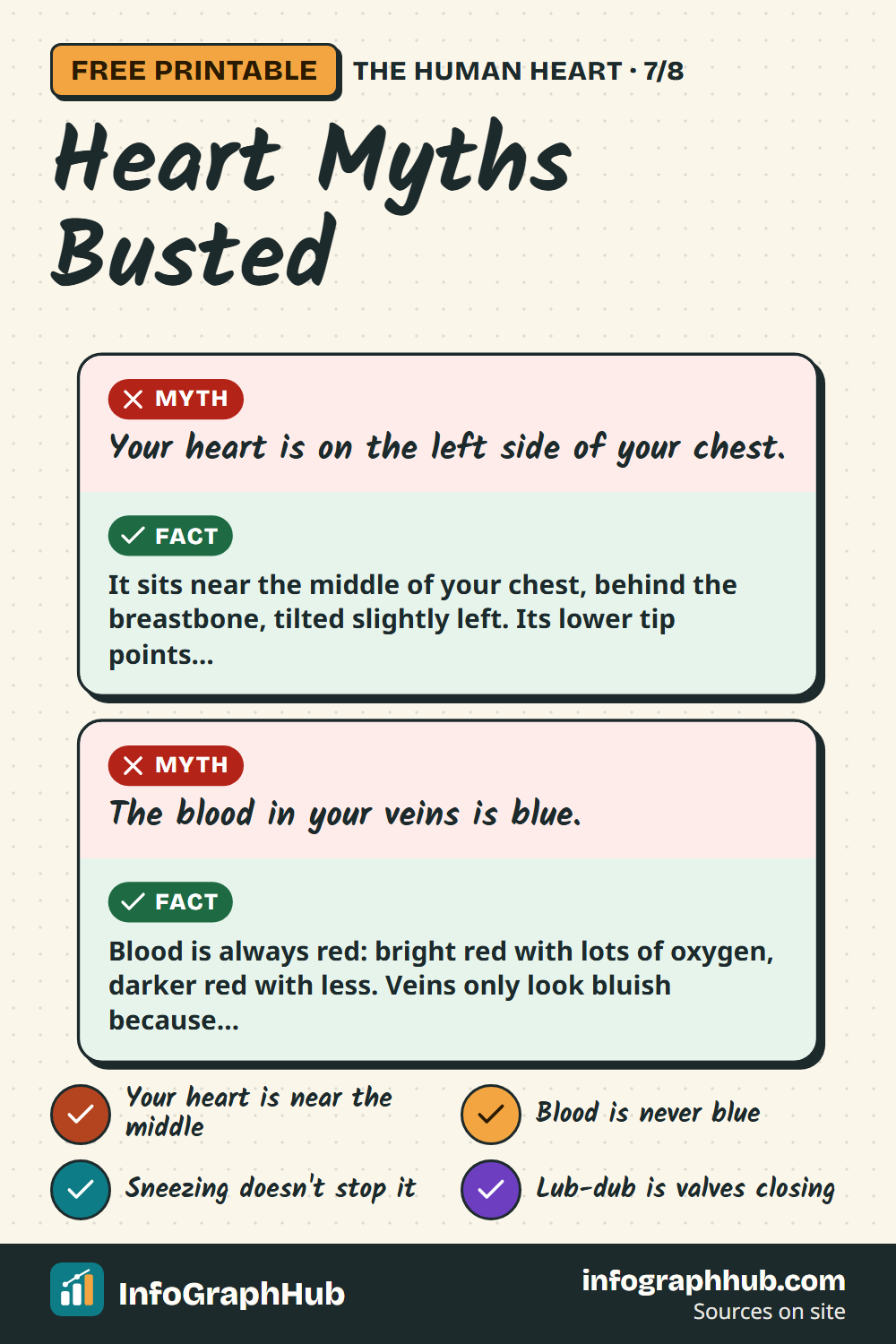
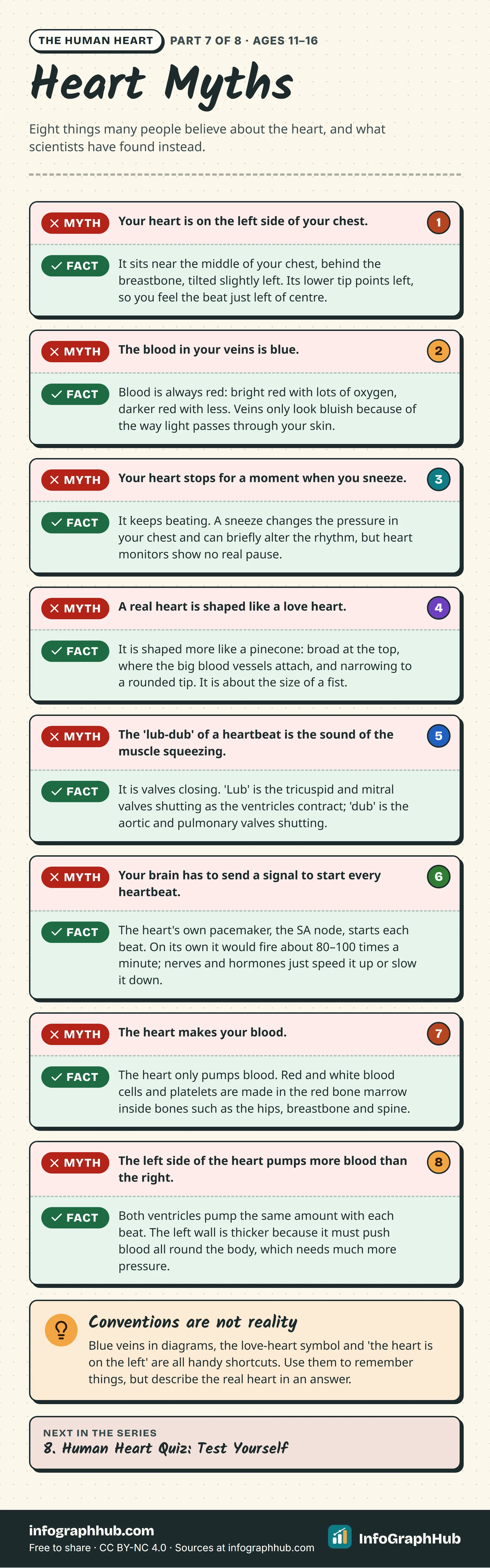
Eight common myths about the heart, corrected with evidence: it is not on the left, blood in veins is not blue, it does not stop when you sneeze, it is not love-heart shaped, and the 'lub-dub' is the sound of valves closing.
Use this infographic
Free under CC BY-NC 4.0, with credit to InfoGraphHub.
Why heart myths stick
The heart is the organ we feel most directly: we hear it, feel it thump after running and see it drawn on cards and emojis. That familiarity makes it easy to pick up ideas that sound right but are not. Simplified diagrams add to the confusion, because they use colours and shapes that are conventions rather than reality. The myths on this infographic are some of the most common.
Where it is and what it looks like
Many people put a hand on the left of their chest to point to their heart. In fact the heart sits near the middle of the chest, between the lungs and behind the breastbone. It is tilted so that its lower tip, the apex, points down and to the left. That is where the beat is strongest, which is why the 'left side' idea is so persistent.
A real heart does not look like the symbol on a greetings card either. Anatomists compare its shape to a pinecone: broad at the top, where the large blood vessels attach, and narrowing to a rounded tip. It is roughly the size of a fist.
The colour of blood
Blood is always red. Haemoglobin, the protein that carries oxygen in red blood cells, makes oxygen-rich blood bright red and oxygen-poor blood a darker red, but never blue.
Veins look bluish through the skin because of the way light travels through skin and back to your eye: the skin scatters away much of the red light before it can reflect off the blood, so more of the blue light comes back. Diagrams colour oxygen-poor blood blue only so that you can tell the two streams apart.
Sneezes, sounds and signals
Your heart does not stop when you sneeze. A sneeze briefly raises the pressure in your chest and affects a nerve that helps to set your heart rate, so the rhythm can change for a moment. Heart monitors that record every beat do not show the kind of pause that would count as the heart stopping.
The familiar 'lub-dub' is not the sound of muscle squeezing. The 'lub' is the tricuspid and mitral valves snapping shut as the ventricles start to contract. The 'dub' is the aortic and pulmonary valves closing as the ventricles relax.
Your brain does not have to order each beat, either. The heart has its own pacemaker, the sinoatrial (SA) node, which fires by itself. Left completely alone, it would set a rhythm of roughly 80 to 100 beats a minute. Nerves from the brain, and hormones, only speed the heart up or slow it down.
Pumping, not making
The heart moves blood, but it does not make it. Red blood cells, white blood cells and platelets are produced in the red bone marrow inside bones such as the hip bones, breastbone and spine.
It is also tempting to think that the bigger, stronger left ventricle pumps more blood than the right. It does not: both ventricles push out the same amount with each beat, otherwise blood would pile up in one circuit. The left ventricle is thicker because it has to create much higher pressure to send blood all round the body, while the right ventricle only pumps to the nearby lungs.
Frequently asked questions
Is your heart on the left side of your chest?
Not exactly. It is near the middle of the chest, behind the breastbone, tilted so that its tip points to the left. That is why you feel the beat most strongly just left of centre.
Is the blood in your veins blue?
No. Blood is always red: bright red when it carries a lot of oxygen and darker red when it carries less. Veins only look bluish because of how light passes through skin.
Does your heart stop when you sneeze?
No. A sneeze changes the pressure in your chest and can briefly alter your heart rhythm, but the heart keeps beating. Heart monitors do not show a real pause.
What makes the 'lub-dub' sound of a heartbeat?
Valves closing. 'Lub' is the tricuspid and mitral valves shutting when the ventricles contract; 'dub' is the aortic and pulmonary valves shutting when the ventricles relax.
Does the heart make blood?
No. The heart only pumps blood. Blood cells and platelets are made in the red bone marrow inside bones.
Sources & methodology
Every fact is checked against the sources below. We write original explanations and draw original graphics; no figures are copied from textbooks. Spotted an error? See our corrections policy.
- How your heart works (British Heart Foundation, accessed 1 Oct 2026)
- Heart Anatomy (Texas Heart Institute, accessed 1 Oct 2026)
- Why are veins blue? (Science Questions with Surprising Answers, West Texas A&M University, accessed 1 Oct 2026)
- Does Your Heart Really Stop When You Sneeze? (Cleveland Clinic, accessed 1 Oct 2026)
- Anatomy and Physiology 2e, 19.1 Heart Anatomy (OpenStax, Rice University, accessed 1 Oct 2026)
- Anatomy and Physiology 2e, 19.2 Cardiac Muscle and Electrical Activity (OpenStax, Rice University, accessed 1 Oct 2026)
- Anatomy and Physiology 2e, 19.3 Cardiac Cycle (OpenStax, Rice University, accessed 1 Oct 2026)
- Anatomy and Physiology 2e, 18.2 Production of the Formed Elements (OpenStax, Rice University, accessed 1 Oct 2026)
Editorial review pending · Updated
Made by the InfoGraphHub editorial team (how we research and check: editorial and AI policy). First published 1 October 2026, last reviewed 1 October 2026. Found a mistake? Tell the editors.
For teachers: ages and curriculum fit
Ages 11–16 · Grades 6–10 (US) · Years 7–11 (UK) · Classes 6–10 (India)
Cambridge and IGCSE are trademarks of Cambridge University Press & Assessment. Names and codes are used only to describe curriculum fit; InfoGraphHub is not endorsed by these organisations.
Embed this on your site
Paste this HTML into your page. Keep the credit line: it is required by the CC BY-NC 4.0 license.
Related infographics


For teachers and parents: new InfoGraphHub resources by email
One short email when new free resources go live. For adults (18+) only. No spam, no tracking in emails, unsubscribe anytime.