Science, human bodyComparisonPart 4 of 8, The Human HeartUpdated 2 October 2026
Arteries, Veins and Capillaries
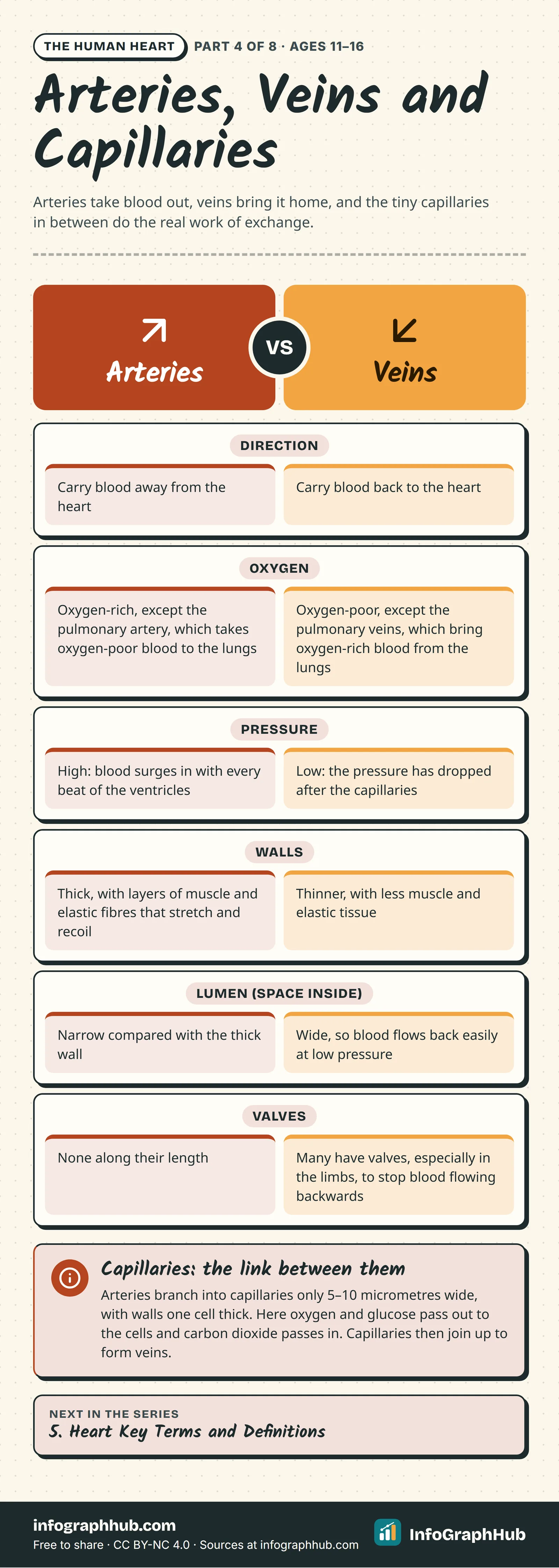
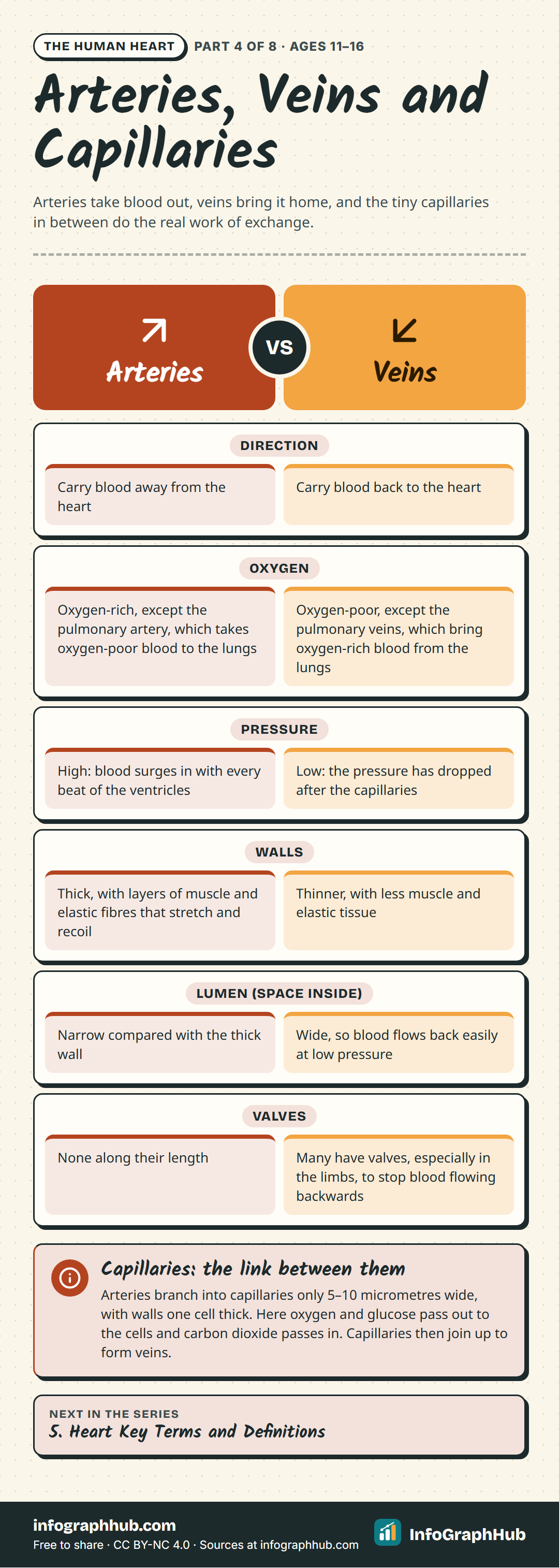
The three kinds of blood vessel compared: arteries carry blood away from the heart under high pressure, veins bring it back at low pressure with the help of valves, and capillaries, only one cell thick, are where the real exchange happens.
Interactive
Explore it step by step
- Direction
Arteries: Carry blood away from the heart
Veins: Carry blood back to the heart
- Oxygen
Arteries: Oxygen-rich, except the pulmonary artery, which takes oxygen-poor blood to the lungs
Veins: Oxygen-poor, except the pulmonary veins, which bring oxygen-rich blood from the lungs
- Pressure
Arteries: High: blood surges in with every beat of the ventricles
Veins: Low: the pressure has dropped after the capillaries
- Walls
Arteries: Thick, with layers of muscle and elastic fibres that stretch and recoil
Veins: Thinner, with less muscle and elastic tissue
- Lumen (space inside)
Arteries: Narrow compared with the thick wall
Veins: Wide, so blood flows back easily at low pressure
- Valves
Arteries: None along their length
Veins: Many have valves, especially in the limbs, to stop blood flowing backwards
Use this infographic
Free under CC BY-NC 4.0, with credit to InfoGraphHub.
Three vessels, one network
Blood never leaves its tubes on the way round the body. It travels through three main kinds of blood vessel, linked in a fixed order:
heart → arteries → arterioles → capillaries → venules → veins → heart
Arteries branch into smaller and smaller vessels. The smallest, the arterioles, lead into capillaries, where materials are exchanged with the body's cells. Capillaries join up into small veins called venules, which merge into larger and larger veins that carry the blood back to the heart. Each kind of vessel has a structure that suits its job.
Arteries: built for pressure
Arteries carry blood away from the heart. Blood leaves the ventricles in powerful surges, so arteries have thick walls with a middle layer of smooth muscle and elastic fibres. The elastic tissue stretches as each surge arrives and then springs back, which helps keep blood moving forward between beats. The muscle can tighten or relax to change the width of the vessel and control how much blood reaches each organ.
Compared with the thickness of the wall, the space inside an artery, called the lumen, is fairly narrow.
Capillaries: where the exchange happens
Capillaries are the smallest blood vessels. Their lumen is only about 5 to 10 micrometres across (a micrometre is a thousandth of a millimetre), so the narrowest are barely wide enough for a single red blood cell to squeeze through.
The wall of a capillary is just one layer of thin cells. That short distance lets substances pass easily between the blood and the cells around it:
- oxygen and glucose move out of the blood to the cells;
- carbon dioxide and other waste move from the cells into the blood.
Capillaries form dense networks called capillary beds, so almost every cell in the body is close to one.
Veins: the way home
Veins carry blood back to the heart. By the time blood has passed through the capillaries, its pressure is low. Veins therefore have thinner walls with less muscle and elastic tissue, and a wider lumen that lets blood flow back with little resistance.
Many veins, especially in the arms and legs, contain valves. These stop blood from slipping backwards, which matters because the pressure is low and the blood in your legs has to travel upwards against gravity.
Veins also act as the body's blood store: at any moment the veins of the body hold about 64 per cent of all your blood.
The exceptions to remember
A common slip is to say that arteries always carry oxygen-rich blood. The rule is about direction, not oxygen. The pulmonary artery carries oxygen-poor blood away from the heart to the lungs, and the pulmonary veins bring oxygen-rich blood back. Everywhere else in the body, arteries carry oxygen-rich blood and veins carry oxygen-poor blood.
Frequently asked questions
What is the difference between an artery and a vein?
Arteries carry blood away from the heart at high pressure, so they have thick, muscular, elastic walls and a narrow lumen. Veins carry blood back to the heart at low pressure, so they have thinner walls, a wider lumen and often valves.
Why are capillary walls only one cell thick?
So that oxygen, glucose, carbon dioxide and other substances only have a very short distance to travel between the blood and the body's cells. This makes exchange fast.
Why do veins have valves?
Blood in veins is at low pressure, and in the legs it has to flow upwards against gravity. Valves stop it from flowing backwards, so it keeps moving towards the heart.
Do arteries always carry oxygen-rich blood?
No. The pulmonary artery carries oxygen-poor blood from the heart to the lungs. Arteries are defined by carrying blood away from the heart, not by how much oxygen it holds.
Sources & methodology
Every fact is checked against the sources below. We write original explanations and draw original graphics; no figures are copied from textbooks. Spotted an error? See our corrections policy.
- Anatomy and Physiology 2e, 20.1 Structure and Function of Blood Vessels (OpenStax, Rice University, accessed 1 Oct 2026)
- Classification and Structure of Blood Vessels (SEER Training Modules, US National Cancer Institute, accessed 1 Oct 2026)
- How your heart works (British Heart Foundation, accessed 1 Oct 2026)
Editorial review pending · Updated
Made by the InfoGraphHub editorial team (how we research and check: editorial and AI policy). First published 1 October 2026, last reviewed 2 October 2026. Found a mistake? Tell the editors.
For teachers: ages and curriculum fit
Ages 11–16 · Grades 6–10 (US) · Years 7–11 (UK) · Classes 6–10 (India)
Cambridge and IGCSE are trademarks of Cambridge University Press & Assessment. Names and codes are used only to describe curriculum fit; InfoGraphHub is not endorsed by these organisations.
Embed this on your site
Paste this HTML into your page. Keep the credit line: it is required by the CC BY-NC 4.0 license.
Related infographics


For teachers and parents: new InfoGraphHub resources by email
One short email when new free resources go live. For adults (18+) only. No spam, no tracking in emails, unsubscribe anytime.