Science, chemistryLabelled diagramUpdated 9 October 2026
How Lithium-ion Batteries Store and Release Energy
A lithium-ion battery stores energy by holding lithium in its graphite electrode. When it powers a device, lithium ions cross inside to the metal oxide electrode while electrons flow through the device. Charging pushes both back.
Interactive
Explore it step by step
6 labelled parts: Two electrodes → The ion pathway → Ions move inside → Electrons power it → Recharging → Looking after it. Press play, or choose a number to explore.
Step 1 of 6: Two electrodes
The negative electrode (anode) is usually graphite, which stores lithium between its layers. The positive electrode (cathode) is a lithium metal oxide, such as lithium cobalt oxide.
Step 2 of 6: The ion pathway
Between the electrodes is an electrolyte and a thin separator full of tiny pores. Lithium ions can pass through, but the separator keeps the two electrodes apart.
Step 3 of 6: Ions move inside
When the battery discharges, lithium in the graphite gives up electrons. The lithium ions (Li⁺) travel through the electrolyte and separator to the cathode.
Step 4 of 6: Electrons power it
The electrons cannot take the inside route, so they flow through the wire: out of the anode, through the phone and into the cathode. This flow is the current that runs the device.
Step 5 of 6: Recharging
A charger drives electrons back from the cathode to the anode. Lithium ions follow inside, from the cathode back into the graphite, so energy is stored again.
Step 6 of 6: Looking after it
A used battery still holds enough charge to start a fire if it is crushed. Never put one in a household bin: take it to a battery recycling or collection point.
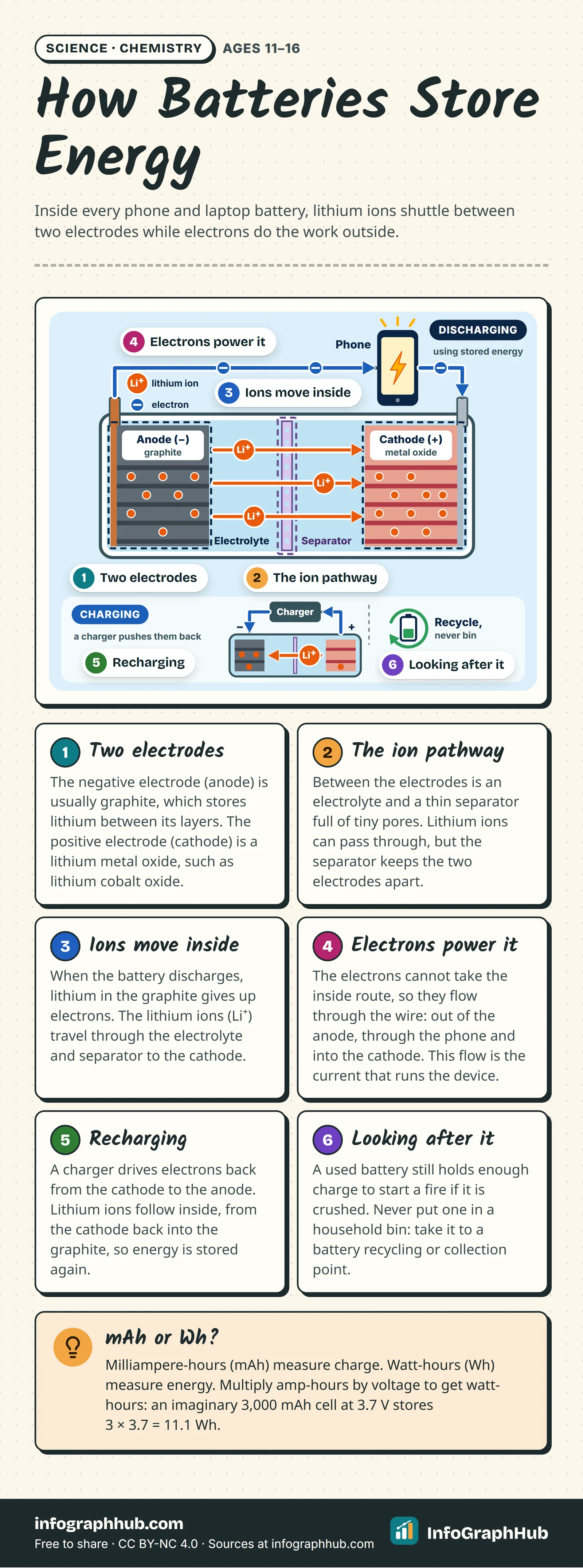
Use this infographic
Free under CC BY-NC 4.0, with credit to InfoGraphHub.
The short answer
A lithium-ion battery stores energy in chemical form. When it is charged, lithium is packed into one electrode, usually graphite. When you use it, the lithium moves to the other electrode, a metal oxide, and the battery releases energy as an electric current.
Two things move at once. Lithium ions travel inside the battery, through a material called the electrolyte. Electrons travel outside, through the wires and the device. Charging pushes both of them back to where they started. Because the reactions can run backwards, the battery can be recharged many times.
Inside a lithium-ion cell
A single unit is called a cell. Lithium-ion cells power phones, laptops and electric cars, and each one has the same main parts:
- Negative electrode (anode): usually graphite. Graphite is made of flat sheets of carbon atoms stacked in layers, and lithium can slip in between the layers. This is called intercalation.
- Positive electrode (cathode): a lithium metal oxide, such as lithium cobalt oxide. Others use manganese oxide or iron phosphate. It also has spaces where lithium can sit.
- Electrolyte: a substance that lets lithium ions move between the electrodes.
- Separator: a very thin sheet full of tiny pores. Ions can pass through it, but it keeps the two electrodes from touching.
Discharging: where the energy comes from
In a charged cell, most of the lithium sits between the graphite layers. Lithium is more stable in the metal oxide, so it has a tendency to move there. That difference is the stored energy.
When you switch on a device, the circuit is complete. Each lithium atom in the graphite gives up one electron and becomes a positive lithium ion (Li⁺). The ion drifts through the electrolyte and the separator to the cathode, where it slots into the metal oxide.
The electron cannot follow that inside route. Instead it leaves the anode through the negative terminal, travels along the wire, passes through the device and enters the cathode. There it meets a lithium ion again. This flow of electrons is the electric current, and it does useful work on the way, lighting a screen or turning a motor.
A lithium-ion cell gives about 3.6 to 3.7 volts. Its voltage stays nearly constant as it runs down, which suits electronics.
Charging: running it backwards
A charger is an outside power supply. It pushes electrons the opposite way round the circuit: out of the cathode and back into the graphite anode. To balance the charge, lithium ions leave the metal oxide, cross the electrolyte and separator, and slide back between the graphite layers.
The charger does work to move the lithium back to its higher-energy position. That is how the energy is stored again. Graphite is good at this because its layers hold lithium without being bent out of shape, so the process can be repeated many times.
Capacity and energy: mAh and Wh
Two numbers are often printed on a battery. Capacity, in milliampere-hours (mAh) or ampere-hours (Ah), is an amount of electric charge: a current multiplied by a time. Energy, in watt-hours (Wh), is how much work the battery can do.
To get energy, multiply charge by voltage. Two batteries can share the same voltage but store very different amounts of energy if one can move much more charge. So mAh alone only compares batteries of the same voltage.
Lithium-ion cells pack a lot of energy into a small mass. They can store up to about 330 Wh per kilogram, compared with about 75 Wh per kilogram for a lead-acid battery. They also lose charge only slowly when stored, around 1.5–2% a month.
Looking after a battery
A used lithium-ion battery still holds enough charge to cause injury or start a fire. The risk grows if it is damaged or crushed, for example in a rubbish lorry or at a sorting plant.
- Never put a used lithium-ion battery in household rubbish or recycling bins. Take it to a battery recycling or hazardous waste collection point.
- Before you drop it off, cover the terminals with tape and keep each battery in its own bag.
- If a battery is damaged, ask the maker of the device how to handle it.
Cells do not last for ever. A common reason lithium cells fail is that thin threads of lithium metal, called dendrites, grow on the anode, a little like tree roots pushing through a pavement.
Frequently asked questions
Which way do lithium ions move when a battery is used?
When a lithium-ion battery discharges, lithium ions move inside the cell from the negative electrode (graphite anode) to the positive electrode (metal oxide cathode). When it charges, they move back from the cathode to the anode.
Why don't the electrons travel through the electrolyte too?
The electrolyte and separator let ions through but not electrons. The electrons have to go round the outside circuit instead, which is why a battery can power a device connected to its terminals.
What is the difference between mAh and Wh?
Milliampere-hours (mAh) measure electric charge. Watt-hours (Wh) measure energy. Energy depends on both the charge and the voltage, so multiply amp-hours by volts to get watt-hours.
Why is graphite used for the negative electrode?
Graphite is made of stacked sheets of carbon. Lithium can slip in between the sheets and back out again without damaging the structure, so the electrode can be charged and discharged many times.
How should I get rid of an old lithium-ion battery?
Never put it in a household rubbish or recycling bin, because a crushed battery can start a fire. Tape over the terminals, bag it, and take it to a battery recycling or hazardous waste collection point.

Sources & methodology
Every fact is checked against the sources below. We write original explanations and draw original graphics; no figures are copied from textbooks. Spotted an error? See our corrections policy.
- 17.5 Batteries and Fuel Cells (Chemistry 2e) (OpenStax, Rice University, accessed 9 Oct 2026)
- Lithium-Ion Battery (Clean Energy Institute, University of Washington, accessed 9 Oct 2026)
- 19.1 Electric Potential Energy: Potential Difference (College Physics 2e) (OpenStax, Rice University, accessed 9 Oct 2026)
- Used Lithium-Ion Batteries (U.S. Environmental Protection Agency (EPA), accessed 9 Oct 2026)
Approved for publication by InfoGraphHub editorial team on 9 Oct 2026 · Updated
Made by the InfoGraphHub editorial team (how we research and check: editorial and AI policy). First published 9 October 2026, last reviewed 9 October 2026. Found a mistake? Tell the editors.
For teachers: ages and curriculum fit
Ages 11–16 · Grades 6–10 (US) · Years 7–11 (UK) · Classes 6–10 (India)
Embed this on your site
Paste this HTML into your page. Keep the credit line: it is required by the CC BY-NC 4.0 license.
Related infographics


For teachers and parents: new InfoGraphHub resources by email
One short email when new free resources go live. For adults (18+) only. No spam, no tracking in emails, unsubscribe anytime.