MathsVisual listPart 7 of 8, FractionsUpdated 1 October 2026
Fractions in Everyday Life
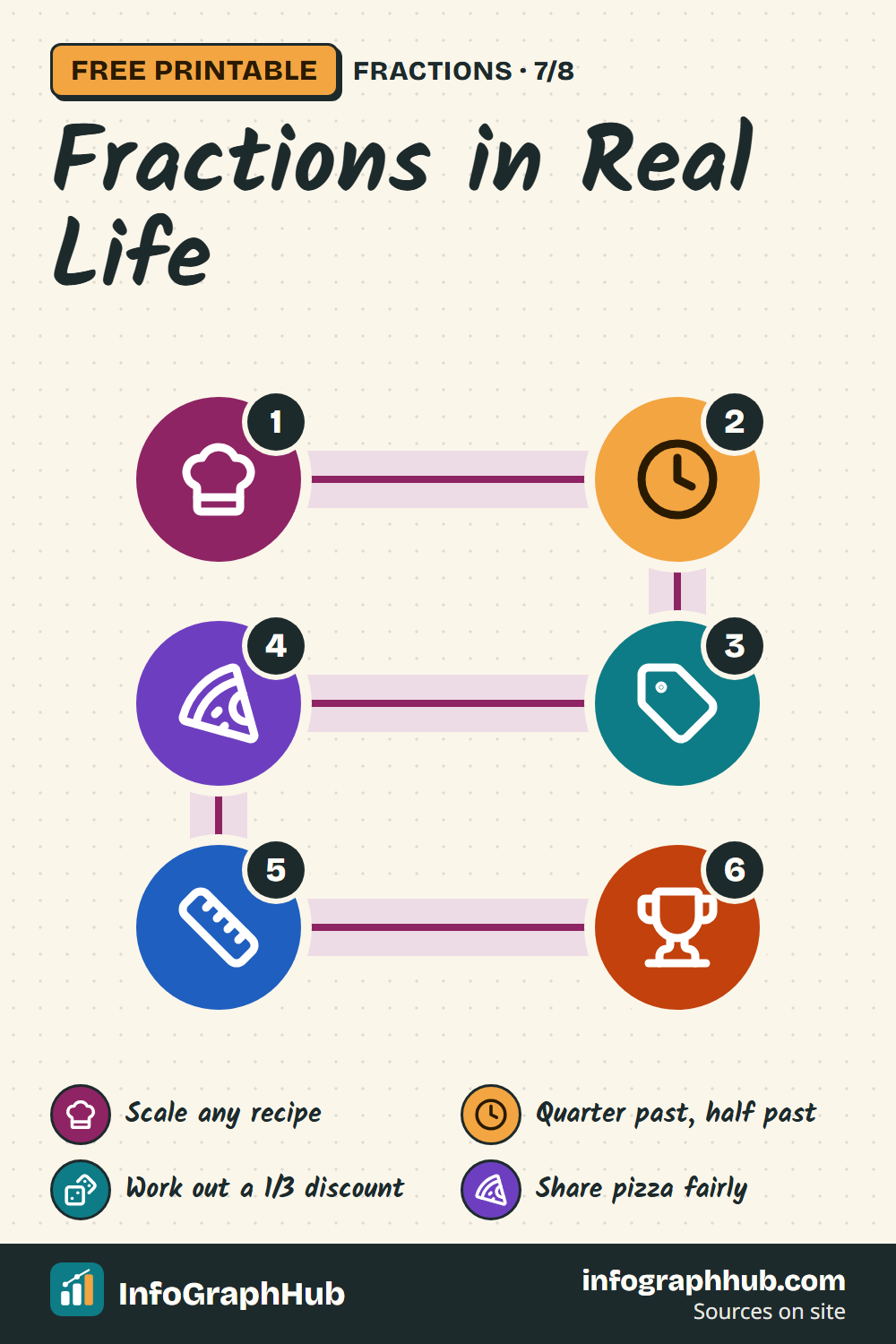
Eight places you use fractions without noticing: scaling recipes, telling the time, prices and discounts, sharing food fairly, metric measurements, sport statistics, chance, and battery and fuel gauges, each with a worked number.
Use this infographic
Free under CC BY-NC 4.0, with credit to InfoGraphHub.
Fractions are everywhere
You probably used a fraction today without writing one down. 'Quarter past', 'half price', 'a third of the pizza' and 'the battery is nearly empty' are all fractions. Most real-life fraction problems are the same calculation in disguise: finding a fraction of an amount. Divide by the denominator, then multiply by the numerator. 3/4 of 300 g is 300 ÷ 4 × 3 = 225 g.
In the kitchen
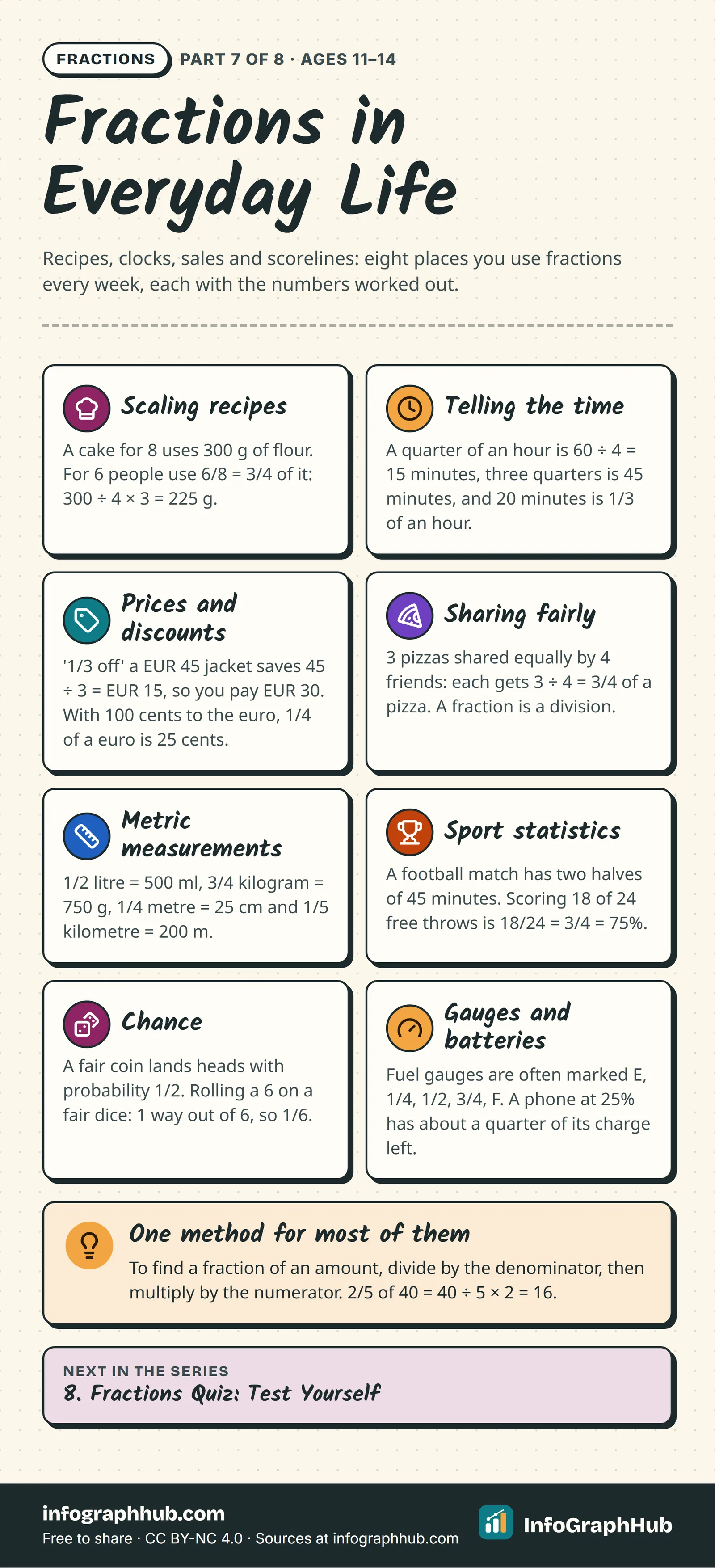
Recipes are written for a set number of people, so changing the number of servings means multiplying by a fraction. A cake for 8 people that uses 300 g of flour needs 6/8 = 3/4 of the amounts for 6 people: 3/4 × 300 = 225 g. For 12 people you need 12/8 = 3/2, or 1 1/2 times as much: 450 g. If a recipe asks for 3/4 of a cup of milk and you are making half the amount, you need 1/2 × 3/4 = 3/8 of a cup.
Time and money
An hour has 60 minutes, so a quarter of an hour is 60 ÷ 4 = 15 minutes, half an hour is 30 minutes, and three quarters of an hour is 45 minutes. A third of an hour is 20 minutes, which is why '20 minutes' and '1/3 of an hour' mean the same thing.
Many currencies split one unit into 100 smaller units, such as cents. A quarter of 1 euro or 1 dollar is 25 cents and a fifth is 20 cents. A sale sign saying '1/3 off' a jacket priced EUR 45 means you save 45 ÷ 3 = EUR 15 and pay EUR 30. Note that paying 2/3 of the price is the same thing seen the other way round.
Sharing fairly
When things do not split into whole numbers, fractions give the fair answer. Three pizzas shared equally between four friends gives each person 3 ÷ 4 = 3/4 of a pizza. This is the idea that a fraction is a division: 3/4 means 3 ÷ 4. You could cut each pizza into quarters and give everyone one quarter from each pizza, so each friend still gets 3 quarters.
Measuring with metric units
Metric units are based on 10, 100 and 1,000, which makes fractions of them easy to work out. Half a litre is 1,000 ÷ 2 = 500 ml. Three quarters of a kilogram is 750 g. A quarter of a metre is 25 cm, and a fifth of a kilometre is 200 m. Building, sewing and science all use these conversions.
Sport, chance and gauges
A football match under the Laws of the Game is played in two equal halves of 45 minutes, so each half is 45/90 = 1/2 of the normal playing time (any added time is extra). Statistics such as success rates are fractions too: a basketball player who scores 18 of 24 free throws has a success rate of 18/24, which simplifies to 3/4, or 75%.
Probability is written as a fraction. A fair coin lands heads with probability 1/2, and the chance of rolling a 6 on a fair six-sided dice is 1/6. Gauges show fractions as well: many fuel gauges are marked E, 1/4, 1/2, 3/4 and F, and a phone showing 25% has about a quarter of its charge left.
Frequently asked questions
How do you find a fraction of an amount?
Divide the amount by the denominator, then multiply by the numerator. For example, 3/4 of 300 g is 300 ÷ 4 = 75, then 75 × 3 = 225 g.
How do I change a recipe for a different number of people?
Multiply every amount by (people you are cooking for) ÷ (people the recipe serves). A recipe for 8 made for 6 uses 6/8 = 3/4 of each amount; made for 12 it uses 12/8 = 1 1/2 times each amount.
What fraction of an hour is 20 minutes?
20/60, which simplifies to 1/3. Similarly, 15 minutes is 1/4 of an hour, 30 minutes is 1/2 and 45 minutes is 3/4.
Why are probabilities written as fractions?
A probability compares the number of ways something can happen with the total number of equally likely outcomes. A fair dice has 6 equally likely outcomes and one of them is a 6, so the probability of rolling a 6 is 1/6.
Sources & methodology
Every fact is checked against the sources below. We write original explanations and draw original graphics; no figures are copied from textbooks. Spotted an error? See our corrections policy.
- How to find a fraction of an amount (BBC Bitesize (KS3 Maths), accessed 1 Oct 2026)
- What are fractions? (BBC Bitesize (KS3 Maths), accessed 1 Oct 2026)
- Law 7: The Duration of the Match (The IFAB (Laws of the Game), accessed 1 Oct 2026)
- Teaching Fractions With Understanding: Part-Whole Concept (NRICH, University of Cambridge, accessed 1 Oct 2026)
- Mixed Fractions (Math is Fun, accessed 1 Oct 2026)
Editorial review pending · Updated
Made by the InfoGraphHub editorial team (how we research and check: editorial and AI policy). First published 1 October 2026, last reviewed 1 October 2026. Found a mistake? Tell the editors.
For teachers: ages and curriculum fit
Ages 11–14 · Grades 6–8 (US) · Years 7–9 (UK) · Classes 6–8 (India)
Common Core State Standards © Copyright 2010 National Governors Association Center for Best Practices and Council of Chief State School Officers. All rights reserved. Names and codes are used only to describe curriculum fit; InfoGraphHub is not endorsed by these organisations.
Embed this on your site
Paste this HTML into your page. Keep the credit line: it is required by the CC BY-NC 4.0 license.
Related infographics


For teachers and parents: new InfoGraphHub resources by email
One short email when new free resources go live. For adults (18+) only. No spam, no tracking in emails, unsubscribe anytime.