8-part series · Ages 11–14
Fractions
Eight infographics that take you from 'what is a numerator?' to dividing mixed numbers with confidence.
The 5 parts (3 more coming soon)
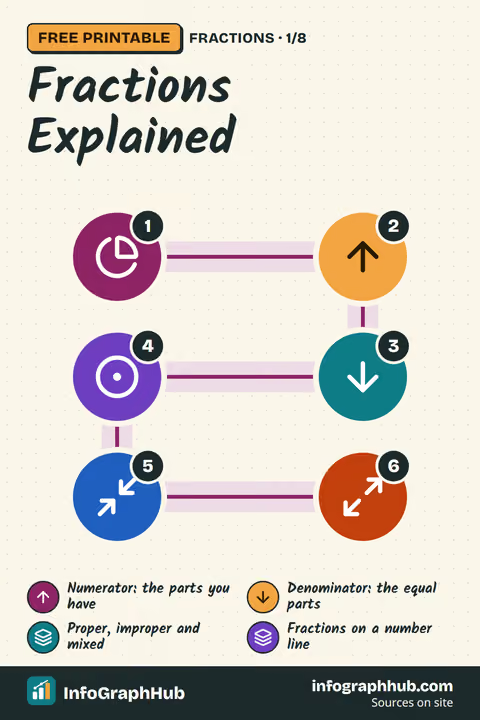


The complete guide
Fractions explained
Fractions turn up in almost every part of maths, and in kitchens, shops and scoreboards too. This series takes them one question at a time: what the two numbers in a fraction mean, how one fraction can have many names, how to add, subtract, multiply and divide them, how they connect to decimals and percentages, and where students most often slip.
Each part is a printable infographic with sources and fully checked working, written for ages 11–14 and their teachers. Work through them in order or jump to the part you need, then test yourself with the quiz at the end. The guide below explains the whole topic in one place.
What a fraction is
A fraction is a number that describes part of a whole, where the whole has been split into equal parts. It is written as one whole number above another, such as 3/4.
- The denominator (the bottom number) says how many equal parts the whole is split into. It names the size of the parts: quarters, fifths, tenths. It can never be 0.
- The numerator (the top number) counts how many of those parts you have.
A fraction is also a division: 3/4 means 3 ÷ 4, which is 0.75. That is why you can share 3 pizzas between 4 people and give each one 3/4 of a pizza.
Some fractions have special names:
- A unit fraction has a numerator of 1, such as 1/2, 1/3 or 1/10. The bigger the denominator, the smaller the unit fraction, because the whole is cut into more pieces: 1/8 is smaller than 1/4.
- A proper fraction has a numerator smaller than its denominator (3/5) and is worth less than 1.
- An improper fraction has a numerator bigger than its denominator (9/4) and is worth more than 1.
- A mixed number combines a whole number and a proper fraction (2 1/4).
To change 9/4 into a mixed number, divide: 9 ÷ 4 = 2 remainder 1, so 9/4 = 2 1/4. To go back, multiply the whole number by the denominator and add the numerator: 2 × 4 + 1 = 9.
On a number line, split the gap from 0 to 1 into as many equal steps as the denominator and count along by the numerator. 3/4 is three steps of 1/4 from 0. Proper fractions sit between 0 and 1; improper fractions lie beyond 1.
Equivalent fractions and simplest form
Equivalent fractions are different-looking fractions with the same value, such as 1/2, 2/4 and 4/8. You make one by multiplying or dividing the numerator and the denominator by the same number. Multiplying 2/3 by 4 on top and bottom gives 8/12: every third has been cut into 4 smaller pieces, so there are 4 times as many pieces but the amount is unchanged. In number terms, you have multiplied by 4/4, which is 1.
Adding the same number to the top and bottom does not work: 1/2 is not equal to 2/3.
To find a missing number, compare the parts you know. In 3/5 = ?/20, the denominator was multiplied by 4, so the numerator must be too: 3 × 4 = 12.
Simplifying a fraction means writing it with the smallest possible whole numbers. The quickest way is to divide the numerator and denominator by their highest common factor (HCF). For 18/24, the factors of 18 are 1, 2, 3, 6, 9 and 18, and the factors of 24 are 1, 2, 3, 4, 6, 8, 12 and 24. The HCF is 6, so 18/24 = 3/4. You can also simplify in smaller steps (18/24 → 9/12 → 3/4). A fraction is in its simplest form when its numerator and denominator share no factor except 1.
See the infographic: Part 2, Equivalent Fractions and Simplifying →
Adding and subtracting fractions
Fractions can only be added or subtracted when the parts are the same size, which means the denominators must match. Then you add or subtract the numerators and keep the denominator: 2/7 + 3/7 = 5/7.
When the denominators are different, rename the fractions first using a common denominator, ideally the lowest common multiple (LCM) of the denominators.
Example: 3/4 + 1/6. Multiples of 4 are 4, 8, 12…; multiples of 6 are 6, 12…, so the LCM is 12. 3/4 = 9/12 and 1/6 = 2/12, so the total is 11/12.
Multiplying the denominators (4 × 6 = 24) also gives a common denominator, but then the answer needs more simplifying: 18/24 + 4/24 = 22/24 = 11/12.
For mixed numbers, the most reliable method is to change them into improper fractions.
Example: 4 1/2 − 2 3/4. Change to improper fractions: 9/2 − 11/4. With the common denominator 4, that is 18/4 − 11/4 = 7/4, which is 1 3/4. Check with decimals: 4.5 − 2.75 = 1.75.
Always finish by simplifying, and decide whether to write an improper answer as a mixed number. An estimate before you start (here, a bit less than 2) catches most slips.
See the infographic: Part 3, Adding and Subtracting Fractions →
Multiplying and dividing fractions
Multiplying needs no common denominator. Multiply the numerators, multiply the denominators, then simplify: 2/3 × 4/5 = 8/15. You can see why with a rectangle split into thirds one way and fifths the other: it has 15 equal pieces, and 2/3 of 4/5 of it covers 8 of them.
The word 'of' means multiply, so 3/4 of 20 = 3/4 × 20 = 15. To keep numbers small, cancel common factors before multiplying. In 3/5 × 10/21, divide 3 and 21 by 3, and 10 and 5 by 5, to get 1/1 × 2/7 = 2/7. Mixed numbers must be changed to improper fractions first.
Dividing by a fraction is the same as multiplying by its reciprocal, the fraction turned upside down. Many students remember this as keep, change, flip: keep the first fraction, change ÷ to ×, flip the second.
Example: 5/6 ÷ 2/3 = 5/6 × 3/2 = 15/12 = 5/4 = 1 1/4.
Why it works. Division asks how many times one number fits into another. There are 2 halves in every whole, so 3 ÷ 1/2 = 6, which is 3 × 2. For a general reason, remember that multiplying both numbers in a division by the same amount does not change the answer (12 ÷ 4 = 24 ÷ 8). Multiply both 5/6 and 2/3 by 3/2: the divisor becomes 2/3 × 3/2 = 1, and dividing by 1 changes nothing, so the answer is simply 5/6 × 3/2. That is exactly keep, change, flip.
A size check helps: multiplying a positive number by a proper fraction makes it smaller, and dividing by one makes it bigger.
See the infographic: Part 4, Multiplying and Dividing Fractions →
Fractions, decimals and percentages
Fractions, decimals and percentages are three ways to write the same value. Percent means 'per hundred'.
| Fraction | Decimal | Percentage |
|---|---|---|
| 1/2 | 0.5 | 50% |
| 1/4 | 0.25 | 25% |
| 3/4 | 0.75 | 75% |
| 1/5 | 0.2 | 20% |
| 1/8 | 0.125 | 12.5% |
| 1/3 | 0.333… | 33 1/3% (about 33.3%) |
To convert:
- Fraction to decimal: divide the numerator by the denominator. 7/8 = 7 ÷ 8 = 0.875.
- Decimal to fraction: use place value, then simplify. 0.45 = 45/100 = 9/20.
- Decimal to percentage: multiply by 100. 0.875 = 87.5%.
- Percentage to decimal or fraction: divide by 100. 45% = 0.45 = 9/20.
Some fractions never give an exact decimal. 1/3 = 0.333… and 2/7 = 0.285714285714…, with the digits repeating for ever. These are recurring decimals. A fraction in its simplest form gives a decimal that ends only when its denominator has no prime factors other than 2 and 5, which is why 3/40 = 0.075 ends but 1/6 = 0.1666… does not.
See the infographic: Part 5, Fractions, Decimals and Percentages →
Common mistakes and how to avoid them
Most fraction mistakes come from treating the numerator and denominator as two separate whole numbers instead of one value. The ones that cost the most marks:
- Adding the denominators: 1/2 + 1/3 is not 2/5. Use sixths: 3/6 + 2/6 = 5/6.
- Leaving answers unsimplified: 6/10 should become 3/5.
- Flipping the wrong fraction when dividing: only the second fraction is flipped. 2/3 ÷ 4/5 = 2/3 × 5/4 = 5/6.
- Multiplying mixed numbers in pieces: 2 1/2 × 2 1/2 is not 4 1/4. As improper fractions, 5/2 × 5/2 = 25/4 = 6 1/4.
- Comparing by the denominator: a bigger denominator means smaller pieces. 5/8 = 15/24 is less than 2/3 = 16/24.
- Adding to top and bottom: 2/3 is not equal to 3/4. Only multiplying or dividing keeps the value.
The best defence is an estimate. Adding should make a total bigger, so an answer smaller than one of the fractions you added must be wrong. Checking with decimals takes seconds.
Fractions in everyday life
Most everyday fraction problems are about finding a fraction of an amount: divide by the denominator, then multiply by the numerator. 2/5 of 35 is 35 ÷ 5 × 2 = 14.
- Cooking: a recipe for 8 people using 300 g of flour needs 6/8 = 3/4 of that for 6 people, which is 225 g.
- Time: a quarter of an hour is 15 minutes, and 20 minutes is 1/3 of an hour.
- Money: '1/3 off' an item priced EUR 45 saves EUR 15.
- Sharing: 3 pizzas shared equally between 4 friends gives 3/4 of a pizza each.
- Measuring: half a litre is 500 ml and three quarters of a kilogram is 750 g.
- Sport and chance: a football match has two halves of 45 minutes, a free-throw record of 18 out of 24 is 3/4 or 75%, and the chance of rolling a 6 on a fair dice is 1/6.
Spotting the fraction hidden in a real situation is often the hardest step; the arithmetic that follows is the same as in class.
Test yourself
The final part is a ten-question quiz that covers the whole series: what the denominator means, equivalent fractions, simplifying, adding, mixed numbers, multiplying, dividing, converting to decimals and percentages, and a recipe problem. Seven questions are multiple choice and three ask for a short written answer, such as explaining why 5 ÷ 1/2 = 10.
Try every question before checking, and always write your working down. If you get one wrong, go back to the matching part of this series: it explains the method step by step, with worked examples whose answers have been checked twice.
Frequently asked questions
What is the difference between the numerator and the denominator?
The denominator, the bottom number, tells you how many equal parts the whole is split into. The numerator, the top number, tells you how many of those parts you have. In 3/4 the whole is split into 4 parts and you have 3.
How do you add fractions with different denominators?
Rewrite them as equivalent fractions with a common denominator, ideally the lowest common multiple of the denominators, then add the numerators and simplify. For example, 3/4 + 1/6 = 9/12 + 2/12 = 11/12.
Why do you flip the second fraction when dividing?
Dividing by a number gives the same answer as multiplying by its reciprocal. Dividing by 1/2 asks how many halves fit in, and every whole holds 2, so it is the same as multiplying by 2. In general, multiplying both numbers by the reciprocal of the divisor turns the divisor into 1.
How do you simplify a fraction?
Divide the numerator and the denominator by their highest common factor. For 18/24 the highest common factor is 6, so 18/24 = 3/4. You can also divide by smaller common factors several times until none is left.
How do you convert a fraction to a decimal and a percentage?
Divide the numerator by the denominator to get the decimal, then multiply by 100 for the percentage. For example, 3/8 = 3 ÷ 8 = 0.375 = 37.5%.
What age is this fractions series for?
It is written for students aged 11 to 14 and their teachers, covering the fraction skills taught in the first years of secondary school in most countries. Younger learners can use the first two parts, and older students can use it for revision.
Sources & methodology
Every fact is checked against the sources below. We write original explanations and draw original graphics; no figures are copied from textbooks. Spotted an error? See our corrections policy.
- KS3 Maths: Fractions (BBC Bitesize, accessed 1 Oct 2026)
- Fractions (Math is Fun, accessed 1 Oct 2026)
- Dividing Fractions (Math is Fun, accessed 1 Oct 2026)
- Meaning of the reciprocal (video) (Khan Academy, accessed 1 Oct 2026)
- Teaching Fractions With Understanding: Part-Whole Concept (NRICH, University of Cambridge, accessed 1 Oct 2026)
- National curriculum in England: mathematics programmes of study (Department for Education (GOV.UK), accessed 1 Oct 2026)
- Common Core State Standards for Mathematics: Number & Operations—Fractions, Grade 5 (Common Core State Standards Initiative, accessed 1 Oct 2026)
Editorial review pending · Updated
For teachers and parents: new InfoGraphHub resources by email
One short email when new free resources go live. For adults (18+) only. No spam, no tracking in emails, unsubscribe anytime.