MathsCheat sheetPart 4 of 8, FractionsUpdated 1 October 2026
Multiplying and Dividing Fractions
The rules for multiplying and dividing fractions on one sheet: multiply across, 'of' means multiply, cancel first, mixed and whole numbers, reciprocals, and keep-change-flip for division, with a clear explanation of why flipping works.
Use this infographic
Free under CC BY-NC 4.0, with credit to InfoGraphHub.
Multiplying: no common denominator needed
Multiplying fractions is simpler than adding them. Multiply the numerators together, multiply the denominators together, then simplify:
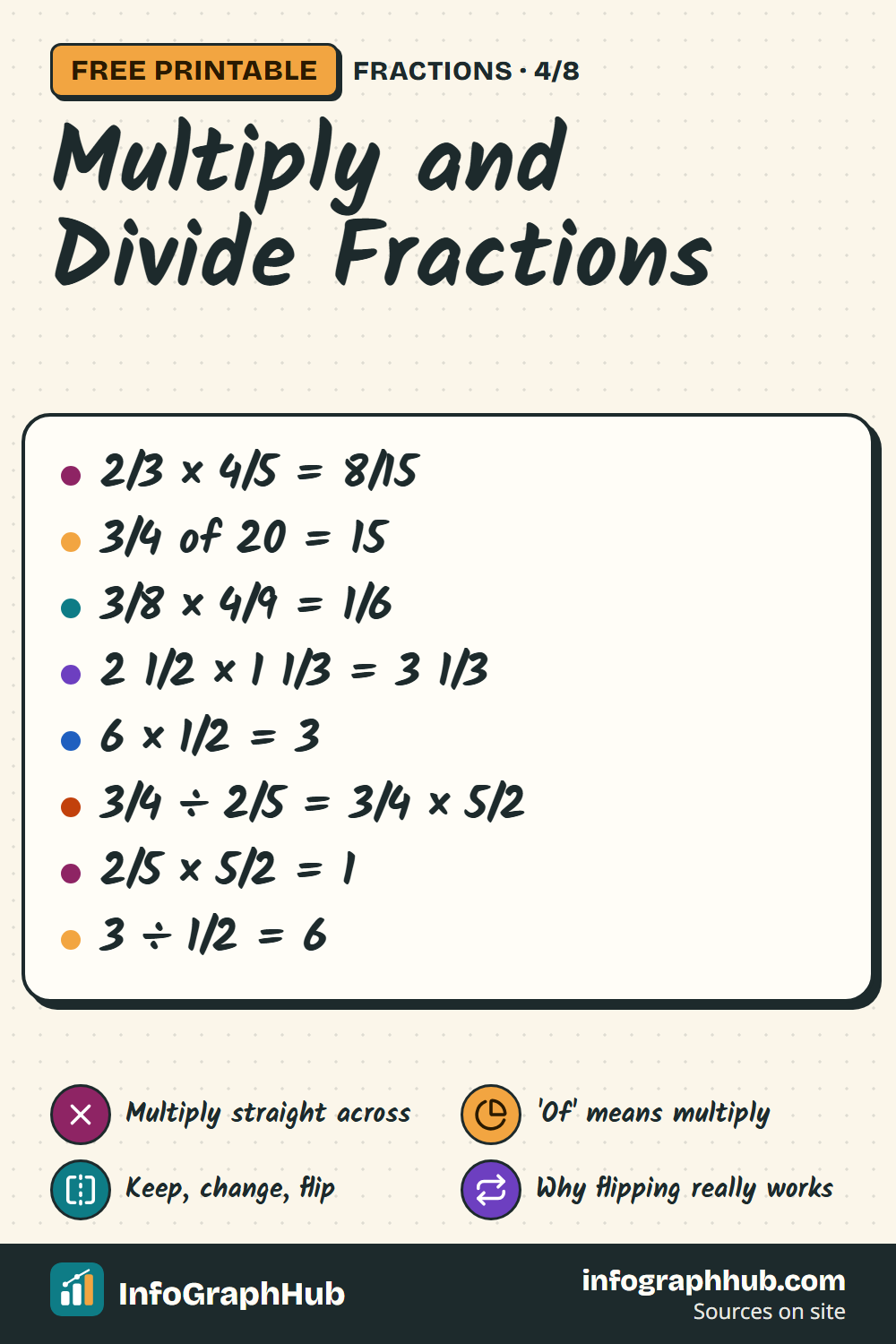
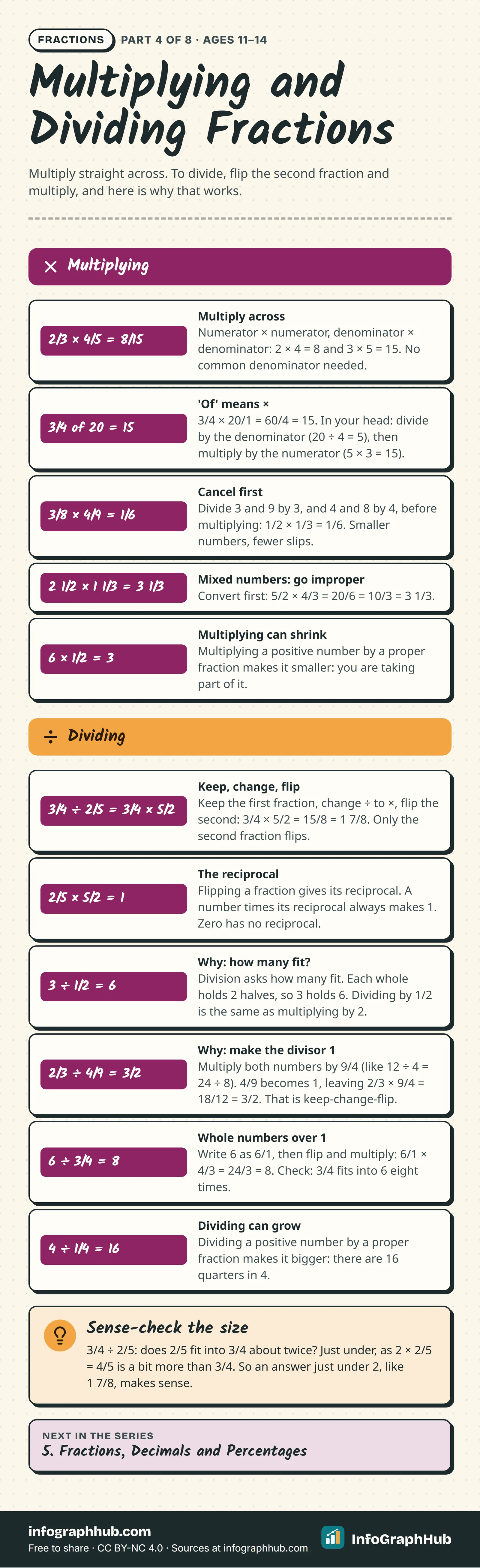
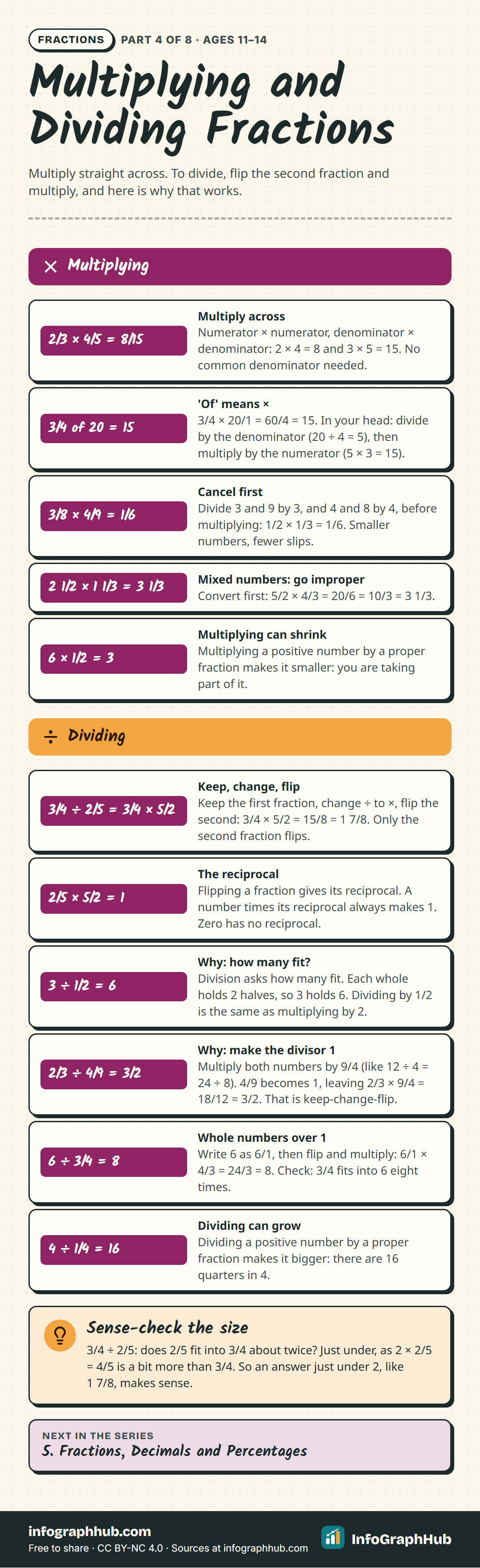
2/3 × 4/5 = (2 × 4)/(3 × 5) = 8/15.
Why does this work? Picture a square. Split its width into halves and its height into thirds: it is now cut into 2 × 3 = 6 equal pieces. Shading half of one third shades exactly one of those pieces, so 1/2 × 1/3 = 1/6. Multiplying the denominators counts the pieces; multiplying the numerators counts the shaded ones.
'Of' means multiply
In maths, 'of' between a fraction and an amount means multiply. 3/4 of 20 is 3/4 × 20. Write the whole number over 1 and multiply across: 3/4 × 20/1 = 60/4 = 15. Or do it in your head: divide by the denominator (20 ÷ 4 = 5), then multiply by the numerator (5 × 3 = 15).
Cancel first to keep numbers small
Before multiplying, you can divide any numerator and any denominator by a common factor. In 3/8 × 4/9, the 3 and the 9 share a factor of 3, and the 4 and the 8 share a factor of 4. Cancelling gives 1/2 × 1/3 = 1/6. Multiplying first gives 12/72, which also simplifies to 1/6, but with bigger numbers and more chances to slip.
Mixed numbers and whole numbers
Change mixed numbers into improper fractions before you multiply or divide. 2 1/2 × 1 1/3 becomes 5/2 × 4/3 = 20/6 = 10/3 = 3 1/3. A mixed number is really a sum (2 1/2 = 2 + 1/2), so it cannot be multiplied piece by piece. A whole number becomes a fraction over 1: 6 = 6/1.
Dividing: keep, change, flip
To divide by a fraction, multiply by its reciprocal, which is the fraction turned upside down. The reciprocal of 2/5 is 5/2, and a number times its reciprocal always makes 1 (2/5 × 5/2 = 10/10 = 1). Zero has no reciprocal.
Many students remember the method as keep, change, flip: keep the first fraction, change ÷ to ×, flip the second fraction.
3/4 ÷ 2/5 = 3/4 × 5/2 = 15/8 = 1 7/8.
Only the second fraction, the one you are dividing by, is flipped.
Why flipping works
Reason 1: how many fit? Division asks how many times one number fits into another. How many halves fit into 3? Each whole holds 2 halves, so 3 holds 3 × 2 = 6. Dividing by 1/2 is the same as multiplying by 2. In the same way, dividing by 1/4 is multiplying by 4, and dividing by 2/3 is multiplying by 3/2.
Reason 2: make the divisor 1. Multiplying both numbers in a division by the same amount does not change the answer: 12 ÷ 4 = 24 ÷ 8 = 3. So for 2/3 ÷ 4/9, multiply both numbers by 9/4. The second number becomes 4/9 × 9/4 = 1, and dividing by 1 changes nothing. What is left is 2/3 × 9/4 = 18/12 = 3/2. That is exactly keep, change, flip.
A useful check: dividing a positive number by a proper fraction makes it bigger, and multiplying by one makes it smaller. 4 ÷ 1/4 = 16, but 4 × 1/4 = 1.
Frequently asked questions
Why do you flip the second fraction when dividing?
Dividing by a number gives the same result as multiplying by its reciprocal. Dividing by 1/2 asks how many halves fit, and there are 2 in every whole, so it is the same as multiplying by 2. More generally, multiplying both numbers by the reciprocal of the divisor turns the divisor into 1.
Do you need a common denominator to multiply fractions?
No. Common denominators are needed to add and subtract. To multiply, just multiply the numerators and the denominators, then simplify.
What is a reciprocal?
The reciprocal of a fraction is the fraction turned upside down: the reciprocal of 3/4 is 4/3, and of 5 (5/1) is 1/5. A number multiplied by its reciprocal equals 1. Zero has no reciprocal.
How do you multiply or divide mixed numbers?
Change each mixed number into an improper fraction first, then multiply or divide as normal and simplify. For example, 2 1/4 ÷ 3/5 = 9/4 × 5/3 = 45/12 = 15/4 = 3 3/4.
Sources & methodology
Every fact is checked against the sources below. We write original explanations and draw original graphics; no figures are copied from textbooks. Spotted an error? See our corrections policy.
- How to multiply fractions (BBC Bitesize (KS3 Maths), accessed 1 Oct 2026)
- How to divide fractions (BBC Bitesize (KS3 Maths), accessed 1 Oct 2026)
- Meaning of the reciprocal (video) (Khan Academy, accessed 1 Oct 2026)
- Multiplying Fractions (Math is Fun, accessed 1 Oct 2026)
- Dividing Fractions (Math is Fun, accessed 1 Oct 2026)
Editorial review pending · Updated
Made by the InfoGraphHub editorial team (how we research and check: editorial and AI policy). First published 1 October 2026, last reviewed 1 October 2026. Found a mistake? Tell the editors.
For teachers: ages and curriculum fit
Ages 11–14 · Grades 6–8 (US) · Years 7–9 (UK) · Classes 6–8 (India)
Common Core State Standards © Copyright 2010 National Governors Association Center for Best Practices and Council of Chief State School Officers. All rights reserved. Names and codes are used only to describe curriculum fit; InfoGraphHub is not endorsed by these organisations.
Embed this on your site
Paste this HTML into your page. Keep the credit line: it is required by the CC BY-NC 4.0 license.
Related infographics


For teachers and parents: new InfoGraphHub resources by email
One short email when new free resources go live. For adults (18+) only. No spam, no tracking in emails, unsubscribe anytime.