MathsWorked examplePart 3 of 8, FractionsUpdated 1 October 2026
Adding and Subtracting Fractions
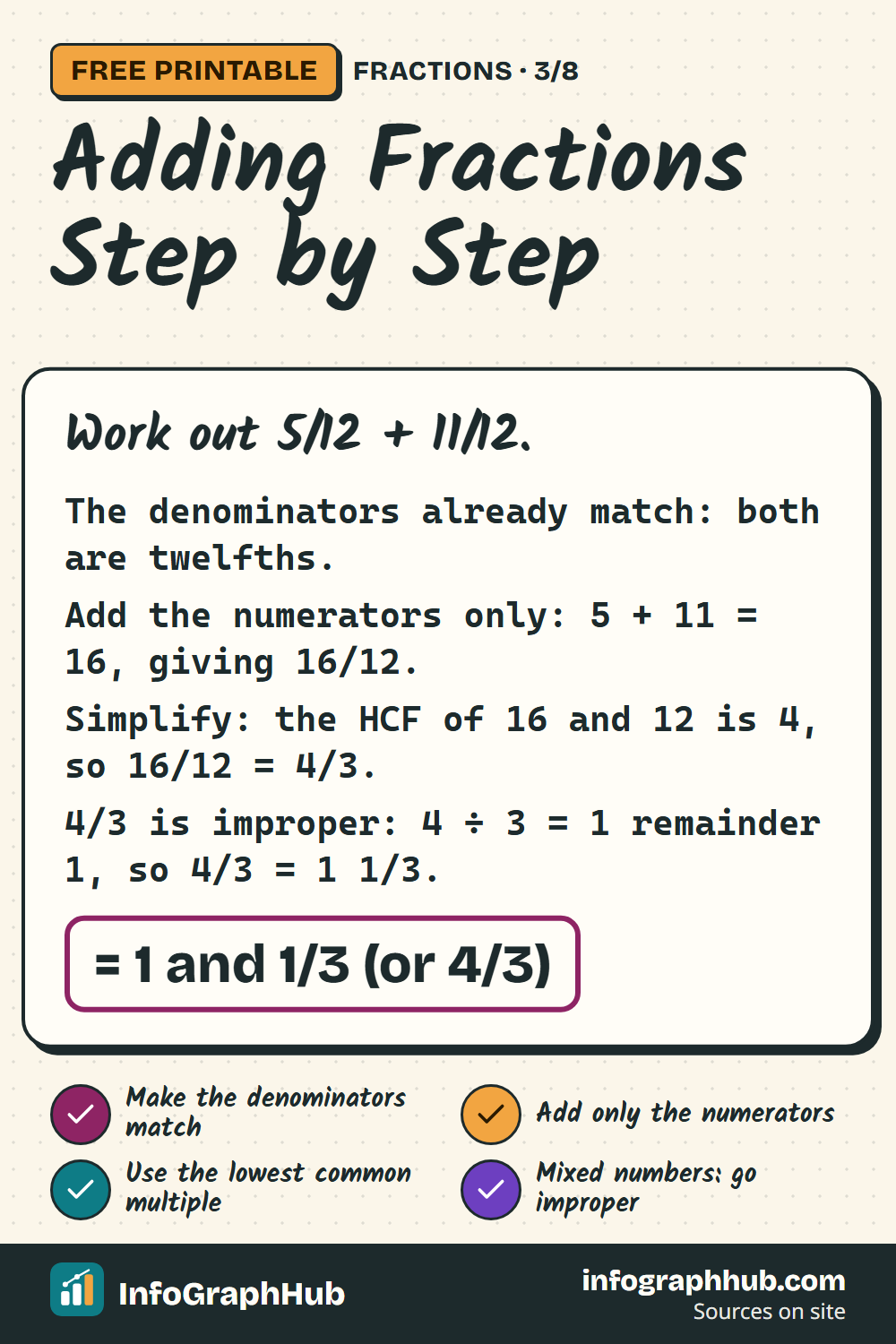
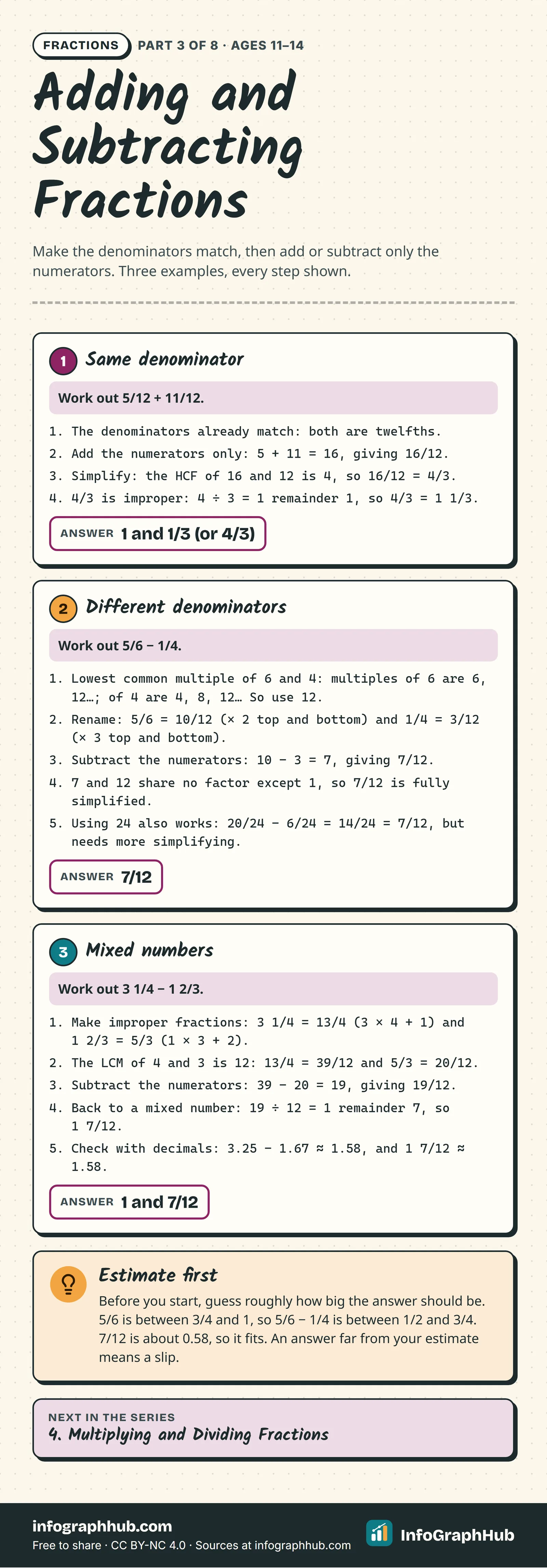
Three fully worked examples of adding and subtracting fractions: same denominators, different denominators using the lowest common multiple, and mixed numbers, with every step shown and a check on each answer.
Use this infographic
Free under CC BY-NC 4.0, with credit to InfoGraphHub.
The one rule behind every example
You can only add or subtract fractions when the parts are the same size, which means the denominators must match. 2 fifths + 1 fifth = 3 fifths, in the same way that 2 apples + 1 apple = 3 apples. The denominator is the name of the parts, so it stays the same; only the numerators are added or subtracted.
When the denominators are different, you first rename the fractions as equivalent fractions with a common denominator. Then add or subtract the numerators, and finally simplify.
Finding a common denominator
Any common multiple of the denominators will work, but the lowest common multiple (LCM) keeps the numbers small. To find it, list the multiples of each denominator until one appears in both lists.
For 5/6 − 1/4: multiples of 6 are 6, 12, 18…; multiples of 4 are 4, 8, 12…, so the LCM is 12. Multiplying the denominators together (6 × 4 = 24) also works, but you then have to simplify more at the end: 20/24 − 6/24 = 14/24, which simplifies to 7/12, the same answer.
When the denominators share no common factor, their product is the LCM. For 2/5 + 3/4, the LCM of 5 and 4 is 20: 2/5 = 8/20 and 3/4 = 15/20, so the total is 23/20, or 1 3/20.
Two ways to handle mixed numbers
Method 1: improper fractions. Turn each mixed number into an improper fraction, then add or subtract as usual. This always works, and it is the method shown in example 3 on the infographic: 3 1/4 − 1 2/3 = 13/4 − 5/3 = 39/12 − 20/12 = 19/12 = 1 7/12.
Method 2: wholes and parts separately. Add or subtract the whole numbers, then the fractions. For 2 1/3 + 1 1/2: the wholes give 3, and 1/3 + 1/2 = 2/6 + 3/6 = 5/6, so the answer is 3 5/6.
Method 2 needs care with subtraction. In 3 1/4 − 1 2/3, the fraction parts become 3/12 − 8/12, and 3/12 is too small. Exchange one whole for 12/12: 3 3/12 becomes 2 15/12. Now 2 15/12 − 1 8/12 = 1 7/12. Both methods give the same answer.
Simplify and check
Always finish by simplifying (divide top and bottom by their highest common factor) and, if the answer is an improper fraction, decide whether to write it as a mixed number. Ask what form the question wants; both 4/3 and 1 1/3 are correct.
A quick estimate catches most slips. 5/6 lies between 3/4 and 1, so 5/6 − 1/4 must lie between 1/2 and 3/4; 7/12 is just over a half, so it fits. For mixed numbers, decimals help: 3 1/4 − 1 2/3 is about 3.25 − 1.67 = 1.58, and 1 7/12 is about 1.58 too.
Where you will use this
Adding and subtracting fractions comes up whenever amounts are measured in parts: combining 3/4 of an hour and 1/2 an hour of homework (1 1/4 hours), working out how much of a pizza is left after two people have eaten 1/3 and 1/4 of it (5/12 left), or adding lengths on a plan. The same skills are needed later in algebra, where fractions contain letters instead of numbers but follow exactly the same rules.
Frequently asked questions
Why can't you just add the denominators?
The denominator tells you the size of the parts, not how many you have. Halves and thirds are different sizes, so 1/2 + 1/3 is not 2/5 (that is less than 1/2 on its own). Rename both as sixths: 3/6 + 2/6 = 5/6.
Do I have to use the lowest common denominator?
No. Any common denominator gives the right answer. The lowest common multiple keeps the numbers smaller, so there is less simplifying to do at the end.
How do you subtract mixed numbers?
The safest way is to change them into improper fractions, find a common denominator, subtract the numerators, then change the answer back to a mixed number. For example, 3 1/4 − 1 2/3 = 39/12 − 20/12 = 19/12 = 1 7/12.
Should the answer be an improper fraction or a mixed number?
Both are correct and equal. Follow what the question asks for. If it does not say, a mixed number in its simplest form is usually the clearest.
Sources & methodology
Every fact is checked against the sources below. We write original explanations and draw original graphics; no figures are copied from textbooks. Spotted an error? See our corrections policy.
- How to add fractions (BBC Bitesize (KS3 Maths), accessed 1 Oct 2026)
- How to subtract fractions (BBC Bitesize (KS3 Maths), accessed 1 Oct 2026)
- Adding Fractions (Math is Fun, accessed 1 Oct 2026)
- Subtracting Fractions (Math is Fun, accessed 1 Oct 2026)
Editorial review pending · Updated
Made by the InfoGraphHub editorial team (how we research and check: editorial and AI policy). First published 1 October 2026, last reviewed 1 October 2026. Found a mistake? Tell the editors.
For teachers: ages and curriculum fit
Ages 11–14 · Grades 6–8 (US) · Years 7–9 (UK) · Classes 6–8 (India)
Common Core State Standards © Copyright 2010 National Governors Association Center for Best Practices and Council of Chief State School Officers. All rights reserved. Names and codes are used only to describe curriculum fit; InfoGraphHub is not endorsed by these organisations.
Embed this on your site
Paste this HTML into your page. Keep the credit line: it is required by the CC BY-NC 4.0 license.
Related infographics


For teachers and parents: new InfoGraphHub resources by email
One short email when new free resources go live. For adults (18+) only. No spam, no tracking in emails, unsubscribe anytime.