MathsCheat sheetPart 5 of 8, FractionsUpdated 1 October 2026
Fractions, Decimals and Percentages
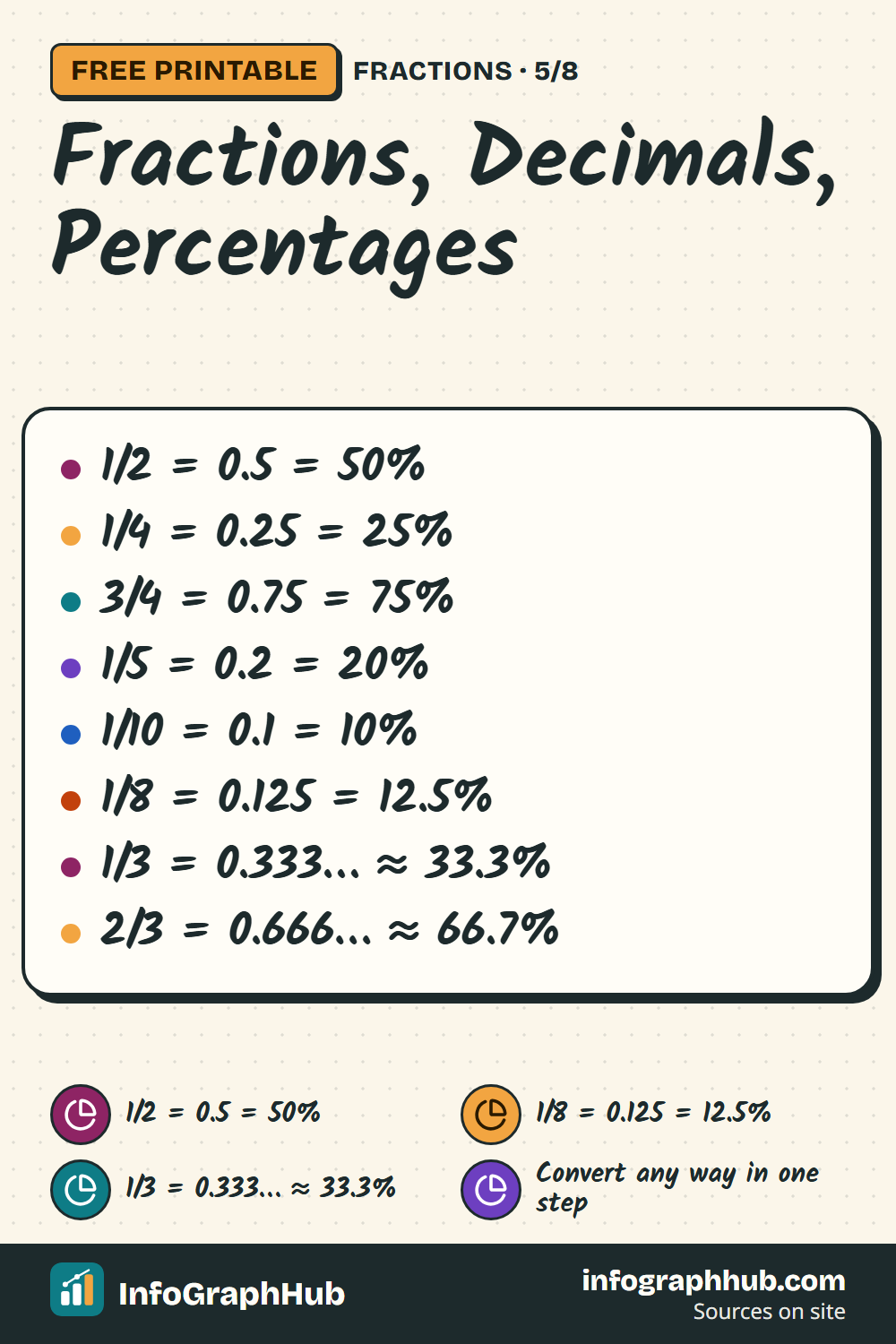
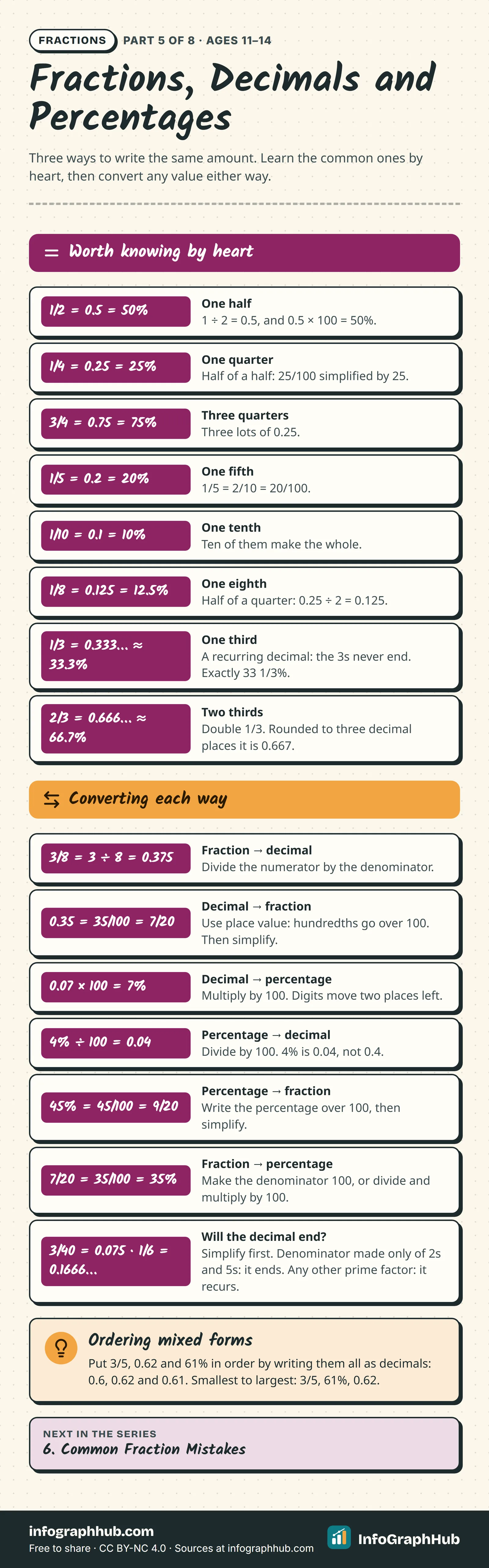
A cheat sheet of the fraction, decimal and percentage equivalents worth knowing by heart, from 1/2 = 0.5 = 50% to 1/3 = 0.333… ≈ 33.3%, plus the six conversions between the three forms and how to tell if a decimal will end.
Use this infographic
Free under CC BY-NC 4.0, with credit to InfoGraphHub.
Three ways to write the same amount
Fractions, decimals and percentages are three ways of writing one value. A half can be written 1/2, 0.5 or 50%. Each form suits a different job: fractions are exact and easy to picture, decimals suit calculators and measuring, and percentages make comparisons easy because everything is 'out of 100'.
The word percent means 'per hundred', so 50% is 50/100. That single fact links percentages to the other two forms.
Why learn the common ones by heart
A handful of equivalents come up again and again: halves, quarters, fifths, tenths, eighths and thirds. Knowing them instantly saves time and lets you build others. If 1/8 = 0.125, then 3/8 is 3 × 0.125 = 0.375 and 5/8 is 0.625. If 1/5 = 20%, then 4/5 = 80%. It also helps you spot when a calculator answer looks wrong, and it makes mental calculations like '25% off' (take off a quarter) quick.
Fraction to decimal
A fraction is a division, so divide the numerator by the denominator. 3/8 = 3 ÷ 8 = 0.375.
If the denominator multiplies easily to 10, 100 or 1,000, use an equivalent fraction instead: 7/20 = 35/100 = 0.35, and 3/25 = 12/100 = 0.12.
Decimal to fraction
Use place value. The last digit of the decimal tells you the denominator: tenths, hundredths or thousandths.
- 0.8 is 8 tenths: 8/10 = 4/5.
- 0.35 is 35 hundredths: 35/100 = 7/20 (divide by 5).
- 0.125 is 125 thousandths: 125/1000 = 1/8 (divide by 125).
Always simplify at the end.
Percentages both ways
- Decimal to percentage: multiply by 100. 0.07 × 100 = 7%, and 0.375 × 100 = 37.5%.
- Percentage to decimal: divide by 100. 45% = 0.45, and 4% = 0.04 (not 0.4).
- Percentage to fraction: write it over 100 and simplify. 45% = 45/100 = 9/20.
- Fraction to percentage: make the denominator 100 if you can (9/20 = 45/100 = 45%), or divide and multiply by 100 (5/8 = 0.625 = 62.5%).
Recurring decimals
Some fractions give decimals that never end. 1 ÷ 3 = 0.333…, with the 3s repeating for ever, so 1/3 is about 33.3% (exactly 33 1/3%). 2/3 = 0.666…, which rounds to 0.667 to three decimal places, or about 66.7%. These are called recurring decimals; the dots show that the digits carry on.
There is a quick test. Simplify the fraction, then look at the prime factors of the denominator. If they are only 2s and 5s, the decimal terminates (ends): 3/40 = 0.075, because 40 = 2 × 2 × 2 × 5. If any other prime appears, the decimal recurs: 1/6 = 0.1666…, because 6 = 2 × 3.
Comparing mixed forms
To put 3/5, 0.62 and 61% in order, write them all in the same form. As decimals they are 0.6, 0.62 and 0.61, so the order from smallest is 3/5, 61%, 0.62. Decimals are usually the easiest common form for comparing; percentages work just as well.
Frequently asked questions
How do you turn a fraction into a percentage?
Either make the denominator 100 (3/4 = 75/100 = 75%) or divide the numerator by the denominator and multiply by 100 (5/8 = 0.625, so 62.5%).
Is 1/3 equal to 0.33?
No, 0.33 is only an approximation. 1/3 = 0.333…, with the 3s repeating for ever. As a percentage it is exactly 33 1/3%, often rounded to 33.3%.
Which fractions give decimals that end?
A fraction in its simplest form gives a terminating decimal only if its denominator has no prime factors other than 2 and 5. So 3/8, 7/20 and 3/40 terminate, while 1/3, 1/6 and 2/7 recur.
What is 1/8 as a decimal and a percentage?
1/8 = 1 ÷ 8 = 0.125, which is 12.5%. It is half of 1/4 (0.25 ÷ 2 = 0.125).
Sources & methodology
Every fact is checked against the sources below. We write original explanations and draw original graphics; no figures are copied from textbooks. Spotted an error? See our corrections policy.
- How to convert between fractions and decimals (BBC Bitesize (KS3 Maths), accessed 1 Oct 2026)
- How to convert fractions to percentages (BBC Bitesize (KS3 Maths), accessed 1 Oct 2026)
- How to convert percentages to fractions and decimals (BBC Bitesize (KS3 Maths), accessed 1 Oct 2026)
- Decimals, Fractions and Percentages (Math is Fun, accessed 1 Oct 2026)
- Convert Fractions to Decimals (Math is Fun, accessed 1 Oct 2026)
Editorial review pending · Updated
Made by the InfoGraphHub editorial team (how we research and check: editorial and AI policy). First published 1 October 2026, last reviewed 1 October 2026. Found a mistake? Tell the editors.
For teachers: ages and curriculum fit
Ages 11–14 · Grades 6–8 (US) · Years 7–9 (UK) · Classes 6–8 (India)
Common Core State Standards © Copyright 2010 National Governors Association Center for Best Practices and Council of Chief State School Officers. All rights reserved. Names and codes are used only to describe curriculum fit; InfoGraphHub is not endorsed by these organisations.
Embed this on your site
Paste this HTML into your page. Keep the credit line: it is required by the CC BY-NC 4.0 license.
Related infographics


For teachers and parents: new InfoGraphHub resources by email
One short email when new free resources go live. For adults (18+) only. No spam, no tracking in emails, unsubscribe anytime.