MathsVisual listPart 1 of 8, FractionsUpdated 1 October 2026
Fractions Explained
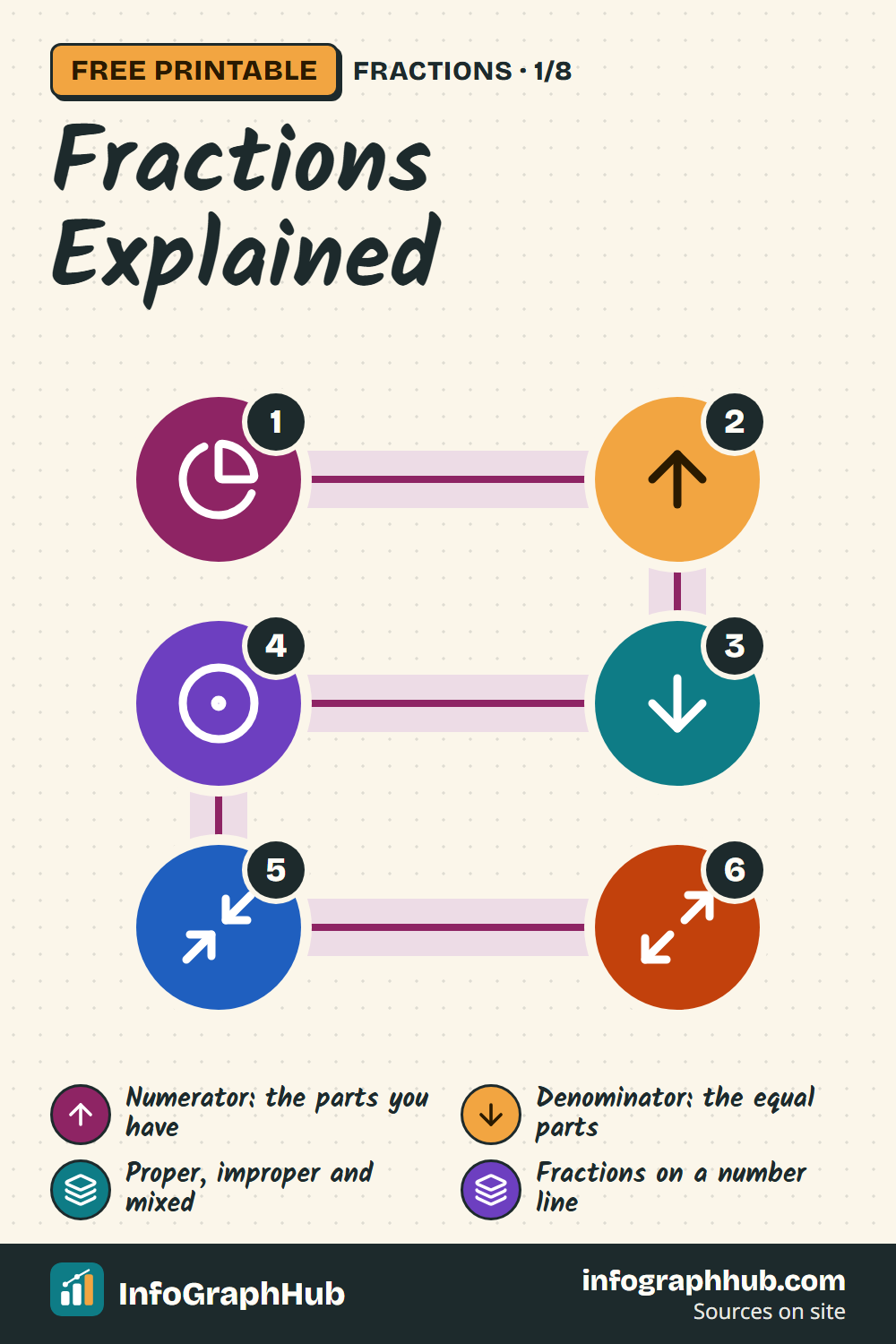
What a fraction is and the words you need to talk about one: numerator, denominator, unit fractions, proper and improper fractions, mixed numbers, and where fractions sit on a number line, with a short example for each.
Use this infographic
Free under CC BY-NC 4.0, with credit to InfoGraphHub.
What a fraction is
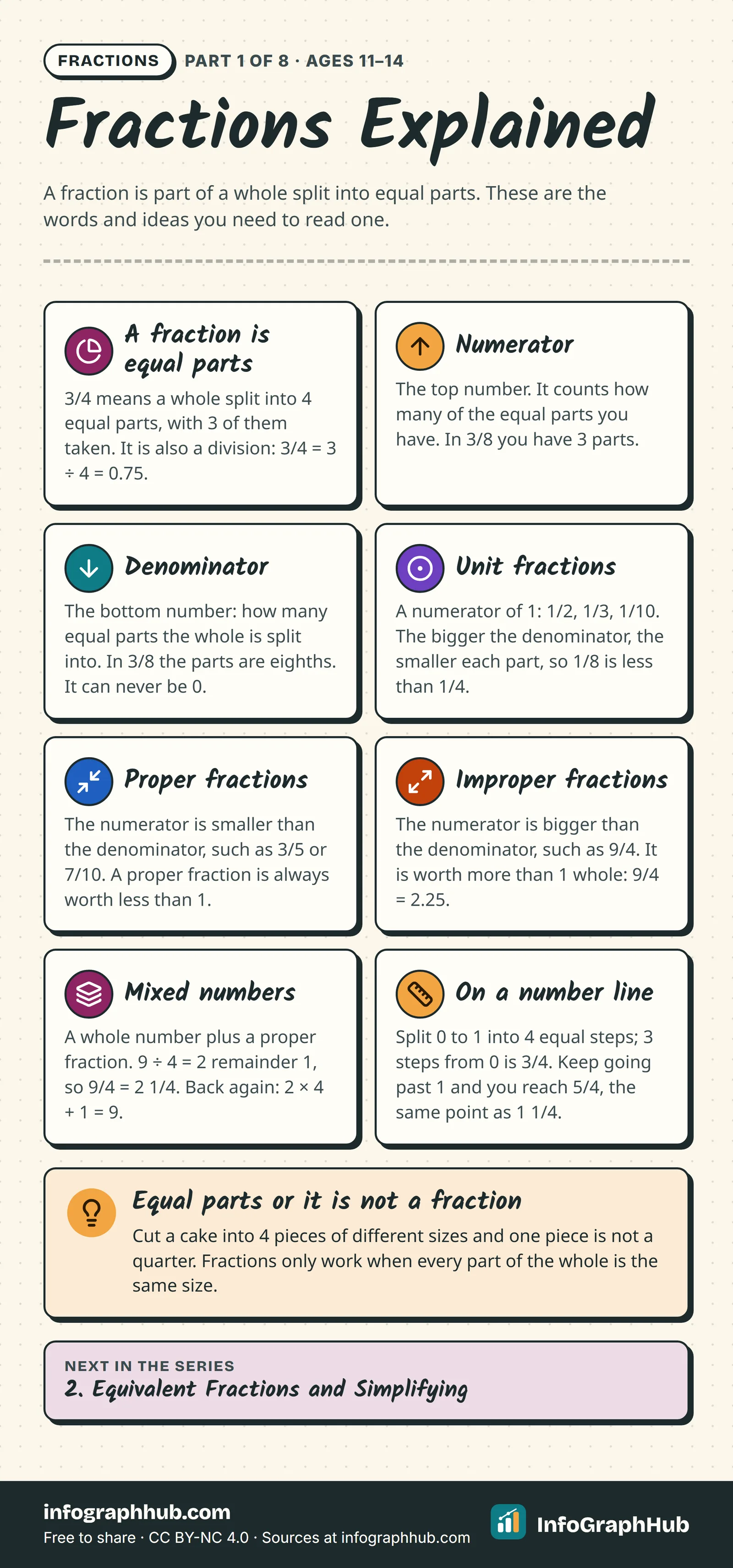
A fraction describes part of a whole that has been split into equal parts. If a pizza is cut into 8 equal slices and you eat 3, you have eaten 3/8 of it. The word 'equal' matters: if the slices are different sizes, counting them does not tell you what fraction you have.
A fraction is also a number in its own right, and it is a division. 3/4 means 3 ÷ 4, which is 0.75. That is why fractions can be placed on a number line, compared, added and multiplied just like whole numbers.
Numerator and denominator
Every fraction has two parts, separated by a line:
- The denominator is the bottom number. It says how many equal parts the whole is split into, so it names the size of each part. In 3/8 the parts are eighths.
- The numerator is the top number. It counts how many of those parts you have. In 3/8 you have 3 of them.
A quick way to remember which is which: the denominator is down. The denominator can never be 0, because a whole cannot be split into zero parts.
Unit fractions
A unit fraction has a numerator of 1: 1/2, 1/3, 1/4, 1/10 and so on. It is one single part of the whole. Every other fraction can be built from unit fractions: 3/8 is 1/8 + 1/8 + 1/8.
With unit fractions, a bigger denominator means a smaller fraction. Share a cake between 8 people instead of 4 and each slice gets smaller, so 1/8 is less than 1/4. This surprises many people at first, because 8 is bigger than 4.
Proper fractions, improper fractions and mixed numbers
- A proper fraction has a numerator smaller than its denominator, such as 3/5 or 7/10. It is worth less than 1.
- An improper fraction has a numerator bigger than its denominator, such as 9/4. It is worth more than 1.
- A mixed number is a whole number and a proper fraction together, such as 2 1/4 (two and a quarter).
Improper fractions and mixed numbers are two ways of writing the same amount.
Improper to mixed: divide the numerator by the denominator. For 9/4, 9 ÷ 4 = 2 remainder 1, so 9/4 = 2 1/4.
Mixed to improper: multiply the whole number by the denominator and add the numerator. For 2 1/4, 2 × 4 + 1 = 9, so 2 1/4 = 9/4.
Mixed numbers are easier to picture in everyday life (two and a quarter pizzas). Improper fractions are usually easier to calculate with, especially when multiplying and dividing.
Fractions on a number line
To place 3/4 on a number line, split the gap between 0 and 1 into 4 equal steps. Each step is 1/4. Count 3 steps from 0 and you land on 3/4. Keep counting past 1 and you reach 5/4, which is the same point as 1 1/4.
The number line shows two useful facts. Proper fractions always lie between 0 and 1, while improper fractions lie beyond 1. And different fractions can land on exactly the same point: 1/2 and 2/4 sit in the same place because they are equal. The next part of this series explains these equivalent fractions.
Comparing fractions at a glance
Two simple cases need no working out:
- Same denominator: the parts are the same size, so the bigger numerator wins. 5/9 is more than 4/9.
- Same numerator: you have the same number of parts, so the smaller parts lose. 3/10 is less than 3/7, because tenths are smaller than sevenths.
When both numbers are different, rewrite the fractions with a common denominator first, or turn them into decimals.
Frequently asked questions
What is the difference between the numerator and the denominator?
The denominator (bottom number) says how many equal parts the whole is split into. The numerator (top number) says how many of those parts you have. In 3/8 the whole is split into 8 parts and you have 3.
What is a unit fraction?
A fraction with 1 as its numerator, such as 1/2, 1/5 or 1/100. It stands for one equal part of a whole. The bigger its denominator, the smaller the fraction.
How do you change an improper fraction into a mixed number?
Divide the numerator by the denominator. The answer is the whole number and the remainder becomes the new numerator over the same denominator. For example, 11 ÷ 4 = 2 remainder 3, so 11/4 = 2 3/4.
Why can't the denominator be zero?
The denominator says how many equal parts a whole is split into, and you cannot split something into zero parts. In the language of division, a fraction such as 3/0 would mean 3 ÷ 0, which has no answer.
Sources & methodology
Every fact is checked against the sources below. We write original explanations and draw original graphics; no figures are copied from textbooks. Spotted an error? See our corrections policy.
- What are fractions? (BBC Bitesize (KS3 Maths), accessed 1 Oct 2026)
- Mixed numbers, proper and improper fractions (BBC Bitesize (KS3 Maths), accessed 1 Oct 2026)
- Fractions (Math is Fun, accessed 1 Oct 2026)
- Unit Fraction (definition) (Math is Fun, accessed 1 Oct 2026)
- Teaching Fractions With Understanding: Part-Whole Concept (NRICH, University of Cambridge, accessed 1 Oct 2026)
Editorial review pending · Updated
Made by the InfoGraphHub editorial team (how we research and check: editorial and AI policy). First published 1 October 2026, last reviewed 1 October 2026. Found a mistake? Tell the editors.
For teachers: ages and curriculum fit
Ages 11–14 · Grades 6–8 (US) · Years 7–9 (UK) · Classes 6–8 (India)
Common Core State Standards © Copyright 2010 National Governors Association Center for Best Practices and Council of Chief State School Officers. All rights reserved. Names and codes are used only to describe curriculum fit; InfoGraphHub is not endorsed by these organisations.
Embed this on your site
Paste this HTML into your page. Keep the credit line: it is required by the CC BY-NC 4.0 license.
Related infographics


For teachers and parents: new InfoGraphHub resources by email
One short email when new free resources go live. For adults (18+) only. No spam, no tracking in emails, unsubscribe anytime.