MathsProcessPart 2 of 8, FractionsUpdated 1 October 2026
Equivalent Fractions and Simplifying
How to make equivalent fractions by multiplying or dividing top and bottom by the same number, find a missing numerator, and simplify a fraction to its lowest terms using the highest common factor, step by step with checked examples.
Interactive
Explore it step by step
6 steps: Spot equal values → Multiply top and bottom → Find a missing number → Find the HCF → Divide by the HCF → Check it is fully simplified. Press play, or choose a number to explore.
Step 1 of 6: Spot equal values
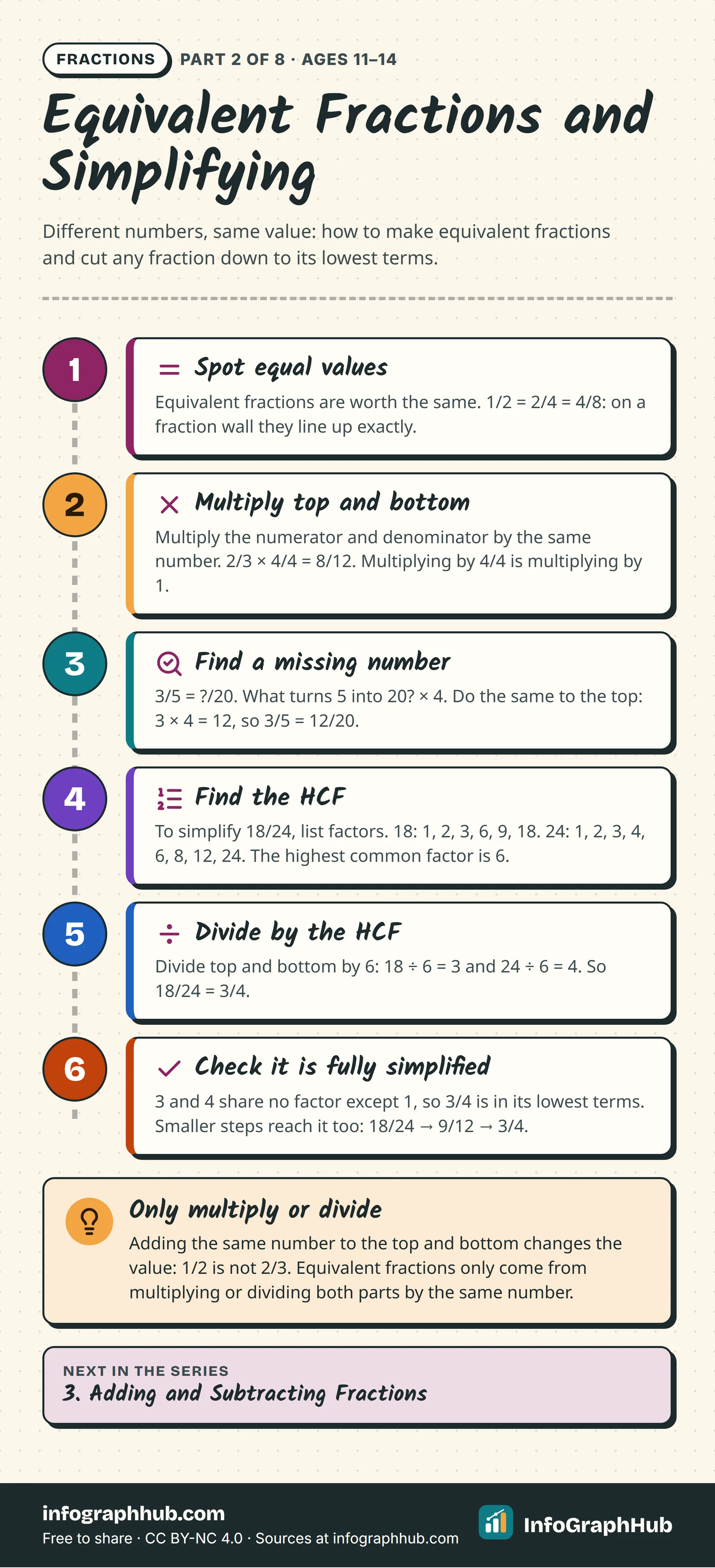
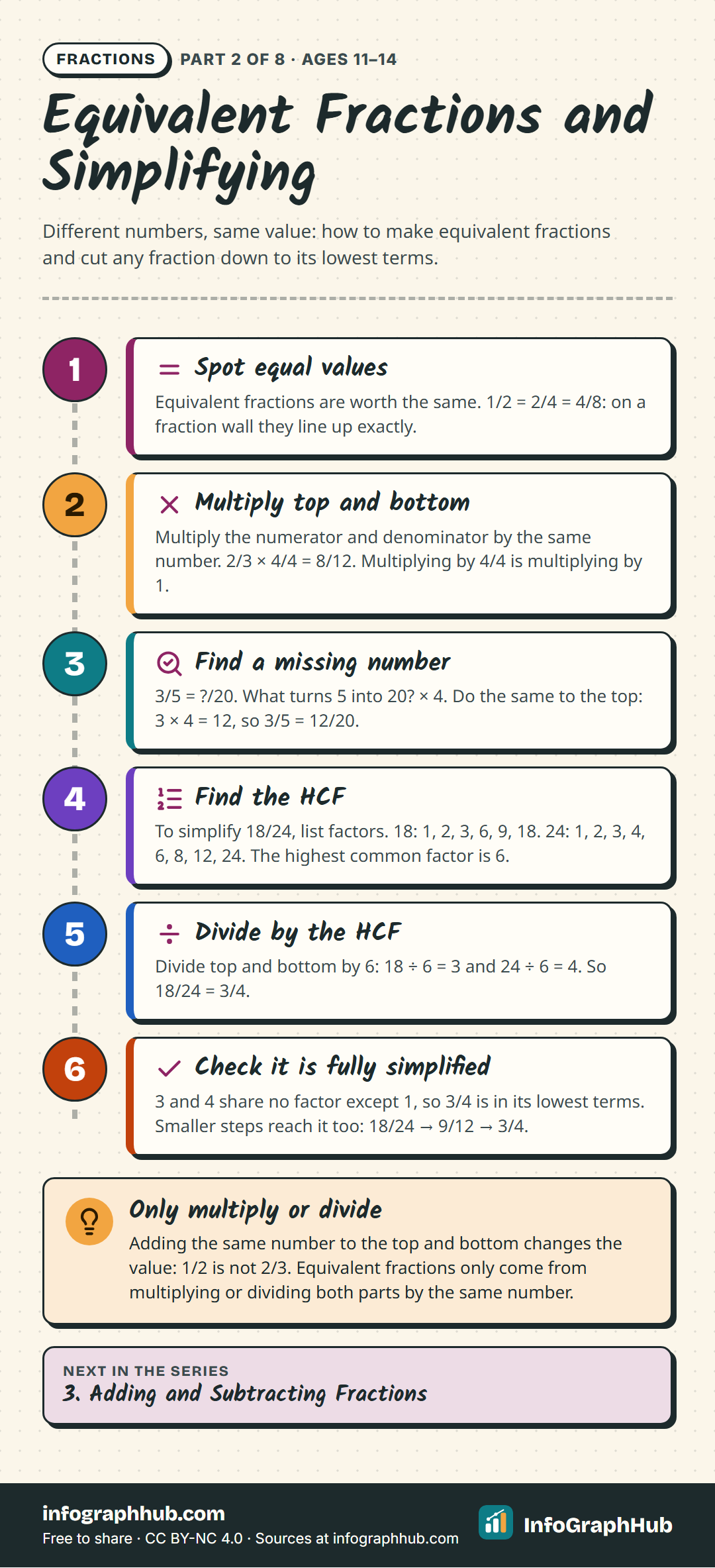
Equivalent fractions are worth the same. 1/2 = 2/4 = 4/8: on a fraction wall they line up exactly.
Step 2 of 6: Multiply top and bottom
Multiply the numerator and denominator by the same number. 2/3 × 4/4 = 8/12. Multiplying by 4/4 is multiplying by 1.
Step 3 of 6: Find a missing number
3/5 = ?/20. What turns 5 into 20? × 4. Do the same to the top: 3 × 4 = 12, so 3/5 = 12/20.
Step 4 of 6: Find the HCF
To simplify 18/24, list factors. 18: 1, 2, 3, 6, 9, 18. 24: 1, 2, 3, 4, 6, 8, 12, 24. The highest common factor is 6.
Step 5 of 6: Divide by the HCF
Divide top and bottom by 6: 18 ÷ 6 = 3 and 24 ÷ 6 = 4. So 18/24 = 3/4.
Step 6 of 6: Check it is fully simplified
3 and 4 share no factor except 1, so 3/4 is in its lowest terms. Smaller steps reach it too: 18/24 → 9/12 → 3/4.
Use this infographic
Free under CC BY-NC 4.0, with credit to InfoGraphHub.
Same value, different numbers
Equivalent fractions are fractions that look different but are worth exactly the same. Cut a pizza into 2 equal pieces and take 1, or cut the same pizza into 8 pieces and take 4: you get the same amount of pizza. So 1/2 = 4/8.
A fraction wall shows this well. Each row is one whole, split into halves, thirds, quarters and so on. Any fractions that line up exactly, such as 2/3, 4/6 and 8/12, are equivalent.
Why multiplying top and bottom works
To make an equivalent fraction, multiply (or divide) the numerator and the denominator by the same number.
For 2/3, multiplying both by 4 gives 8/12. In picture terms, you have cut every third into 4 smaller pieces. There are now 4 times as many pieces, each a quarter of the size, so the amount you have has not changed. In number terms, you have multiplied by 4/4, which equals 1, and multiplying by 1 never changes a number.
Adding the same number to the top and bottom does not work. Adding 1 to both parts of 1/2 gives 2/3, which is bigger than 1/2.
Finding a missing number
A common question is: 3/5 = ?/20. Look at the denominators first. What turns 5 into 20? Multiplying by 4. Do the same to the numerator: 3 × 4 = 12. So 3/5 = 12/20.
It also works with division: 15/25 = 3/?. The numerator went from 15 to 3, which is dividing by 5, so 25 ÷ 5 = 5, and 15/25 = 3/5.
Simplifying with the highest common factor
Simplifying (also called cancelling or reducing) means finding the equivalent fraction with the smallest possible whole numbers. A fraction in its simplest form or lowest terms has no common factor bigger than 1 in its numerator and denominator.
The fastest way is to divide both numbers by their highest common factor (HCF), the biggest number that divides exactly into both.
Take 18/24:
- Factors of 18: 1, 2, 3, 6, 9, 18.
- Factors of 24: 1, 2, 3, 4, 6, 8, 12, 24.
- The biggest number in both lists is 6, so the HCF is 6.
- 18 ÷ 6 = 3 and 24 ÷ 6 = 4, so 18/24 = 3/4.
For bigger numbers, prime factors help. 36 = 2 × 2 × 3 × 3 and 48 = 2 × 2 × 2 × 2 × 3. The primes they share are 2 × 2 × 3 = 12, so the HCF is 12 and 36/48 = 3/4.
Simplifying in smaller steps
You do not have to find the HCF straight away. Divide by any common factor you can spot, then keep going. 18/24 → divide by 2 → 9/12 → divide by 3 → 3/4. You reach the same answer, it just takes more steps. Stop when the only number that divides into both is 1. Small primes such as 2, 3, 5 and 7 are good ones to try.
Using equivalent fractions to compare
Equivalent fractions also let you compare fractions that have different denominators. Which is bigger, 5/8 or 2/3? Rename both with the lowest common multiple of 8 and 3, which is 24: 5/8 = 15/24 and 2/3 = 16/24. Now the parts are the same size, so 2/3 is bigger, but only by 1/24. The same idea is the first step of adding and subtracting fractions, the next part of this series.
Frequently asked questions
How do you know if two fractions are equivalent?
Simplify both to their lowest terms: if you get the same fraction, they are equivalent. For example, 6/9 and 10/15 both simplify to 2/3. You can also turn both into decimals and compare.
What does simplest form mean?
A fraction is in its simplest form (lowest terms) when the numerator and denominator have no common factor except 1. 3/4 is in simplest form; 6/8 is not, because 6 and 8 can both be divided by 2.
What is the highest common factor and why does it help?
The highest common factor (HCF) of two numbers is the biggest number that divides exactly into both. Dividing the top and bottom of a fraction by their HCF simplifies it fully in one step.
Do I have to find the HCF to simplify a fraction?
No. You can divide by any common factor, then repeat until no common factor except 1 is left. Using the HCF just gets there in fewer steps.

Sources & methodology
Every fact is checked against the sources below. We write original explanations and draw original graphics; no figures are copied from textbooks. Spotted an error? See our corrections policy.
- How to find equivalent fractions (BBC Bitesize (KS3 Maths), accessed 1 Oct 2026)
- How to simplify fractions (BBC Bitesize (KS3 Maths), accessed 1 Oct 2026)
- Equivalent Fractions (Math is Fun, accessed 1 Oct 2026)
- Simplifying Fractions (Math is Fun, accessed 1 Oct 2026)
Editorial review pending · Updated
Made by the InfoGraphHub editorial team (how we research and check: editorial and AI policy). First published 1 October 2026, last reviewed 1 October 2026. Found a mistake? Tell the editors.
For teachers: ages and curriculum fit
Ages 11–14 · Grades 6–8 (US) · Years 7–9 (UK) · Classes 6–8 (India)
Common Core State Standards © Copyright 2010 National Governors Association Center for Best Practices and Council of Chief State School Officers. All rights reserved. Names and codes are used only to describe curriculum fit; InfoGraphHub is not endorsed by these organisations.
Embed this on your site
Paste this HTML into your page. Keep the credit line: it is required by the CC BY-NC 4.0 license.
Related infographics


For teachers and parents: new InfoGraphHub resources by email
One short email when new free resources go live. For adults (18+) only. No spam, no tracking in emails, unsubscribe anytime.