History & GeographyLabelled diagramPart 1 of 9, Plate TectonicsUpdated 1 October 2026
Plate Tectonics Explained
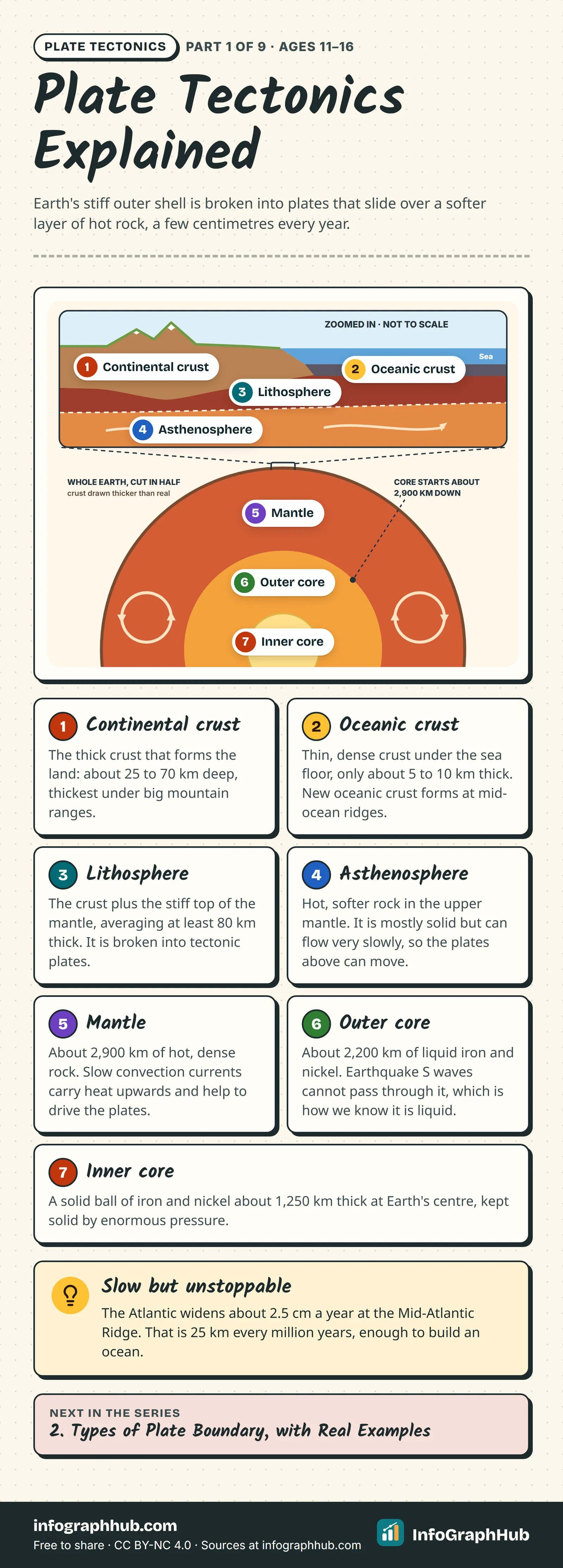
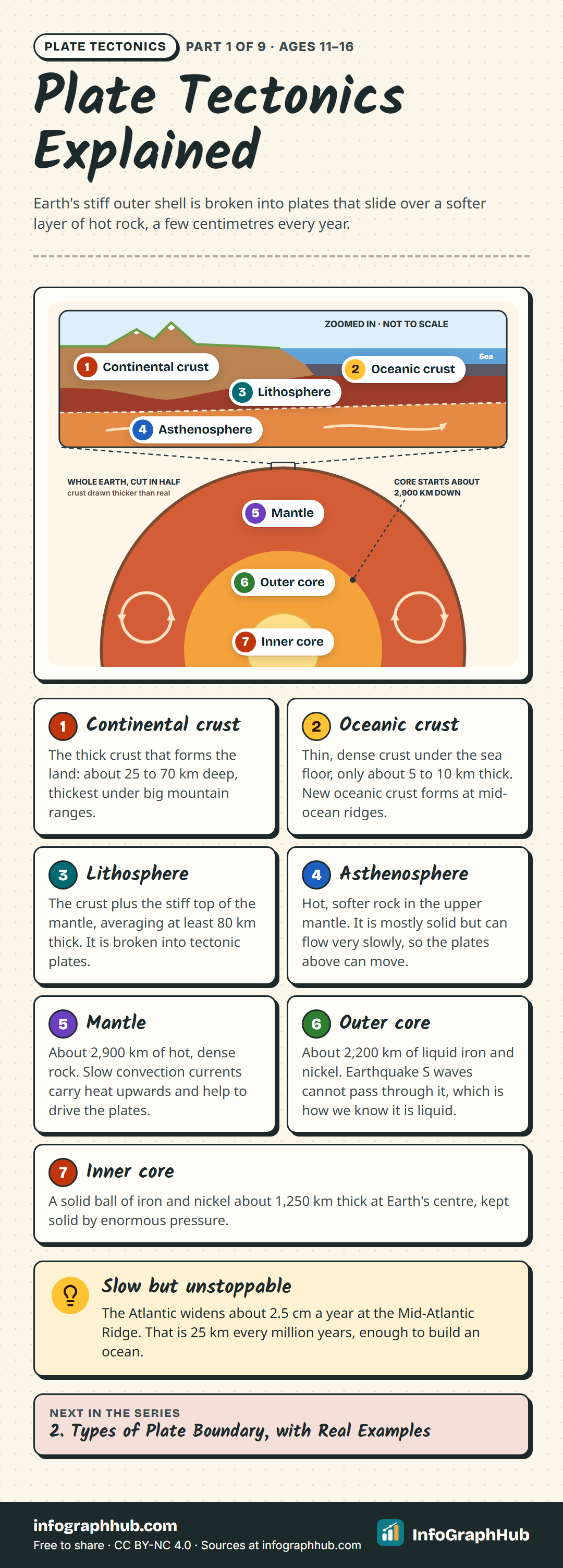
Earth's rigid outer shell, the lithosphere, is broken into about 15 major tectonic plates that ride on the softer asthenosphere and move a few centimetres a year. This guide labels every layer, from continental crust to the solid inner core.
Interactive
Explore it step by step
7 labelled parts: Continental crust → Oceanic crust → Lithosphere → Asthenosphere → Mantle → Outer core → Inner core. Press play, or choose a number to explore.
Step 1 of 7: Continental crust
The thick crust that forms the land: about 25 to 70 km deep, thickest under big mountain ranges.
Step 2 of 7: Oceanic crust
Thin, dense crust under the sea floor, only about 5 to 10 km thick. New oceanic crust forms at mid-ocean ridges.
Step 3 of 7: Lithosphere
The crust plus the stiff top of the mantle, averaging at least 80 km thick. It is broken into tectonic plates.
Step 4 of 7: Asthenosphere
Hot, softer rock in the upper mantle. It is mostly solid but can flow very slowly, so the plates above can move.
Step 5 of 7: Mantle
About 2,900 km of hot, dense rock. Slow convection currents carry heat upwards and help to drive the plates.
Step 6 of 7: Outer core
About 2,200 km of liquid iron and nickel. Earthquake S waves cannot pass through it, which is how we know it is liquid.
Step 7 of 7: Inner core
A solid ball of iron and nickel about 1,250 km thick at Earth's centre, kept solid by enormous pressure.
Use this infographic
Free under CC BY-NC 4.0, with credit to InfoGraphHub.
What plate tectonics is
Earth's surface is not one solid shell. It is cracked into huge slabs of rock called tectonic plates, which fit together like the pieces of a cracked eggshell. The British Geological Survey (BGS) counts about 15 major plates, plus many smaller ones. Some carry a continent, some lie under the ocean, and most carry both.
Plate tectonics is the theory that explains how these plates move and what happens where they meet. Their edges, called plate boundaries, are where most earthquakes, volcanoes, deep ocean trenches and young mountain ranges are found. The rest of this series looks at each of those in turn.
Earth's layers, from the outside in
To understand the plates, start with what lies beneath them. Earth has four main layers:
- Crust: the thin outer skin. Continental crust is about 25 to 70 km thick and forms the land; oceanic crust under the sea floor is only about 5 to 10 km thick, but its rock is denser.
- Mantle: a hot, dense layer of rock about 2,900 km thick. It is solid, yet over millions of years parts of it slowly flow.
- Outer core: about 2,200 km of liquid iron and nickel.
- Inner core: a ball about 1,250 km thick at the centre, made mostly of iron and nickel, which is solid despite temperatures of around 5,200 °C because of the enormous pressure.
In the diagram, the half-Earth is drawn with these thicknesses in proportion. At that scale the crust would be thinner than a pencil line, so the top panel zooms in on it.
Lithosphere and asthenosphere
Geologists also divide the outer layers by how the rock behaves, not just what it is made of.
The lithosphere is the crust plus the very top of the mantle, welded together into a stiff, brittle layer. The US Geological Survey (USGS) says it averages at least 80 km thick over much of the Earth. The lithosphere is the layer that is broken into plates.
Below it is the asthenosphere, a narrower zone of the mantle where hot rock is close to melting. It is still mostly solid, but it can soften and flow very slowly, rather like warm toffee. The rigid plates of lithosphere rest on this softer layer, which lets them move.
What makes the plates move?
Heat from deep inside Earth keeps the mantle slowly churning. Hot rock rises, spreads out, cools and sinks again in giant loops called convection currents. Scientists describe three forces that work together:
- Mantle convection drags on the base of the plates.
- Ridge push: at mid-ocean ridges, new hot plate sits high and slides away downhill.
- Slab pull: where an old, cold, dense plate sinks into the mantle at an ocean trench, it pulls the rest of the plate after it. The BGS describes slab pull as the main driving force.
How fast do plates move?
Plates move at about 2 to 15 cm a year, according to National Geographic. That sounds tiny, but it adds up. The Atlantic Ocean is widening at about 2.5 cm a year along the Mid-Atlantic Ridge. Over one million years that is:
2.5 cm × 1,000,000 = 2,500,000 cm = 25 km.
Over the 100 to 200 million years since the Atlantic began to open, this slow spreading has built an entire ocean.
How do we know what is inside Earth?
Nobody has drilled through the crust, so scientists use earthquakes as a giant X-ray. Seismic waves change speed and direction as they pass through different materials. One kind, the S wave, cannot travel through liquid. S waves never get through the outer core, which is how we know it is liquid. The geologist R. D. Oldham first identified Earth's core from earthquake records in 1906.
Frequently asked questions
What is the difference between the crust and the lithosphere?
The crust is the outermost rock layer. The lithosphere is the crust plus the stiff top part of the mantle beneath it. Tectonic plates are pieces of lithosphere, not just crust.
How many tectonic plates are there?
The British Geological Survey counts about 15 major plates, plus many smaller ones. Different maps give slightly different totals depending on how small a piece they count as a plate.
Is the mantle liquid?
No. The mantle is mostly solid rock, but it is so hot that over millions of years it can flow very slowly. The only liquid layer inside Earth is the outer core.
Why is the inner core solid if it is so hot?
The pressure at Earth's centre, millions of times the air pressure at the surface, squeezes the iron and nickel into a solid, even though the inner core is thought to be about 5,200 °C.

Sources & methodology
Every fact is checked against the sources below. We write original explanations and draw original graphics; no figures are copied from textbooks. Spotted an error? See our corrections policy.
- This Dynamic Earth: Inside the Earth (U.S. Geological Survey (USGS), accessed 1 Oct 2026)
- This Dynamic Earth: Understanding plate motions (U.S. Geological Survey (USGS), accessed 1 Oct 2026)
- What causes earthquakes? (British Geological Survey (BGS), accessed 1 Oct 2026)
- Plate Tectonics (National Geographic Education, accessed 1 Oct 2026)
- Core (National Geographic Education, accessed 1 Oct 2026)
- Cool Earthquake Facts (U.S. Geological Survey (USGS) Earthquake Hazards Program, accessed 1 Oct 2026)
Editorial review pending · Updated
Made by the InfoGraphHub editorial team (how we research and check: editorial and AI policy). First published 1 October 2026, last reviewed 1 October 2026. Found a mistake? Tell the editors.
For teachers: ages and curriculum fit
Ages 11–16 · Grades 6–10 (US) · Years 7–11 (UK) · Classes 6–10 (India)
NGSS is a registered trademark of WestEd. Names and codes are used only to describe curriculum fit; InfoGraphHub is not endorsed by these organisations.
Embed this on your site
Paste this HTML into your page. Keep the credit line: it is required by the CC BY-NC 4.0 license.
Related infographics


For teachers and parents: new InfoGraphHub resources by email
One short email when new free resources go live. For adults (18+) only. No spam, no tracking in emails, unsubscribe anytime.