Timeline of the Internet: From ARPANET to Today
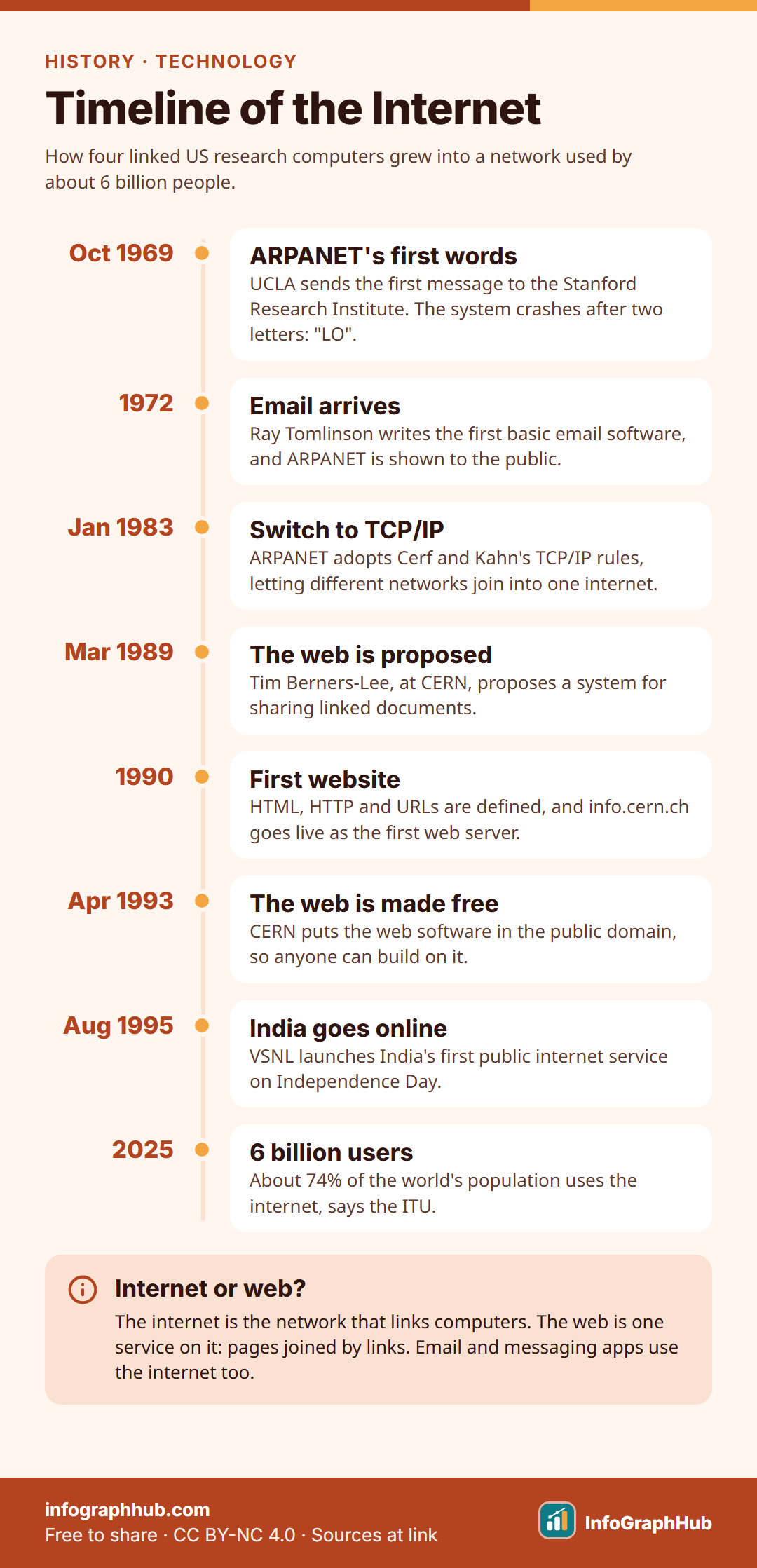
The internet grew from ARPANET, a US research network that sent its first message in 1969. TCP/IP in 1983, the World Wide Web from 1989 and public access, reaching India in 1995, led to about 6 billion users by 2025.

A research network, not a nuclear bunker
The internet's ancestor was ARPANET, a network funded by ARPA, a research agency of the US Department of Defense. Its purpose was to let scientists at different universities share computers and information. A popular story says it was built to survive a nuclear war, but the history written by internet pioneers for the Internet Society calls that a false rumour.
ARPANET used packet switching: a message is chopped into small packets that travel separately and are put back together at the other end. The internet still works this way today, whether you are streaming a cricket match or sending a photo.
The first words: "LO"
On 29 October 1969, a student programmer in Leonard Kleinrock's lab at UCLA tried to log in to a computer at the Stanford Research Institute (SRI) in California. He typed "L" and "O" and then the system crashed. So the first message ever sent over ARPANET was simply "LO". By the end of 1969, four host computers were connected.
In 1972, Ray Tomlinson at the company BBN wrote the first basic email software, and ARPANET was shown to the public for the first time at a conference that October.
One language for every network: TCP/IP
During the 1970s, many separate computer networks appeared, and they could not easily talk to one another. Vint Cerf and Bob Kahn designed a shared set of rules, TCP/IP, that lets any network connect to any other.
On 1 January 1983, every computer on ARPANET switched over to TCP/IP on a single day. That "network of networks" is what we now call the internet. In April 1995, the US government stopped funding the main NSFNET backbone, and commercial companies took over running the network.
The World Wide Web is born
The internet and the web are not the same thing. The internet is the network; the web is a way of publishing linked pages on top of it.
In March 1989, British scientist Tim Berners-Lee, working at CERN near Geneva, proposed a system for sharing information through linked documents. By Christmas 1990 he had defined its three building blocks, HTML, HTTP and URLs, and had the first web server and browser running at info.cern.ch. In August 1991 he announced the software to the wider internet, and on 30 April 1993 CERN put the web into the public domain so anyone could use it free of charge.
India comes online
On 15 August 1995, India's Independence Day, the government-owned VSNL (Videsh Sanchar Nigam Limited) launched the country's first internet service open to the public. It started in Delhi, Bombay, Calcutta, Madras and Pune, using slow dial-up connections over telephone lines. Getting online meant a screeching modem and a lot of patience.
The internet today
According to the International Telecommunication Union (ITU), about 6 billion people, roughly 74 per cent of the world's population, were using the internet in 2025. The gap is still large: around 94 per cent of people in high-income countries are online, compared with only 23 per cent in low-income countries.
Frequently asked questions
What was the internet called before it was called the internet?
Its direct ancestor was ARPANET, a research network funded by the US Department of Defense that sent its first message in October 1969. After ARPANET switched to TCP/IP in 1983, the connected networks became what we call the internet.
Who invented the internet?
No single person. Leonard Kleinrock's team sent the first ARPANET message, Vint Cerf and Bob Kahn designed TCP/IP, and Tim Berners-Lee invented the World Wide Web that runs on top of the internet.
Is the internet the same as the World Wide Web?
No. The internet is the global network that connects computers. The web is one service on it: pages linked by URLs and fetched with HTTP. Email and messaging apps also use the internet but are not part of the web.
When did public internet service start in India?
On 15 August 1995, when VSNL launched India's first public internet service, starting in Delhi, Bombay, Calcutta, Madras and Pune.
How many people use the internet today?
About 6 billion people, or roughly three in every four people on Earth, according to ITU estimates for 2025.
Sources & methodology
Every fact is checked against the sources below. We write original explanations and draw original graphics; no figures are copied from textbooks. Spotted an error? See our corrections policy.
- Brief History of the Internet (Internet Society, accessed 30 Sept 2026)
- Web History (Web at 30) (CERN, accessed 30 Sept 2026)
- How VSNL launched internet services in India in 1995 when even China hadn't (ThePrint (excerpt from 'Telecom Man' by B.K. Syngal), accessed 30 Sept 2026)
- Facts and Figures 2025: Internet use (International Telecommunication Union, accessed 30 Sept 2026)
Reviewed by Claude (pending owner check) · Updated
Embed this on your site
Paste this HTML into your page. Keep the credit line: it is required by the CC BY-NC 4.0 license.
Related infographics
 Tech
TechHow Large Language Models Work: From Prompt to Answer
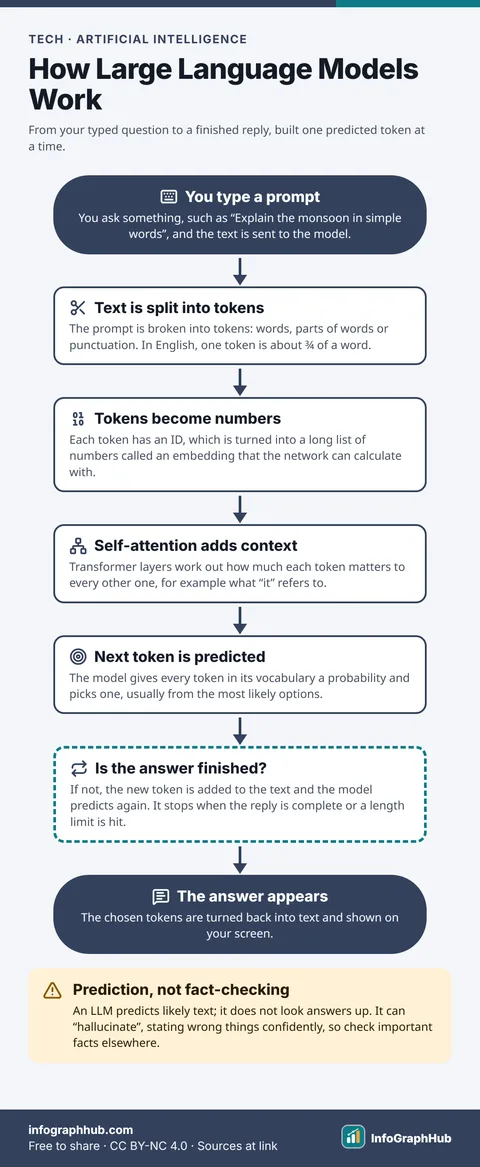
A large language model splits your prompt into tokens, turns them into numbers, uses self-attention to work out context, then predicts the most likely next token. It repeats that prediction, one token at a time, until the answer is complete.
 Tech
TechGit Commands Cheat Sheet: The Essentials for Beginners
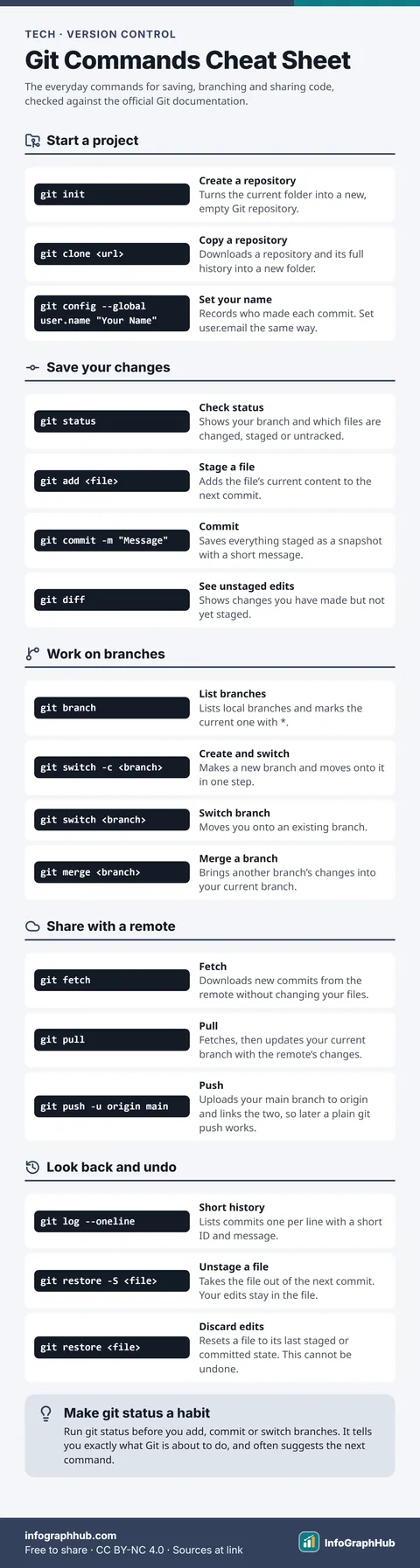
The Git commands beginners use most: set up a repository with init or clone, save work with add and commit, build features on branches with switch and merge, share work with fetch, pull and push, and undo safely with restore.
 Finance
Compound Interest Explained: How Money Grows Over Time
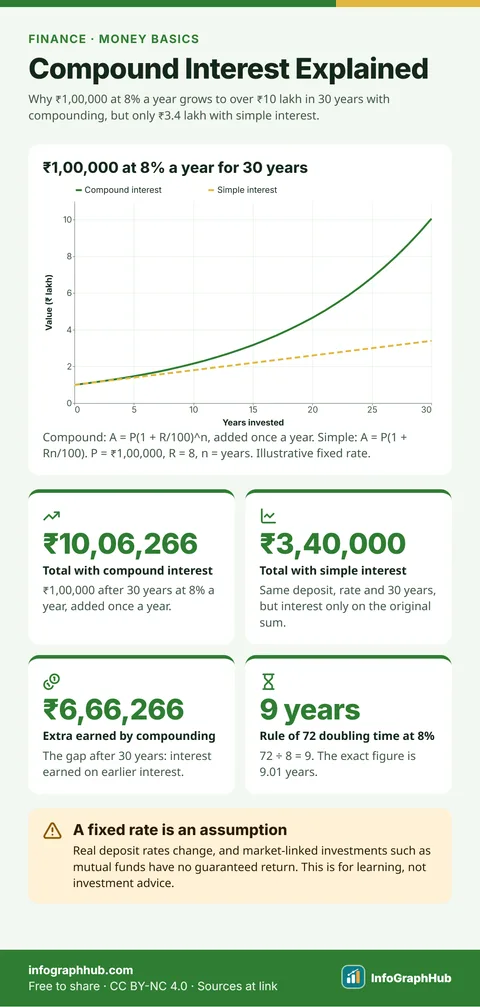
Compound interest is interest earned on your interest. Each year’s interest is added to the balance, so the next year’s interest is worked out on a bigger sum. Over long periods this makes money grow far faster than simple interest.
 Finance
How Credit Scores Work in India: What Moves Your Score
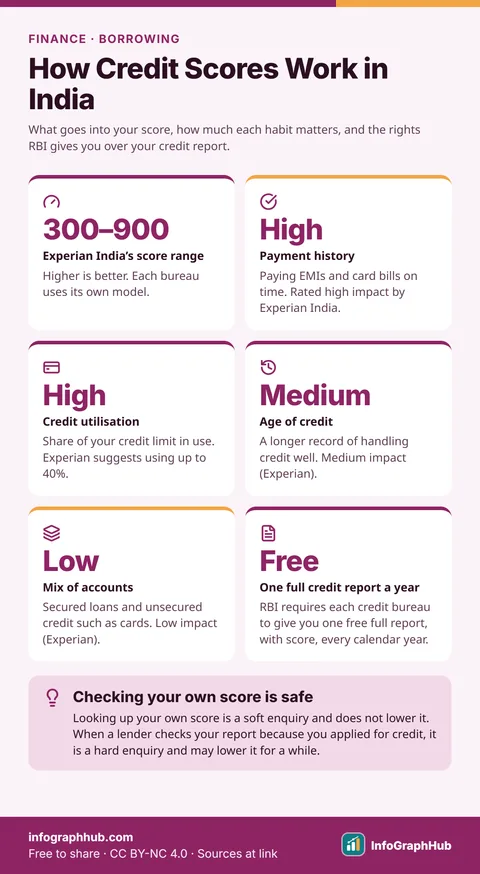
A credit score is a three-digit number, such as Experian India’s 300–900 score, built from your borrowing record. Paying on time and using little of your credit limit matter most; the age and mix of your accounts matter less.
 Science
How Photosynthesis Works: From Sunlight to Sugar
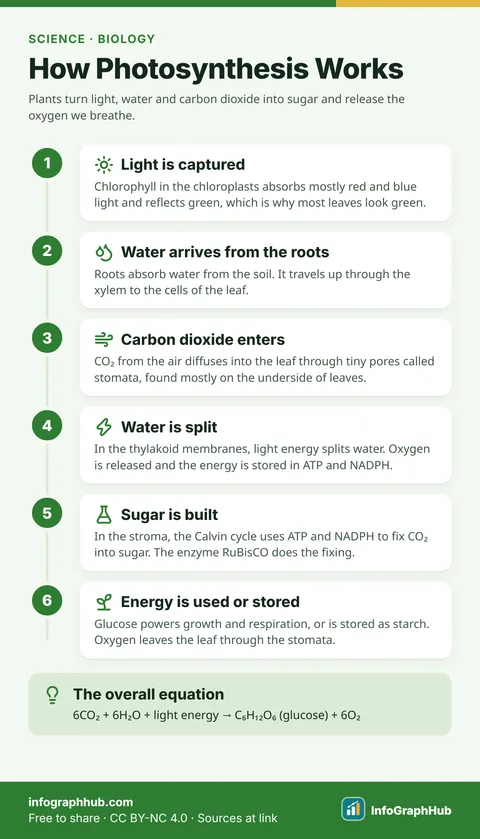
Photosynthesis is how plants use light energy to turn carbon dioxide and water into glucose, releasing oxygen as a by-product. It happens in chloroplasts in two linked stages: the light-dependent reactions and the Calvin cycle.
 Science
How Vaccines Work: Training Your Immune System
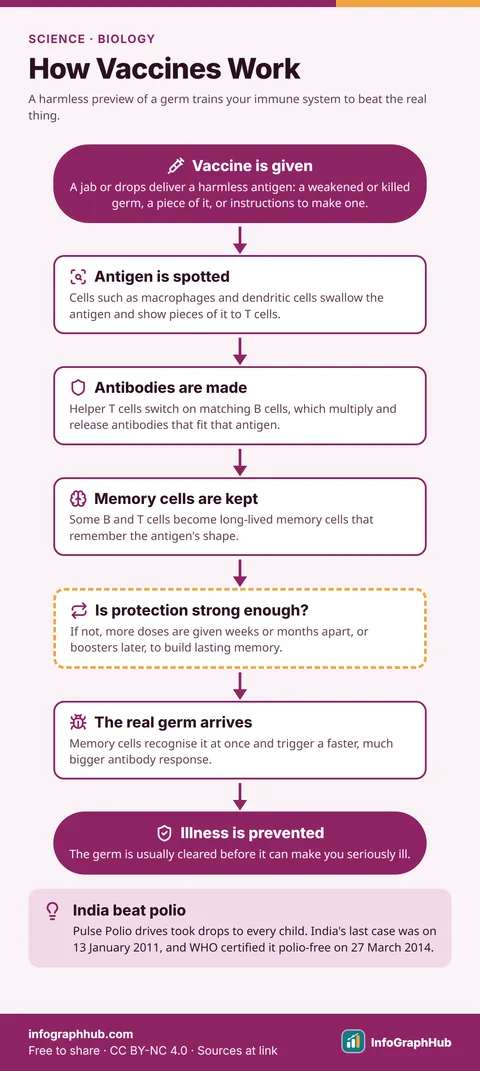
Vaccines work by imitating an infection. They show your immune system a harmless antigen from a germ, so it makes matching antibodies and memory cells that can fight the real germ quickly if it ever arrives.
Get new InfoGraphHub resources by email
One short email when new free resources go live. No spam, unsubscribe anytime.