9-part series · Ages 11–16
Plate Tectonics
Nine infographics on the moving plates beneath our feet, and the earthquakes and volcanoes they cause.
The 1 parts (8 more coming soon)
The complete guide
Plate Tectonics explained
The ground under your feet is moving, a few centimetres every year. This series explains plate tectonics one question at a time: what lies inside the Earth, what happens where plates meet, how an earthquake starts, what goes on inside a volcano, and how scientists worked it all out.
Each part is a printable infographic with sources, written for ages 11–16 and their teachers. It ends with practical, official advice on staying safe in an earthquake, eight myths put right and a quiz on the whole topic. Read the guide below for the full story, or jump straight to the part you need.
What is plate tectonics?
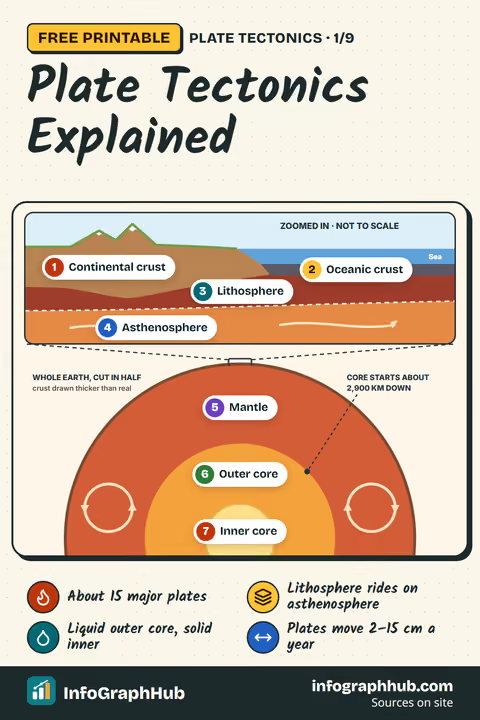
Plate tectonics is the theory that Earth's outer shell is broken into large, rigid slabs called tectonic plates, which move slowly over the hotter, softer rock beneath. The British Geological Survey counts about 15 major plates and many smaller ones. Most carry both continent and ocean floor.
To see why plates can move, look inside the Earth. It has four main layers:
- the crust, a thin skin of rock: about 25–70 km thick under the continents and only about 5–10 km under the oceans;
- the mantle, about 2,900 km of hot, dense rock that is solid but can flow extremely slowly;
- the outer core, about 2,200 km of liquid iron and nickel;
- the inner core, a solid ball about 1,250 km thick, kept solid by enormous pressure.
Geologists also group the outer layers by how they behave. The lithosphere is the crust plus the stiff uppermost mantle, averaging at least 80 km thick; it is the layer that is broken into plates. Beneath it, the asthenosphere is a zone of the mantle where rock is hot enough to soften and creep, so the plates above can slide.
Nobody has ever drilled through the crust, so how do we know any of this? Earthquakes act like a giant X-ray. Seismic waves bend and change speed as they pass through different materials, and one kind, the S wave, cannot travel through liquid. Because S waves never cross the outer core, scientists know it is liquid. The geologist R. D. Oldham first identified Earth's core from earthquake records in 1906.
What makes the plates move?
The energy comes from Earth's internal heat. In the mantle, hot rock slowly rises, spreads and sinks again in giant loops called convection currents. Scientists recognise three forces working together:
- Mantle convection, which drags on the underside of the plates;
- ridge push, as young, hot plate slides away from the raised mid-ocean ridges;
- slab pull, as old, cold, dense plate sinks into the mantle at an ocean trench and drags the rest of the plate after it. The BGS describes slab pull as the main driving force.
Plates move about 2 to 15 cm a year. That is slow, but it adds up. The Mid-Atlantic Ridge opens about 2.5 cm a year:
2.5 cm × 1,000,000 years = 2,500,000 cm = 25 km per million years.
Over 100–200 million years, that steady spreading has created the whole Atlantic Ocean.
Plate boundaries: where the action is
Most earthquakes, volcanoes, ocean trenches and young mountain ranges are found at plate boundaries. There are three main types, which some courses call constructive, destructive and conservative:
- Divergent (constructive): plates move apart and magma rises to form new crust. Most are mid-ocean ridges, such as the Mid-Atlantic Ridge, with Iceland sitting on top. On land, a divergent boundary forms a rift valley, like the East African Rift.
- Convergent (destructive): plates move together. Where an oceanic plate is involved, it sinks beneath the other plate in a process called subduction, making a deep trench. Off South America the Nazca Plate sinks under the continent, feeding the volcanoes of the Andes. Where two oceanic plates meet, a trench and an arc of volcanic islands form, as at the Mariana Trench, nearly 11,000 m deep.
- Continental collision: when two continents meet, neither sinks, so the crust crumples upwards. India began colliding with Asia about 50 million years ago, raising the Himalayas.
- Transform (conservative): plates slide past each other and crust is neither made nor destroyed. The San Andreas Fault in California is the best-known example.
The type of boundary decides what a place experiences. Divergent boundaries have frequent small earthquakes, transform faults can produce large, shallow ones, and convergent boundaries produce most of the world's earthquakes above magnitude 6, as well as chains of explosive volcanoes.
How an earthquake happens
Plate boundaries are made of many faults, cracks where blocks of rock move past each other. The plates keep moving, but the rough fault surfaces stick together, so the rock on each side bends and stores energy. When the stress finally overcomes the friction, the fault slips suddenly and the energy is released as seismic waves.
The point underground where the slip starts is the hypocentre or focus; the point on the surface above it is the epicentre. Three kinds of wave spread out:
- P waves, the fastest (about 5–7 km/s in the crust), which push and pull the rock and can pass through liquids;
- S waves (about 3–4 km/s), which shake the rock sideways and cannot cross liquids;
- surface waves, the slowest, which usually cause the most damage.
The time gap between the P and S waves at three seismometers lets scientists pinpoint the epicentre. The size of an earthquake is now given on the moment magnitude scale. Each step of one whole number means waves about 10 times larger and roughly 32 times more energy.
Magnitude is not the same as shaking. One earthquake has one magnitude, but the intensity of shaking varies from place to place: it is usually strongest near the epicentre, and soft, wet ground shakes far more than solid bedrock. Most earthquakes start less than 80 km down, though at subduction zones they can begin hundreds of kilometres deep. After a large earthquake, smaller aftershocks continue for weeks, months or even years.
Volcanoes and how they work
A volcano is an opening where molten rock, gas and rock fragments reach the surface. Underground the molten rock is called magma; once erupted it is lava. Magma rises because it is less dense than the rock around it and because its dissolved gas expands as the pressure drops.
In a stratovolcano, such as Mount Fuji in Japan or Cotopaxi in Ecuador, magma collects in a magma chamber in the crust and rises through a pipe called the conduit to the vent in the summit crater. Lava may also escape through side vents. The steep cone is built from alternating layers of lava and of ash and cinders from explosive eruptions.
The type of magma decides the eruption. Runny lava lets gas escape and builds gently sloping shield volcanoes, like Mauna Loa in Hawaii. Sticky, gas-rich magma erupts explosively, throwing out ash clouds and sometimes pyroclastic flows, avalanches of hot gas and rock that can travel at up to about 160 km/h.
Most volcanoes on land grow above subduction zones, where melting above the sinking plate supplies magma. Others erupt along the mid-ocean ridges, mostly unseen under the sea. A few, like those of Hawaii, sit over a hotspot, an exceptionally hot region of the mantle far from any plate boundary. As the Pacific Plate moves over the hotspot, a chain of volcanic islands forms, oldest at one end and youngest at the other.
Where and how often
Earthquakes are far more common than most people think. The US Geological Survey (USGS) estimates about 500,000 detectable earthquakes a year, of which about 100,000 can be felt and about 100 cause damage. On average there are about 16 major earthquakes (magnitude 7 or more) each year.
They are concentrated in belts. About 90 per cent of all earthquakes, and about 81 per cent of the largest, happen around the Pacific in the Ring of Fire, where oceanic plates are being subducted. The largest earthquake ever recorded struck Chile on 22 May 1960, at magnitude 9.5.
The USGS counts about 1,350 potentially active volcanoes on land, many of them around the Ring of Fire, plus long belts of volcanoes hidden along the mid-ocean ridges.
The second most active belt, the Alpide belt, runs from Java and Sumatra through the Himalayas and the Mediterranean. It accounts for about 17 per cent of the largest earthquakes, including the magnitude 9.1 Indian Ocean earthquake of 2004, whose tsunami killed more than 230,000 people.
From continental drift to plate tectonics
In 1912, the German meteorologist Alfred Wegener proposed continental drift: the idea that the continents were once joined and had drifted apart. His evidence included the fit of the coastlines, matching fossils such as Mesosaurus and Glossopteris on continents now separated by oceans, rock types and mountain ranges that line up, and traces of ancient glaciers in hot regions. But he could not explain what force could move continents, and most geologists rejected the idea.
The answer came from the ocean floor. Arthur Holmes proposed that mantle convection could carry continents. In the 1950s, surveys found a global system of mid-ocean ridges and magnetic stripes in the sea floor. In 1962 Harry Hess proposed seafloor spreading; in 1963 Fred Vine and Drummond Matthews showed the magnetic stripes were mirror images on either side of the ridges; in 1965 J. Tuzo Wilson described transform faults. In 1968, rock drilled from the Atlantic floor proved to be youngest at the ridge and older further away. Together these discoveries became plate tectonics, a theory that solidified in the 1960s and transformed the earth sciences.
Living with earthquakes
No one can predict exactly when an earthquake will strike, so preparation matters. Rescue teams and emergency agencies agree on one action when the shaking starts: Drop, Cover and Hold On. Drop to your hands and knees, cover your head and neck (under a sturdy table if there is one) and hold on until the shaking stops. Most injuries are caused by falling objects and by people falling as they try to move, so do not run outside and do not shelter in a doorway.
Near the coast, a strong earthquake, the sea suddenly draining away or a roar from the ocean can mean a tsunami is coming: go to high ground or inland at once. Before an earthquake, secure heavy furniture, agree a family plan and prepare a kit with water, food, a torch, a whistle and first-aid supplies. Always follow the advice of your local emergency services.
Common misconceptions
Many popular beliefs about earthquakes are wrong. California will not fall into the sea: the land west of the San Andreas Fault is sliding sideways, not sinking. No reliable link has been found between earthquakes and animal behaviour or the weather. Faults do not open up and swallow people. Most earthquakes and volcanoes are at plate boundaries, but not all: earthquakes also happen inside plates, and Hawaii's volcanoes sit over a hotspot in the middle of the Pacific Plate.
Test yourself
When you have worked through the series, try the ten-question quiz. It covers every part, from Earth's layers to tsunami warning signs, and each answer comes with a worked explanation.
Frequently asked questions
What is plate tectonics in simple terms?
Earth's rigid outer shell is broken into large pieces called plates. They move slowly, a few centimetres a year, over hotter, softer rock in the mantle. Where plates meet, they cause earthquakes and volcanoes and build mountains.
What causes tectonic plates to move?
Heat from inside the Earth drives slow convection currents in the mantle. The plates are moved by this convection, by ridge push at mid-ocean ridges and, most of all, by slab pull, as old, dense plate sinks into the mantle at ocean trenches.
What are the three types of plate boundary?
Divergent boundaries, where plates move apart; convergent boundaries, where they move together; and transform boundaries, where they slide past each other. They are also called constructive, destructive and conservative.
Why do earthquakes and volcanoes happen in the same places?
Both are caused by plate movement, so both cluster along plate boundaries. Around the Pacific's Ring of Fire, oceanic plates sink beneath other plates, causing frequent earthquakes and feeding chains of volcanoes.
Who discovered plate tectonics?
No single person. Alfred Wegener proposed continental drift in 1912; Arthur Holmes suggested mantle convection; Harry Hess proposed seafloor spreading in 1962; Vine and Matthews found the magnetic evidence in 1963; and J. Tuzo Wilson described transform faults in 1965.
Sources & methodology
Every fact is checked against the sources below. We write original explanations and draw original graphics; no figures are copied from textbooks. Spotted an error? See our corrections policy.
- This Dynamic Earth: The Story of Plate Tectonics (U.S. Geological Survey (USGS), accessed 1 Oct 2026)
- What causes earthquakes? (British Geological Survey (BGS), accessed 1 Oct 2026)
- The Science of Earthquakes (U.S. Geological Survey (USGS) Earthquake Hazards Program, accessed 1 Oct 2026)
- About Volcanoes (U.S. Geological Survey (USGS) Volcano Hazards Program, accessed 1 Oct 2026)
- Cool Earthquake Facts (U.S. Geological Survey (USGS) Earthquake Hazards Program, accessed 1 Oct 2026)
- Plate Tectonics (National Geographic Education, accessed 1 Oct 2026)
- How to protect yourself during an earthquake (Earthquake Country Alliance, accessed 1 Oct 2026)
Editorial review pending · Updated
For teachers and parents: new InfoGraphHub resources by email
One short email when new free resources go live. For adults (18+) only. No spam, no tracking in emails, unsubscribe anytime.