History & GeographyMyths and factsPart 8 of 9, Plate TectonicsUpdated 1 October 2026
Earthquake and Volcano Myths and the Real Science
Eight popular myths about earthquakes and volcanoes, corrected with evidence from the USGS and BGS: California will not fall into the sea, animals cannot predict quakes, there is no earthquake weather, and big quakes are not only found at plate boundaries.
Use this infographic
Free under CC BY-NC 4.0, with credit to InfoGraphHub.
Why earthquake myths spread
Earthquakes are sudden, frightening and hard to understand, so it is natural to look for patterns and warnings. Films add dramatic scenes of the ground opening up, and stories about strange weather or restless pets get passed on after every big earthquake. The US Geological Survey (USGS) has a whole page answering these questions, and the myths on this infographic are among the most common.
California will not fall into the sea
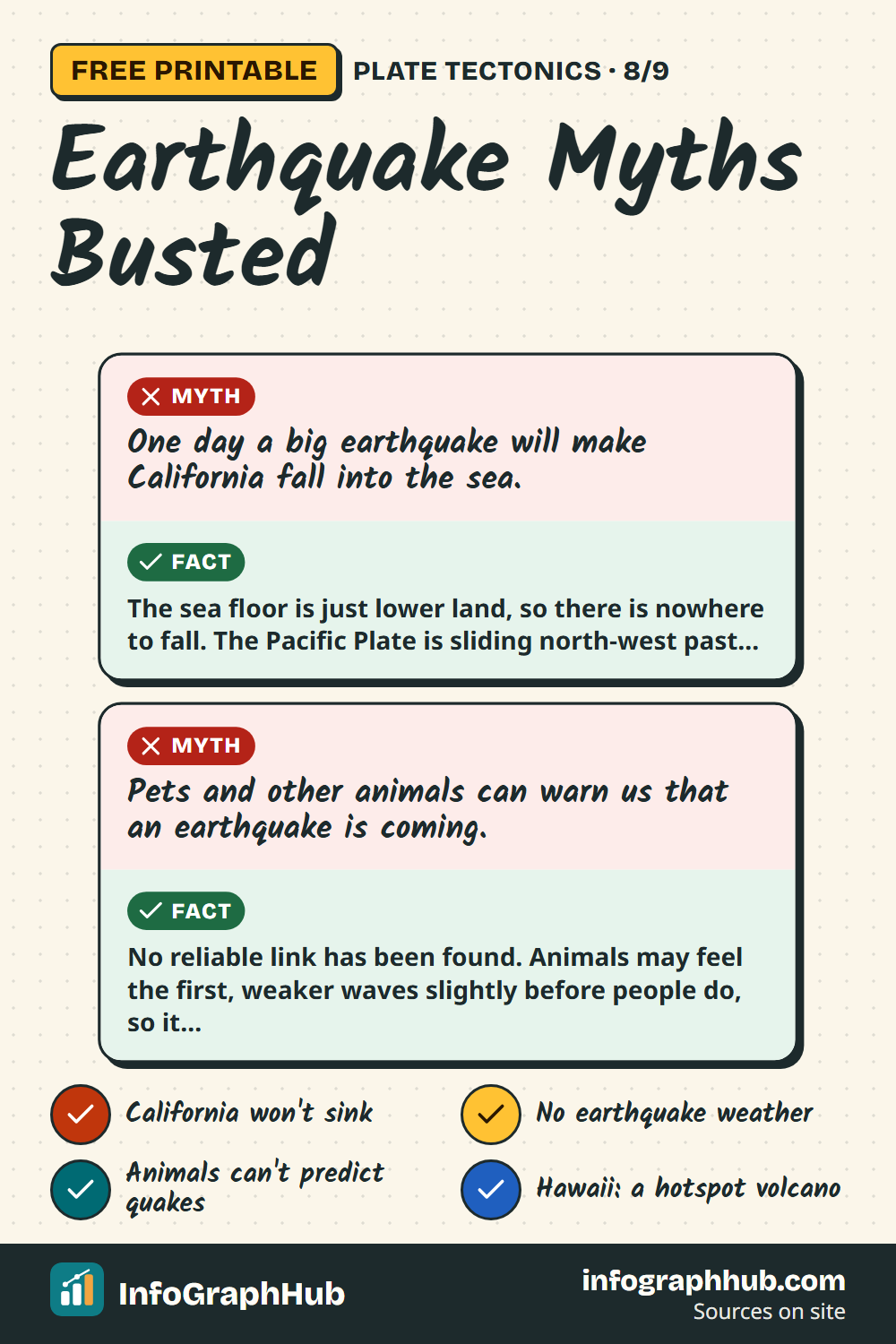
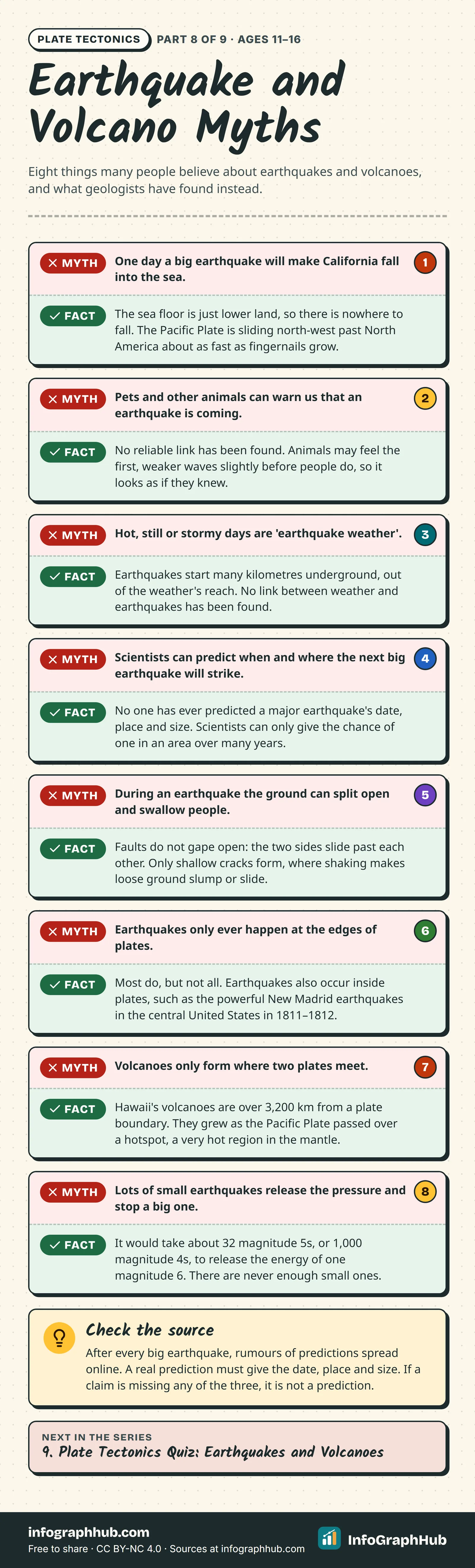
The ocean is not a hole for land to fall into: the sea floor is simply land at a lower level, covered by water. California sits across two plates. West of the San Andreas Fault is the Pacific Plate; east of it is the North American Plate. They are sliding sideways past each other at about 46 mm a year, about as fast as your fingernails grow.
So the land west of the fault is moving north-west, not sinking. The USGS calculates that, at this rate, Los Angeles and San Francisco will be next to each other in about 15 million years.
No one can predict earthquakes, not even animals
The USGS says that neither it nor any other scientists have ever predicted a major earthquake. A real prediction must give the date and time, the place and the size. Scientists can only work out the probability that an earthquake will happen in an area over a number of years, which helps decide where to build stronger buildings.
Animals do sometimes behave strangely before earthquakes, but no reliable link between a particular behaviour and a coming earthquake has been found. Animals often feel the first, weaker waves of an earthquake slightly before people do, which makes it look as if they knew in advance. With millions of pets in a shaken area, a few will be acting oddly by chance anyway.
There is no 'earthquake weather'
Earthquakes begin many kilometres underground, far below anything the weather can affect, and no link with weather has been found. People tend to remember the earthquakes that fit their idea and forget the ones that do not. Every region seems to have its own story of earthquake weather, and it usually matches whatever the weather was during its most memorable earthquake.
Faults do not swallow people
In films, the ground splits open and swallows a car or a person. Real faults do not gape open: the two sides slide past each other, and friction between them is what makes the earthquake in the first place. Shallow cracks can appear when shaking causes landslides or makes loose ground slump, but a fault does not open into a chasm.
Plate boundaries are not the whole story
Most earthquakes and volcanoes really are found at plate boundaries, but not all. The British Geological Survey notes that earthquakes do happen in the middle of plates, although they are not usually large. Some exceptions are serious: very powerful earthquakes struck the New Madrid area of the central United States in 1811 and 1812, far from any plate edge.
Volcanoes break the rule too. The Hawaiian Islands are more than 3,200 km from the nearest plate boundary. They formed as the Pacific Plate moved over a hotspot, a long-lasting, exceptionally hot region in the mantle.
Small earthquakes do not use up big ones
It sounds hopeful that lots of small earthquakes might let off pressure and prevent a big one. The numbers say otherwise. It would take about 32 magnitude 5 earthquakes, 1,000 magnitude 4s or 32,000 magnitude 3s to release the same energy as one magnitude 6, and there are never enough small ones to do that.
Frequently asked questions
Will California fall into the ocean?
No. California spans the Pacific and North American Plates, which slide sideways past each other along the San Andreas Fault. The land is moving north-west, not sinking.
Can animals sense earthquakes before they happen?
No reliable link has been found. Animals may feel the first, weaker waves slightly before people do, which can make it look as if they knew the earthquake was coming.
Is there such a thing as earthquake weather?
No. Earthquakes start many kilometres underground, and scientists have found no link between earthquakes and the weather.
Do earthquakes only happen at plate boundaries?
Most do, but not all. Earthquakes also happen inside plates, usually smaller ones, and occasionally powerful ones, such as the New Madrid earthquakes in the central United States in 1811–1812.
Sources & methodology
Every fact is checked against the sources below. We write original explanations and draw original graphics; no figures are copied from textbooks. Spotted an error? See our corrections policy.
- Earthquake Facts & Earthquake Fantasy (U.S. Geological Survey (USGS) Earthquake Hazards Program, accessed 1 Oct 2026)
- Will California eventually fall into the ocean? (U.S. Geological Survey (USGS), accessed 1 Oct 2026)
- Can you predict earthquakes? (U.S. Geological Survey (USGS), accessed 1 Oct 2026)
- What causes earthquakes? (British Geological Survey (BGS), accessed 1 Oct 2026)
- This Dynamic Earth: Hotspots (U.S. Geological Survey (USGS), accessed 1 Oct 2026)
Editorial review pending · Updated
Made by the InfoGraphHub editorial team (how we research and check: editorial and AI policy). First published 1 October 2026, last reviewed 1 October 2026. Found a mistake? Tell the editors.
For teachers: ages and curriculum fit
Ages 11–16 · Grades 6–10 (US) · Years 7–11 (UK) · Classes 6–10 (India)
NGSS is a registered trademark of WestEd. Names and codes are used only to describe curriculum fit; InfoGraphHub is not endorsed by these organisations.
Embed this on your site
Paste this HTML into your page. Keep the credit line: it is required by the CC BY-NC 4.0 license.
Related infographics


For teachers and parents: new InfoGraphHub resources by email
One short email when new free resources go live. For adults (18+) only. No spam, no tracking in emails, unsubscribe anytime.