History & GeographyLabelled diagramPart 4 of 9, Plate TectonicsUpdated 1 October 2026
Inside a Volcano: The Parts of a Stratovolcano
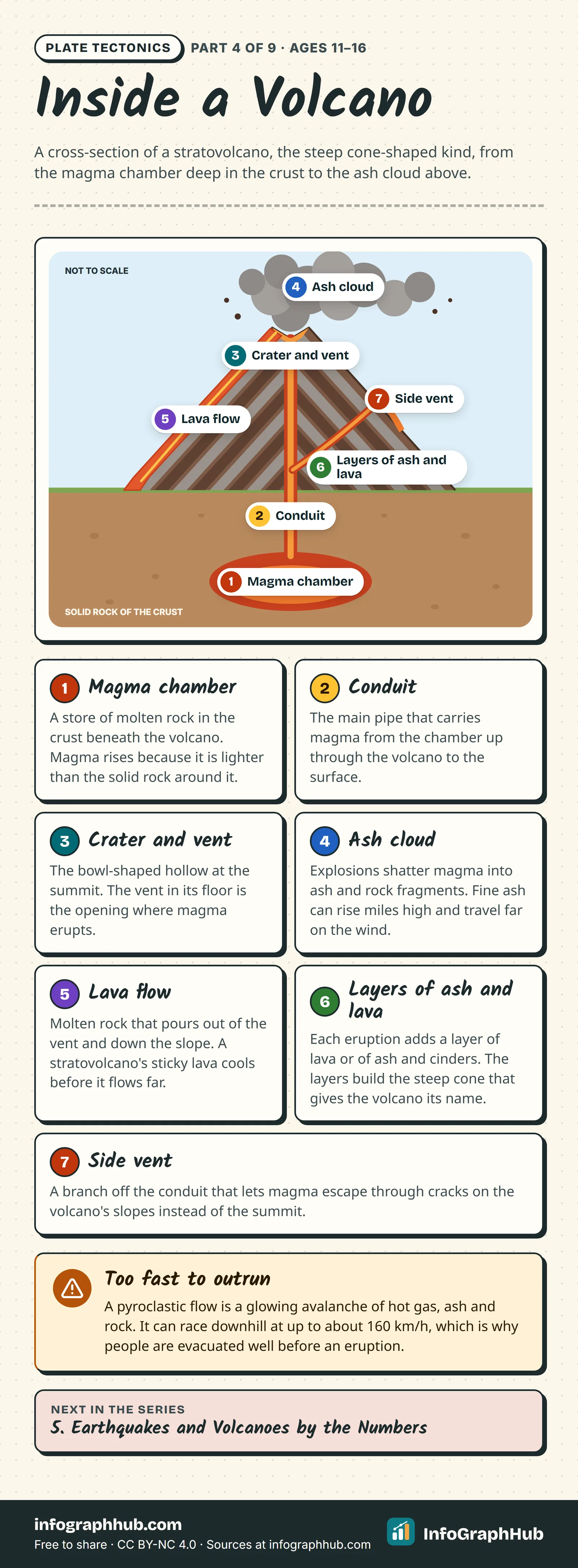
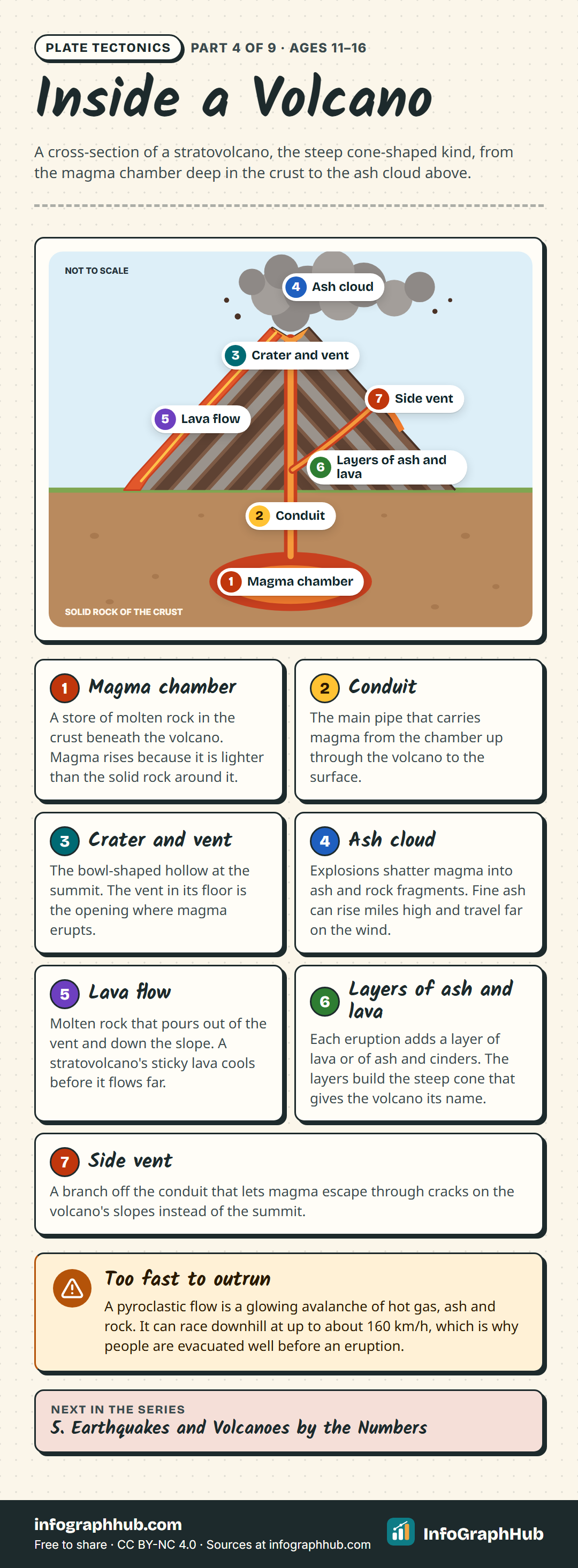
A labelled cross-section of a stratovolcano: the magma chamber, the conduit, the crater and vent, the ash cloud, lava flows, a side vent and the layers of ash and lava that build the cone, plus how it differs from shield volcanoes.
Interactive
Explore it step by step
7 labelled parts: Magma chamber → Conduit → Crater and vent → Ash cloud → Lava flow → Layers of ash and lava → Side vent. Press play, or choose a number to explore.
Step 1 of 7: Magma chamber
A store of molten rock in the crust beneath the volcano. Magma rises because it is lighter than the solid rock around it.
Step 2 of 7: Conduit
The main pipe that carries magma from the chamber up through the volcano to the surface.
Step 3 of 7: Crater and vent
The bowl-shaped hollow at the summit. The vent in its floor is the opening where magma erupts.
Step 4 of 7: Ash cloud
Explosions shatter magma into ash and rock fragments. Fine ash can rise miles high and travel far on the wind.
Step 5 of 7: Lava flow
Molten rock that pours out of the vent and down the slope. A stratovolcano's sticky lava cools before it flows far.
Step 6 of 7: Layers of ash and lava
Each eruption adds a layer of lava or of ash and cinders. The layers build the steep cone that gives the volcano its name.
Step 7 of 7: Side vent
A branch off the conduit that lets magma escape through cracks on the volcano's slopes instead of the summit.
Use this infographic
Free under CC BY-NC 4.0, with credit to InfoGraphHub.
What a volcano is
A volcano is an opening in Earth's surface where molten rock, rock fragments and gases escape. Over many eruptions the erupted material piles up around the opening and builds a hill or mountain. Underneath, cracks and channels connect the opening to a store of molten rock, which is why a volcano can erupt again and again from the same place.
Molten rock is called magma while it is underground and lava once it reaches the surface.
Why magma rises
Magma forms many tens of kilometres below the surface. It is a mixture of molten rock, crystals and dissolved gas. Two things push it upwards:
- Buoyancy: magma is less dense than the solid rock around it, so it rises, a bit like a blob in a lava lamp.
- Gas pressure: as magma rises and the pressure on it falls, its dissolved gas forms bubbles that expand, like the fizz when you open a shaken bottle of fizzy drink.
Magma often collects in a magma chamber in the crust. If it forces its way up through weak rock and reaches the surface, an eruption begins.
Inside a stratovolcano
The volcano on this infographic is a stratovolcano, also called a composite volcano. These are the tall, steep, cone-shaped mountains most people picture, such as Mount Fuji in Japan and Cotopaxi in Ecuador. The tallest on Earth is Ojos del Salado in Chile, about 6,890 m above sea level.
The key feature, according to the US Geological Survey, is a conduit system: a pipe that carries magma from a reservoir deep in the crust up to the surface. At the top is a crater holding the main vent. Lava can also escape through cracks in the crater wall or from side vents on the slopes.
The cone itself is built from alternating layers of lava flows and of ash, cinders, blocks and volcanic bombs thrown out in explosions. Each eruption adds new layers, so the mountain grows taller and wider over time. Its sides are steep, often about 30 to 35 degrees.
Other volcano shapes
- Shield volcanoes are built almost entirely of runny lava that spreads a long way before it cools, so their slopes are gentle, usually under 10 degrees. The Hawaiian Islands are a chain of shield volcanoes, including Mauna Loa, the world's largest active volcano.
- Cinder cones are the simplest kind: small, steep piles of bubbly lava fragments that fall around a single vent. They are rarely more than about 300 m high.
Gentle or explosive?
How a volcano erupts depends mostly on its magma. Thin, runny lava lets gas escape easily, so shield volcanoes usually pour out lava flows. Stratovolcanoes erupt stickier, more viscous lava that traps gas until it bursts out explosively.
An explosive eruption blasts out tephra: rock fragments of every size. Ash, the finest tephra, can be carried miles into the sky and around the world by high winds. The most dangerous hazard is a pyroclastic flow, a glowing avalanche of hot gas, ash and rock that can race downhill at up to about 160 km/h (100 mph).
Where volcanoes are found
Many volcanoes on land grow above subduction zones, such as those around the Pacific's Ring of Fire, where melting above a sinking plate feeds chains of stratovolcanoes. Long belts of volcanoes also line the mid-ocean ridges, hidden under the sea. A few, such as those of Hawaii, sit over hotspots far from any plate boundary.
Frequently asked questions
What is the difference between magma and lava?
They are the same molten rock. It is called magma while it is underground and lava once it has erupted onto the surface.
What is a magma chamber?
It is a store of molten or partly molten rock in the crust beneath a volcano. Magma from the chamber rises through the conduit to the vent during an eruption.
Why are stratovolcanoes so steep?
Their sticky lava does not flow far before it cools, and explosive eruptions pile ash and rock fragments around the vent. Layer upon layer builds a steep cone, often 30 to 35 degrees.
What is a pyroclastic flow?
A fast-moving avalanche of hot gas, ash and rock that pours down the side of a volcano during an explosive eruption. It can travel at up to about 160 km/h, far faster than people can run.

Sources & methodology
Every fact is checked against the sources below. We write original explanations and draw original graphics; no figures are copied from textbooks. Spotted an error? See our corrections policy.
- About Volcanoes (U.S. Geological Survey (USGS) Volcano Hazards Program, accessed 1 Oct 2026)
- Volcanoes: Principal types of volcanoes (U.S. Geological Survey (USGS), accessed 1 Oct 2026)
- Volcanoes: Types of volcanic eruptions (U.S. Geological Survey (USGS), accessed 1 Oct 2026)
- How volcanoes form (British Geological Survey (BGS), accessed 1 Oct 2026)
- This Dynamic Earth: Hotspots (U.S. Geological Survey (USGS), accessed 1 Oct 2026)
Editorial review pending · Updated
Made by the InfoGraphHub editorial team (how we research and check: editorial and AI policy). First published 1 October 2026, last reviewed 1 October 2026. Found a mistake? Tell the editors.
For teachers: ages and curriculum fit
Ages 11–16 · Grades 6–10 (US) · Years 7–11 (UK) · Classes 6–10 (India)
NGSS is a registered trademark of WestEd. Names and codes are used only to describe curriculum fit; InfoGraphHub is not endorsed by these organisations.
Embed this on your site
Paste this HTML into your page. Keep the credit line: it is required by the CC BY-NC 4.0 license.
Related infographics


For teachers and parents: new InfoGraphHub resources by email
One short email when new free resources go live. For adults (18+) only. No spam, no tracking in emails, unsubscribe anytime.