History & GeographyProcessPart 3 of 9, Plate TectonicsUpdated 1 October 2026
How an Earthquake Happens, Step by Step
Stress builds up on a locked fault until the rock suddenly slips. The rupture starts at the hypocentre, seismic waves race outwards, and scientists use seismometers and the moment magnitude scale to locate and measure the earthquake.
Interactive
Explore it step by step
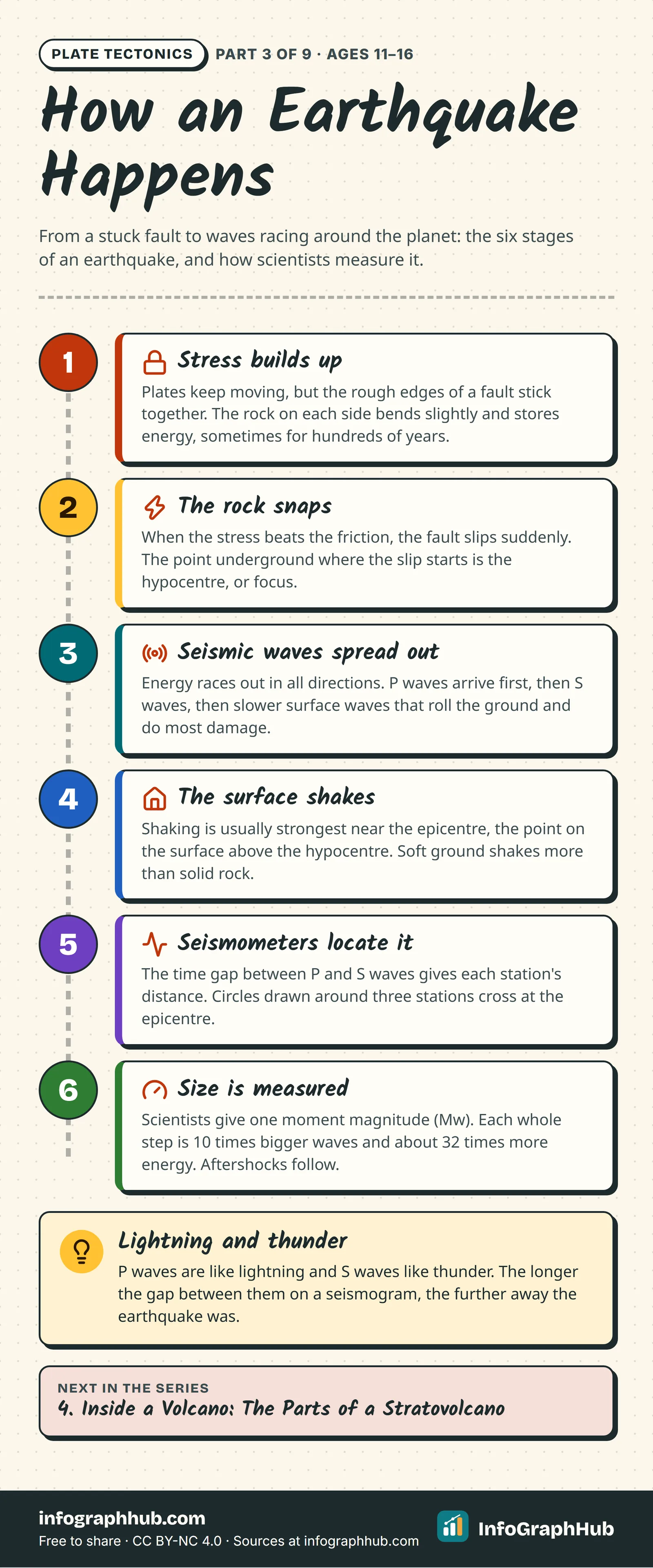
6 steps: Stress builds up → The rock snaps → Seismic waves spread out → The surface shakes → Seismometers locate it → Size is measured. Press play, or choose a number to explore.
Step 1 of 6: Stress builds up
Plates keep moving, but the rough edges of a fault stick together. The rock on each side bends slightly and stores energy, sometimes for hundreds of years.
Step 2 of 6: The rock snaps
When the stress beats the friction, the fault slips suddenly. The point underground where the slip starts is the hypocentre, or focus.
Step 3 of 6: Seismic waves spread out
Energy races out in all directions. P waves arrive first, then S waves, then slower surface waves that roll the ground and do most damage.
Step 4 of 6: The surface shakes
Shaking is usually strongest near the epicentre, the point on the surface above the hypocentre. Soft ground shakes more than solid rock.
Step 5 of 6: Seismometers locate it
The time gap between P and S waves gives each station's distance. Circles drawn around three stations cross at the epicentre.
Step 6 of 6: Size is measured
Scientists give one moment magnitude (Mw). Each whole step is 10 times bigger waves and about 32 times more energy. Aftershocks follow.
Use this infographic
Free under CC BY-NC 4.0, with credit to InfoGraphHub.
Stuck faults and stored energy
An earthquake is the shaking caused when two blocks of rock suddenly slip past each other. The crack they slip along is called a fault. Plate boundaries are made up of many faults, which is why most earthquakes happen there.
The plates themselves keep moving slowly and steadily, but the rough edges of a fault stick together. While the fault is stuck, the rock on either side bends a little and stores energy, like a ruler being bent or a spring being squeezed. When the stress finally becomes greater than the friction holding the fault, the rock slips in a sudden jolt and the stored energy is released. Geologists call this idea elastic rebound.
Hypocentre and epicentre
The point underground where the slip begins is the hypocentre, also called the focus. The point on the surface directly above it is the epicentre. News reports usually give the epicentre, because that is where people live.
Most earthquakes start less than 80 km below the surface. The very deepest ones happen only at subduction zones, where cold plate is being pushed far down into the mantle. In 1994, for example, a magnitude 8.3 earthquake under Bolivia started about 636 km down.
Three kinds of seismic wave
The released energy spreads out from the fault in all directions as seismic waves, like ripples on a pond.
| Wave | How it moves the ground | Typical speed in the crust |
|---|---|---|
| P wave (primary) | pushes and pulls in the direction it travels; passes through solids and liquids | 5–7 km/s, the fastest |
| S wave (secondary) | shakes the ground side to side or up and down; solids only | 3–4 km/s |
| Surface waves | roll and sway along the surface | 2.0–4.5 km/s, the slowest |
Surface waves arrive last but usually shake the ground hardest, and they cause most of the damage to buildings.
Finding where it happened
Instruments called seismometers record the shaking as a wiggly line called a seismogram. Because P waves travel faster than S waves, the gap between their arrival times tells scientists how far away the earthquake was, just as the gap between lightning and thunder tells you how far away a storm is.
One station gives only a distance, not a direction. Draw a circle of that radius around three different stations, and the place where the three circles cross is the epicentre. This method is called triangulation.
Magnitude: measuring the size
Every earthquake has a single magnitude, a number for its size. Charles Richter introduced the idea in 1935, but his scale only worked well for nearby, moderate earthquakes in California. Today seismologists use the moment magnitude scale (Mw), which is worked out from the area of fault that slipped, how far it slipped and how strong the rock is.
The scale is logarithmic. Each step of one whole number means the waves on a seismogram are 10 times larger and the earthquake releases about 32 times more energy. So a magnitude 7 releases about 32 × 32, roughly 1,000 times, the energy of a magnitude 5.
Magnitude is not the same as shaking
How strongly the ground shakes in one place is called the intensity, and it changes from place to place. It depends on the distance from the fault, the depth of the earthquake and the ground underneath: soft mud shakes far more than solid bedrock. After a large earthquake, smaller aftershocks follow in the same area for weeks, months or even years.
Frequently asked questions
What is the difference between the epicentre and the hypocentre?
The hypocentre, or focus, is the point underground where the fault starts to slip. The epicentre is the point on the Earth's surface directly above it.
Which seismic waves cause the most damage?
Surface waves. They are the slowest and arrive last, but they produce the largest ground motions and the kind of shaking that makes buildings fail.
Is the Richter scale still used?
Only for small, local earthquakes. For most earthquakes, scientists now use the moment magnitude scale (Mw), which measures the size of the fault slip itself and works for the very largest earthquakes.
How much stronger is a magnitude 6 than a magnitude 5?
The recorded waves are about 10 times bigger, and the earthquake releases about 32 times more energy.

Sources & methodology
Every fact is checked against the sources below. We write original explanations and draw original graphics; no figures are copied from textbooks. Spotted an error? See our corrections policy.
- The Science of Earthquakes (U.S. Geological Survey (USGS) Earthquake Hazards Program, accessed 1 Oct 2026)
- Earthquake Magnitude, Energy Release, and Shaking Intensity (U.S. Geological Survey (USGS) Earthquake Hazards Program, accessed 1 Oct 2026)
- How are earthquakes detected? (British Geological Survey (BGS), accessed 1 Oct 2026)
- Earthquake Facts & Earthquake Fantasy (U.S. Geological Survey (USGS) Earthquake Hazards Program, accessed 1 Oct 2026)
- This Dynamic Earth: Understanding plate motions (U.S. Geological Survey (USGS), accessed 1 Oct 2026)
Editorial review pending · Updated
Made by the InfoGraphHub editorial team (how we research and check: editorial and AI policy). First published 1 October 2026, last reviewed 1 October 2026. Found a mistake? Tell the editors.
For teachers: ages and curriculum fit
Ages 11–16 · Grades 6–10 (US) · Years 7–11 (UK) · Classes 6–10 (India)
NGSS is a registered trademark of WestEd. Names and codes are used only to describe curriculum fit; InfoGraphHub is not endorsed by these organisations.
Embed this on your site
Paste this HTML into your page. Keep the credit line: it is required by the CC BY-NC 4.0 license.
Related infographics


For teachers and parents: new InfoGraphHub resources by email
One short email when new free resources go live. For adults (18+) only. No spam, no tracking in emails, unsubscribe anytime.