Science, chemistryLabelled diagramPart 1 of 8, Atoms and the Periodic TableUpdated 1 October 2026
Atoms Explained
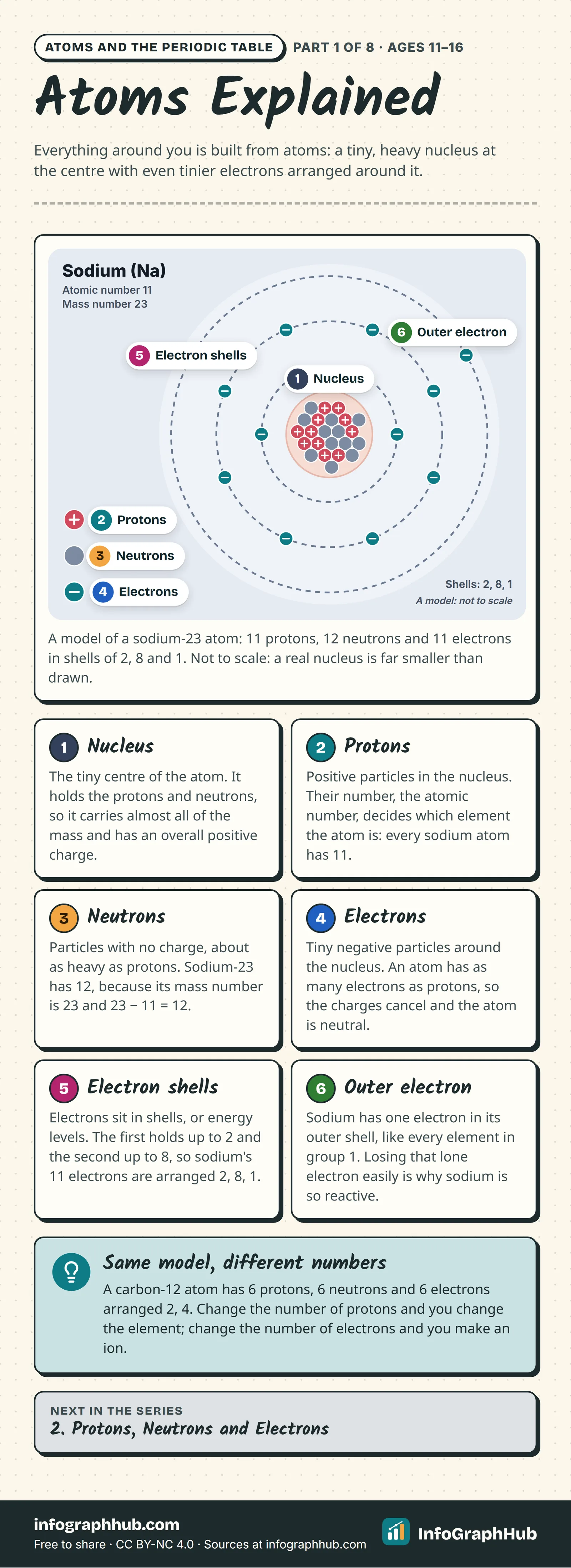
An atom is a tiny nucleus of protons and neutrons with electrons arranged in shells around it. This labelled model of a sodium atom shows each part, how many of each particle there are, and why the atom has no overall charge.
Interactive
Explore it step by step
6 labelled parts: Nucleus → Protons → Neutrons → Electrons → Electron shells → Outer electron. Press play, or choose a number to explore.
Step 1 of 6: Nucleus
The tiny centre of the atom. It holds the protons and neutrons, so it carries almost all of the mass and has an overall positive charge.
Step 2 of 6: Protons
Positive particles in the nucleus. Their number, the atomic number, decides which element the atom is: every sodium atom has 11.
Step 3 of 6: Neutrons
Particles with no charge, about as heavy as protons. Sodium-23 has 12, because its mass number is 23 and 23 − 11 = 12.
Step 4 of 6: Electrons
Tiny negative particles around the nucleus. An atom has as many electrons as protons, so the charges cancel and the atom is neutral.
Step 5 of 6: Electron shells
Electrons sit in shells, or energy levels. The first holds up to 2 and the second up to 8, so sodium's 11 electrons are arranged 2, 8, 1.
Step 6 of 6: Outer electron
Sodium has one electron in its outer shell, like every element in group 1. Losing that lone electron easily is why sodium is so reactive.
Use this infographic
Free under CC BY-NC 4.0, with credit to InfoGraphHub.
What an atom is
Everything you can touch, from the air to your own body, is made of atoms. An atom is the smallest part of an element that can exist and still be that element. A lump of sodium is made of sodium atoms; a gold ring is made of gold atoms.
There are 118 known elements, so there are 118 different kinds of atom. Atoms join together in countless combinations to make every other substance. Water, for example, is made of hydrogen and oxygen atoms bonded together.
Inside the atom: a nucleus and electrons
Every atom has two regions:
- The nucleus at the centre. It contains protons, which are positively charged, and (in every atom except the commonest kind of hydrogen) neutrons, which have no charge. Protons and neutrons are heavy, so the nucleus holds almost all of the atom's mass.
- The electrons, which are negatively charged and very light. They are found in the space around the nucleus.
The nucleus is astonishingly small. A typical atom has a radius of about 0.1 nanometres (1 × 10⁻¹⁰ m), and the nucleus has a radius less than 1/10,000 of that. If the nucleus were drawn 1 cm across, the whole atom would be at least 100 metres across.
Why an atom has no overall charge
A proton's positive charge is exactly equal and opposite to an electron's negative charge. An atom always has the same number of electrons as protons, so the charges cancel out and the atom is neutral.
Sodium has 11 protons, so a sodium atom has 11 electrons: 11 positive charges and 11 negative charges. If an atom gains or loses electrons, the balance is broken and it becomes a charged particle called an ion.
Electrons in shells
In the model used in school chemistry, electrons are arranged in shells, also called energy levels. The shells fill from the inside out:
- The first shell holds up to 2 electrons.
- The second shell holds up to 8.
- For the first 20 elements, the third shell also takes up to 8 before the fourth shell starts.
The arrangement is written as numbers separated by commas. Sodium's 11 electrons go 2, 8, 1; carbon's 6 go 2, 4; calcium's 20 go 2, 8, 8, 2.
Think of a shell as a region where an electron is likely to be found, not as a track it runs round.
Reading the sodium diagram
The diagram shows sodium-23, the only stable form of sodium found in nature.
- 11 protons (red, with a + sign): sodium's atomic number is 11.
- 12 neutrons (grey): the mass number is 23, and 23 − 11 = 12.
- 11 electrons (blue, with a − sign) on three shells, arranged 2, 8, 1.
The lone electron in the outer shell is the key to sodium's chemistry. Every element in group 1 of the periodic table has one outer electron, and losing it easily is why these metals react so readily. Sodium's three shells match its place in period 3.
A model, not a photograph
No one has ever seen an atom looking like this. The diagram is a model: a simplified picture that helps explain and predict how atoms behave. The colours are just a key, and nothing is to scale. Drawn to scale, the nucleus would be a speck too small to see in the middle of the page, and the electrons would be smaller still.
Scientists built this model step by step from experimental evidence, and it is still being refined. For school chemistry it does an excellent job of explaining how atoms bond and why the periodic table looks the way it does.
Frequently asked questions
What are the three particles in an atom?
Protons (positive charge) and neutrons (no charge) in the nucleus, and electrons (negative charge) in shells around the nucleus.
Why do atoms have no overall charge?
An atom has the same number of electrons as protons. Their charges are equal and opposite, so they cancel out.
How many electrons can each shell hold?
In the school model, the first shell holds up to 2 electrons and the second up to 8. For the first 20 elements, the third shell also holds up to 8 before the fourth shell starts filling.
What is the electron arrangement of sodium?
2, 8, 1. Sodium has 11 electrons: 2 in the first shell, 8 in the second and 1 in the third, outer shell.

Sources & methodology
Every fact is checked against the sources below. We write original explanations and draw original graphics; no figures are copied from textbooks. Spotted an error? See our corrections policy.
- Atomic structure - AQA: Structure of the atom (BBC Bitesize, accessed 1 Oct 2026)
- Chemistry 2e, 2.3 Atomic Structure and Symbolism (OpenStax, Rice University, accessed 1 Oct 2026)
- How to teach atomic structure at 14–16 (Royal Society of Chemistry (RSC Education), accessed 1 Oct 2026)
- Atomic weight of sodium (IUPAC Commission on Isotopic Abundances and Atomic Weights (CIAAW), accessed 1 Oct 2026)
Editorial review pending · Updated
Made by the InfoGraphHub editorial team (how we research and check: editorial and AI policy). First published 2 October 2026, last reviewed 1 October 2026. Found a mistake? Tell the editors.
For teachers: ages and curriculum fit
Ages 11–16 · Grades 6–10 (US) · Years 7–11 (UK) · Classes 6–10 (India)
NGSS is a registered trademark of WestEd. Names and codes are used only to describe curriculum fit; InfoGraphHub is not endorsed by these organisations.
Embed this on your site
Paste this HTML into your page. Keep the credit line: it is required by the CC BY-NC 4.0 license.
Related infographics


For teachers and parents: new InfoGraphHub resources by email
One short email when new free resources go live. For adults (18+) only. No spam, no tracking in emails, unsubscribe anytime.