8-part series · Ages 11–16
Atoms and the Periodic Table
Eight infographics on the building blocks of everything: what atoms are made of and how the periodic table organises them.
The 1 parts (7 more coming soon)
The complete guide
Atoms and the Periodic Table explained
Every substance you have ever touched is made of atoms, and just 118 kinds of atom build them all. This series takes the topic one question at a time: what is inside an atom, how heavy and how charged its particles are, how to read the periodic table, what the families of elements have in common, how scientists worked it all out, which words to use and which popular ideas are wrong.
Each part is a printable infographic with sources, written for ages 11–16 and their teachers. Work through the parts in order or jump to the one you need, then test yourself with the quiz at the end.
What an atom is
An atom is the smallest part of an element that can exist and still be that element. A piece of copper wire is made of copper atoms; the oxygen you breathe is made of oxygen atoms. There are 118 known elements, so there are 118 kinds of atom, and they combine in countless ways to make every other substance.
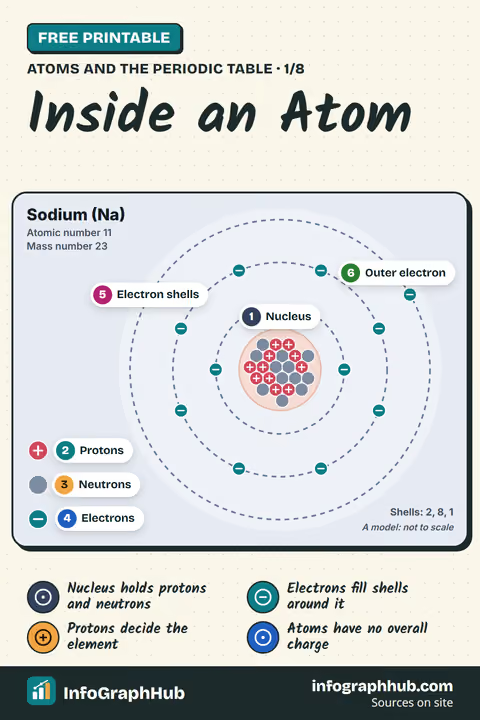
Every atom has the same basic layout:
- a tiny central nucleus, which contains positively charged protons and (in almost every atom) uncharged neutrons;
- negatively charged electrons in the space around the nucleus.
An atom always has as many electrons as protons. Their charges are equal and opposite, so an atom has no overall charge. A sodium atom, for example, has 11 protons and 11 electrons. If an atom gains or loses electrons it becomes a charged particle called an ion.
The pictures of atoms in books are models. They are not to scale, and the colours are just a key. They are useful because they explain and predict how atoms behave, not because they show what an atom looks like.
Protons, neutrons and electrons in numbers
The real masses of subatomic particles are tiny (a proton is about 1.67 × 10⁻²⁷ kg), so chemists compare them using relative values:
| Particle | Relative mass | Relative charge | Where it is |
|---|---|---|---|
| Proton | 1 | +1 | Nucleus |
| Neutron | 1 | 0 | Nucleus |
| Electron | Very small (about 1/1836) | −1 | Shells around the nucleus |
It takes about 1,836 electrons to match the mass of one proton, so more than 99.9% of an atom's mass is in its nucleus. Even in hydrogen, the lone electron is only about 0.05% of the atom's mass.
Atoms are also extremely small. A typical atom has a radius of about 0.1 nm (1 × 10⁻¹⁰ m), so about a million of them side by side would span the width of a human hair. The nucleus is smaller still, with a radius less than 1/10,000 of the atom's. Most of an atom's volume is the region where its electrons are found.
Two numbers tell you how many particles an atom has:
- the atomic number (Z) is the number of protons, which is also the number of electrons in a neutral atom;
- the mass number (A) is the number of protons plus neutrons.
Worked example. Sodium-23 has atomic number 11 and mass number 23. It has 11 protons, 11 electrons and 23 − 11 = 12 neutrons.
Electron shells
In the model used in school chemistry, electrons are arranged in shells, or energy levels, which fill from the inside out. The first shell holds up to 2 electrons and the second up to 8. For the first 20 elements, the third shell also takes up to 8 before the fourth begins.
The arrangement, called the electronic structure, is written as numbers from the inside out:
- carbon (6 electrons): 2, 4
- sodium (11 electrons): 2, 8, 1
- chlorine (17 electrons): 2, 8, 7
- calcium (20 electrons): 2, 8, 8, 2
The electrons in the outer shell matter most, because they are the ones involved when atoms react and bond. Sodium's single outer electron is easily lost, which is why sodium is so reactive. Chlorine needs just one more electron to fill its outer shell, so it reacts readily too.
A shell is best thought of as a region where electrons are likely to be found, not a track that they run round.
How to read the periodic table
The periodic table arranges all the elements in order of atomic number, placed so that elements with similar properties fall in the same column. Each box usually shows:
- the symbol, with a capital first letter and a lower-case second letter (Co is cobalt);
- the atomic number, the smaller whole number;
- the relative atomic mass, the larger number, often a decimal.
The 7 rows are periods. The period number equals the number of occupied electron shells: sodium (2, 8, 1) is in period 3.
The 18 columns are groups. Elements in a group have the same number of outer electrons, so they react in similar ways. For the main groups, the number of outer electrons follows from the group: 1 in group 1, 2 in group 2, and 3 to 8 in groups 13 to 18 (helium has 2). IUPAC has numbered the columns 1 to 18 since 1988, but many school courses, including GCSEs in England, number the main groups 1 to 7 and 0, so the halogens are group 7 and the noble gases group 0.
A zigzag staircase line separates the metals on the left from the non-metals on the right; most elements are metals. Metalloids such as silicon sit along the line with in-between properties. Because properties change in steady patterns, an element's position lets you predict how it will behave.
Groups of the periodic table
Several groups and blocks have names of their own:
- Alkali metals (group 1): soft, low-density metals with one outer electron. They react with water to make hydrogen and an alkaline solution, and reactivity increases down the group because the outer electron is further from the nucleus and easier to lose.
- Alkaline earth metals (group 2): two outer electrons; very reactive, but less so than group 1.
- Transition metals (groups 3 to 12): harder, stronger and denser than group 1 metals. Many form ions with different charges, coloured compounds and useful catalysts.
- Halogens (group 17): reactive non-metals with seven outer electrons, existing as pairs of atoms such as Cl₂. Reactivity decreases down the group, so a more reactive halogen displaces a less reactive one from its compounds.
- Noble gases (group 18): full outer shells make them very unreactive. Their boiling points rise down the group.
- Lanthanides (57 to 71) and actinides (89 to 103): the two strips printed below the table. Lanthanides are vital in strong magnets and screens; all actinides are radioactive.
Hydrogen is often placed above group 1 because it has one electron, but it is a non-metal gas, not an alkali metal.
Isotopes and relative atomic mass
All atoms of an element have the same number of protons, but the number of neutrons can vary. Atoms of the same element with different numbers of neutrons are isotopes. Carbon-12 has 6 protons and 6 neutrons; carbon-14 has 6 protons and 8 neutrons. Isotopes of an element react in the same way, because they have the same number of electrons.
Because most elements are a mix of isotopes, the relative atomic mass (Aᵣ) in the periodic table is an average, weighted by how common each isotope is and measured on a scale where one carbon-12 atom has a mass of exactly 12.
Worked example: chlorine. About 75% of chlorine atoms are chlorine-35 and about 25% are chlorine-37.
Aᵣ = (75 × 35 + 25 × 37) ÷ 100 = (2,625 + 925) ÷ 100 = 35.5
The answer is closer to 35 than to 37 because chlorine-35 is the more common isotope. Do not confuse this with mass number, which belongs to a single atom and is always a whole number.
Elements, compounds, molecules and ions
Atoms combine to make every substance, and a few precise words describe how:
- An element contains only one type of atom, such as iron or oxygen.
- A compound contains two or more elements chemically combined in fixed proportions, such as water (H₂O) or sodium chloride (NaCl). It has new properties: sodium is a reactive metal and chlorine a toxic gas, but sodium chloride is table salt.
- A mixture contains substances that are not chemically combined, such as air, and can be separated by physical methods.
- A molecule is two or more atoms joined by covalent bonds. Oxygen gas (O₂) is made of molecules but is an element; water (H₂O) is a molecule and a compound.
- An ion is an atom or group of atoms that has gained or lost electrons, so it carries a charge, such as Na⁺ or Cl⁻.
How scientists discovered the atom
Our model of the atom was built step by step, each time new evidence forced a change:
- 5th century BC: Leucippus and Democritus propose that matter is made of indivisible particles, atomos.
- 1803–1808: John Dalton turns the idea into a scientific theory: each element has its own kind of atom with its own mass.
- 1869: Dmitri Mendeleev arranges the elements into a periodic table, leaving gaps that were later filled by gallium (1875), scandium (1879) and germanium (1886).
- 1897: J. J. Thomson discovers the electron, so atoms have parts. In 1904 he describes the plum pudding model: a ball of positive charge with electrons spread through it.
- 1909–1911: Hans Geiger and Ernest Marsden fire alpha particles at thin gold foil. Most pass straight through, but about one in every few thousand bounces back by more than 90 degrees. In 1911 Ernest Rutherford explains this with the nuclear model: a tiny, dense, positive nucleus with electrons around it.
- 1913: Niels Bohr proposes that electrons sit at fixed energy levels, the idea behind shells. The same year, Henry Moseley shows that an element's atomic number is the charge on its nucleus, and the periodic table is ordered by atomic number.
- 1932: James Chadwick discovers the neutron, completing the school model of the atom.
The table has kept growing: four elements, nihonium (113), moscovium (115), tennessine (117) and oganesson (118), were named by IUPAC in 2016, completing the seventh row.
Common misconceptions
Several popular ideas about atoms are wrong:
- 'Electrons orbit the nucleus like planets.' That was Bohr's 1913 picture. Today electrons are described by orbitals, regions where they are most likely to be found, not set paths.
- 'Atoms are solid balls.' An atom is mostly empty space: if an atom were the size of a sports stadium, its nucleus would be about the size of a marble.
- 'Atoms are the smallest things.' Protons and neutrons are each made of three smaller particles called quarks.
- 'The periodic table is finished.' Laboratories are trying to make elements 119 and 120, which would start an eighth row.
- 'Heavier atoms are always bigger.' Across a period, atoms get heavier but smaller, because extra protons pull the electrons in more tightly. Chlorine is heavier than sodium but smaller.
- 'Noble gases never react.' In 1962 Neil Bartlett made the first compound of xenon.
Ready to check what you have learned? The quiz covers every part of this guide.
Frequently asked questions
What are the three main particles in an atom?
Protons (relative mass 1, charge +1) and neutrons (relative mass 1, no charge) in the nucleus, and electrons (very small mass, charge −1) in shells around the nucleus.
How is the periodic table arranged?
In order of atomic number, the number of protons in each atom. The 7 rows are called periods and the 18 columns are called groups. Elements in the same group have the same number of outer electrons, so they have similar chemical properties.
What is the difference between atomic number and mass number?
The atomic number is the number of protons in an atom. The mass number is the number of protons plus neutrons. Subtract the atomic number from the mass number to find the number of neutrons.
Why are elements in the same group similar?
They have the same number of electrons in their outer shell, and the outer electrons are the ones involved in chemical reactions. All group 1 metals have one outer electron, for example, so they all react vigorously with water.
How many elements are there?
There are 118 known elements. The four newest, nihonium, moscovium, tennessine and oganesson, were named by IUPAC in 2016. Scientists are trying to make elements 119 and 120.
Who discovered the structure of the atom?
Many scientists, over more than a century. Dalton proposed his atomic theory (1803–1808), Thomson discovered the electron (1897), Rutherford the nucleus (1911), Bohr proposed electron shells (1913) and Chadwick discovered the neutron (1932).
Sources & methodology
Every fact is checked against the sources below. We write original explanations and draw original graphics; no figures are copied from textbooks. Spotted an error? See our corrections policy.
- Chemistry 2e, Chapter 2: Atoms, Molecules, and Ions (OpenStax, Rice University, accessed 1 Oct 2026)
- Atomic structure - AQA (BBC Bitesize, accessed 1 Oct 2026)
- How to teach atomic structure at 14–16 (Royal Society of Chemistry (RSC Education), accessed 1 Oct 2026)
- The key elements of the periodic table (How to read the periodic table) (Royal Society of Chemistry (RSC Education), accessed 1 Oct 2026)
- Periodic Table of Elements (International Union of Pure and Applied Chemistry (IUPAC), accessed 1 Oct 2026)
- Joseph John 'J. J.' Thomson (Science History Institute, accessed 1 Oct 2026)
- The Standard Model (CERN, accessed 1 Oct 2026)
Editorial review pending · Updated
For teachers and parents: new InfoGraphHub resources by email
One short email when new free resources go live. For adults (18+) only. No spam, no tracking in emails, unsubscribe anytime.