TechNumbersPart 5 of 9, How the Internet WorksUpdated 1 October 2026
The Internet by the Numbers
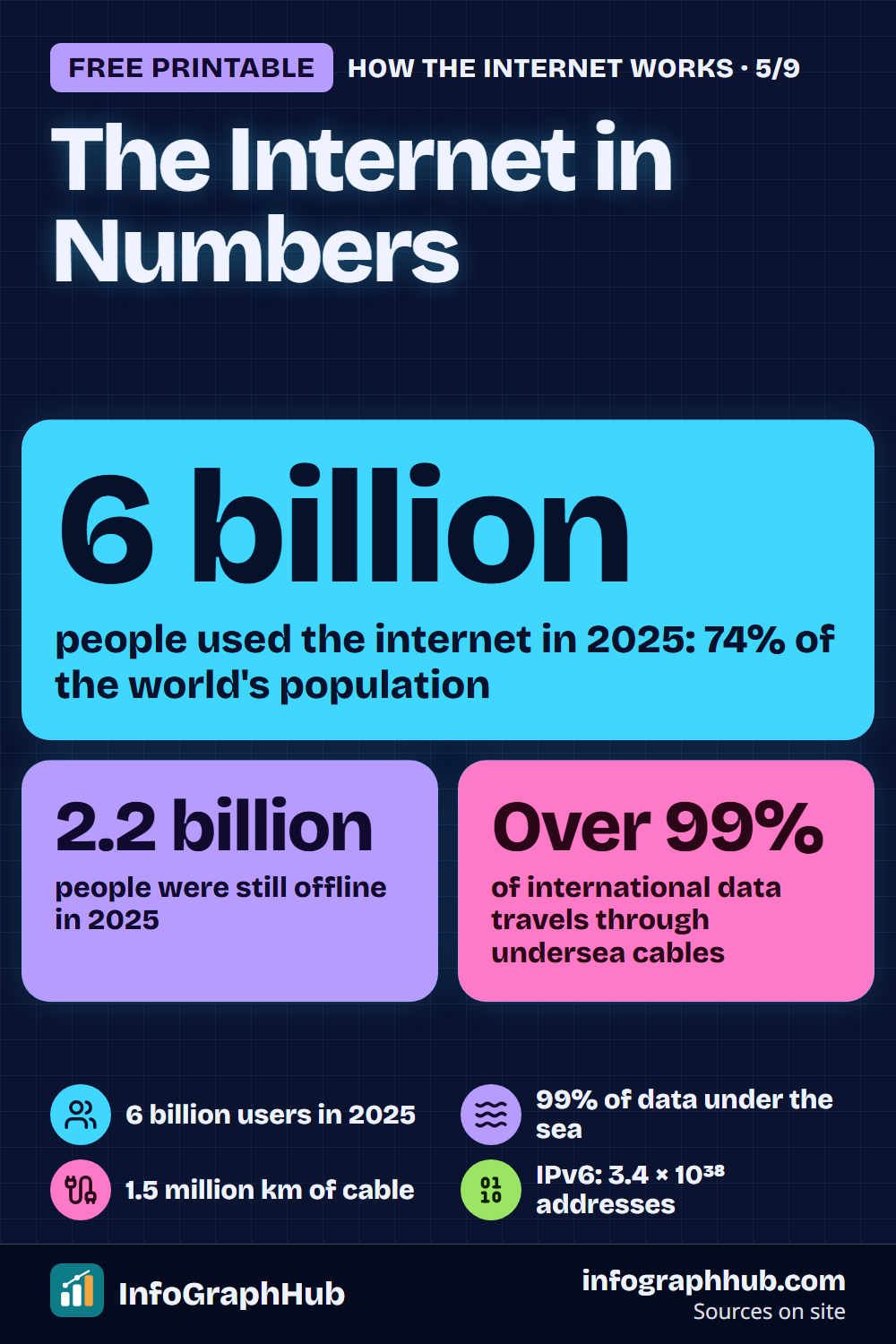
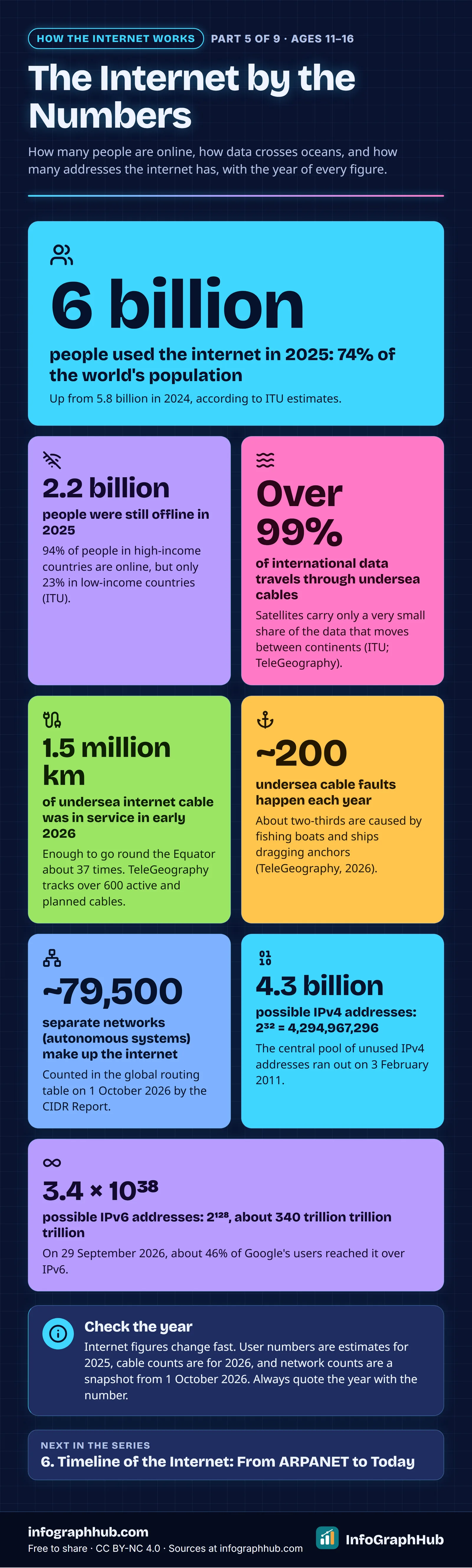
How big is the internet? About 6 billion people were online in 2025 while 2.2 billion were not. Over 99% of international data crosses undersea cables, around 79,500 networks make up the internet, and IPv6 offers 3.4 × 10³⁸ addresses.
Use this infographic
Free under CC BY-NC 4.0, with credit to InfoGraphHub.
Who is online, and who is not
The International Telecommunication Union (ITU), the United Nations agency for digital technology, estimates that about 6 billion people used the internet in 2025. That is 74 per cent of the world's population, up from 5.8 billion in 2024.
The other side of that number matters just as much: about 2.2 billion people were still offline, most of them in low- and middle-income countries. In high-income countries 94 per cent of people use the internet; in low-income countries only 23 per cent do. The average for Africa is 36 per cent. This gap is often called the digital divide.
Cables under the sea
According to the ITU, undersea cables carry over 99 per cent of international data. TeleGeography, a research company that maps them, tracks more than 600 active and planned submarine cables and estimates that over 1.5 million kilometres of cable were in service in early 2026.
To picture that length: the Earth's circumference at the Equator is about 40,075 km, so 1,500,000 ÷ 40,075 ≈ 37 times round the planet.
Cables do get damaged, roughly 200 faults a year. About two-thirds are accidents caused by fishing boats and ships dragging their anchors; earthquakes and other natural events cause others. Because most routes have back-up cables, a single break usually slows traffic rather than cutting a country off.
A network of about 79,500 networks
The big networks that make up the internet, run by internet service providers, large companies, universities and governments, are called autonomous systems. Each one tells the others which IP addresses it can reach. The CIDR Report, which watches the global routing system, counted about 79,500 of them on 1 October 2026.
The Domain Name System that turns names into addresses is spread out in the same way. Its top level is 13 named root servers run by 12 independent organisations, but those 13 names are answered by 2,045 separate server copies around the world (October 2026).
Running out of addresses
Every device on the internet needs an IP address. The original system, IPv4, uses 32-bit addresses, so there are 2³² = 4,294,967,296 possible addresses, about 4.3 billion. That is fewer than one per person alive today, and some ranges are reserved. The central pool of unused IPv4 addresses ran out on 3 February 2011. Home routers help by letting every device in a house share one public address.
The newer system, IPv6, uses 128-bit addresses. That gives 2¹²⁸ ≈ 3.4 × 10³⁸ addresses: about 340 trillion trillion trillion, which is 2⁹⁶ ≈ 7.9 × 10²⁸ times as many as IPv4. The switch is gradual. On 29 September 2026, about 46 per cent of Google's users reached Google over IPv6.
Reading these numbers
Internet statistics change quickly, so always check the year. User numbers are estimates built from national surveys; cable and network counts are snapshots that grow every year. Where a number is rounded, the exact figure is in the sources below.
Frequently asked questions
How many people use the internet?
About 6 billion people in 2025, or 74 per cent of the world's population, according to the International Telecommunication Union. Around 2.2 billion people were still offline, mostly in low- and middle-income countries.
How much internet data goes through undersea cables?
Over 99 per cent of international data exchange travels through submarine cables, according to the ITU. More than 600 cables are active or planned, with over 1.5 million kilometres in service in early 2026.
How many IP addresses are there?
IPv4 has 2³² = 4,294,967,296 possible addresses, about 4.3 billion, and its central pool ran out in 2011. IPv6 has 2¹²⁸, about 3.4 × 10³⁸ addresses, which is enough for every device for the foreseeable future.
How many networks make up the internet?
About 79,500 autonomous systems (large networks with their own routing policy) were visible in the global routing table on 1 October 2026, according to the CIDR Report. Each is run by an ISP, company, university, government or similar organisation.
Sources & methodology
Every fact is checked against the sources below. We write original explanations and draw original graphics; no figures are copied from textbooks. Spotted an error? See our corrections policy.
- Facts and Figures 2025: Internet use (International Telecommunication Union (ITU), accessed 1 Oct 2026)
- Facts and Figures 2025 (International Telecommunication Union (ITU), accessed 1 Oct 2026)
- Submarine cable resilience (International Telecommunication Union (ITU), accessed 1 Oct 2026)
- Submarine Cable FAQs (TeleGeography, accessed 1 Oct 2026)
- CIDR Report (CIDR Report (Geoff Huston, APNIC), accessed 1 Oct 2026)
- Root Servers (Root Server Technical Operations Association, accessed 1 Oct 2026)
- IPv6 Information (American Registry for Internet Numbers (ARIN), accessed 1 Oct 2026)
- Free Pool of IPv4 Address Space Depleted (Number Resource Organization (NRO), accessed 1 Oct 2026)
- IPv6 Statistics (Google, accessed 1 Oct 2026)
Editorial review pending · Updated
Made by the InfoGraphHub editorial team (how we research and check: editorial and AI policy). First published 1 October 2026, last reviewed 1 October 2026. Found a mistake? Tell the editors.
For teachers: ages and curriculum fit
Ages 11–16 · Grades 6–10 (US) · Years 7–11 (UK) · Classes 6–10 (India)
Embed this on your site
Paste this HTML into your page. Keep the credit line: it is required by the CC BY-NC 4.0 license.
Related infographics


For teachers and parents: new InfoGraphHub resources by email
One short email when new free resources go live. For adults (18+) only. No spam, no tracking in emails, unsubscribe anytime.